Aligned abandons its core product, proactively clearing the old narrative before the TGE.
Written by: Grok
Assisted by: AididiaoJP, Foresight News
On August 20, the ZK infrastructure project Aligned announced that its native token ALIGN will be listed for spot trading on exchanges such as Coinbase, Bitget, and KuCoin. Coinbase currently supports the generation of deposit addresses for this token, but as of the time of writing, the specific trading time has not been announced.
Previously, Aligned launched an official airdrop check page, and the airdrop will open simultaneously when the token officially launches.
This ZK infrastructure project, originated from LambdaClass, has completed a relatively rare operation over the past two years: making ZK proof verification a runnable product and then proactively shutting down this most mature product line one month before the TGE. The discussions sparked by this operation in the market are more worth breaking down than the full-stack narrative of the project itself.
First understand LambdaClass, then understand Aligned
To understand the Aligned project, one must first understand the company behind it, LambdaClass.
LambdaClass, commonly abbreviated as Lambda in the industry, was founded in Buenos Aires, Argentina in 2014 and has its headquarters located there. The team is distributed in Buenos Aires, Montevideo, and Barcelona. The company currently has over 100 engineers, focusing on formal verification, cryptography, distributed systems, and high-performance software, and is part of the Ergodic Group.
Technically, Lambda’s core stack utilizes Lean 4 for formal verification, Rust for high-performance secure systems, and Erlang/Elixir for distributed fault tolerance. They have a strong judgment that traditional testing and code review are no longer sufficient, especially today as AI-generated code becomes more prevalent; mathematical proofs must be used to ensure software behavior correctness. Their work philosophy is "observe, iterate, simplify" — observe, iterate, simplify, pursuing production-level quality and not creating academic prototypes.
A detail in data is worth noting: Lambda's software has been running in production environments, claiming to cover about 40% of Ethereum validators (mainly through projects like Commit-Boost), with secured and transferred asset scales in the tens of billions of dollars. In other words, this is not a startup starting from scratch in ZK, but an engineering team with an actual delivery record at the Ethereum infrastructure layer.
Aligned is precisely the project that Lambda has isolated to apply its accumulated capabilities in the ZK field.
Starting point: A ZK veteran from a parts factory
Aligned's team background can be considered solid within the ZK track. The founder of LambdaClass has been involved in open-source cryptography libraries and ZK infrastructure since 2013, having deeply participated in the development of Starknet, zkSync, and Polygon Miden, and has open-sourced EthRex and Lambdaworks. This group of people repeatedly observed the same problem: institutions wanting to build verifiable applications on Ethereum have to connect with dozens of vendors simultaneously, leading to high integration costs and chaotic security boundaries.
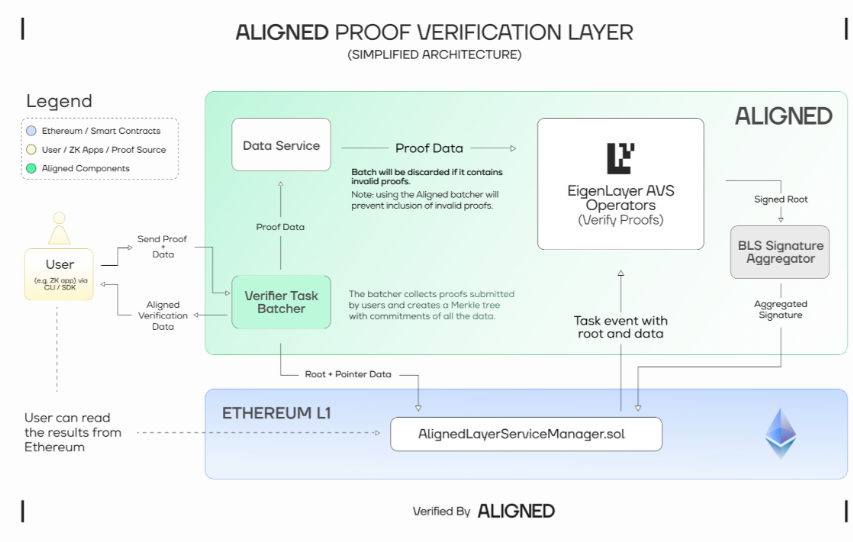
In 2024, they decided to package these capabilities and establish Aligned.
The fundraising pace was tight. In April 2024, a seed round raised approximately $2.6 million (with participation from Lemniscap, Bankless Ventures, and others), and in the same month, Hack VC led a $20 million Series A round, with follow-on investments from dao5, L2 Iterative, Nomad Capital, Finality Capital, Symbolic Capital, Theta Capital, and others. The total amount raised in the institutional round was about $22.6 million. At the beginning of 2025, they completed a community round raising over $4 million through CoinList and Echo.
Turning point: Shutting down the most mature product line before the TGE
The roadmap documents a clear shift.
In November 2024, the Proof Verification Layer entered the mainnet beta in the form of EigenLayer AVS, accumulating over 136,000 proofs verified and more than 50 peak operators. In Q1 2025, the Proof Aggregation Service launched its testnet. In Q1 2026, the aggregation service entered the mainnet alpha, and Wallet-as-a-Service completed its MVP based on EIP-7702.
Then came the controversial decision. On July 21, 2026, the official announced the abandonment of the Proof Verification Layer, fully shifting focus to the aggregation service.
The official explanation provided three reasons: ZK technology itself has matured significantly, and the bottlenecks that required a dedicated verification layer are no longer pressing; the Ethereum protocol layer is pushing for native ZK support; and the market places more emphasis on Ethereum-level security guarantees rather than extreme low latency.
Data-wise, after the abandonment, the number of operators dropped from a peak of over 50 to about 26, with a staking scale of approximately $119 million.
The point of contention is the timing — the most mature product, which has verified over 130,000 proofs, was proactively shut down less than a month before the TGE. This is not a simple technical iteration. The full-stack narrative is complete, but the only part currently running and generating fee scenarios is the aggregation service, which has just entered the mainnet alpha. RaaS, LambdaVM (in collaboration with LambdaClass and 3MI Labs), and interoperability protocols are still under development.
Product status: Cost accounting of the aggregation service
The core logic of the Proof Aggregation Service is compressing multiple proofs into a single on-chain verification through recursive aggregation. The official disclosure shows a cost reduction of over 90%. WaaS lowers the user entry barrier. The early verification layer relies on EigenLayer for re-staking security, while the aggregation service directly depends on Ethereum finality.
In terms of practical implementation, it includes cost optimization for some Rollups, exploration of institutional scenarios, and verification data during the ZK Arcade. All of these come from official disclosures, indicating that the product has moved beyond pure concept, but the scale and demand for payment remain limited.
Partners include Sovra (800+ million users) and Loom Finance (1.2 billion euros + marketplace).
Token economics and valuation forecast
The total supply of ALIGN is fixed at 10 billion. As of April 2026, the updated distribution is as follows: team 23.50%, investors 19.71%, ecosystem 18.00%, future reserves 16.61%, foundation 11.40%, airdrop 8.74%, community sale 2.04%. The initial circulation of ALIGN at TGE will be approximately 16%.
The terms for the team and investors are notable: 40% unlock after a 12-month cliff, with the remaining 60% released linearly over the next 18 months. This means there will be no selling pressure from the team and investors in the first 12 months.
Regarding the airdrop, 44.36% will unlock at TGE, accounting for about 3.88% of the total supply. The distribution rules vary based on scale: full unlock for amounts under 10,000 tokens, for amounts over 10,000, 10,000 unlocks at TGE with the remaining released linearly over 12 months. Outstanding contributors account for 2.10%, with specific allocations of: Protocol Guild 1.5%, L2BEAT 0.2%, ZachXBT 0.2%, ZK Podcast 0.2%. The TGE will unlock 2.08%, with the remaining portion released linearly over 47 months.
Protocol Guild is a collective funding mechanism for Ethereum core developers (L1 protocol maintainers). The standard request it makes to ecosystem projects is usually 1% of token supply for continuous support of Ethereum core research and development. Aligned provided 1.5%, clearly exceeding this conventional standard.
Data from the prediction market Polymarket shows that the probability of the project exceeding a $50 million FDV upon listing is over 96%, but it should be noted that the total transaction volume in this market is only about $55,000 to $60,000. Other data includes:
- Probability of FDV exceeding $20 million is close to 100%
- Exceeding $50 million is about 96%
- Exceeding $100 million is about 89%-91%
- Exceeding $200 million is about 61%-69%
- Exceeding $300 million is about 45%
- Exceeding $500 million is about 20%
- Exceeding $800 million and $1 billion probabilities drop to about 4% and 2%, respectively
Team introduction
The core team is entirely from LambdaClass. Federico Carrone is a co-founder of Aligned, having founded LambdaClass in 2014. Roberto Catalán serves as co-founder and CEO, responsible for markets and partnerships. Diego Kingston is in charge of research. Mauro Toscano is the CTO. The team is distributed across Buenos Aires, Montevideo, and Barcelona.
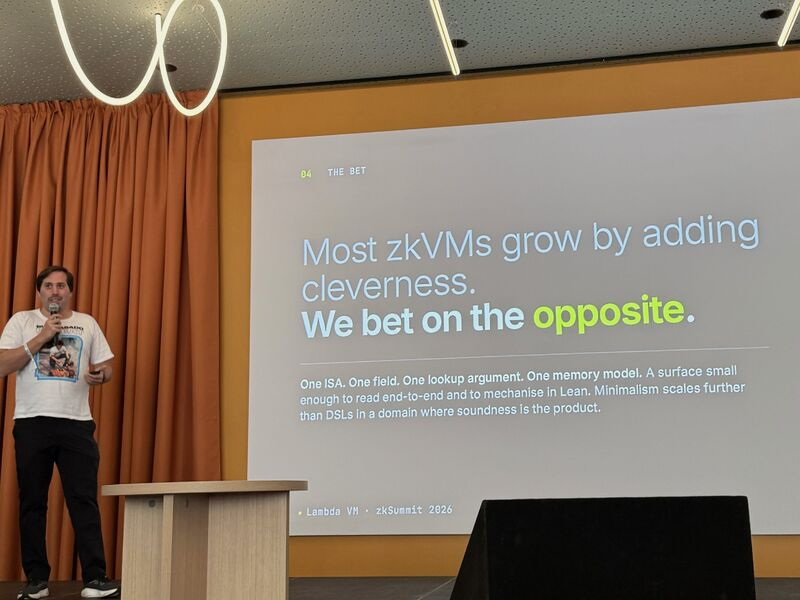
A photo of Diego Kingston speaking at zkSummit 14
Therefore, Aligned's technical background is positioned in the first tier of the ZK track. However, the distance between technical strength and commercialization is precisely what this transformation needs to address.
Conclusion
The most critical risks are already on the table: the original core product has been abandoned before the TGE, and the number of operators and re-staking scale has clearly contracted. RaaS, LambdaVM, and interoperability protocols within the full stack are still in development. The initial 16% circulation combined with the airdrop unlock might bring short-term selling pressure.
Another angle to observe: after abandoning the verification layer, the speed of paid adoption for the aggregation service will determine whether the valuation logic for this project can hold. The narrative of moving from a parts factory to a complete vehicle assembly factory has been written; what truly needs verification is whether the new product mix can create a sustainable business model after abandoning the old layer.
免责声明:本文章仅代表作者个人观点,不代表本平台的立场和观点。本文章仅供信息分享,不构成对任何人的任何投资建议。用户与作者之间的任何争议,与本平台无关。如网页中刊载的文章或图片涉及侵权,请提供相关的权利证明和身份证明发送邮件到support@aicoin.com,本平台相关工作人员将会进行核查。


