Original Title: Beware the Bond: Operation Twist is Back
Original Author: Trader Joe
Original Translator: Peggy
Editor's Note: Earlier this week, the yield on the U.S. 30-year Treasury bond briefly rose to about 5.34%, reaching the highest level since 2007. Subsequently, U.S. Treasury Secretary Yellen announced an expansion of long-term Treasury bond buybacks, increasing the maximum single buyback size for certain 10–30 year Treasury bonds from $2 billion to at least $4 billion, with the relevant arrangements to be implemented from September 9 to November 4. After the news was announced, long-end yields retreated, the dollar weakened, and risk assets received some support.
On the surface, this is a liquidity operation of relatively small scale for Treasury bonds. A more worth discussing question is: why have U.S. long-end rates risen to a level that requires more proactive attention from the Treasury? And is the market reinterpreting the Treasury's "policy reaction function" regarding long-end yields?
In "Beware the Bond," Trader Joe provides an explanation that the recent sell-off in long bonds cannot simply be attributed to inflation. Ongoing fiscal deficits are continuously creating Treasury bond supply, traditional long-bond buyers like Japan are experiencing changes in demand, while AI capital expenditure is generating a large supply of long-term bonds in the credit market, with several forces collectively pushing up the scale of long-duration assets that the market needs to absorb.
The author further compares Yellen's expansion of long-bond buybacks to the Treasury's version of "Operation Twist." This metaphor captures the direction of "reducing long-duration supply in the market," but the two are not equivalent: the Operation Twist in 2011 involved the Federal Reserve selling short bonds and buying long bonds, explicitly aimed at lowering long-term rates and easing financial conditions; the current Treasury buyback plan is officially still positioned as improving secondary market liquidity and cash management. What is truly worth noting, therefore, is not the $4 billion itself, but whether this tool will increasingly assume the role of managing long-end financial conditions in the future.
以下为原文编译:
Earlier this week, the yield on the U.S. 30-year Treasury bond briefly rose to its highest level since 2007, U.S. stocks gave back some of their gains, and the dollar began to weaken.
Then, Yellen took action.
The U.S. Treasury announced that the maximum buyback size for certain 10–30 year long-term Treasury bonds would be increased from $2 billion to at least $4 billion, to be executed from September 9 to November 4. After the announcement, the yield on the 30-year Treasury bond fell from around 5.34% to approximately 5.2%, the dollar weakened further, and the stock market stabilized.
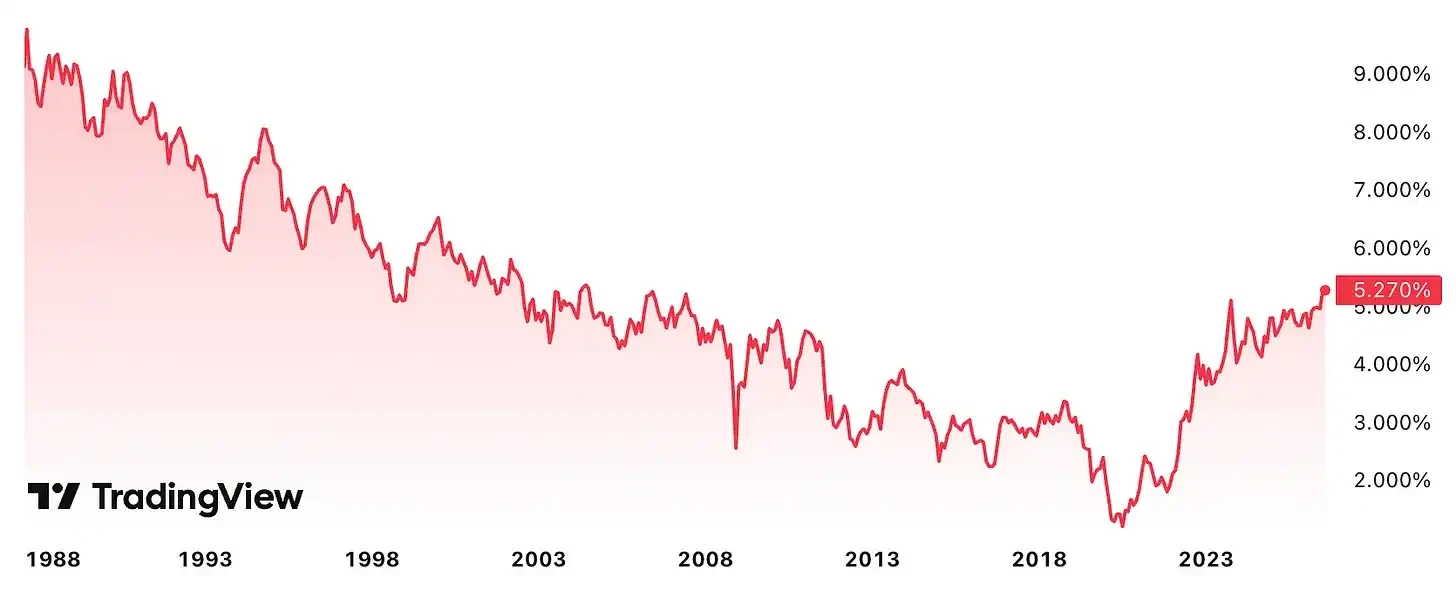
U.S. 30-year Treasury bond yields
The question is: is this merely a temporary fix for liquidity in the bond market, or does it indicate a change in the U.S. policy stance on long-end rates?
To understand this, we must first answer another question: why have long-end yields risen to this level?
Why Have Long-End Yields Risen to This Level? The Issue is Not Just Inflation
The most straightforward explanation is inflation.
If investors are concerned about inflation remaining high for the long term, they will naturally demand higher long-term Treasury yields as compensation. However, the author believes this is not sufficient to explain all of the recent movements.
At least from consumer surveys, there has not yet been a significant loss of control in long-term inflation expectations. The preliminary survey by the University of Michigan in early August showed that one-year inflation expectations rose slightly from 4.2% to 4.3%, while five-year inflation expectations remained at 3.3%. In other words, there are still short-term inflation concerns, but "long-term inflation expectations becoming unanchored" is not currently the only or even the most important explanation.
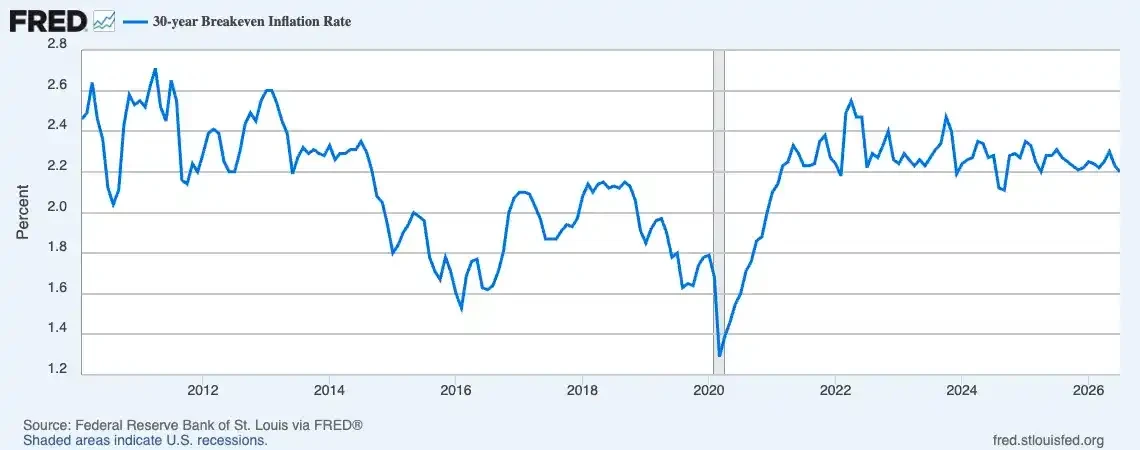
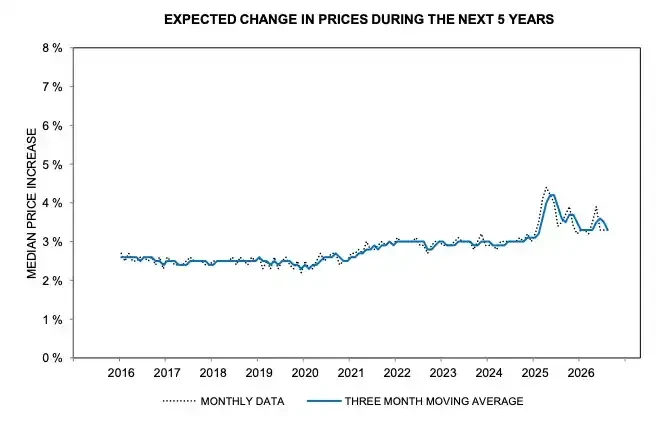
Data Source: University of Michigan Consumer Survey
Long-term Treasury yields have always reflected more than just future short-term policy rates and inflation. Economic growth, term premiums, regulatory environments, how many bonds the Treasury needs to issue, and how much long-term U.S. Treasuries insurance companies, pensions, and overseas investors are willing to allocate can all affect long-end pricing.
The author believes that what is most noteworthy now is that the supply of long bonds is continuously increasing, but traditional demand has not expanded in tandem.
The U.S. fiscal deficit means that the Treasury still needs to keep funding, and whether this funding is done through short-term Treasury bills (T-bills), medium-term Treasury bonds, or 30-year long bonds will directly affect how much duration risk the market needs to absorb.
If the Treasury relies more on short-term T-bills for financing, it reduces the long-term bond supply that the market needs to digest, putting relatively less pressure on long-end yields. Conversely, if more financing shifts to long-term securities like 10-year, 20-year, and 30-year bonds, the market must absorb more duration, which could pose greater upward pressure on long-end yields.
That is also why the structure of debt issuance itself is increasingly resembling a macro variable.
Why Did the Treasury Act Now? 5.3% Long-End Rates Begin to Affect Financial Conditions
Short Bonds Can Alleviate Long-End Pressure, but Liquidity Buffer is Thin
The problem is, short bonds cannot be issued indefinitely.
In recent years, when the U.S. Treasury issued large amounts of T-bills, an important source of funding was the cash from money market funds that was originally placed in the Federal Reserve's overnight reverse repurchase agreements (ON RRP). When short bond yields became more attractive, this cash could flow from the RRP to Treasury bills, absorbing new short bonds without significantly pulling back bank reserves.
However, this buffer has now come close to depletion. Federal Reserve data shows that the usage of ON RRP is currently close to zero on most trading days. Meanwhile, as of mid-year, the U.S. banking system's reserves were about $3.1 trillion.
In the second half of 2025, the massive replenishment of the U.S. Treasury General Account (TGA) further drained liquidity from the banking system. Federal Reserve data shows that after the debt ceiling issue was resolved, the TGA balance increased by about $442 billion, while reserves noticeably declined.
This is one of the backgrounds for the Federal Reserve to end quantitative tightening (QT) by the end of 2025.
In October 2025, the Federal Reserve announced it would stop reducing its balance sheet from December 1; in December, it began purchasing short-term U.S. Treasuries through Reserve Management Purchases (RMP) to ensure that bank reserves remained at "ample" levels.
This kind of operation can easily visually resemble QE, but the policy goals are different.
QE typically involves buying long-term Treasuries or MBS to actively lower long-term yields and ease overall financial conditions; RMP primarily purchases T-bills and other short-term securities, with its official goal being to maintain sufficient bank reserves and control short-end rates, rather than providing macroeconomic stimulus. The Federal Reserve has also explicitly emphasized that RMP does not represent a change in monetary policy stance.
The author is concerned that if the Treasury continues to increase its reliance on short bond financing to reduce long bond supply, then when the liquidity buffers like RRP are nearing exhaustion, new short bonds may end up competing more for bank reserves.
At that point, the Federal Reserve may have to conduct more reserve management operations to maintain system liquidity. This creates a subtle policy combination: the Treasury tries to release less duration to the market, while the Federal Reserve ensures sufficient reserves at the short end.
Japan and AI are Changing the Supply-Demand Structure of Long Bonds
Another side of the long-end issue is: who will buy?
Japan has long been the most important overseas investor in U.S. Treasuries. The latest TIC data from the U.S. Treasury shows that as of June 2026, Japan held about $1.116 trillion in U.S. Treasuries, remaining the largest foreign holder, but down about 2.3% from May.
Meanwhile, Japan's own long-term Treasury yields are rising.
For Japanese insurance companies, banks, and pensions, if Japanese bonds can offer increasingly attractive yields, the marginal appeal of allocating U.S. long-term Treasuries is naturally likely to decrease, especially when accounting for the cost of hedging against the dollar.
This does not mean Japan will necessarily continue to sell off U.S. debt aggressively, but it does imply that a structural long-term bond buyer that has been stable for a long time may no longer absorb U.S. duration as consistently in the future.
The other competitor comes from AI.
AI infrastructure construction is shifting from a stock market story to a credit market story. Goldman Sachs estimates that since 2026 alone, the entire AI-related industry chain has issued nearly $500 billion in debt; of this, hyper-scale cloud providers themselves have issued about $194 billion. More importantly, in terms of term structure, about 40% of new issues in the U.S. investment-grade credit market this year with ten-year terms or longer have already come from AI companies or AI-related financing.
This means that traditional long-duration funds, such as pensions and insurance companies, are facing more choices. They are no longer just comparing 30-year U.S. Treasuries and other sovereign bonds but may also invest in long-term investment-grade debt from large tech companies like Amazon and Google, as well as credit assets related to data centers and infrastructure linked to AI.
From the author's framework, this clarifies the core issue facing U.S. long bonds: the Treasury needs to sell increasing amounts of debt, while the need for investors to absorb other long-term assets in the global market is also rising rapidly.
Treasury's Version of Operation Twist: $4 Billion is Small, but the Real Change is in the Policy Response
It is against this backdrop that Yellen expanded the buyback of long-term Treasury bonds.
The U.S. Treasury's regular buyback program began in 2024, with two official purposes: to improve secondary market liquidity and to carry out cash management.
Among them, the liquidity support buybacks mainly purchase less liquid old bonds, known as off-the-run Treasuries. The Treasury hopes to help dealers release inventory and improve transactions of old bonds by regularly being a potential buyer of these bonds. (U.S. Department of the Treasury)
Therefore, from the perspective of institutional design, this is not a QE tool established to lower 30-year yields.
Moreover, a single buyback size of at least $4 billion in a U.S. Treasury bond market exceeding $30 trillion remains very small. Reuters also pointed out that the market generally believes this scale is insufficient to address structural issues like fiscal deficits and increases in long-term supply.
But what the author truly cares about is not the scale, but the policy intent.
In the past, the Treasury could emphasize that buybacks were merely market liquidity tools; now, as the 30-year yield rapidly approaches two-decade highs, the Treasury immediately expands long-term bond buybacks, prompting the market to question: if long-end yields continue to spiral out of control in the future, will the Treasury further adjust buyback and issuance structures?
This is precisely why the author refers to the current policy as the Treasury's version of "Operation Twist."
Note: Operation Twist is usually referenced as "扭曲操作" or "期限延长操作" in Chinese. Its core is not "printing more money," but rather adjusting the maturity structure of bonds held by the central bank: selling short bonds and buying long bonds to lower long-term interest rates.
The classic Operation Twist of 2011 was executed by the Federal Reserve: the Fed sold or allowed short-term Treasuries to mature while purchasing an equivalent amount of 6–30 year Treasuries, extending the duration of the asset portfolio without expanding the size of the balance sheet, thereby decreasing the amount of long-term Treasuries held by the private sector and lowering long-term rates.
What is happening today is not the same kind of operation. The Treasury is not engaging in a strict "sell short, buy long" like the Fed did back then, and the expansion of buybacks is still officially defined as debt management and liquidity tools. However, from the perspective of market duration supply, both have a similar direction: if the Treasury buys back more long-old bonds while leaving more net financing pressure on the short end, the net duration the private market needs to absorb may relatively decrease.
This is also what the author refers to as "the Treasury's version of operation twist." More accurately, it is currently a market interpretation rather than a newly established policy framework.
Can This Approach Contain Long-End Yields? Risks May Shift to the Dollar and Inflation
So, under what circumstances will this set of policies continue to upgrade? The author believes that rather than seeking an absolute "red line" for the 30-year yield, it is better to observe the speed of yield increases. A 30-year yield of 5.2% or 5.3% may not be enough to trigger policy changes; however, if the market starts to see rapid jumps of about ten basis points repeatedly, it would indicate that trading order and demand are deteriorating significantly, increasing the probability that the Treasury or the Fed will intervene further.
Meanwhile, long-end yields are increasingly competing directly with stocks for funds. According to the data at the time of the author's publication, the nominal yield on the 30-year Treasury bond was about 5.2%, with the corresponding real yield of long-term TIPS close to 3%; in contrast, the earnings yield of the S&P 500 was about 3.8%.
The two cannot be directly compared one-to-one—earnings yield is not a risk-free yield, and corporate earnings will grow or decline in the future—but when risk-free long-term real yields rise to such high levels, the opportunity cost that stock valuations need to bear is clearly increasing.
Therefore, the real importance of Yellen's action may not be temporarily pulling the 30-year yield back from above 5.3% to around 5.2%.
Rather, it is that the market has received a new observation sample for the first time: when U.S. long-end yields rise rapidly, will the Treasury increasingly respond proactively through buyback scales and debt maturity structures?
If the answer gradually becomes "yes," then in the future, what influences the dollar, U.S. stocks, gold, and long-term Treasuries will not only be the Federal Reserve's policy reaction function but will also include this layer of the Treasury.
However, this logic also has its boundaries. If the long-end rise is primarily due to an imbalance in bond supply and demand, reducing the duration the market needs to absorb may alleviate pressure; if inflation expectations rise sharply again, then continuing to expand buybacks and increase short bond financing may instead lead to market concerns that policy is artificially suppressing financial conditions.
Therefore, what needs to be observed going forward is not only whether the Treasury will increase buybacks but also whether inflation expectations, the structure of long-term Treasury issuance, overseas demand, and the speed of fluctuations in long-end yields change simultaneously.
Only if these variables continue to point in the same direction will the author's judgment that "the Treasury is taking over some control of long-end financial condition management" be further validated.
免责声明:本文章仅代表作者个人观点,不代表本平台的立场和观点。本文章仅供信息分享,不构成对任何人的任何投资建议。用户与作者之间的任何争议,与本平台无关。如网页中刊载的文章或图片涉及侵权,请提供相关的权利证明和身份证明发送邮件到support@aicoin.com,本平台相关工作人员将会进行核查。