The predictive power in 2026 has significantly increased, making Kalshi a high-frequency trading "collective forecasting" platform.
Written by: Synth Research
Translated by: AididiaoJP, Foresight News
Kalshi is increasingly becoming the venue for Bitcoin price discovery itself.
Conventional wisdom holds that Kalshi's 15-minute Bitcoin market should follow Binance. Binance leads the way, and after the algorithm observes the new spot price, Kalshi traders then reprice the probability of Bitcoin being above or below the market threshold at the end of the 15-minute window. This logic sounds impeccable: the spot market is the source of information, and the prediction market merely passively reflects it.
However, the analysis from the Synth Research team shows that this relationship is undergoing a fundamental change. Kalshi prices are becoming increasingly predictive of the subsequent movements of Binance Bitcoin, and the strength of this predictive relationship has significantly increased throughout 2026.
Kalshi is increasingly becoming the venue for Bitcoin price discovery itself.
The following report analyzes in detail the correlation between the BTC 15-minute market price on Kalshi and subsequent movements in BTC spot prices within a few seconds, as well as the development of this correlation so far this year. The conclusion is not complicated, yet it is disruptive enough to overturn common sense: in short cycles, the direction of information flow has already begun to reverse.
Kalshi leads, Bitcoin follows
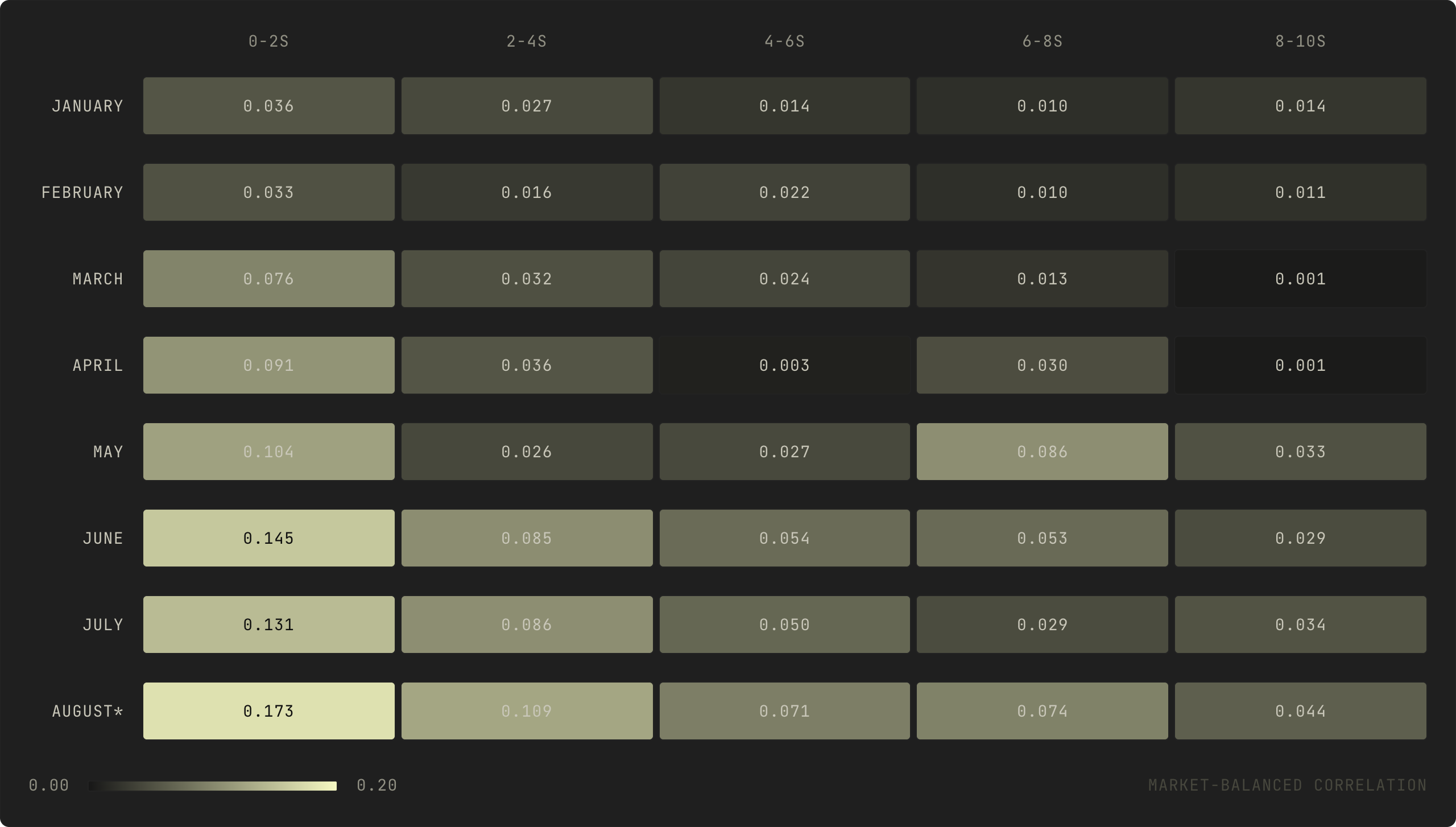
The research team observed the changes in the Kalshi YES price within two seconds and measured what happened to Binance BTC in the following ten seconds.
The relationship is very clear: when Kalshi drops, BTC tends to drop afterward; when Kalshi rises, BTC tends to rise afterward. Larger fluctuations in Kalshi are usually accompanied by larger fluctuations in BTC. The magnitude correspondence is stable, and the directional consistency is also very high.
The key lies in the order. The team is not measuring whether Kalshi and Binance move synchronously, but strictly distinguishing the sequence of events. Changes in Kalshi occur first, and Binance's returns are measured afterward.
In other words, information about Bitcoin's next movement has already been expressed in the Kalshi price ahead of time. Traders are not "chasing" the spot market, but are voting with real funds, anticipating what is about to happen in the spot market.
The predictive power is significantly increasing
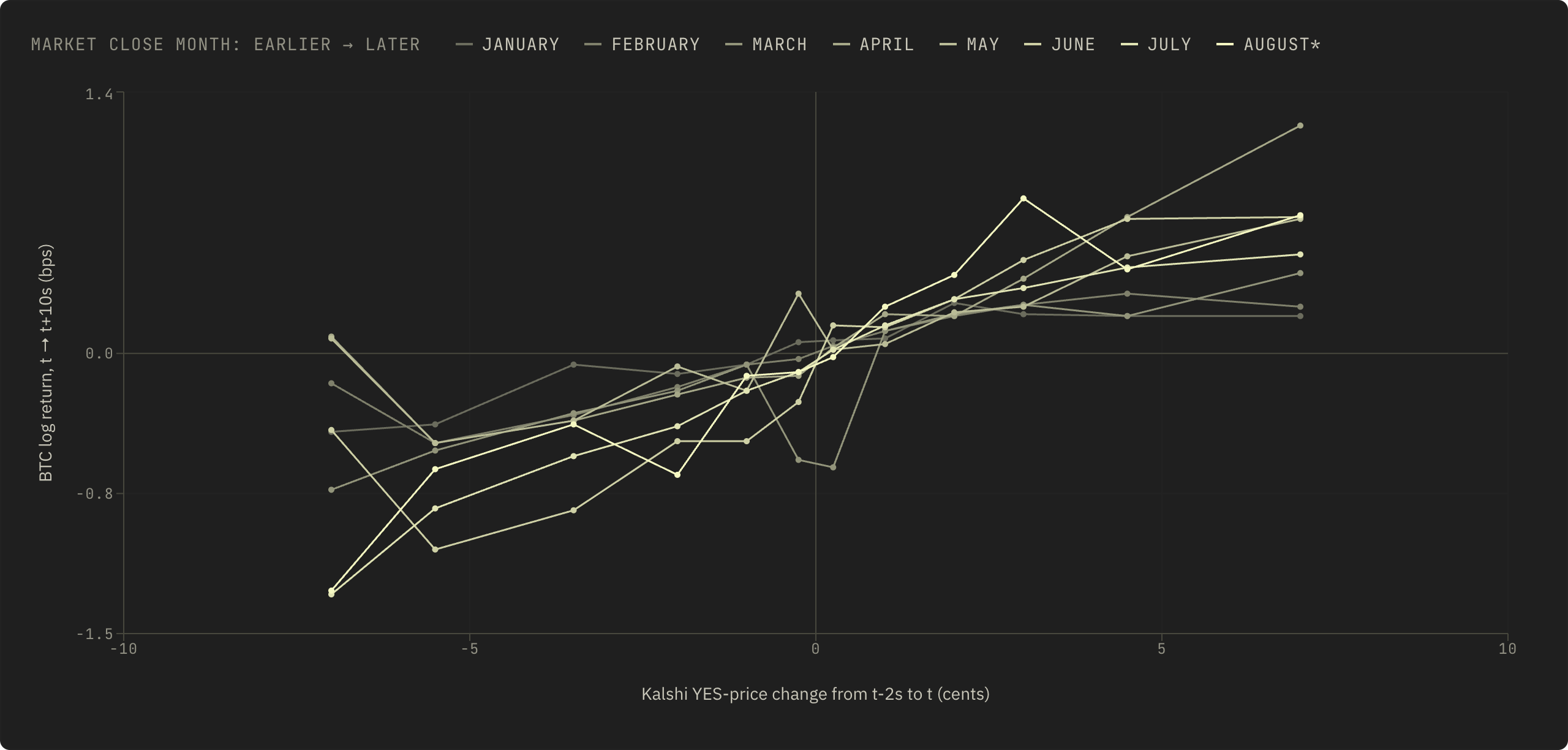
Further analysis breaks down the future Binance movements following Kalshi signals into independent two-second windows: 0–2 seconds, 2–4 seconds, 4–6 seconds, 6–8 seconds, and 8–10 seconds.
The clearest results appear in the first window. The correlation between Kalshi's changes and the subsequent 0–2 seconds trend of Binance has risen from 0.036 in January to 0.173 in August. By June, it had reached 0.145, maintaining a high position of 0.131 in July.
This tells us two key things:
First, Kalshi's predictive power has significantly increased over the year. From an almost negligible weak correlation at the beginning of the year, it now possesses a considerable leading indicator effect by the end of summer.
Second, the signals are extending over longer time spans. The initial advantage was primarily focused on the extremely short 0–2 second window, but over time, the correlations of subsequent windows are also gradually increasing, indicating that market participants' predictive horizons are lengthening.
When viewed in the context of high-frequency trading, a correlation of 0.173 is already significant enough to attract the attention of professional teams. It indicates that the price movements on Kalshi are no longer just noise, but signals with real informational content.
Why is this happening?
The theory proposed by the Synth team is that the participants setting the Kalshi prices have become significantly more complex, with proprietary information being used extensively for pricing.
Earlier this year, algorithmic traders could still price these markets using relatively simple models: taking the current Binance price, estimating the distribution of BTC at the end of the 15-minute window using volatility models, calculating the probability of being above the threshold, and then making markets around that probability. At that time, the flow of information was one-way —
Binance → Model → Kalshi
But leading high-frequency traders and institutions do not only use the current Binance price. They first predict where Binance will trade in 5 seconds, 10 seconds, or 30 seconds, using the microstructure of order books, cross-exchange capital flows, perpetual futures, liquidation data, proprietary order flow, and other secret signals.
This future price estimate is then input into the Kalshi pricing model. If these predictions are accurate enough, traders will move the Kalshi price before the predicted Binance movements actually occur.
Thus, the flow of information is completely reversed:
Proprietary information → High-frequency trading predictions → Kalshi → Future Binance price
This explains why Kalshi is increasingly able to "lead" the spot market. It is no longer a simple mapping of spot prices but a result of the most astute short-cycle predictors voting with real capital.
Kalshi as a price discovery venue
This provides an entirely different way to understand what Kalshi BTC prices represent.
There is no single predictive model behind it. Many complex participants are independently predicting Bitcoin, expressing these predictions through capital, and competing with each other. Everyone has their own signals, models, and risk preferences, and the final price is the equilibrium after a multi-party game.
Kalshi is actually becoming a market for the commercialization of short-cycle predictive models.
Moreover, this collective forecasting seems to be improving. The predictive relationship between Kalshi and future Binance prices has significantly strengthened over the year. If trading volume continues to grow and participants become more specialized, this trend will persist.
For the entire crypto market, this indicates a subtle yet significant change: the forefront of price discovery is shifting from traditional spot exchanges to shorter cycles and higher-frequency prediction markets. At least on the 15-minute time scale, Kalshi has begun to play the role of a "leading indicator."
免责声明:本文章仅代表作者个人观点,不代表本平台的立场和观点。本文章仅供信息分享,不构成对任何人的任何投资建议。用户与作者之间的任何争议,与本平台无关。如网页中刊载的文章或图片涉及侵权,请提供相关的权利证明和身份证明发送邮件到support@aicoin.com,本平台相关工作人员将会进行核查。


