Key Takeaways
- Bessent said Treasury buybacks could exceed $4 billion per operation.
- Bitcoin stands above $72,000 per unit Aug. 20 as long-term Treasury yields retreated.
- Treasury’s expanded buybacks begin Sept. 9, with markets watching yields next.
The comments followed the Treasury Department’s decision Wednesday to at least double the maximum size of liquidity-support buybacks for longer-dated government securities. The new floor jumps from $2 billion to $4 billion per operation beginning Sept. 9 and stays in place through Nov. 4.
“We’re going to increase the size of the buyback,” Bessent told CNBC during his interview. “I would note that it could be more than the 4 billion per issue.”
Bessent stressed that Treasury has a “big toolkit” and framed the move partly as a warning to markets that current yields do not reflect underlying economic fundamentals. The firepower targets Treasury securities with maturities ranging from 10 to 30 years.
Treasury buybacks are not debt cancellation. Washington purchases older, less actively traded securities, known as off-the-run Treasurys, while simultaneously selling fresh debt to finance deficits and refinance maturing obligations. The mechanics can inject liquidity and prop up prices in corners of the bond market where trading has grown strained.
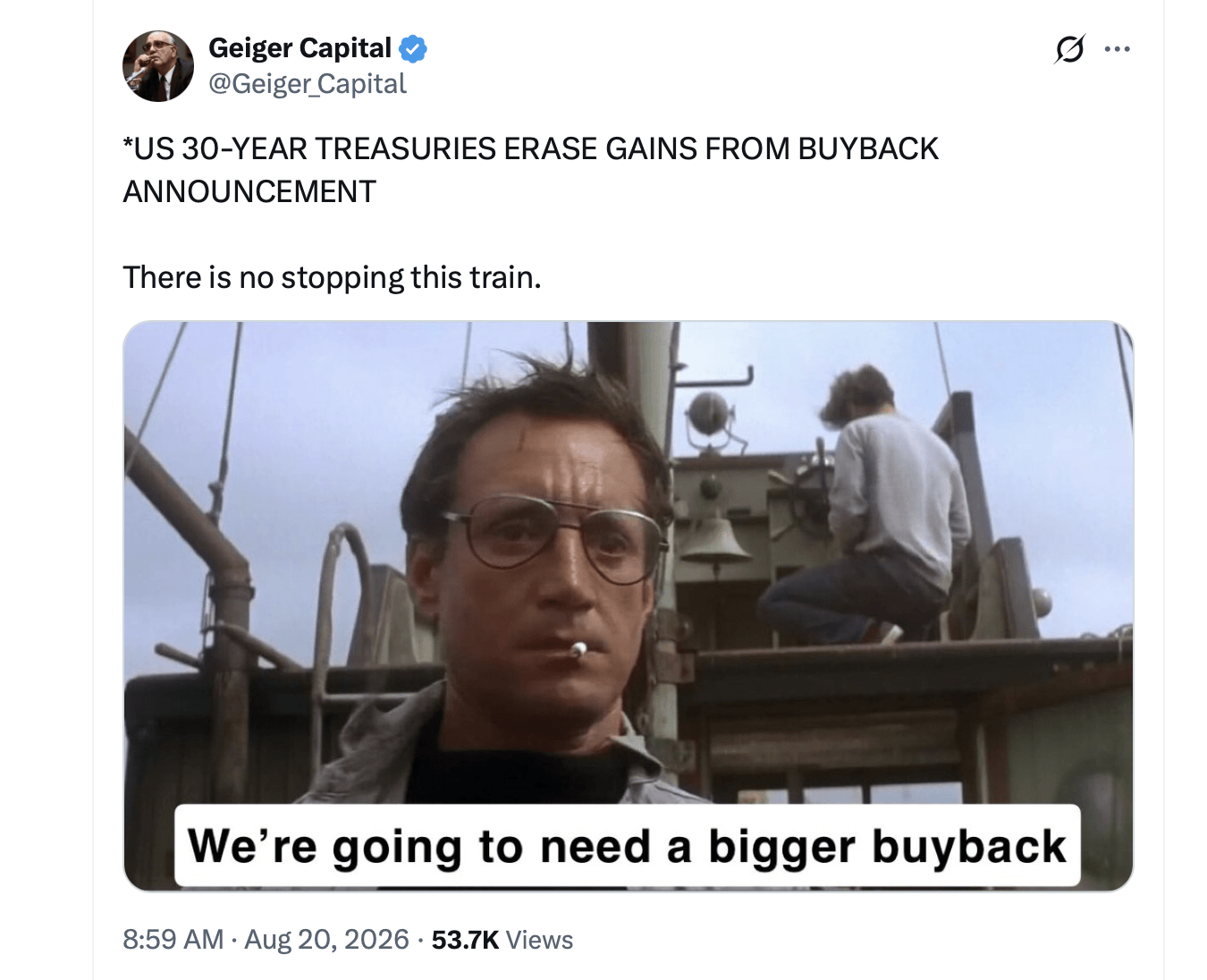
Image source: X
The math matters because bond prices and yields move in opposite directions. When Treasury buys push bond prices higher, yields can retreat. Those yields ripple through borrowing costs across the economy, including mortgage rates, corporate financing and other long-term loans.
The timing is impossible to miss. The 30-year Treasury yield climbed to roughly 5.33% to 5.34% earlier this week, its highest level since 2007, while total U.S. public debt cracked $40 trillion. Investors are increasingly confronting relentless government borrowing, persistent deficits, and mounting federal interest expenses.
Markets wasted little time. The 30-year yield dropped roughly 8 to 10 basis points following Wednesday’s announcement, while the 10-year yield also fell. A basis point equals one-hundredth of a percentage point. Part of that move was later reversed as traders measured the relatively small program against the enormous Treasury market.
Bitcoin ripped the other way. After trading in the mid-$64,000 range before the announcement, the cryptocurrency raced toward $69,000 to $70,000 Wednesday before extending the move on Thursday. As of about 11:40 a.m. EDT Aug. 20, bitcoin traded above $72,000.
Falling Treasury yields make assets without interest payments, including bitcoin and gold, relatively more attractive. A weaker dollar and renewed appetite for risk poured fuel on the trade, while heavy cryptocurrency short liquidations accelerated the move as bearish traders were forced to close positions.
Still, the numbers expose the program’s limits. The Treasury market contains roughly $32 trillion in outstanding securities, meaning even purchases above $4 billion amount to pocket change against the broader market. Buybacks also cannot shrink the national debt because the Treasury keeps issuing securities to finance federal spending.
That leaves investors testing whether Bessent’s intervention can deliver anything beyond a temporary break in long-term yields. Treasury has indicated that more details on future buyback sizes will arrive with its next Quarterly Refunding announcement.
The first expanded operations are expected in September, including purchases targeting 10- to 20-year and 20- to 30-year securities. Markets will watch how hard Treasury presses its new flexibility, whether long-term yields start climbing again and whether bitcoin can defend the gains ignited by Washington’s bond-market intervention.
免责声明:本文章仅代表作者个人观点,不代表本平台的立场和观点。本文章仅供信息分享,不构成对任何人的任何投资建议。用户与作者之间的任何争议,与本平台无关。如网页中刊载的文章或图片涉及侵权,请提供相关的权利证明和身份证明发送邮件到support@aicoin.com,本平台相关工作人员将会进行核查。


