
Author: Yuki (Liu Yuqing) Stablehunter/Money in Motion
Recently, I went to a friend's house for dinner. He connected his computer to the television, showcasing some recent things he had done using AI. One of them was that he opened a separate account on Robinhood specifically for his own Agent, allowing AI to manage his regular investments.
I’m not sure whether this account is officially launched by Robinhood as an Agentic Account, nor do I know if he is using the official interface or his own integration plan. However, when I saw it, this system had already been running for over a month, and the account's earnings had exceeded 20%.
For me, the real surprise was not the rate of return.
Data from just over a month doesn't explain much. It could be due to market conditions, concentration on specific assets, or just a temporarily attractive time window. Without a comprehensive benchmark, drawdown, and trading record, we cannot judge whether AI is truly better at investing than humans.
What astonished me more was that he really dared to entrust money to AI.
This is not just about letting AI analyze the market, organize news, or generate an investment suggestion, but about giving it a real account and allowing it to take continuous action.
Later, I started to explore the series of products recently launched by Robinhood, and found that this might not just be an experiment by one person. Robinhood is transforming similar behaviors into a formal product direction.
Robinhood's AI Path Does Not Start with Automated Trading
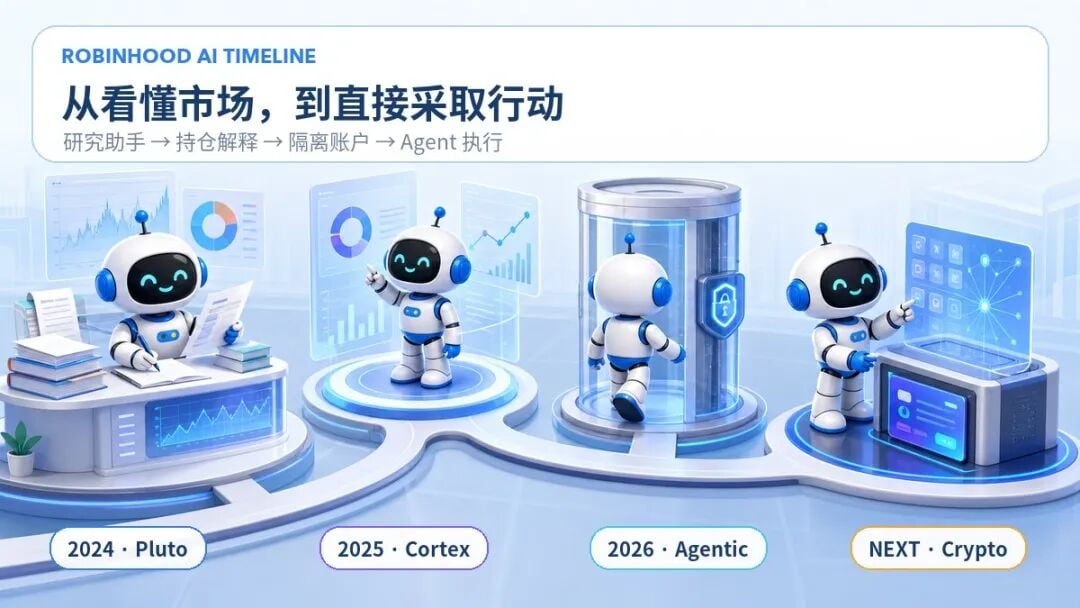
Robinhood's layout for AI can be traced back at least to 2024.
That year, it acquired the AI investment research platform Pluto. Originally, Pluto was focused on investment Copilot: feeding real-time market data, news, financial reports, and user personal information to a large model to generate personalized research and strategies. Pluto's founder Jacob Sansbury subsequently joined Robinhood, responsible for accelerating the AI product roadmap.
This step addresses the "information" problem.
In 2025, Robinhood launched Cortex. Initially, Cortex resembled an AI research assistant embedded in the investment app: explaining why a stock rose or fell, analyzing the relationship between news and holdings, and generating Stock Digests, Crypto Digests, and Portfolio Digests.
By the first quarter of 2026, Robinhood reported that nearly 1 million users were utilizing Cortex-related features. It started evolving from a tool for summarizing information to a unified operating interface within the Robinhood App: users can research the market, filter stocks, analyze holdings, and gradually execute account operations using natural language.
This path is clear:
First allow AI to help you understand the market, then let AI help you take action.
In 2026, Robinhood Officially Opened Accounts to Agents
In May 2026, Robinhood launched Agentic Trading.
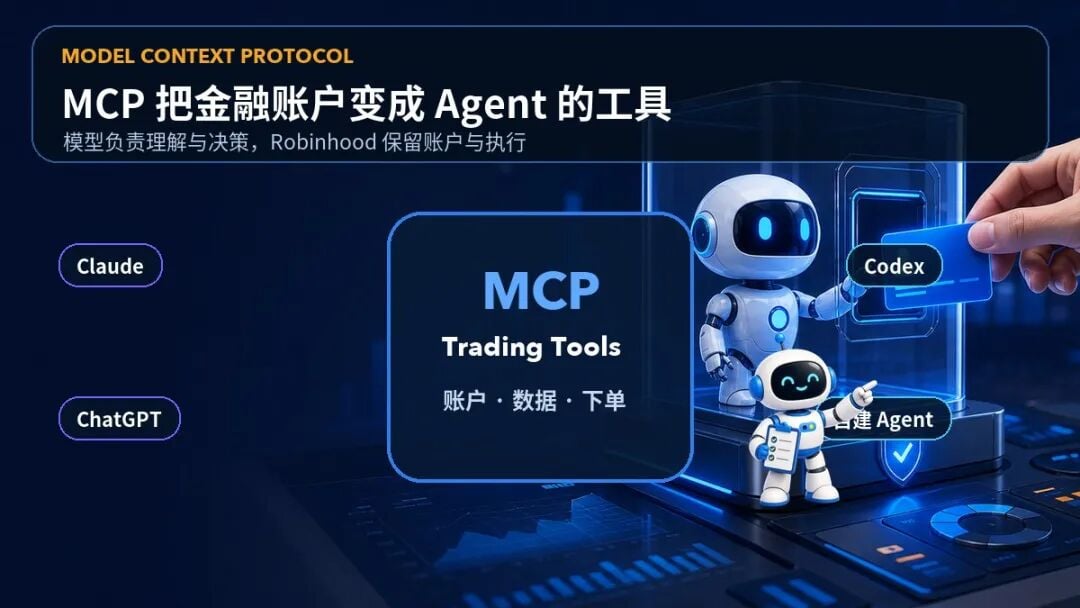
Users can create a new independent Agentic Account, transfer some funds into it, and then connect Claude, ChatGPT, Codex, Cursor, Grok, or their own developed Agent to the account via Robinhood's Trading MCP.
The most important design here is not that Robinhood itself provides the "smartest stock trading model." On the contrary, it allows users to choose third-party AI.
Robinhood provides accounts, data, and execution interfaces:
- The Agent can read Robinhood accounts, holdings, balances, and historical orders;
- It can read watchlists and user-saved scans;
- It can study assets, create filtering conditions, and run scans;
- It can place orders within the independent Agentic Account;
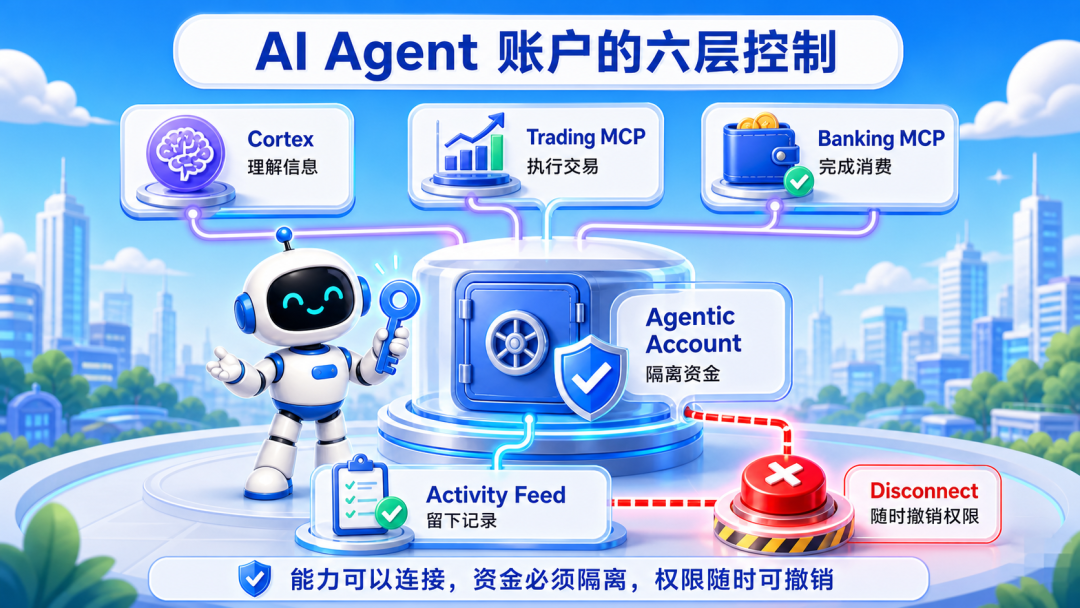
- Users can view real-time activities and P&L and disconnect the Agent at any time.
Robinhood’s official documentation even directly lists the MCP access methods for Claude Code, Claude Desktop, ChatGPT, Codex, Cursor, and Grok.
This means that it is no longer a set of unofficial APIs or an automated trading script that needs to bypass platform rules. Robinhood is actively packaging its financial capabilities into tools that AI Agents can call upon.
This may be a crucial point for Agentic Finance:
Financial accounts are beginning to transform from "clickable apps" into "execution environments callable by Agents."

It Even Wants More than Just Letting AI Trade
On the same day, Robinhood also launched the Agentic Credit Card.
Users can create a separate virtual card for the Agent, setting a monthly limit, and can also require that each transaction be confirmed by a person. The Agent searches for products, and upon reaching the checkout page, it retrieves the authorized virtual card information through Robinhood Banking MCP to complete the payment.
Later, Robinhood announced that Agentic Trading would be expanded from stocks and options to Crypto. Users can connect their chosen AI models to Robinhood's data and trading tools, allowing Agents to continuously scan the market and execute strategies.
Looking at these products together, Robinhood's direction is no longer just "AI investment assistant":
It is attempting to answer a bigger question:
When AI can manage investments and spending on behalf of people, how should financial platforms provide accounts, permissions, and responsibility boundaries?
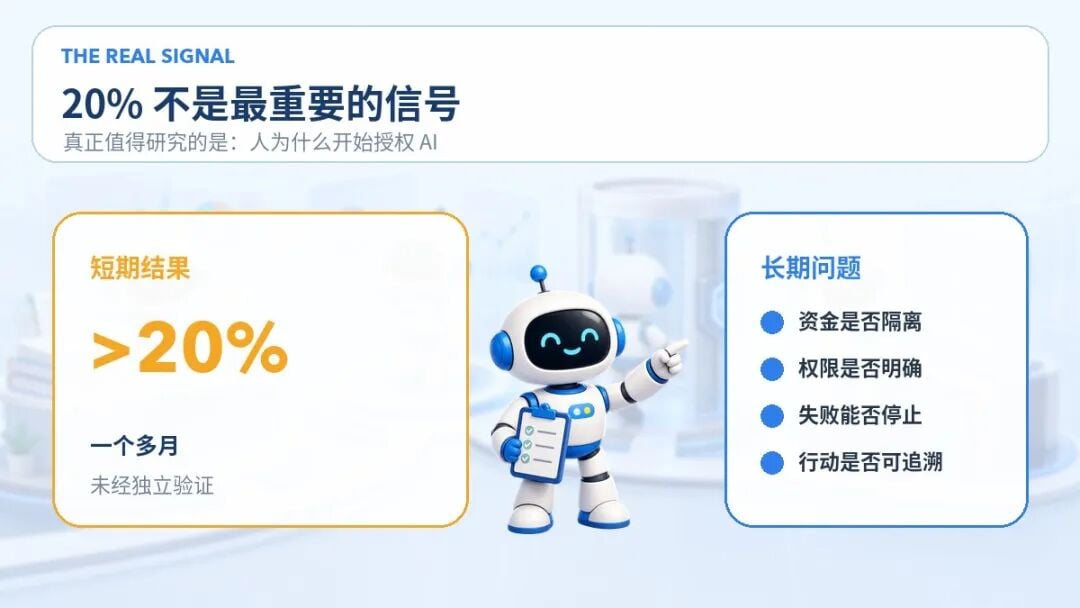
20% Return Is Not the Most Important Signal
Returning to my friend's example, after his Agent ran for just over a month, the account temporarily showed a return exceeding 20%. This is certainly attractive, but it is not sufficient evidence to determine whether this system is valid.
To seriously assess an AI investment Agent, at least the following should be considered:
- What did it buy, and what market risks did it take on;
- How much more did it earn compared to the benchmark for the same period;
- What is the maximum drawdown;
- Is trading overly concentrated;
- How would it handle a sudden market reversal;
- Are there position limits, stop conditions, and manual takeover mechanisms.
Short-term high returns can easily become material for spreading but may hide actual risks.
Moreover, whether it's Cortex or Agentic Trading, Robinhood repeatedly emphasizes that AI may misunderstand commands, use incomplete or outdated information, and may take unexpected actions. Robinhood does not oversee the third-party Agents chosen by users, and the final trading risks are still borne by the users.
So what I’m more concerned about is not:
Can AI help everyone earn 20%?
But rather:
What does a person need to see to be willing to entrust real money to AI?
Users Dare to Authorize, Not Based on Model Promises
My friend's approach is actually quite representative: he did not hand over all his assets but instead opened a separate account. While this may seem like an operational detail, it could be the most important product design of the entire Agentic Finance.
Because whether users dare to authorize depends not only on how smart the model is but also on whether the failure is controllable:
- How much money can the Agent utilize?
- What assets can it trade?
- Can funds be withdrawn or transferred?
- Does each transaction need confirmation?
- At what level of loss must it stop?
- Can users revoke permissions with one click?
- After a problem occurs, can it restore what it saw and what it did?
Robinhood's answer is to confine the Agent to an independent account: it can access a vast amount of information but can only execute trades within a designated account; users can view activities and disconnect at any time.
This design does not eliminate investment risk, but it lowers the psychological threshold for authorization.
For Agentic Finance, this may be more important than the model itself: it's not about proving that AI will never make mistakes, but rather about limiting the potential losses caused by mistakes to a clear scope.

What Robinhood Really Wants to Do Is Create an Agent Interface for the Financial World
In the past, the design target of financial apps was people.
People open pages, read information, click buttons, input amounts, and then confirm transactions. Every financial product is designed around human attention and operational habits.
But if more operations are initiated by Agents in the future, financial platforms will need to establish another set of interfaces:
- Account data that machines can understand;
- Trading tools that machines can call upon;
- Programmable permissions and budgets;
- Approval and revocation mechanisms that humans can intervene at any time;
- Logs that can trace every action taken.
The significance of MCP here is not just another AI technical term. It allows Robinhood not to bet on any specific model. Claude, ChatGPT, Codex, or user-developed Agents can all use the same set of financial tools.
Robinhood retains the accounts and execution, AI companies provide understanding and decision-making, and users are responsible for setting goals and risk boundaries. This may represent a new division of labor for future financial platforms.
We Are Entering the Stage of “Entrusting Accounts to AI”
When I previously discussed Agent Trading, I always thought that its earliest mature form would not be a fully automated money-making machine but rather a more honest trading operating system: helping users establish rules, execute discipline, and prevent avoidable mistakes.
Robinhood's new products make me feel that this direction is moving forward.
The past question was: "Can AI provide me with better investment advice?"
Now the question has turned into: "How much execution authority am I willing to give to AI?"
Further along, the question may be: "Can multiple financial accounts of one person all be called upon by an Agent under unified rules?"
The demonstration at my friend's house may just be a very early, personalized experiment. Over a month, with more than 20% returns, is also far from proving any long-term capability.
But at that moment, I felt for the first time: Agentic Finance no longer exists only in protocols, demos, and product launches. Someone has already begun to entrust real accounts to AI; it is not the next "AI stock trading profit myth," but when this behavior gradually becomes common, how should we design authorization, risk control, and responsibility boundaries.
After all, as soon as AI starts handling money, it is no longer just an AI product.
It has become a financial product.
免责声明:本文章仅代表作者个人观点,不代表本平台的立场和观点。本文章仅供信息分享,不构成对任何人的任何投资建议。用户与作者之间的任何争议,与本平台无关。如网页中刊载的文章或图片涉及侵权,请提供相关的权利证明和身份证明发送邮件到support@aicoin.com,本平台相关工作人员将会进行核查。


