Author: Byron Gilliam
Translation: Deep Tides TechFlow
Deep Tides Overview: Kalshi has been attempting to fit sports prediction contracts under the federal regulatory framework by calling them “swaps,” but the Ninth Circuit Court exposed this wordplay with a 3-0 ruling. If the decision is upheld, Kalshi’s core business, which relies on growth, will face state licensing, taxes, and operational bans, and the regulatory arbitrage space for the entire prediction market industry will be significantly compressed. This case will determine whether "event contracts" are classified as financial derivatives or gambling.
A different name, but is a bet still a bet?
On Friday, a panel of judges from the Ninth Circuit Court ruled 3-0 that Kalshi's sports-related event contracts fall under a type of sports betting.
This is almost an obvious fact. What else could purchasing an event contract regarding total scores in a football game be if not gambling?
Even Kalshi itself seems to think so:
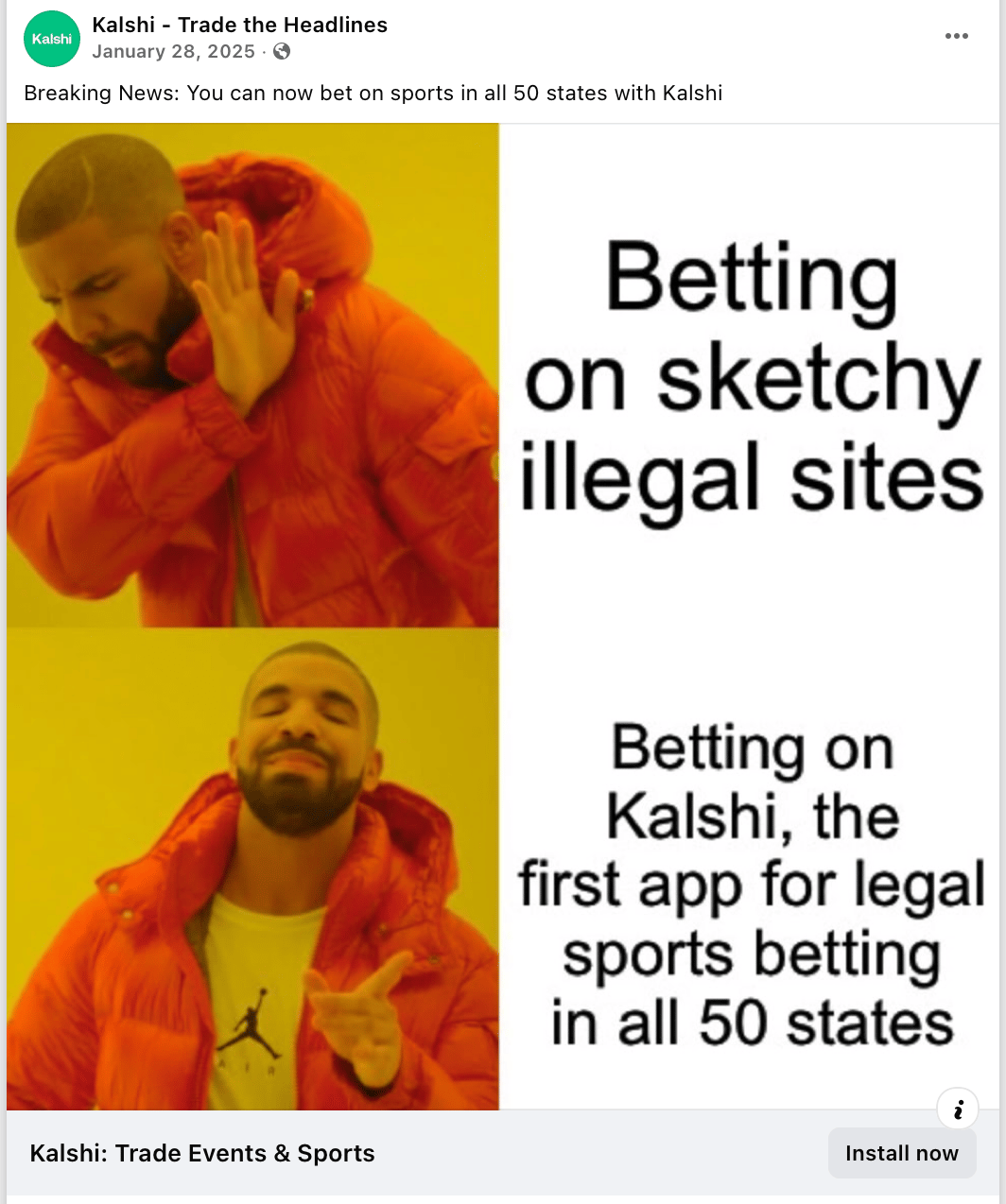
The Ninth Circuit Court supported the ruling from Nevada, beginning by citing the post from Kalshi's Facebook account. Judge Ryan Nelson wrote, “KalshiEX, LLC claims to be the ‘first legal sports betting application in all 50 states.’”
If any case could be finished with a single sentence, this one seems to be it. Sports betting is regulated by individual states, and Kalshi claims to offer sports betting in all 50 states of the U.S. Therefore, Nevada, as one of those states, has the authority to regulate Kalshi.
The case is closed!
Just kidding. The stakes are too high for both parties; this cannot be the final conclusion.
If Kalshi admits its sports-related event contracts are gambling, it must obtain licenses in various states, comply with different state regulations, and pay state taxes. It must also cease operations in the 20 states where online sports betting is still illegal.
This represents a survival crisis for Kalshi: as of now, sports-related business accounts for 72% of its total.
For Nevada, the stakes are equally significant. The state has no personal or corporate income tax, and gambling taxes and fees account for about 17% of state revenue. The broader hotel-casino industry is estimated to comprise up to 37% of revenue.
The average temperature in Las Vegas in July is 107 degrees Fahrenheit (about 41.7 degrees Celsius). If income taxes are imposed, no one would want to endure this horrible weather.
Therefore, whether sports betting in the prediction market is merely gambling, as stated by the Ninth Circuit Court, is of great importance.
Although this sounds like a tautology, the Third Circuit Court disagrees.
In April of this year, the Third Circuit Court (which is much farther from Nevada) accepted Kalshi's argument that its event contracts qualify as "swaps"—a financial derivative regulated solely by the Commodity Futures Trading Commission (CFTC).
The Commodity Exchange Act defines swaps as “any agreement, contract, or transaction … that depends on the occurrence, non-occurrence, or degree of occurrence of a certain event or contingency … and that event or contingency is related to potential financial, economic or commercial consequences.”
For example, the winner of a game: Kalshi says the Seahawks winning the Super Bowl is an event that has already happened.
Or the point spread. The Seahawks winning the Super Bowl by 15 points is the "degree of the event's occurrence."
Therefore, Kalshi argues that contracts related to the outcomes of sports events should be classified as swaps and thus regulated by the CFTC.
The Ninth Circuit Court stated that this contravenes common sense.
Judge Nelson wrote that in everyday language, the Super Bowl itself is an "event." The Seahawks winning is the "result" of that event. (The fact that the Seahawks won by 15 points is another result.)
The court ruled that contracts tied to the outcome of events are simply bets, regardless of what you call them.
Nelson wrote, “The sports event contracts provided on the designated contract market (DCM) by Kalshi are essentially sports gambling, regardless of whether Kalshi calls them swaps.” (And he quoted Shakespeare’s rose.)
True swaps have functions beyond gambling: they hedge risks of events that have actual financial consequences—like rising interest rates or falling stock prices.
In contrast, Nelson wrote, Kalshi’s event contracts “cannot help institutions or investors hedge risks,” but rather “create risks for ordinary consumers where none existed.”
Creating risks where none existed is the definition of gambling—and it is the distinction between gambling and investment, insurance, or hedging.
Kalshi points out that the outcomes of sporting events indeed have economic ramifications beyond speculation. For instance, a football team betting on itself to lose to hedge against financial risks of relegation; another example is a bar betting on the Knicks to hedge risks of a promotional drink campaign.
I can think of other examples, like a hotel hedging the risk of a local team failing to make the playoffs.
However, no company would be inherently exposed to the financial risk of a team winning by 15 points instead of 10 points. Nor would it be exposed to whether Taylor Swift shows up, or how long the national anthem is played.
If Kalshi appeals the Ninth Circuit’s ruling, I guess it can only build its defense on how to dissect the specific wording of the Commodity Exchange Act.
If so, some of the world’s most important judges may soon debate the distinction between "results" and "events."
Polymarket odds indicate a 52% probability of this happening by the end of the year.
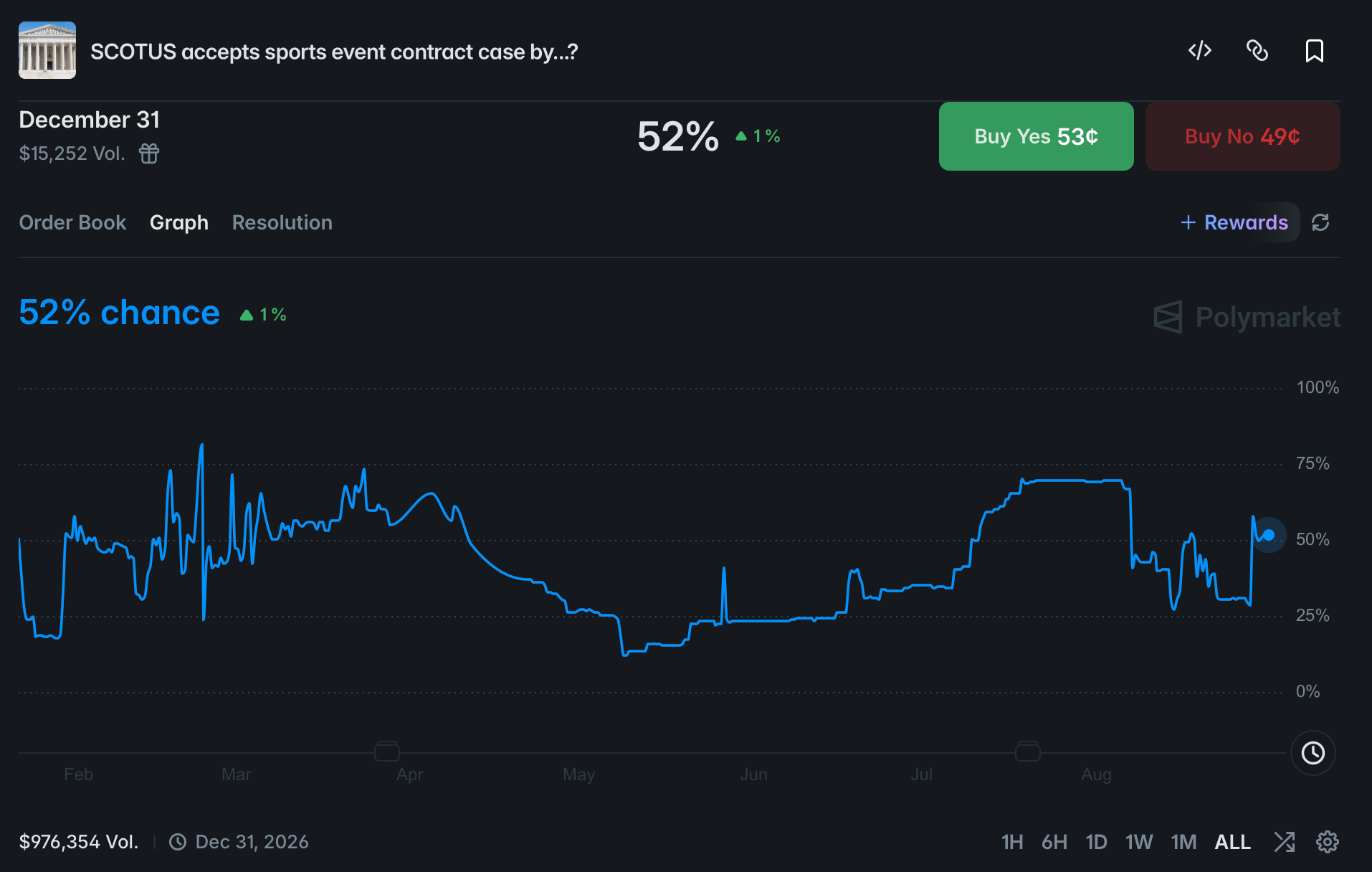
This is what swaps are.
(Kalshi does not offer this.)
— Byron Gilliam
免责声明:本文章仅代表作者个人观点,不代表本平台的立场和观点。本文章仅供信息分享,不构成对任何人的任何投资建议。用户与作者之间的任何争议,与本平台无关。如网页中刊载的文章或图片涉及侵权,请提供相关的权利证明和身份证明发送邮件到support@aicoin.com,本平台相关工作人员将会进行核查。


