Scaling is a must for stablecoins.
Written by: Eric, Foresight News
On September 1, Ethena officially launched its new application, Ethena Pay. In simple terms, this is a banking-like app on your phone where you can deposit dollars to earn interest, transfer money to friends using usernames, and generate a Visa card to spend at 130 million merchants worldwide. It sounds like Revolut or Alipay, but the dollars in the account are not bank deposits but Ethena's own synthetic dollar, USDe.
This is the first time USDe has transformed from an on-chain financial asset into something you can spend.
Ethena Pay is essentially a self-custody wallet. Users can receive fiat currency through IBAN or directly transfer cryptocurrency; regardless of the method, the balance automatically converts to USDe upon receipt. For transfers, users can instantly and free of charge transfer between each other using usernames, and bank transfers in USD, EUR, and GBP are also free. The card operates on the Visa network, issued by Third National Bank of Puerto Rico, and the card project management is handled by Rain, the same company that previously helped Avalanche launch Avalanche Card, with the underlying technology provided by Iron, acquired by MoonPay.
The balance in Ethena Pay itself earns interest based on USDe's base interest rate, and Ethena supplements a Daily Boost to achieve the overall interest rate. Standard users can earn an annualized 5% on amounts up to $5,000; after locking $2,000 worth of ENA or referring 10 friends to upgrade to Pro, they can earn 6% on amounts up to $15,000, and the VIP tier has an interest cap of $50,000. Cash back on card purchases starts at 4%, with a maximum of 5%, all distributed in AVAX.
For designated merchants like Uber, Spotify, and even Claude, VIP users can receive up to 10%. The official promotion includes a feature called Buy Now Pay Never, meaning that daily expenses can be covered by interest, and the principal remains untouched.
Looking back, since the birth of USDe in early 2024, its position has been as an interest-generating asset. The Delta neutral hedging structure enables it to provide returns far exceeding government bonds; over the past two years, it has served as collateral for exchanges and as collateral in Aave and Pendle, integrating more than 100 protocols and processing over $30 billion in minting and redemption. In September last year, it briefly reached a circulation scale of $15 billion, securing the third position among stablecoins.
However, sharp observers know that at that time, USDe was not a true stablecoin; it was merely a $1 share of a Delta neutral fund. To truly become a “stablecoin,” Ethena has made numerous efforts.
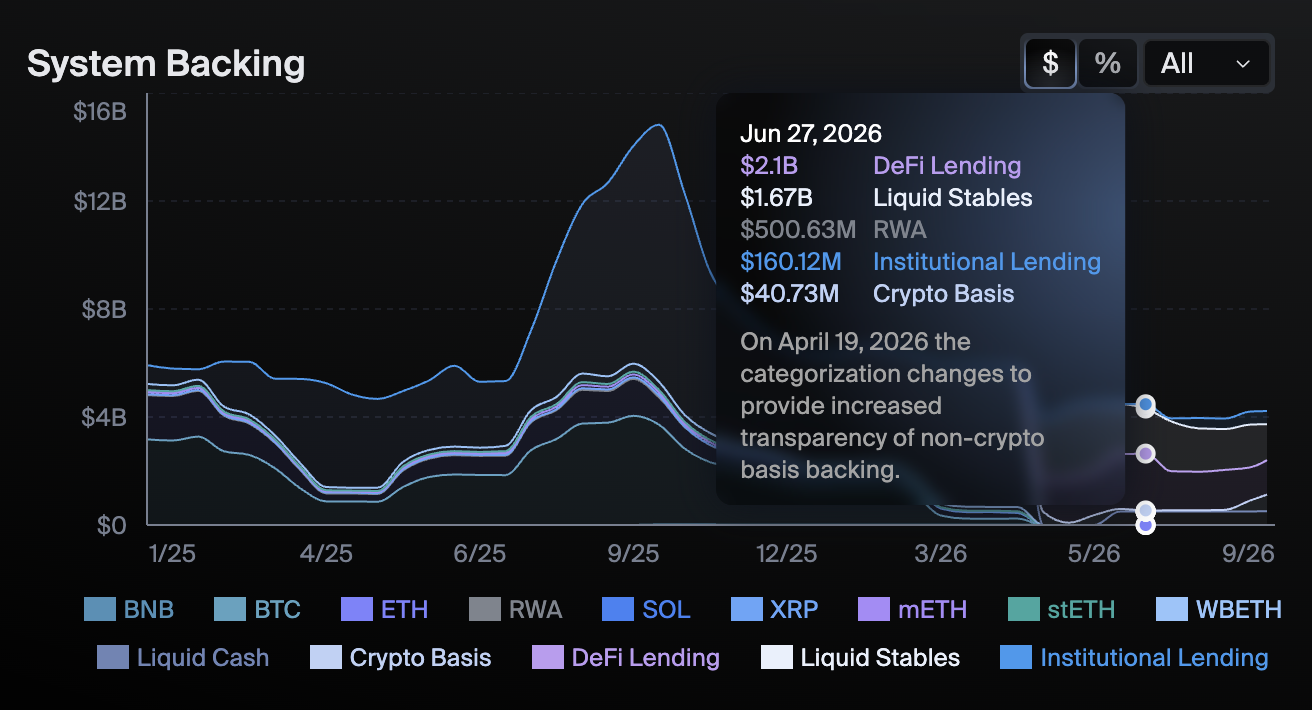
Currently, the proportion of perpetual contracts in Ethena's "reserve assets" has significantly decreased, while the portions of liquidity stablecoin reserves, DeFi lending, and institutional-grade over-collateralized lending have increased. Although this has somewhat lowered the yield, it has also avoided losses similar to those during the extreme market conditions in October last year. Additionally, Ethena has increased tokenized RWA reserves, incorporating tokenized U.S. Treasury bonds, CLOs (Collateralized Loan Obligations), investment-grade corporate bonds, short-term loans, structured credit, and more.
In terms of Delta neutral strategies, Ethena is also further exploring equity and commodity perpetual basis trading, prime lending, and reducing reliance on single cryptocurrency funding rates. Currently, the circulation of USDe is about $4.23 billion, and as shown in the chart, the reserve assets based on pure cryptocurrency hedging have fallen below 1%.
In terms of compliance, it has partnered with Anchorage, which is regulated by U.S. federal authorities, to issue USDtb, aligning with the Genius Act, and has launched iUSDe for institutions. It has also collaborated with Securitize to co-build the RWA settlement chain, Converge. In distribution, earlier this year, it partnered with Coinbase to launch a savings product, bringing USDe to millions of exchange users. In terms of ecosystem, last September, USDe and sUSDe launched on Avalanche, connecting to lending markets like Euler and Silo, and rewarding interactive users with AVAX. Now, launching cards directly on Avalanche seems like a natural result of that collaboration.
The past story of USDe was "high-yield dollars," but countless incidents of theft and significant losses due to extreme market conditions in the DeFi space remind us that high yield corresponds to high risk. To maintain its issuance volume, USDe must be usable.
As for why Avalanche was chosen instead of its own Converge project, founder Guy Young's explanation is straightforward: both sides share similar views on "creating products for enterprises." Avalanche excels at building invisible infrastructure that users are unaware of, and has long-standing experience issuing cards with Rain. Moreover, Avalanche recently formed a payment alliance composed of 28 institutions, including Franklin Templeton, Paxos, Anchorage, Rain, and Ethena; Ethena Pay directly plugs into an existing payment ecosystem. For Avalanche, distributing cash back in AVAX creates a continuous demand scenario for its own tokens, making this a win-win for both parties.
In a previous article, I pointed out that Avalanche has become the most cost-effective chain for tokenized RWAs, including stablecoins, in the EVM ecosystem. Ethena’s choice confirms this view, as previously, Avalanche did not dominate stablecoin settlements compared to other chains, but embracing Ethena may lead to some changes.
From USDC ceding most of its yield to claim Hyperliquid, to Ethena reducing its yield to make USDe a "currency," everyone realizes one thing: for the stablecoin business to succeed, the key is scale. And the core of scale is that stablecoins must be useful.
USDT's usage rate on the payment layer may not be lower than that of USDC, but in areas like fund transfers, USDT still holds absolute advantages. If USDC merely focuses on compliance, and USDe only focuses on yield, then their ceiling was foreseeable from the start. Only when stablecoins are actually applied in daily life and can circulate between different individuals and entities can they secure their base, maintain yield, and free up more energy for lateral expansion.
免责声明:本文章仅代表作者个人观点,不代表本平台的立场和观点。本文章仅供信息分享,不构成对任何人的任何投资建议。用户与作者之间的任何争议,与本平台无关。如网页中刊载的文章或图片涉及侵权,请提供相关的权利证明和身份证明发送邮件到support@aicoin.com,本平台相关工作人员将会进行核查。


