

Author: Jason, NDV Research Observation
On August 18, the US national debt surpassed $40 trillion, several months earlier than expected. This news only made the financial headlines for a day.
We believe it is worth interpreting as a signal of a decade-level significance. The argument of this article can be summarized in one paragraph: the mathematics of US debt has reached a stage where it can only be solved by "devaluation" (as calculated by official institutions); historically, the winners of this path are always scarce assets; gold has completed its repricing, sitting atop as the largest reserve asset for global central banks, while Bitcoin—an asset that is younger and even scarcer under the same logic—has a market value only 5% of that of gold. The core anti-devaluation asset of the previous generation was gold; for this generation, Bitcoin is added to the candidate list. We validated the tradability of this judgment using three and a half years of fund net values.
This story will unfold over many years, and we will track every milestone here.
1. Clarifying the Word "Insurance"
When buying fire insurance, you don't need to predict which day the fire will occur. You just need to confirm three things: the house is important, the fire source genuinely exists, and the premium is relatively cheap compared to the risk.
This article argues these three points—
- The house: the purchasing power of your assets. It is denominated in dollars, and the credit of the dollar is predicated on US fiscal responsibility;
- The fire source: the mathematics of US debt has entered a stage where it can only be solved by "devaluation." This is not a viewpoint; this is from calculations made by official institutions;
- The premium: among the assets that hedge against this issue, gold has already been repriced, while Bitcoin is still sitting on the floor—these premiums are unusually cheap.
Another fact proven repeatedly in insurance history is: when enough people buy an insurance policy, it ceases to be insurance and becomes a core asset. Gold has just completed this transition, and Bitcoin is on the same path. We will elaborate below, and every number in the full text has sources and dates. Feel free to verify them one by one.
2. The Fire Source: An Undisputed Arithmetic Problem
As of August 28, 2026, the figure on the US Treasury's balance sheet is $40,104,097,482,666—$40.1 trillion, approximately 123% of US GDP. Over the past year, the net increase in US debt held by the public has been $2.5 trillion.
More important than the total amount is the interest. In the just concluded fiscal year 2025, the US government paid $970 billion in net interest, consuming 18.5% of total fiscal revenue—the highest figure recorded since 1940. To translate: for every $5 collected in taxes, nearly $1 goes towards repaying past borrowing interest. 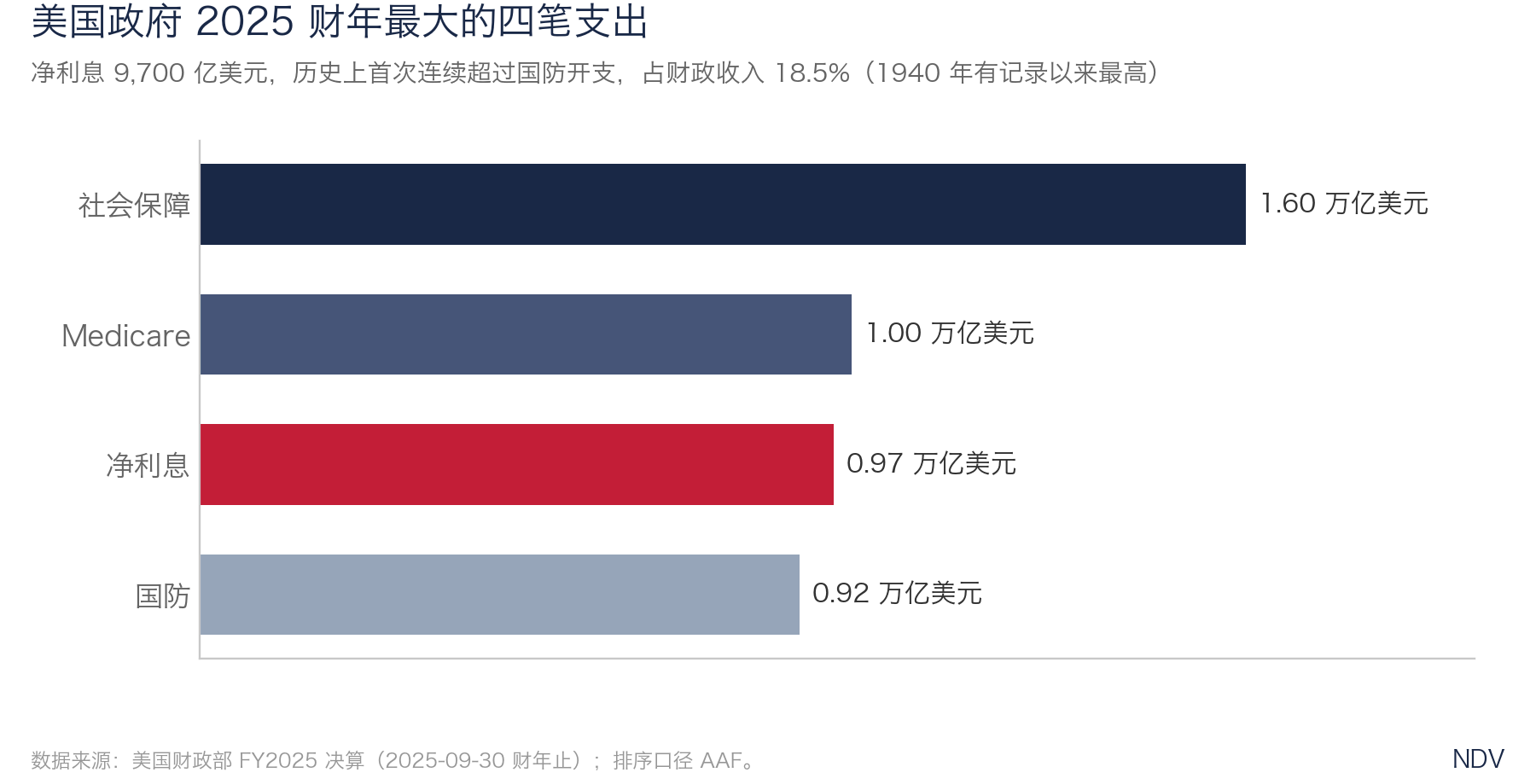
Moreover, this situation will only move in one direction: the average interest rate on existing Treasury securities is only 3.45%, while the 10-year yield is around 4.75%—approximately $10 trillion in old debt will need to be rolled over in the next 12 months; every time a batch is rolled over, the interest cost escalates. According to the Congressional Budget Office (CBO), net interest for fiscal year 2026 will surpass $1 trillion for the first time, reaching $2.1 trillion by 2036. 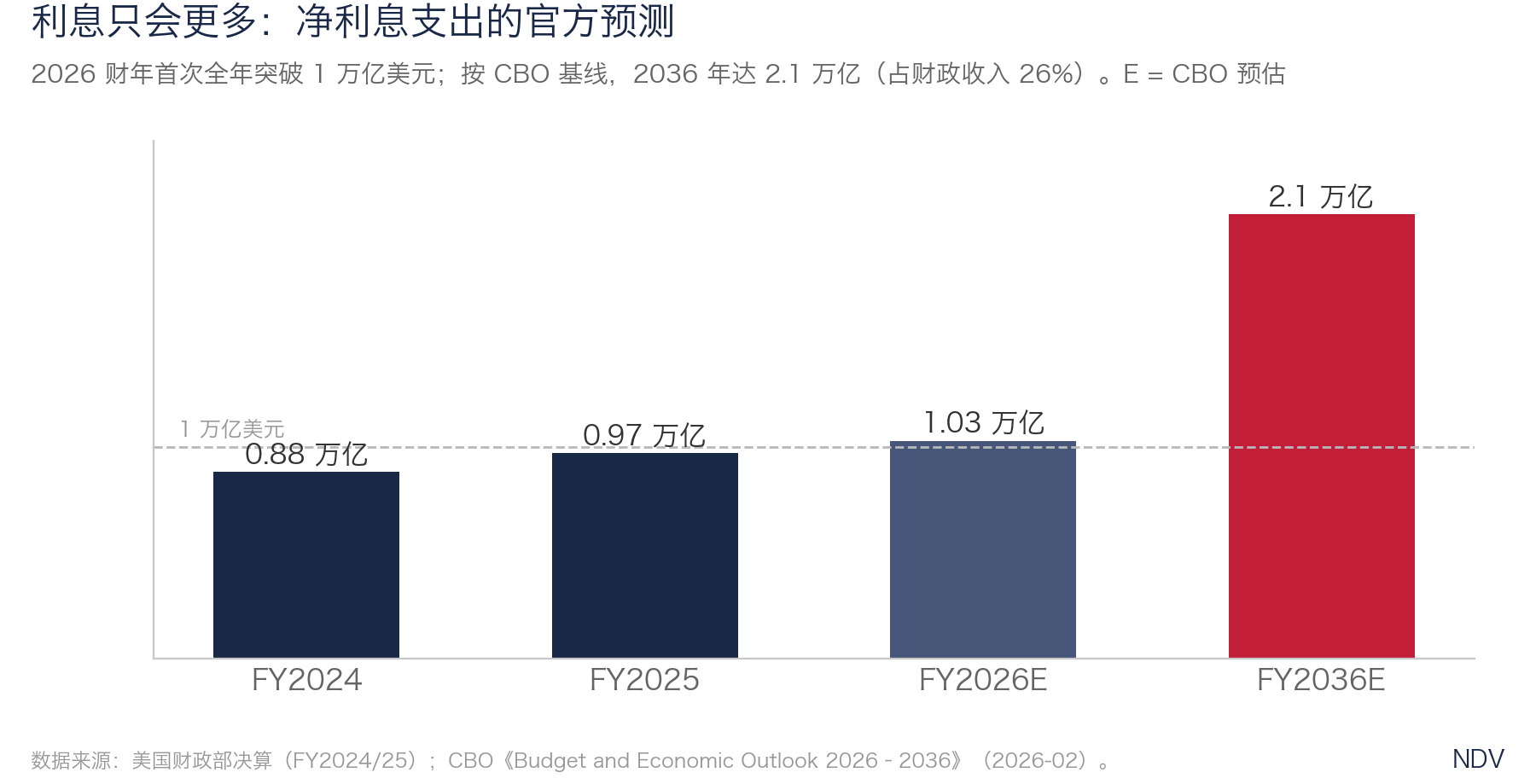
Here is a set of contrasts worth looking at: the supply of US Treasury bonds has seen a net increase of $2.5 trillion a year, with no cap; Bitcoin's supply is strictly capped at 21 million coins, halved every four years. On one side is politically determined unlimited supply, while on the other side is supply determined by code—this difference between the two supply curves forms the basis of the entire argument.
3. Why Fire Cannot Be Extinguished: Budget Cuts Are Mathematically Impractical
Many people's intuition is: just spend less.
The math doesn't allow it. According to calculations by the Bipartisan Policy Center (BPC) based on CBO data, starting in 2025, US mandatory spending (Social Security, Medicare, etc.) plus interest will be approximately equal to total fiscal revenue—every dollar Congress can actually vote on is borrowed, including all defense spending.
The political reality is both parties are doing addition: the major fiscal legislation (OBBBA) in July 2025 is projected by the CBO to add $3.4 trillion in deficits over a decade; in February 2026, the Supreme Court ruled that large tariffs exceeded authority, eliminating the government's only significant new source of revenue, plus a return on $166 billion. The deficit this year is estimated at $2.1 trillion—during peacetime, with full employment, this is a 6% deficit relative to GDP.
For the next decade, this fire has an official schedule, with every milestone having authoritative sources:
- 2027: Again hitting the $41.1 trillion debt ceiling (BPC/CRFB)
- 2028–2030: Debt as a percentage of GDP breaks the historical record of 106% set during WWII (CBO)
- 2029: Global public debt exceeds 100% of global GDP, one year earlier than initially predicted (IMF)
- 2032: The US Social Security Trust Fund will deplete under current laws, automatically cutting benefits by 22% (official Trustees report in 2026)
- 2033: Medicare inpatient fund depletes, automatically cutting hospital payments by 11% (same report)
- 2036: Debt as a percentage of GDP reaches 120%, net interest at $2.1 trillion (CBO)
This is the reason it is "worth betting on for a decade": there’s no need to gamble on which year an event occurs; the official timetable shows that every year in the next decade is headed for one-way pressure. The roadmap of rising premiums is printed by the government itself.
4. The Only Way to Extinguish the Fire: History Reenacted
When debt is too high to repay, theoretically there are three doors: default, genuine austerity, and inflation dilution. Reserve currency countries will not choose the first door, and the second door has just been disproven. Only the third door remains, formally known as financial repression: keeping interest rates below inflation, allowing bondholders and depositors to subtly lose purchasing power each year under the illusion of "not losing money in nominal terms."
The last time the US reached this position was in 1946, with debt at 106% of GDP—almost identical to today. The solution was: the Fed pinned short-term Treasury rates at 0.375% and long-term at up to 2.5%, a period of nine years; inflation during the same period averaged about 6.5%. By 1974, debt as a percentage of GDP dropped from 106% to 23%. Academic estimates (Reinhart & Sbrancia) showed that the US and UK each "cleared" debt equivalent to 3-4% of GDP annually through negative real interest rates—this money didn’t disappear; it was transferred from the pockets of savers. The UK was even more brutal: reducing from 270% to 50%.
Economic historian Russell Napier stated plainly: "Financial repression is slowly taking money away from savers and the elderly. 'Slow' is crucial—it must be slow enough that the pain is not too obvious."
Now looking at the precedent of 1971: after Nixon closed the gold window, in ten years, the gold price rose from $35 per ounce to $850 in 1980. Every time the monetary system is forced to "reset," scarce assets will complete another repricing. This is not the first time; it's just this generation's turn.
If you think these are still history books, look at last week’s news: in August 2026, the US Treasury doubled the scale of its long-term bond repurchase to $4 billion, trying to suppress long-end yields; legendary trader Stanley Druckenmiller immediately published an article in the Wall Street Journal—"This is not liquidity management, it’s price management." The Treasury Secretary publicly replied in the G20 three days later. Both sides have entered the arena. Financial repression is not a prophecy; it’s breaking news.
5. Gold: The Complete Process of Transforming Insurance into a Core Asset Just Happened Before Our Eyes
Before fire insurance prices rise, who acts first? The most informed and conservative investors in the world—central banks. 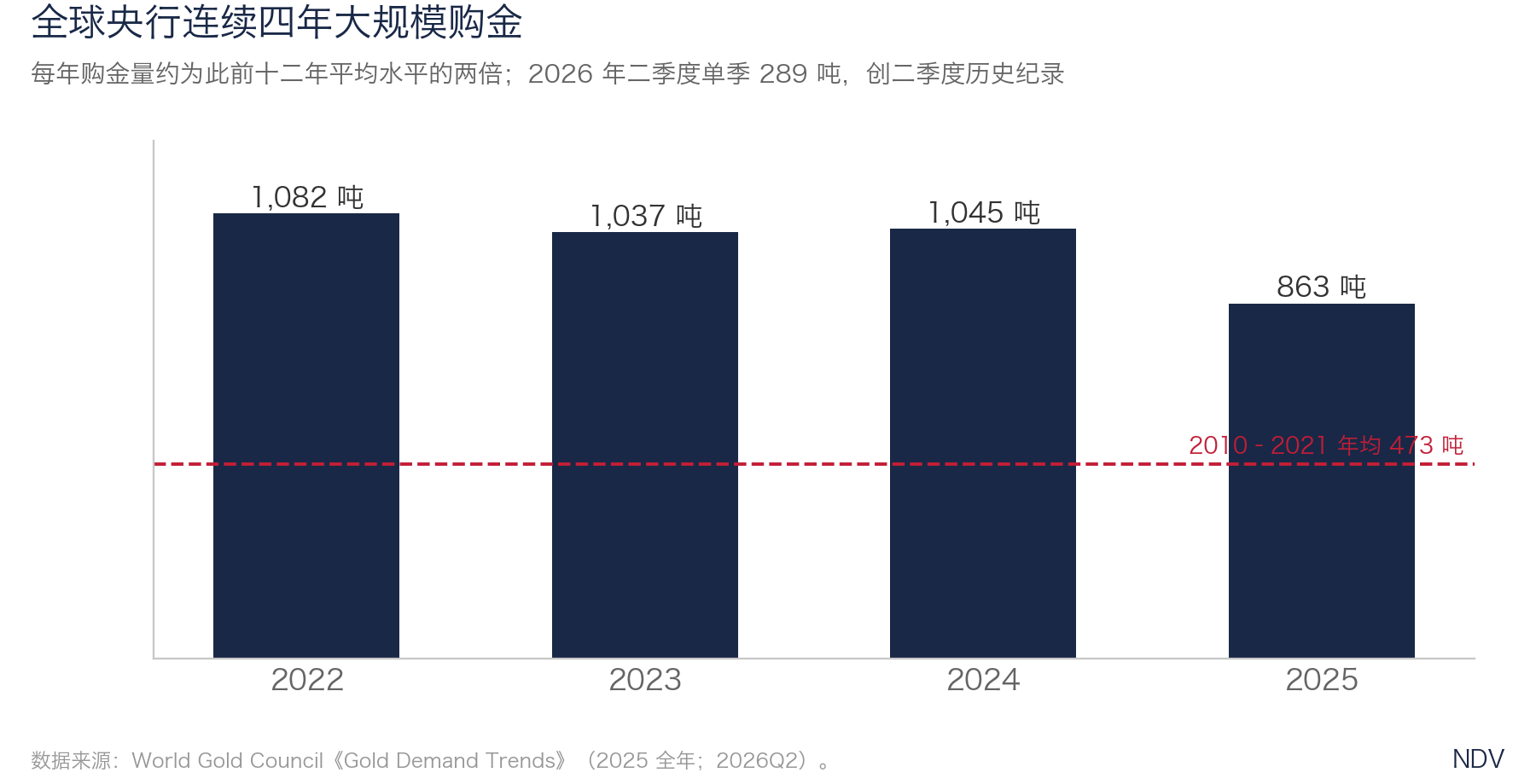
Since 2022, global central banks have bought gold for a scale of 850-1,100 tons annually for four consecutive years, about twice the average level of the previous twelve years; during the second quarter of 2026, as gold prices deeply corrected, central banks instead bought 289 tons in a single quarter, setting a historical record for the second quarter—buying more as prices drop.
The result is a historic seat change: according to a European Central Bank report in June 2026, gold accounted for 27% of global central bank reserves, exceeding US Treasuries (22%) for the first time in history, becoming the largest single reserve asset. 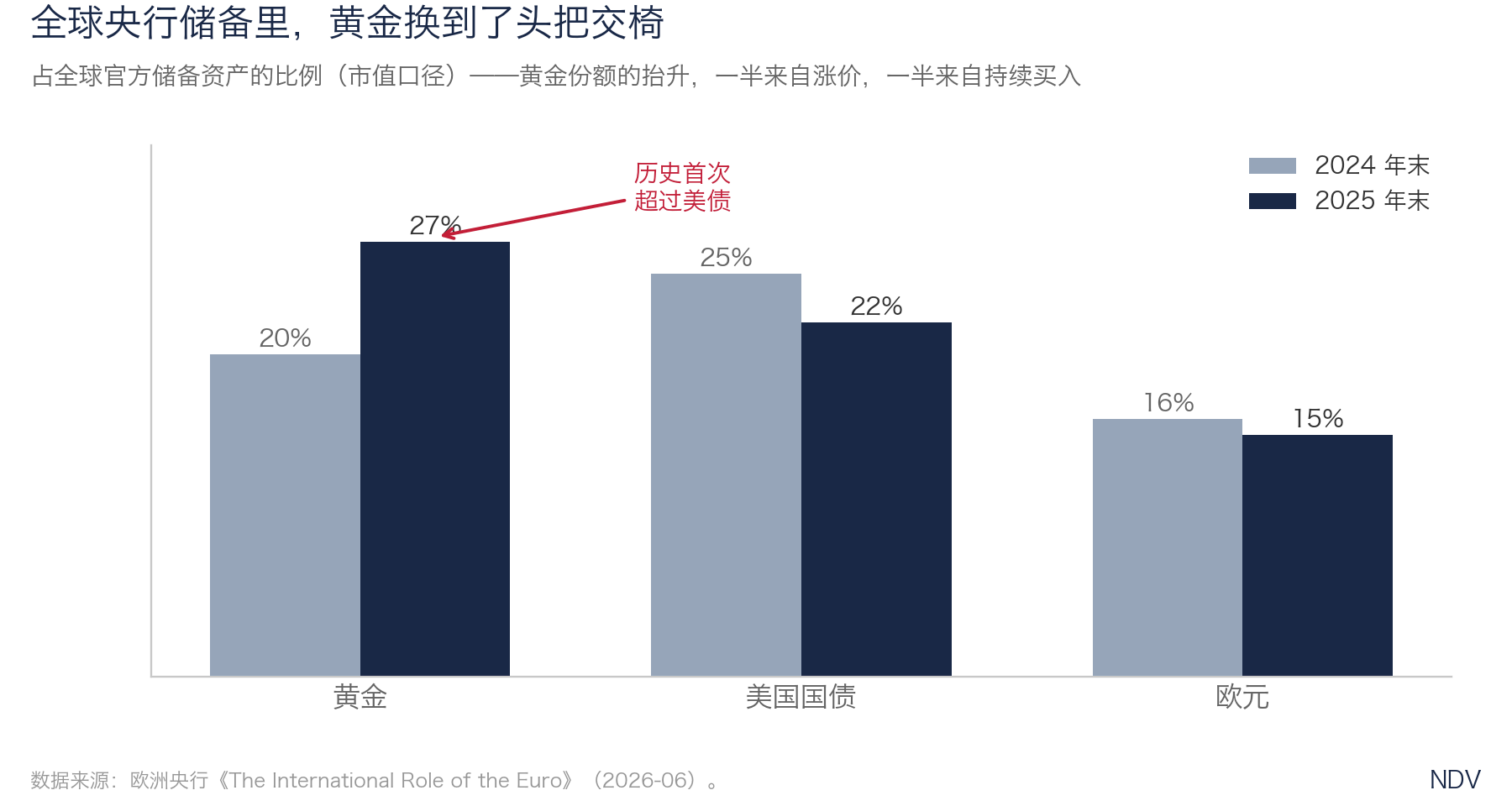
Note the weight of this narrative: gold has transformed from a "marginal hedge" in portfolios to the top seat of the official reserve system in less than five years—this is the complete process of an insurance transforming into a core asset, played out by global central banks in front of everyone. Gold prices annotate this: +27% in 2024, +65% in 2025 (the best since 1979), and in January 2026, hitting a historical high of about $5,590. The mechanism has also changed—the negative correlation between gold prices and US real interest rates, which lasted nearly two decades, expired after 2022, as marginal buyers transitioned from interest rate-focused Western funds to sovereign nations unconcerned with interest rates.
Gold tells this debt story, and its transformation has largely been completed.
6. Bitcoin: The Asset Halfway Down the Same Path
From early 2025 to today: gold has risen about +80%, while Bitcoin has fallen about -20%. The same story of currency devaluation, two pricing mechanisms, with an approximately 100 percent gap. The amount of gold that one Bitcoin can buy has compressed from over 30 ounces to about 16 ounces—marking the cheapest level of Bitcoin relative to gold on record. 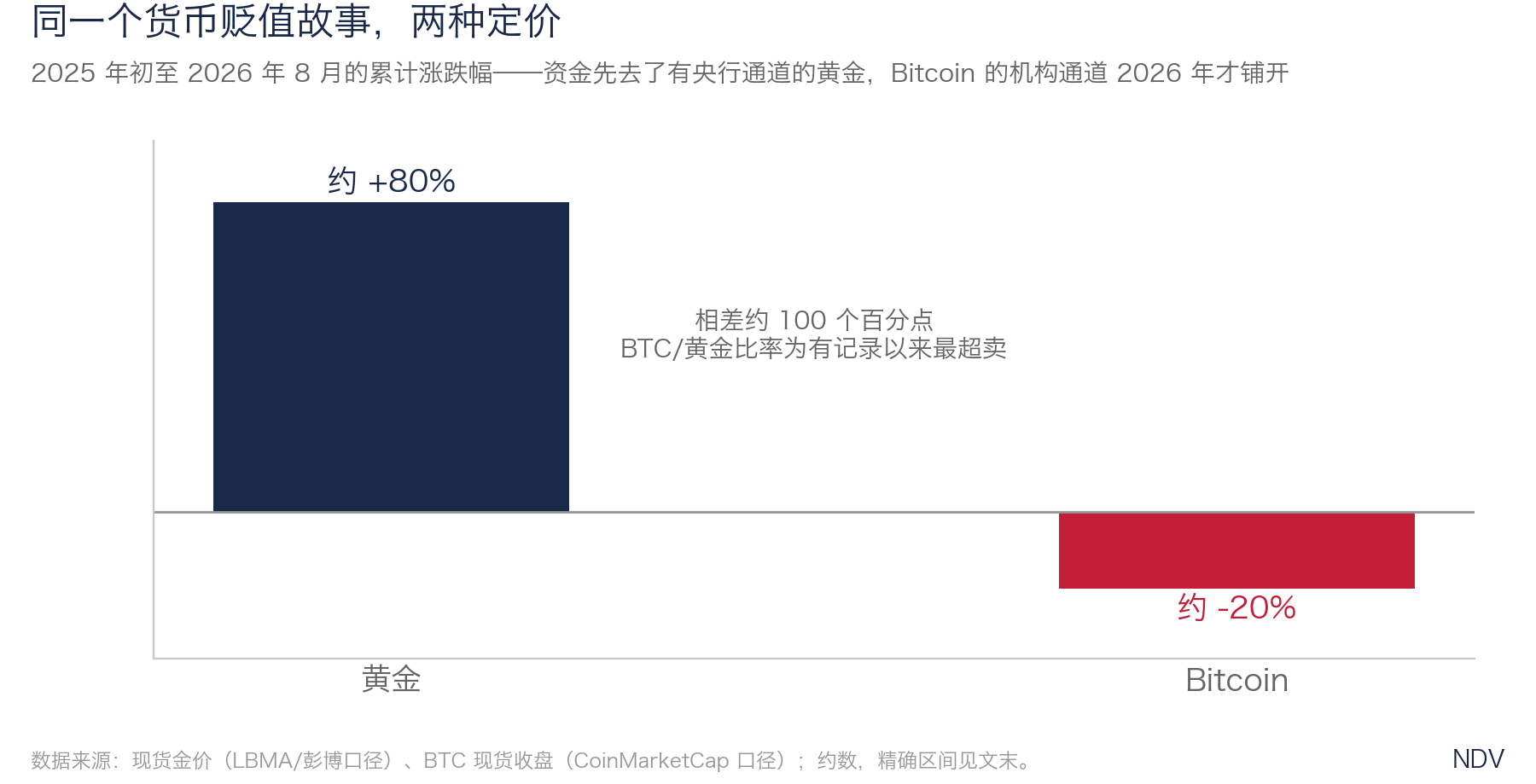
Some say the market has chosen gold and eliminated Bitcoin. History provides another version: from 2019 to 2020, gold reached a new high first (August 2020), while Bitcoin lagged by four to seven months before starting its rise, then surging higher with a larger margin. The reason is simple—central banks have smooth pathways to buy gold, while pathways for large funds to buy Bitcoin were only recently improved.
Three latest signals:
- Attributes are changing tracks: the 90-day correlation between Bitcoin and gold has risen above 0.5 (close to historical highs), while with Nasdaq it has dropped from over 60% to 33%—it is transitioning from "high volatility tech stocks" to "hedges against sovereign debt fears" (Grayscale, 2026-08);
- Funds are beginning to rotate: in August, Bitcoin rose by about 25%, the first positive August since 2021; in the last week of August, approximately $7 billion flowed into gold and Bitcoin funds, setting a single-week record;
- The catalyst comes directly from the debt story: the trigger for the August rally was precisely the Treasury’s actions to suppress yields and the White House’s statements regarding strategic reserves—transmission mechanisms are now connected.
7. Why This Withdrawal Is Not 2018, Nor 2022
After peaking in October 2025, Bitcoin saw a maximum drop of about 54%, with many treating it as yet another "crypto crash." The data does not support this: 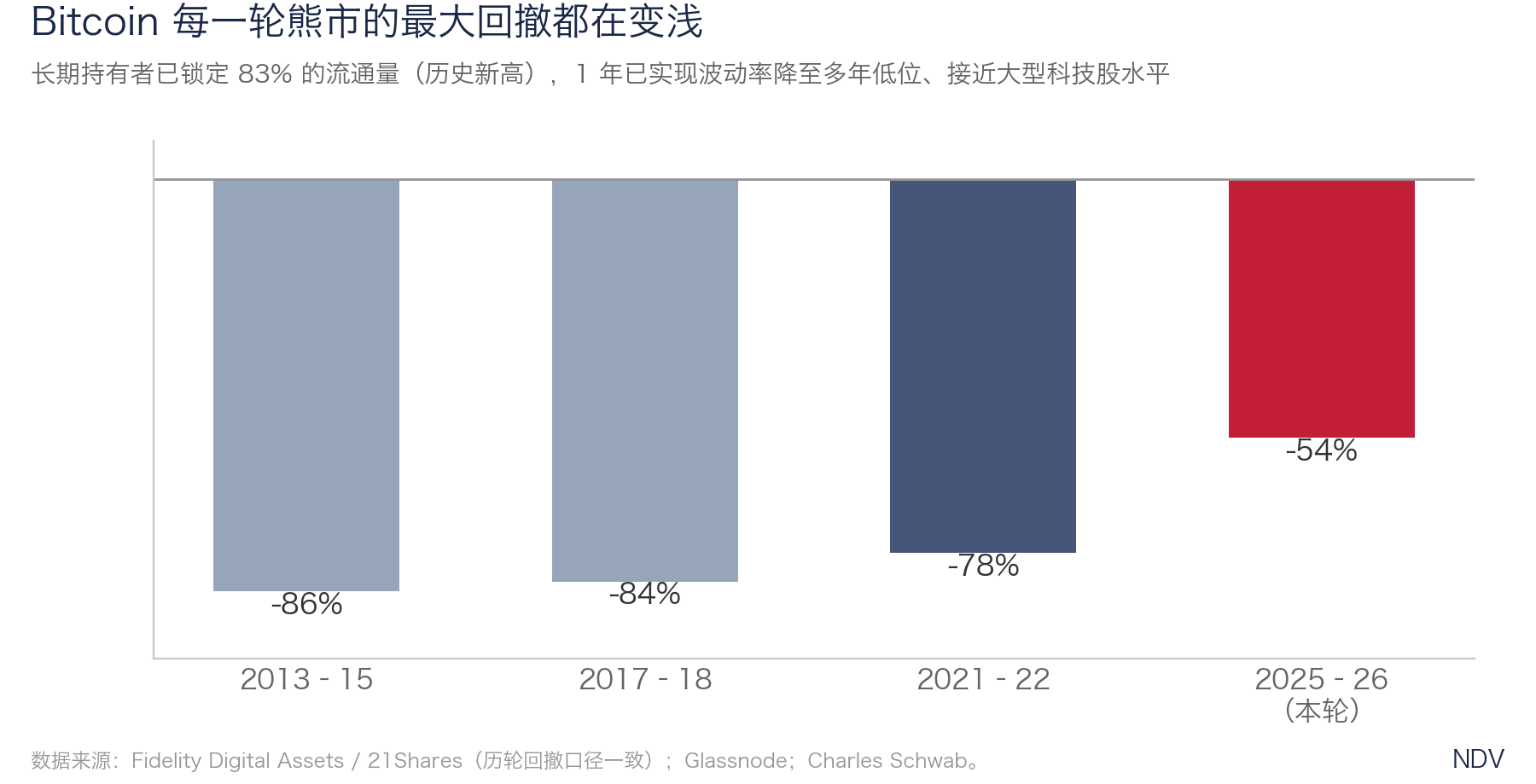
The maximum drawdowns in previous bear markets were -86%, -84%, -78%; this time, it was -54%—each time shallower. Long-term holders have locked in 83% of circulating supply (a historical high), and one-year realized volatility has decreased to multi-year lows, approaching levels of large tech stocks. The holder structure has changed, and the asset is maturing.
More importantly, during this year and a half of price declines, it happens to be the fastest year and a half in terms of institutional pipelines being improved: stablecoin federal legislation (GENIUS Act) is now effective; the market structure bill (CLARITY Act) is being voted on in the Senate in September; bank custody has received regulatory approval; executive orders have been signed to incorporate alternative assets into 401(k) plans; a framework for strategic reserves has been established. In the US, spot ETFs have seen a cumulative net inflow of about $55 billion, with just BlackRock’s IBIT holding about 777,000 coins.
Prices are declining, while pipelines are being improved—this is often the most worthwhile phase to do your homework during a cycle.
8. How Cheap Are the Premiums: An Arithmetic Problem, Backed by Heavyweight Endorsements
Bitcoin’s total market value is approximately $1.58 trillion, only 5% that of gold.
It does not need to "replace" gold—just capturing a fraction of gold’s market value leaves substantial room for growth (scenario analysis, not a prediction). The gap on the demand side is glaringly clear:
- BlackRock’s official white paper: a 1-2% allocation to Bitcoin in multi-asset portfolios is the "reasonable range," calling it a unique diversifier;
- Ray Dalio, founder of Bridgewater (July 2025): "For optimal risk-return portfolios, about 15% should be in gold or Bitcoin." He publicly stated he allocated about 1% and reaffirmed in August 2026: sell bonds, buy gold and Bitcoin, with the debt crisis window "three years, fluctuating two years";
- Paul Tudor Jones (April 2026): "Bitcoin is undoubtedly the best hedge against inflation—better than gold."
- Larry Fink, CEO of BlackRock, warned in his annual letter to investors: if the US cannot control its debt, the dollar's status as a reserve currency may be lost to digital assets like Bitcoin.
Yet in reality, global institutions’ actual allocations do not even reach a fraction of 1%—sovereign funds a few hundred million, elite university endowment funds around $100 million, most institutions are close to zero. The gap between "reasonable range" and "actual holdings" presents a structural buying opportunity in the coming years: the global institutional funds' pool is approximately $200 trillion, so reallocating even 1% would mean $2 trillion, exceeding Bitcoin’s current total market value.
There’s a precedent: when the gold ETF (GLD) was launched in 2004, it opened a compliant channel; subsequently, gold prices rose about 330% over the next seven years. Bitcoin's ETF was launched in January 2024. The same movie is currently about 30 minutes in. 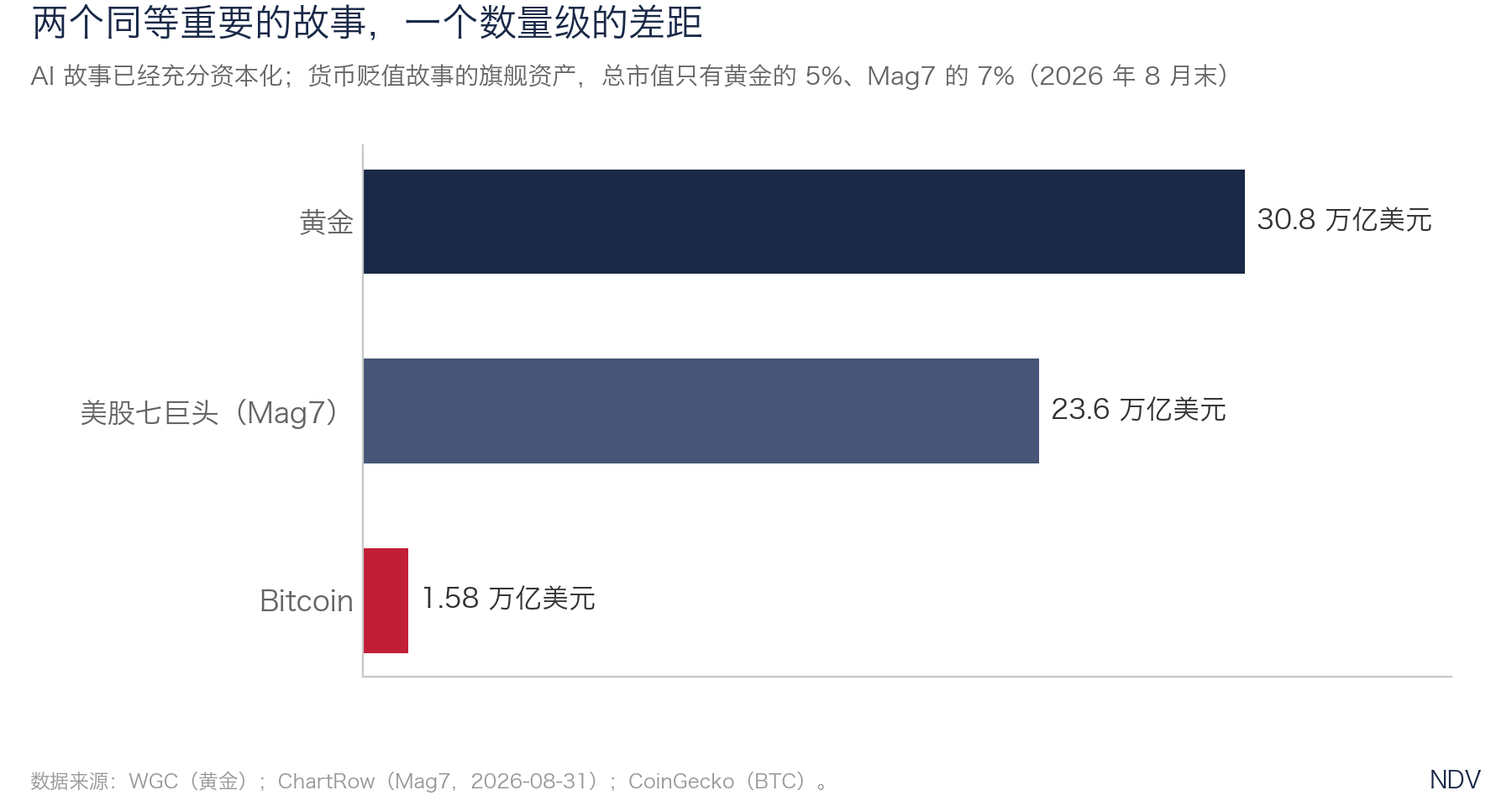
For the past two years, everyone has been discussing AI—we also agree that it is a decade-level productivity revolution. But looking at capitalization levels: the market capitalization of the seven tech giants rose by approximately $6 trillion over two years, and in 2026 alone, the top five cloud vendors' AI capital expenditure exceeds $800 billion; meanwhile, the equally important story of currency devaluation, supported by theoretical (an 80-year debt cycle), official data (CBO interest trajectory), and real monetary actions (central banks buying gold), has a total flagship asset market value of only $1.58 trillion. The two major trades this decade—one betting on productivity and one on the monetary system—are held in most people's portfolios only in the first bet. The asymmetry is not in viewpoints; it’s in positions.
9. Presenting the Counterarguments
Any worthwhile bet must first pass the counterargument test:
"The debt story has already been priced in by gold." It is possible. Thus, we write down a line of falsifiability: if gold continues to hit new highs while Bitcoin's ratio to gold breaks down further, it indicates the reasoning for the rebound was incorrect, warranting a disciplined exit.
"Bitcoin may continue to fall in the short term." Completely possible. Most sell-side analysts believe the bottom is around September-December 2026, with pessimistic scenarios predicting $40,000-$50,000. No one can time the market precisely—what one can do is confirm the cycle position, control downside risk, and hold exposure within the window.
"When a crisis does hit, Bitcoin will first fall along with risk assets." This is how it was in 2022. During the initial stage of liquidity shock, it fell as a risk asset; only in the second stage did it get repriced as a scarce asset—this is precisely why insurance also needs risk control and structure, rather than just "holding on is enough."
There’s one more hard truth to mention: these types of assets see normal fluctuations of 20% up and down in a month. The value of insurance is realized ten years later, with the cost being the bumps along the way. We have never managed volatility but rather the path and survival.
10. NDV: We Have Already Verified This Judgment with Three and a Half Years of Net Values
Having discussed the worldview, let me introduce ourselves. The story above is not new for NDV—it has been discussed since 2023, where we used two fund periods, traversing a full cycle of bull and bear with net value curves to verify its tradability.
NDV (NextGen Digital Venture) was established in 2023 as a global macro hedge fund operating under compliant frameworks in Singapore: we only buy stocks and ETFs listed in the US (including spot Bitcoin ETFs and their options), do not hold tokens directly, and the fund contract specifies a zero-leverage constraint. We view Bitcoin as the anchor asset of this era, expressing it with tools and discipline from traditional finance.
The track record of the first fund (March 2023–February 2025, now liquidated) is public information: founded in the market lows following the FTX crash, with Bitcoin at $30,000 at inception, it achieved a cumulative return of about +275% over 23 months, turning $1 into $3.75, exceeding Bitcoin's performance in the same period by about 67 percentage points, and exited in an orderly manner at the top range. The data can be found in official NDV announcements, and performance sequences are available for query on Bloomberg Terminal (code LSQNEXI), as well as in related public company announcements. 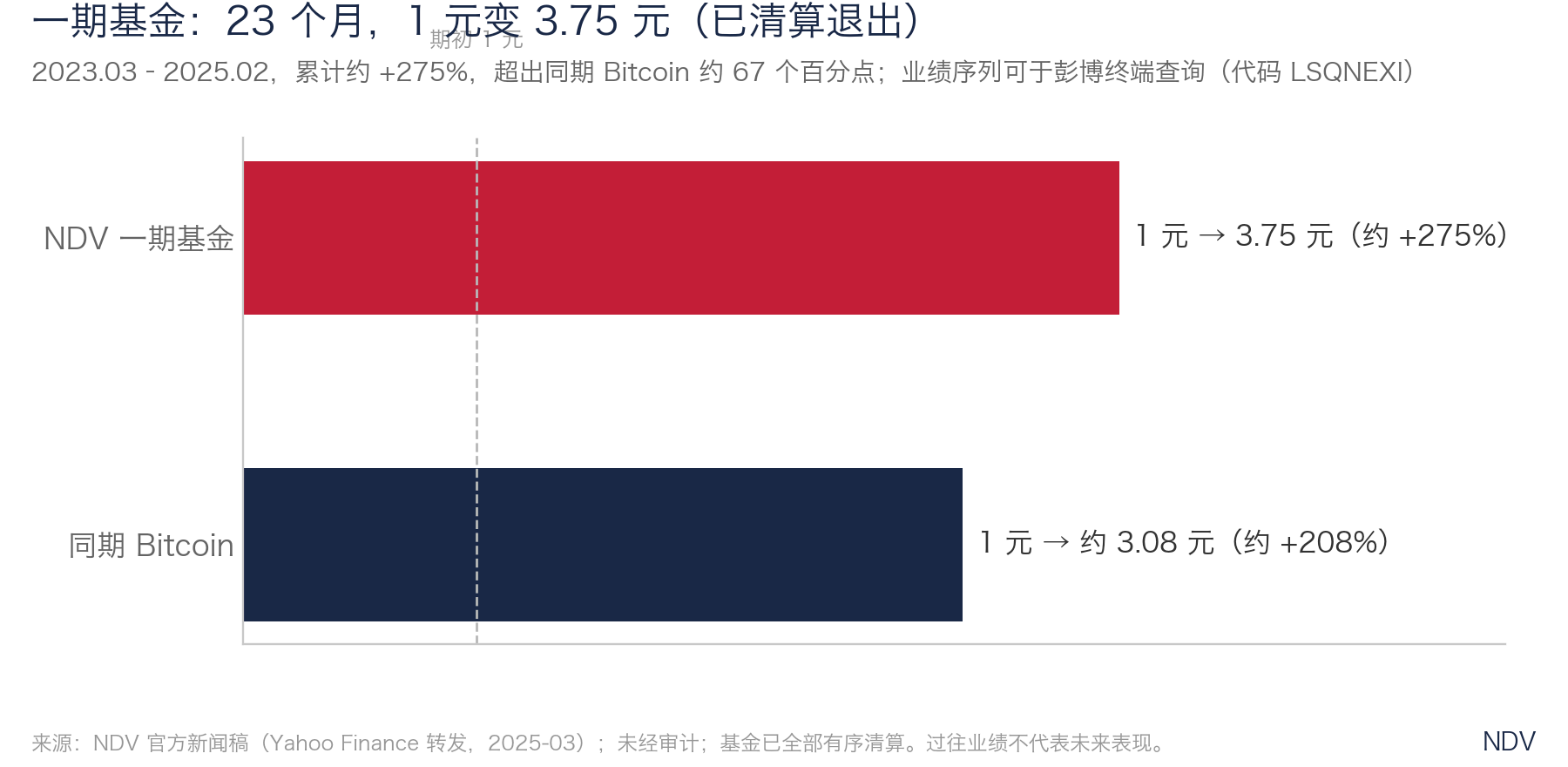
The second fund launched in May 2025, targeting Bitcoin as a performance benchmark—we set our evaluation not on "catching up when prices rise," but on outperforming Bitcoin itself over a complete cycle. After three and a half years, the key numbers from this examination are as follows (the second fund numbers are internal estimates, not audited, with August 2026 as the preliminary value*, ultimately subject to the manager's report):
- Through the full bull and bear cycle: starting from $1 continuous investment in March 2023, by the end of August 2026, approximately $4.4*; during the same period, Bitcoin was around $2.9*, Nasdaq about $2.6*, gold around $2.4*—both in bullish, bearish, and sideways markets, it outperformed the benchmark;
- In the year when Bitcoin fell: by the end of August 2026, the fund recorded above 40%* positive returns, while Bitcoin was down about -10%;
- Drawdown discipline: over three and a half years, the fund’s net value drawdown only entered double digits twice (about -16% for the first fund, deepest about -27% during the transition period of the second fund, on a monthly net value basis), while Bitcoin’s maximum drawdown was -54%—the fund’s maximum drawdown is about half that of the benchmark.
The source of outperformance is not luck, but rather discipline and the unity of knowledge and action. Our judgment records are public and timestamped:
- In December 2025, we wrote in our monthly letter, "the opportunity cost of cash has changed," and drastically reduced positions to move to defense—subsequently, Bitcoin saw its steepest drop of one-third in the first half of 2026;
- In April 2026, we overshot the assessment of Middle Eastern geopolitical risks, missing that rebound—the error was documented in that month’s letter;
- In June 2026, we wrote, "Bitcoin is likely to touch the bottom of this cycle within the next 3-6 months; the task is to retain ammunition to complete the position building"—June 30 became the lowest point of the year.
We are not always right, but every judgment—correct or incorrect—is documented in writing. And one very real fact: the manager is the largest single investor in the fund—if judgments are wrong, we are the ones who bear the largest losses first.
As for how to turn a ten-year judgment into a specific portfolio—what tools to use, what prices to target, and how to exit mistakes—details are not suitable for public articles. If you have plans to allocate digital assets, meet qualified investor standards, and comply with all applicable investment laws and regulations in your country or region, and wish to learn more about the NDV fund, please feel free to reach out. The public version of everyday judgments is continuously updated in the podcast "20 Minutes of Non-Consensus" and this account.
免责声明:本文章仅代表作者个人观点,不代表本平台的立场和观点。本文章仅供信息分享,不构成对任何人的任何投资建议。用户与作者之间的任何争议,与本平台无关。如网页中刊载的文章或图片涉及侵权,请提供相关的权利证明和身份证明发送邮件到support@aicoin.com,本平台相关工作人员将会进行核查。


