Written by: Rita
Capital expenditures for data centers from hyper-scale vendors are expected to reach $1.5 trillion in 2027, up 60% year-on-year, with growth slowing to 12% in 2028. On September 4, Morgan Stanley released an AI guidance report, spanning 7 teams and focusing on 8 key debates. The report noted that AI is transitioning from the training era to the inference era, with investor funding gradually shifting from hardware and semiconductor layers to the enabling and software layers. GenAI enablers such as AMZN, META, GOOGL, and MSFT will benefit from upward earnings revisions and valuation expansions.
Morgan Stanley expects AI computing capacity to grow from 35 gigawatts in 2025 to about 145 gigawatts in 2028, a fourfold increase. The share of custom chips in incremental capacity will rise from 34% to 66%, with Google TPU and Amazon Trainium leading this transition. In terms of AI investment returns, Morgan Stanley outlined three pathways, all pointing to a range of 25% to 50%, with the highest returns coming from operating API at the model layer on owned infrastructure.
Capital Expenditure Slows in 2028, Funds Will Shift Upstream
Capital expenditures for data centers from hyper-scale vendors are expected to grow by 60% to $1.5 trillion in 2027, with growth slowing to 12% in 2028 (about $170 billion). Reasons for the slowdown include chip supply limits, diminishing marginal returns from pre-built capacity, and physical constraints (labor, materials, electricity).
Morgan Stanley estimated the capital expenditure composition for four cloud vendors. Amazon's capital expenditure for data centers in 2026 is about $180 billion, with about 38% for forward-built capacity, to be operational from 2027 to 2029. Microsoft's is about 37%, Meta's about 32%, and Google's only about 5%. Given Google's lowest pre-built ratio, it will need to significantly increase its forward investments in 2027.
Morgan Stanley pointed out that the slowdown in capital expenditure growth, combined with the continued expansion of revenue and cash flow for hyper-scale vendors, will drive investor funds to migrate from hardware and semiconductor layers to the enabling and software layers. This aligns with the capital flow pattern observed in the mobile era, where chips and devices rise first, followed by infrastructure and equipment, and finally software and services.
145 Gigawatts of Computing Power Comes Online, Proportion of ASIC Increases Significantly
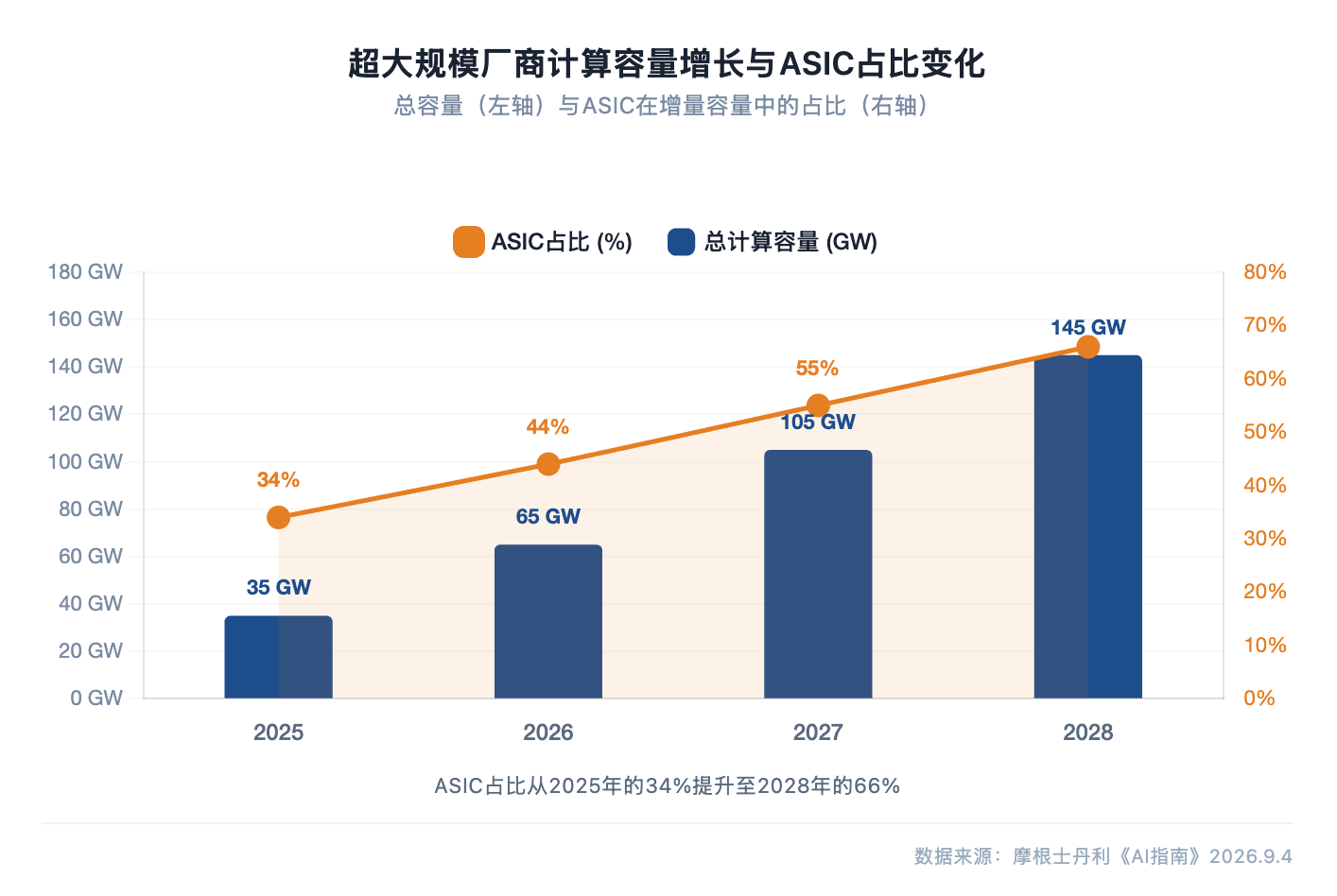
Morgan Stanley predicts total computing capacity will grow from 35 gigawatts in 2025 to about 145 gigawatts in 2028, with approximately 38 gigawatts added in 2027 and around 44 gigawatts in 2028. Google is the vendor adding the most capacity, with a total of about 20 gigawatts added between 2027 and 2028, mainly serving Gemini training, GCP growth, and the deployment of GenAI functionalities for search and YouTube.
The share of custom chips in incremental capacity will increase from 34% (about 2 gigawatts) in 2025 to 66% (about 17 gigawatts) in 2028. Google TPU and Amazon Trainium are spearheading this transition, with Google TPU expected to add about 15 gigawatts in 2027 and 2028. More than 50% of Google's additional capacity will be used for Google Cloud, while Amazon Trainium has already begun pre-selling capacity for the next one to two years.
Morgan Stanley's cost estimate per gigawatt has taken into account memory inflation for GB200/GB300/VR200 racks and rising outside-rack costs (power facilities, construction, etc.). The total cost for the Rubin Ultra generation has reached about $50 billion per gigawatt.
GenAI Investment Returns of 25% to 50%, Highest Returns from Model Layer
Morgan Stanley built three frameworks to estimate GenAI investment returns, all falling within the range of 25% to 50%.
Framework one involves hyper-scale vendors renting GPU capacity. Taking a 1 gigawatt GB300 data center as an example, annual revenue is about $19 to $27 billion, operating costs about $8 billion (including $4.6 billion in IT depreciation), with incremental EBIT margins of 60% to 72%, and after-tax net operating profits of around $9 to $15 billion, yielding a return on investment of 23% to 39%.
Framework two involves model developers providing APIs on their owned infrastructure. Annual revenue is about $30 billion, operating costs about $8 billion, with an incremental EBIT margin of about 75%, yielding after-tax net operating profits of around $18 billion and an investment return of about 46%.
Framework three involves model developers providing APIs on third-party infrastructure. Annual revenue is about $41 billion, with about $28 billion paid in computing power rent, yielding after-tax net operating profits of around $10 billion and an investment return of about 25%.
Morgan Stanley believes that the highest returns come from running APIs at the model layer on owned infrastructure, with META, Google, and SpaceX having advantages in this model.
Knowledge Work Total Addressable Market of About $20 to $30 Trillion
Morgan Stanley estimates the total addressable market for global knowledge work to be about $22.5 trillion (based on 25% of the 3.6 billion global employment population being knowledge workers, with an average annual salary of about $25,200), with the portion that can be digitized and enhanced by GenAI tools amounting to approximately $20 to $30 trillion. On the consumer side, the digital space in areas such as retail, travel, transportation, food delivery, and advertising is about $30 trillion.
Based on Morgan Stanley's estimated $22.5 trillion knowledge work market, even achieving only a 4% penetration rate by 2027 (referencing the second year of public cloud adoption curves) would imply about $800 billion in enterprise AI spending. The pace of AI diffusion is expected to be faster than that of public clouds, due to factors including no need for large-scale infrastructure migration, shorter value realization times, and stronger competitive urgency.
On the consumer side, about 25% of the U.S. population is already using AI tools in daily life. Morgan Stanley referenced Facebook's adoption curve, which covered about 45% of the North American population within 8 years of the product's release.
Adoption Signals Have Spread Across Industries
About 25% of S&P 500 companies quantified the returns from GenAI in their Q2 2026 earnings reports, up from 14% a year earlier. The technology sector had the highest mention rate (51%), followed by finance (37%), healthcare, and industrial (around 20% each).
The returns for tech companies are reflected in both revenue and efficiency. Amazon advertisers experienced an 8% reduction in cost per impression and a 6% reduction in conversion costs after using AI proxies for targeting. Meta's GEM model and sequential learning improved Facebook ad click-through rates by 8.3% and conversion rates by 15.7%. Almost 100% of Uber's engineers use AI coding tools, doubling their code output. Snap's internal AI code review tool covers 90% of pull requests, saving about 30,000 hours of code review time.
The finance, industrial, and healthcare sectors are also quantifying their returns.
Disclaimer
This article is a compilation and interpretation of the third-party brokerage report (Morgan Stanley, September 4, 2026) by Tide Research, combined with publicly available market information. The ratings, target prices, earnings forecasts, and related judgments quoted in this article are the views of the analysts at that brokerage and only represent the stance of their respective institutions, not the views of Tide Research, and do not constitute any investment advice.
The market has risks, and decisions must be made independently. This article should not be used as the basis for buying or selling any securities.
免责声明:本文章仅代表作者个人观点,不代表本平台的立场和观点。本文章仅供信息分享,不构成对任何人的任何投资建议。用户与作者之间的任何争议,与本平台无关。如网页中刊载的文章或图片涉及侵权,请提供相关的权利证明和身份证明发送邮件到support@aicoin.com,本平台相关工作人员将会进行核查。


