
Author: danny
On September 8, 2026, in the afternoon in Asia, Americans had just finished Labor Day, and the Nasdaq had not yet opened. The last official transaction of CEA Industries' stock BNC was still last Friday. On the other hand, in cryptocurrency exchanges like Binance, Bitget, and Bybit, BNC had been trading all weekend. The BNC perpetual price captured by PerpEquities at that time was approximately $4.56, which was 35.5% higher than the closing price before the US stock market closed. In the past 24 hours, the total trading volume of perp across the network was about $71.5 million, and if the exchange’s self-reported data is summed, it has exceeded $200 million; meanwhile, the trading volume of the underlying BNC was only about $2.8 million.
In other words, during this time window, the trading volume of BNC perp was about 25 times that of the underlying stock.
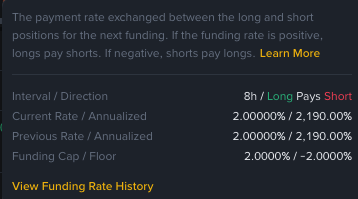
Also worth mentioning is the Open Interest (OI) of the unclosed positions. At that time, the cumulative open contracts for BNC perpetual were about $88 million, which was more than half of its circulating stock value. In just the past 24 hours (on September 8), Binance alone had done about $33.2 million in BNC perp. Funding was also pushed to extreme levels, with BNC funding on Binance reaching the ceiling of +2% every eight hours.
This is not a large stock. At that time, BNC's market value was just over $100 million. In SEC filings, CEA disclosed that as of the end of April this year, the company held 515,544 BNB, with a fair value of about $317 million. It has shifted from being an environmental control equipment company to becoming a BNB treasury company.
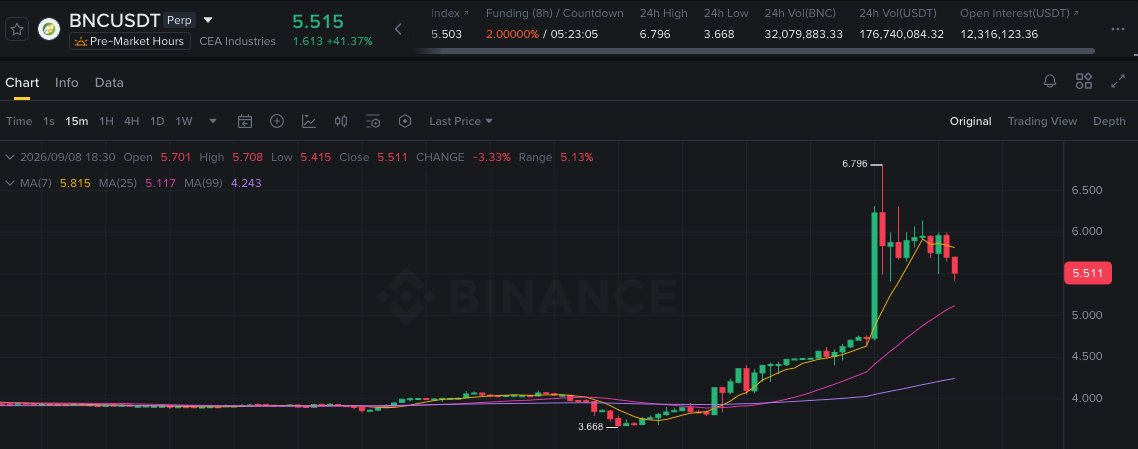
This resulted in a scene rarely seen in US stocks: a Nasdaq company with a market value of more than $100 million had an all-weather derivatives market of nearly $100 million in OI set up outside while the stock exchange was closed. There are long and short positions, leverage, liquidation, funding rates, market makers, and all of this does not require CEA to issue a single additional share of stock.
If one only sees it as the cryptocurrency space having a new contract, one would miss the truly important point. BNC perp is not just adding a product to the stock; it is creating a second capital market for this company.
Small-cap stocks lack not stories, but casinos
Apple does not need stock perp to solve liquidity problems. Nvidia does not need it either. They have spot trading, pre-and post-market trading, mature options, ETFs, securities lending, prime brokers, and institutional OTC markets. For these companies, stock perp can be noisy, but more often, it's just a tributary in the periphery.
This is not true for small-cap stocks. A company might only have a market value of a billion, five hundred million, or even a hundred million, but it hits upon stories like AI, drones, quantum computing, nuclear power, space, crypto treasury, and biotech. Social media discusses these topics enthusiastically every day, yet when it comes to the market, the tools available are few. The stock order book is not deep enough, and pre-and post-market trading is thinner; options may exist, but far-months have no depth, and many strikes have significant spreads; if one wants to short directly, they have to deal with locating, borrowing availability, and borrow fees. By the time Friday night arrives and a company releases an announcement, the US stock exchange can only tell you: see you on Monday.
There is a significant mismatch here: the demand for information is 24 hours, speculative demand is global, yet traditional small-cap stock infrastructure is still built according to the size of the US stock market.
Perpetual futures perfectly fill this gap. They do not require designing dozens of strikes, nor are there monthly expiration issues. As long as the exchange resolves index, oracle, margin, funding, liquidation, and market making, it can establish a unified long/short market for a company. Users can use USDT or USDC as collateral without needing to have a dollar securities account beforehand; if they want to short, they do not need to locate the stock themselves; when Asian markets see news at night, they do not need to wait for New York to open.
For Apple, this is merely an additional tool. But for a small stock that lacks mature options, lending, and a global institutional market-making system, it might directly fill out an entire layer of financial market that did not exist before.
Not all small-cap stocks will turn into BNC
Of course, not just anyone or any random small stock can become a guest of the stock perp. This requires specific conditions under particular circumstances.
Ondas Holdings, or ONDS, is a good counterexample. It possesses many elements that crypto traders like: drones, automation, defense, critical infrastructure, a compelling story, and significant price volatility. In the second quarter of 2026, the company’s revenue surged from $6.27 million in the same period last year to $83.77 million, while half-year revenue grew from about $10.52 million to $133.9 million.

Crypto exchanges certainly did not overlook it. ONDS perp has already spread across more than ten trading venues, including Binance, Bybit, Bitget, OKX, and more. However, as of the afternoon of September 8, PerpEquities recorded that ONDS perp had a 24-hour trading volume of only about $2.14 million, with OI around $2.89 million; during the same period, the underlying stock's trading volume was about $330 million. The perp/spot volume was only about 0.01 times, and OI accounted for a very low portion of the circulating market value.
The reason is not complicated. ONDS’s traditional market is not as barren as BNC. Its own stock trading was already quite active, and there were options with scale. While crypto can replicate the ONDS ticker, it hasn’t solved a problem that a traditional market could not.
Applied Optoelectronics (AAOI) is similar. It is a typical high-beta stock in the AI optical communication industry. In the second quarter of this year, revenues reached $191.9 million, up from $103 million in the same period last year; shipments of 800G products more than doubled quarter-over-quarter, and demand is expected to continue exceeding capacity until mid-2027. AI, data centers, optical modules, high growth, and high volatility: it encompasses almost all the elements that crypto traders favor.
Thus, Bitget, OKX, Binance, and Bybit quickly launched AAOI perp. Now, AAOI perp is already distributed across more than twenty crypto venues. However, on September 8, AAOI perp had a 24-hour trading volume of about $42.7 million, with OI around $28.7 million, while its underlying stock's trading volume reached approximately $736 million. The perp/spot was only about 0.06 times.
Why? Again, it is because traditional finance has not been absent. AAOI itself has an active spot and options market, with tens of thousands of option open interest in a single expiration month. For such stocks, crypto isn’t filling a gap; it is merely setting up another table beside a mature market.
This delineates a boundary for stock perp's future: the less traditional finance is willing to construct derivative infrastructure for a particular stock, the greater perp's value becomes; for stocks where traditional finance has already laid out options, borrowing, ETFs, and market-making networks, perp can only rely on 24/7 access, stablecoin collateral, and the crypto user base to capture peripheral trading volume.
FWDI is where two worlds really start to connect
Forward Industries’ FWDI is particularly interesting because its balance sheet is itself engaged in DeFi.

Forward was once a small hardware company but later transformed itself into a Solana treasury company. As of August 3, 2026, the company held approximately 7.807 million SOL and SOL equivalents, amounting to about 1.3% of Solana's circulating supply. It is not just buying coins to hold; the company operates a validator and has cooperated with Sanctum to develop the liquid staking token—fwdSOL, with a clear plan to stake SOL, deploy assets into DeFi protocols for earnings, lend SOL, use SOL as collateral for loans, and reinvest in the Solana ecosystem.
By the end of June this year, the company already had over 3 million SOL or fwdSOL collateralized with Galaxy, with a loan balance exceeding 100 million dollars, and additionally had on-chain debt. The company has also engaged in SOL lending and OTC options. In other words, it is not merely a “public company that bought crypto,” but rather integrating the treasury of a public company, staking, lending, collateral, and derivatives all into the same balance sheet.
Thus, the emergence of stock perp for FWDI is almost a natural progression. Binance simultaneously launched BNCUSDT and FWDIUSDT on July 9. Currently, FWDI perp's OI is about $60 million, representing several percentage points of its circulating stock value. Its perp trading volume has not yet exceeded that of the underlying stock, but the peripheral derivative exposure has already reached a level that cannot be underestimated.
Comparing BNC, FWDI, ONDS, and AAOI makes this story even more interesting.
AAOI is still predominantly influenced by the traditional stock market; ONDS has a compelling narrative, but TradFi is already active enough; FWDI has accumulated significant peripheral derivative exposure; and BNC, during certain time windows, exhibits perp trading, OI, and price discovery more akin to being the main market than the underlying stock.
The real determinant of whether perp has a chance is not the size of the company but how big the gap between speculative demand and traditional financial supply is.
What perp truly creates is additional risk capacity
The float of a share is limited. The number of shares a company has in circulation is what is available in the market. To increase the number of shares, a company must issue more; to short shares, there usually needs to be someone willing to lend you shares.
Perp is not constrained by this "physical quantity" of stocks. Suppose a company has a circulating market value of 200 million dollars, the perpetual market can completely generate 50 million, 100 million, or even several hundred million dollars in open interest. As long as long and short positions are willing to come in, and the liquidation system is ready to take on those positions, new economic exposure can continue to increase.
This should not be simply stated as "OI equals synthetic shares," because each perp simultaneously has both long and short positions, and whether market makers eventually hedge in the stock market and how much they hedge also depends on the specific market structure. However, perp indeed creates something: additional risk capacity.
A company with only a 100 million dollar stock float can have a derivatives position pool exceeding 50 million or even over 100 million dollars. Market participants do not need to fight over that small handful of physical stocks, nor do they have to wait for the company to issue more shares; they can continue to express their views.
Therefore, in the future, when studying such stocks, the short interest/floating metric will no longer suffice. Research institutions will need to add an additional indicator: Perp OI / Equity Float.
BNC exceeds 50%, FWDI is in the double digits percentage, while AAOI and ONDS are both below 1%. These figures together can give a rough outline of which stocks' peripheral markets have truly grown.
Why OI is money, and why funding is a weapon
OI itself is not revenue. BNC having 88 million dollars OI does not mean Binance received 88 million dollars. However, OI can be a continuously realizable inventory.
When stock investors buy shares worth one million dollars and then leave them untouched for a year, the exchange only collects fees at the time of the transaction. Perp positions are not the same. Some continuously increase positions, decrease positions, close them, or get liquidated, while others change direction due to high funding, and market makers must hedge repeatedly. As long as OI remains in the market, fees and spreads will continue to be generated.
Thus, for exchanges, market deployers, and market makers, OI is closely related to the future trading activity stock. Hyperliquid’s HIP-3 has further productized this; market deployers can create their own perpetual markets and obtain fee shares from trading activities. The exchanges which used to operate "securities markets" are now allowing protocols to enable third parties to manage "markets for specific tickers."
Funding, on another layer, adds dimension. The most interesting part of BNC this time was that longs were once so crowded that Binance funding jumped to +2% every eight hours. Traditional stocks tell you "how much this company is worth," while perp adds another question: "How much does it cost to hold this view now?" (For extreme cases: https://x.com/agintender/status/1954160744678699396?s=20)
This is where funding serves as a weapon, becoming a reason for the next generation of financial battlegrounds. A short trader may not believe BNC should plummet; they might just feel that bulls are willing to pay such high funding, making it worthwhile to stand on the other side. A vault can also develop a market-neutral strategy surrounding spot, tokenized stock, perp, and funding.
Stock markets previously had dividend yield, borrow fee, and option premium. Now there’s also funding yield.
Let the games get fiercer~
Once a stock enters the chain, it no longer has just one form
This is also the biggest distinction between stock perp and traditional CFDs. CFDs can also go long, short, and leverage, but ultimately they remain a contract within a broker database. Crypto assets will continue to connect outward.
Tokenized stocks can enter wallets, serve as collateral, enter lending markets, be used in LPs, and be hedged with perps. xStocks has now covered hundreds of tokenized stocks and ETFs and entered several DeFi scenarios. Protocols like Kamino have also established lending markets around tokenized stocks.
At this stage, the financial structure of a ticker starts to change. Stocks are available on Nasdaq, traditional markets have options, Binance, OKX, and Bybit have perps, and there are also tokenized stocks on-chain. A market maker can hold tokenized stock and short perp; users can use tokenized stocks as collateral to borrow stablecoins and continue to increase exposure; protocols can build vaults around funding.
Then there's the meme. What crypto is best at is not just inventing assets but also turning attention into a layer of liquidity. Once a company possesses a ticker, a story, a community, perp, tokenized assets, and on-chain liquidity all at once, it’s not difficult to imagine memes, prediction markets, points, and various vaults being generated around it.
Companies that previously only had a stock code have learned to transform with the wings of crypto.
FWDI is already telling you that the company may also join this Lego
Forward Industries is worth keeping an eye on because it did not wait for others to do DeFi for it.
It issues fwdSOL on its own, runs validators, stakes, uses assets as collateral, borrows money, writes SOL options, and even uses borrowed funds to repurchase stocks. When explaining such operations, the focus is not just on traditional EPS but also on SOL per share.
This forms a new closed-loop. Stock prices influence financing capabilities; financing can be used to increase crypto treasury; treasury generates returns through staking; LST can continue to be collateralized; collateral can generate new financing; the company uses financing to repurchase stocks, reducing share count; the market recalculates each share’s crypto asset exposure; meanwhile, outside there’s also FWDI perpetual futures, allowing more people without ownership of the stock to trade within this cycle.
This is no longer merely a "public company buying coins," but closer to a public company beginning to utilize a DeFi balance sheet language.
So the companies most suitable for stock perp in the future are likely not random small-cap stocks but rather those whose business models are tightly connected with on-chain assets. Crypto treasury stocks are among the first batch, followed by potential sectors like AI compute, DePIN, RWA, and even some energy companies.
Without needing to issue an additional share, a ticker can be monetized repeatedly
This will lead to an important change: perp can allow the market to create vast economic exposures around a company without requiring the company to issue additional shares.
To utilize market enthusiasm for financing, traditional public companies mostly rely on ATMs, secondary offerings, convertibles, or warrants, ultimately circling back to share supply. Perp separates speculation from issuance. A company with only a 200 million dollar float can have derivative gross exposure of 200 million, 500 million, or even larger amounts externally. This market can turn over numerous times a day, generating fees, funding, spreads, and liquidation activities, without requiring its transfer agent to lift a finger.
So the phrase “undiluted harvest” is half true, but who is harvesting needs to be clarified. If the company has no relation to perp, then regardless of how much trading occurs outside, the company itself will not automatically receive funds. The ones profiting are exchanges, market makers, deployers, arbitrageurs, LPs, and funding receivers.
What is truly worth imagining is the next step. If issuers, tokenization providers, market deployers, oracle providers, and DeFi protocols begin to establish commercial relationships, then the ticker itself may transform into an asset that can be continuously authorized, distributed, and managed. By then, public companies can profit from attention without necessarily having to rely on issuance every time.
This is the true impact of "non-dilution."
The biggest regulatory vacuum is not the absence of laws, but rather that products have run into the classifications between laws
It is incorrect to say that there is no regulation for stock perp. The US has long had rules surrounding single-stock derivatives, including security-based swaps, which have high thresholds for ordinary retail investors.
The real issue is that after layering perpetuals, offshore exchanges, tokenized stocks, stablecoin collaterals, and DeFi lending together, traditional classifications begin to become cumbersome. Past regulatory habits would ask: is this a security, a future, or a swap? Crypto products may now simultaneously encompass a tokenized stock collateral, a perpetual hedge, a stablecoin margin account, along with a DeFi lending position.
In 2026, the SEC and CFTC started to revisit the boundaries of swaps, security-based swaps, and perpetual contracts. This indicates that regulation is not blank; it is catching up with the products.
Thus, the more accurate current statement is not "there are no rules," but rather, there exists an arbitrage among jurisdiction, product classification, and distribution channel. With BNC, US retail investors are purchasing Nasdaq shares through securities accounts, while crypto users outside the US might be trading BNCUSDT perpetual. The company has not issued additional shares, yet the legal relations on both sides are entirely different.
Moreover, it is noteworthy that companies do not even need to actively "issue" this perpetual like a Nasdaq listing. Trading venues can create new markets around its ticker without the company itself necessarily being a party to the contract.
This is a significant shift in traditional corporate finance.
Tax avoidance?! But accurately speaking, it is a change in the tax path
Taxation cannot simply be described as exempting perp from taxes. More accurately, cash-settled derivatives can avoid certain transaction taxes associated with the transfer of stock ownership in some jurisdictions.
Britain is a clear example of this. The establishment and closure of CFDs do not involve the buying and selling of stocks, thus generally do not incur Stamp Duty or Stamp Duty Reserve Tax. Certain cash-settled futures may receive similar treatment.
However, this does not mean that profits are tax-free. The US has Section 871(m) and other rules targeting equity derivatives, while different countries have varying treatments of derivative gains, crypto settlements, and stablecoins.
Therefore, what perp truly changes is the entry point for taxes. Traditional stocks bind trading, custody, ownership, settlement, dividends, and taxes together; stock perp removes ownership, leaving a cash-settled price contract. Taxes and operational friction related to stock transfers may decrease, but funds will enter another set of derivative taxation.
As for how tax authorities will eventually set these up? Let’s wait and see the details. (For detailed participation: https://x.com/agintender/status/2016096621147173253?s=20)
What kind of small-cap stocks are most likely to be "backstabbed" by perp?
Comparing BNC, FWDI, ONDS, and AAOI, the first intuition is that this is unrelated to market capitalization.
The stocks that are truly interesting for perp are those with significant attention but minimal traditional financial capacity. They need to have stories, because without stories, there is no global speculative demand; ideally, the float should not be too large, as the more peripheral derivative capacity seems to loom large; options and borrowing should ideally not be mature, as the worse traditional derivatives are, the higher the alternative value of perp; it’s best to have a large number of Asian or crypto-native users so that 24/7 is not just a gimmick. If they also have tokenized wrappers, related crypto assets, or on-chain hedgable assets, then it becomes even easier to form a closed loop.
BNC almost fulfills all these criteria. FWDI also meets many. ONDS has a strong story, but its own spot and options are already active enough, which is why perp can't capture much trading volume. Although AAOI is also a high-beta AI stock under 10 billion dollars and has been launched by over twenty crypto venues, Nasdaq's spot and options market itself is a mature casino, so crypto can only sit beside it and set up its own table for the time being.
Therefore, what we really should be looking for is not small companies, but rather those whose stories are much larger than the market infrastructure. For example, AMC, HIMS, GME on the Robinhood chain, and so forth.
The next step worth watching is who opens for Monday on the weekends
The Labor Day weekend for BNC has another significance. While the US stock market is closed, perp has not taken a break. If company news, BNB volatility, or changes in the entire crypto market occur, BNC perp can trade first. By Tuesday when Nasdaq opens, the stock is facing not just "the closing price of last Friday," but rather a new price set by dozens of hours of accumulated trading.
When perp is small, this isn’t anything major. However, if perp OI has already reached a substantial portion of float and the 24-hour trading volume could reach multiples or even tens of multiples of the underlying, the weekend perp may at least have enough capital to form a serious price.
As a result, the relationship between underlying and derivative begins to loosen.
Legally, BNC stock is still the underlying. But when the weekend comes, the underlying remains silent while the derivative speaks. By the time Nasdaq reopens, the stock may have to answer the questions posed by perp over the past two days first.
This is where stock perp is most likely to change the structure of the small-cap market. It does not necessarily need to take away a large portion of the annual trading volume, nor does it require the replacement of Nasdaq. As long as it can become the market that remains open when stocks are most in need of liquidity, most lacking trading venues, and most requiring pricing, it begins to possess price discovery capabilities.
The greatest risk lies here
Small-cap stocks are already thin. If peripheral perpetual OI reaches the same magnitude as the stock float, and the US stock market is closed, it will become problematic to decide whom the oracle should trust.
If there are no fresh prices for stocks, perp must still compute indices and marks. The order book moves first, and the mark follows; the mark triggers liquidations, which continue to impact the order book. If the design between market price, oracle, mark, and liquidation is poor, it may lead to a self-propelling cycle.
If the same stock has multiple stock perps at the same time, the situation will become even more complicated. Platform A references B, B references C, and ultimately, the so-called "external price" may derive significantly from other derivative venues.
This is also why Binance, Bitget, OKX, and Bybit are putting considerable effort into designing Impact Price, EWMA, Index band, staleness filter, and mark-price protection. (Related reading: After Nasdaq closes, who will quote: Stock Perp, Oracle, and a 24/7 Stock Pricing War)
For a trillion-dollar stock like Apple, this acts as a seatbelt. But for BNC, it could represent an actual market rule.
Therefore, in the future, regulating stock perp might not be as simple as determining "how many times maximum leverage is allowed." The real challenge is: after the US stock exchanges close, who qualifies to continue producing prices for a public company?
Stocks are replicating the path crypto took ten years ago
Crypto, ten years ago, was also simple. A project had just one token. Then spot exchanges emerged, and afterward came margin, perpetuals, lending, stablecoin collateral, LPs, vaults, structured products, and prediction markets. Ultimately, a whole financial system sprouted around a single token.
Stocks are now reversing down this same path.
Stocks manage legal ownership, tokenized stocks handle on-chain settlement, perp is responsible for leverage and 24/7 price discovery, stablecoins provide collateral, DeFi offers capital efficiency, options continue to manage volatility, memes and communities are responsible for distribution, and funding rates give a price to congestion levels.
BNC is the most extreme early example of this future. AAOI reminds us that not every stock will be rewritten this way. If traditional finance has already provided a sufficiently deep market, crypto will struggle to pull it away; however, the larger the gap traditional markets create, the easier it is for crypto to establish new stances.
Thus, the question worth asking is not “Will stock perp replace stocks?”
But rather: Which tickers will first give rise to a peripheral financial system larger than the original stock market?
The answer is likely not Apple, nor Microsoft, but the next batch of BNC: those with small market capitalizations, limited floats, significant stories, considerable global attention, and where traditional finance has not yet built a sufficiently wide highway.
These companies do not lack investors; they lack a sufficiently large casino. Crypto has now discovered that a casino does not need to be built within stock exchanges. It can be set up next door, open all day, use stablecoins to collect chips, employ funding to price congestion, store speculative demand in OI, and sequentially connect tokenized stocks, lending, vaults, and various DeFi Legos.
Most crucially, the entire process does not even require issuing an additional share of stock.
When a company with a market value of over 100 million dollars can generate nearly 100 million in OI in its perpetual market over a weekend while the Nasdaq remains closed, discussing whether “stock perp is merely a crypto adventurer beside stocks” becomes less significant.
It is simply a new exchange.
Only this exchange has no bells, no trading floors, and does not have to wait for New York to open at nine-thirty in the morning.
免责声明:本文章仅代表作者个人观点,不代表本平台的立场和观点。本文章仅供信息分享,不构成对任何人的任何投资建议。用户与作者之间的任何争议,与本平台无关。如网页中刊载的文章或图片涉及侵权,请提供相关的权利证明和身份证明发送邮件到support@aicoin.com,本平台相关工作人员将会进行核查。


