Non-farm data exceeds expectations, raising the probability of a Federal Reserve rate hike in September to 60%. Waller is trapped in the dilemma of "letting down the market" or "letting down Trump".
Written by: Zhao Ying, Wall Street News
Unexpected non-farm data has pushed the probability of a Federal Reserve rate hike in September to 60%, placing Federal Reserve Chairman Waller in the dilemma of "letting down the market" or "letting down Trump".
Shenwan Hongyuan Research noted in a report on September 8 that historical trends indicate that once market rate hike expectations exceed 40%, rate hikes have never fallen short; if this time expectations fall short, the term premium may rise sharply, and the market faces the risk of "backlash".
The non-farm employment data released on September 4 showed an increase of 162,000 jobs in August, far exceeding the market expectation of 55,000, directly triggering a sharp repricing of the market's expectations for a Federal Reserve rate hike in September. Meanwhile, the rebound in oil prices and the stickiness of AI-related inflation make it unlikely for the probability of significant declines in the August CPI to be more than about 10.6%, implying that the market's high rate hike expectations are unlikely to fade after the CPI data is announced.
In this context, Shenwan Hongyuan believes that a rate hike in September may be the Federal Reserve's current "least bad choice"—the cost of not raising rates could be an increase in term premiums and market backlash, while if the rate hike occurs without significantly adjusting the interest rate path, the impact on the market would be relatively limited.
Non-farm data exceeds expectations, rate hike expectations remain high
After the release of August non-farm data, market pricing for a Federal Reserve rate hike in September heated up rapidly. On September 3, after Federal Reserve Governor Christopher Waller's speech, the probability of a rate hike in September briefly fell to 50%; however, after the non-farm data was released, the probability rose again to around 60%.
The August CPI data will be the last critical variable before the September interest rate decision meeting. Historical data shows that only significantly below-expectation CPI data can lead to a substantial downward revision of the market's rate hike expectations. According to Shenwan Hongyuan's statistics, since 2015, in cases where inflation expectations are low, the average downward revision of market rate hike expectations for the next meeting on the day of CPI release has only been 6 percentage points; historically, there have only been 13 instances where the downward revision of rate hike expectations exceeded 10 percentage points on the day of CPI release, with only 3 occurring in circumstances where inflation was flat or slightly above expectations, and all accompanied by external shocks such as pandemic impacts, unexpected dovish signals from Federal Reserve officials, or banking crises.
Currently, the August CPI faces dual pressures from energy and structural inflation. The escalation of the US-Iran conflict has led to disruptions in the Strait of Hormuz, causing oil prices to fluctuate higher, and the cracking margins in the US Bay Area have risen to $67.9 per barrel; prices for AI-related services are also showing a structural increase trend. Based on 10,000 Monte Carlo simulations using four institutional forecasts, Shenwan Hongyuan found that the probability of CPI significantly being below expectations is only about 10.6%.
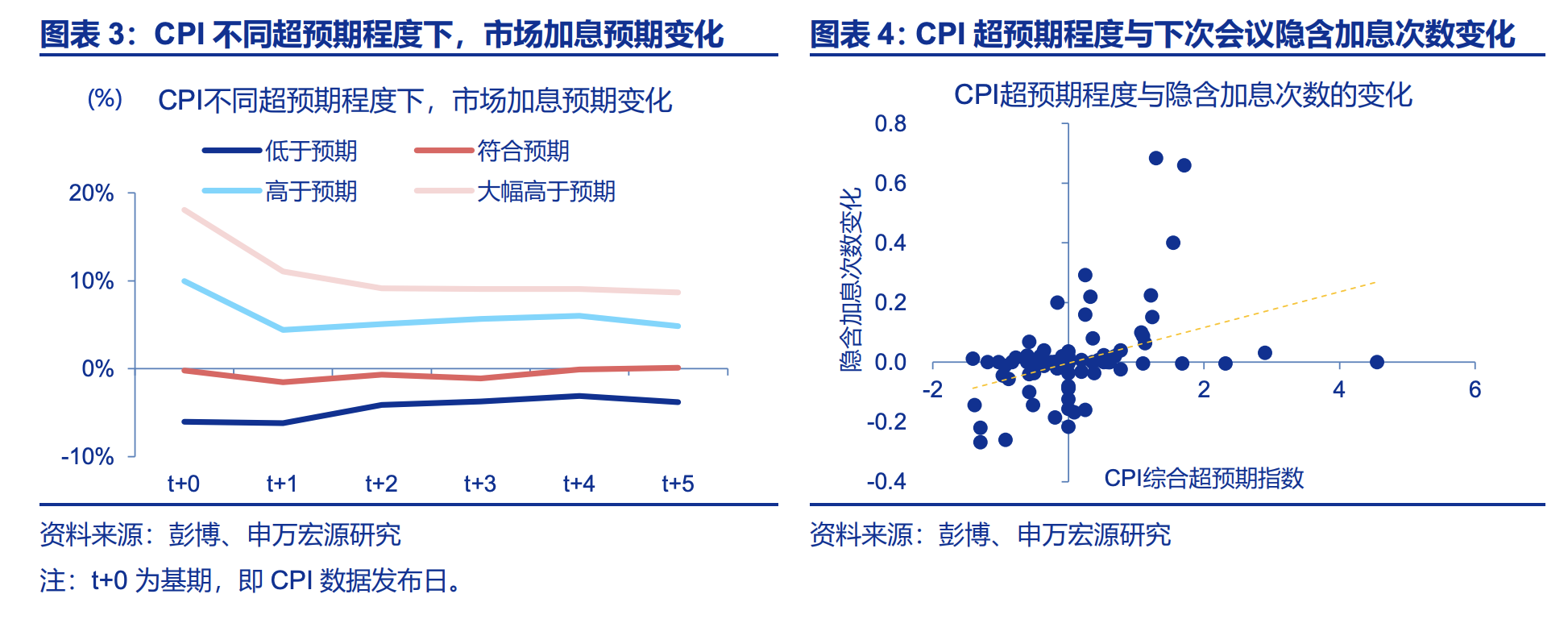
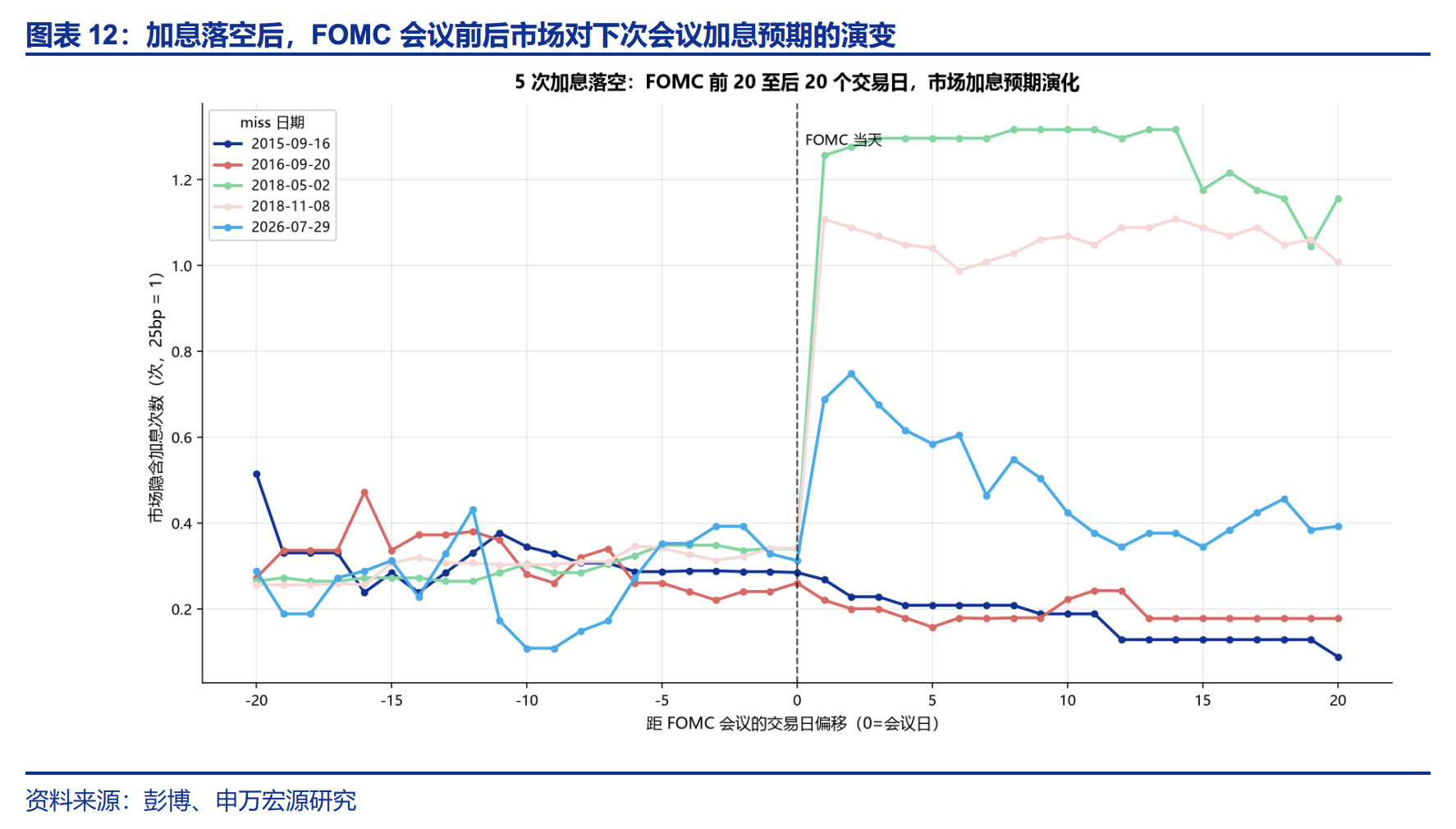
Expectations exceeding 40% have never fallen short, falling short may lead to a "backlash" in term premiums
Currently, there is significant division within the Federal Reserve. After the voting result of 9 to 3 at the July interest rate meeting, internal divisions have further intensified. From recent statements, Beth Hammack, Neel Kashkari, and Lorie Logan are relatively hawkish, continuously calling for rate hikes; Christopher Waller and John Williams are relatively dovish; while Waller himself mentioned on August 28 that if core inflation does not significantly improve, "there is still work to do", indicating signs of a hawkish pivot.
Historical data provides important reference for Waller's decision-making. According to Shenwan Hongyuan's statistics, of the 92 Federal Open Market Committee meetings since 2015, whenever market rate hike expectations exceeded 40% within 10 trading days prior to the meeting, rate hikes have never fallen short, with a total of 20 occurring as scheduled or exceeding expectations. There have only been 5 instances where rate hike expectations between 30% and 40% ultimately fell short, occurring in September 2015, September 2016, May 2018, November 2018, and July 2026.
Among these 5 cases of failure, those in 2015 and 2016 were accepted by the market due to global risks and weak economic data, but the cases in May 2018 and July 2026 are particularly concerning—these were meetings during the initial framework establishment phase of Powell and Waller's tenure, and both saw a significant increase in long-term term premiums after the rate hike expectations fell short: in the 10 trading days following the failed rate hike, the 10-year term premium rose by 5.0 basis points and 6.2 basis points, respectively.
The political pressure from Trump cannot be ignored either. As of September 3, Polymarket data shows a 51% probability of the Democrats gaining control of the Senate, with both the Democrats and Republicans predicted to have 50 seats each, putting Trump under significant pressure for midterm election losses. However, Shenwan Hongyuan points out that historical trends indicate that since 1983, in midterm election years or in years when sitting presidents seek re-election, there have been 3 instances of rate hikes in September, which is no less frequent than in "non-political sensitive years"; in 2018, Powell, newly nominated by Trump, also withstood political pressure and continued to raise rates. In summary, market pressures may tilt Waller's balance toward favoring a rate hike.
The impact of a rate hike may be limited; the key is whether the path is revised upward
If a rate hike occurs as scheduled in September, historical patterns show that its impact on asset prices is relatively limited. According to Shenwan Hongyuan's review of asset performance after 51 rate hikes since 1990: the US stock market typically exhibits a pattern of short-term pullback and medium-term recovery, with cyclical stocks performing relatively weakly; 10-year US Treasury yields rise and fall but term premiums clearly decline.
The divergence in asset trends after rate hikes mainly depends on two factors: whether the rate hike exceeds expectations, and whether there is an upward revision of the forward path after the rate hike. Taking 10-year US Treasuries as an example, if the rate hike exceeds expectations, the average yield on US Treasuries falls by 9 basis points over the subsequent 20 trading days; conversely, if the hike is below expectations, yields typically rise by 28 basis points. If there is a significant upward shift in the forward rate hike path, the yield on 10-year US Treasuries tends to rise by an average of 35 basis points over the following 20 trading days; whereas if the rate hike path remains basically flat, yields will average a fall of 5 basis points.
Shenwan Hongyuan believes that if the September rate hike slightly exceeds expectations, the market may view it as a relative front-loading of rate hikes for the next year, which may not lead to a substantial upward revision of the rate hike path. The reasoning is twofold: on one hand, the August non-farm data is significantly influenced by seasonal adjustments, and considering low hiring rates, low layoff rates, and low labor participation rates, the US labor market still maintains a "weak balance"; on the other hand, wage growth has not shown a significant upward trend, and current inflation exhibits more structural characteristics rather than broad-based; hence, the necessity for continued rate hikes remains in doubt. If the September dot plot guidance does not result in a significant upward revision of the rate hike path, the impact of the rate hike on the market may be relatively limited, with limited short-term impacts on US Treasury yields and even a potential marginal decline in term premiums.
免责声明:本文章仅代表作者个人观点,不代表本平台的立场和观点。本文章仅供信息分享,不构成对任何人的任何投资建议。用户与作者之间的任何争议,与本平台无关。如网页中刊载的文章或图片涉及侵权,请提供相关的权利证明和身份证明发送邮件到support@aicoin.com,本平台相关工作人员将会进行核查。


