Criminals are making "innovative use of crypto asset products to evade detection and move illicit value at scale," Britain's National Economic Crime Centre, a National Crime Agency unit coordinating the country's response to economic crime, said in its annual report, published this week.
The line sits in a threat assessment describing laundering networks proliferating across borders and combining "novel and traditional" methods, moving money through the licit and illicit systems at once. Many organized crime groups no longer launder their own proceeds, the agency says, outsourcing it to dedicated networks for a fee.
The same passage puts AI beside crypto, citing synthetic identities and process automation used against banks.
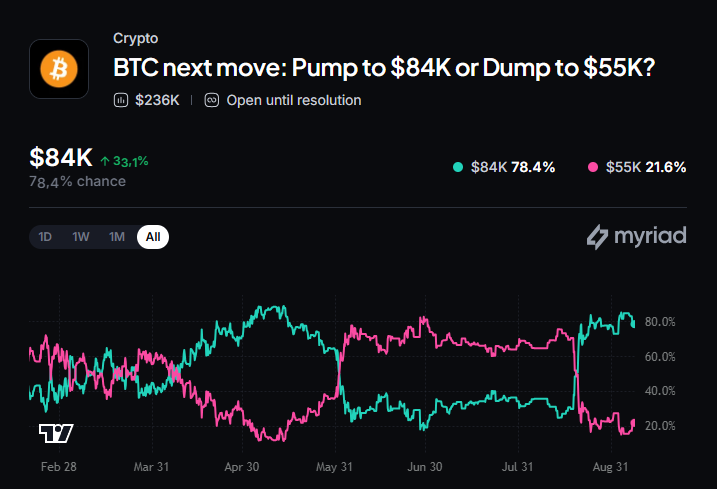
Myriad: BTC next move: Pump to $84K or Dump to $55K? Click to make your prediction.
A proactive crypto capability
Cryptoassets now rank third among nine economic crime priorities the NECC agreed with the Financial Conduct Authority, the Home Office and the Treasury and published in July 2025. The list steers where regulated firms point their compliance effort, placing crypto above criminal cash and money mules.
The agency says it is developing "a more proactive and intelligence-led crypto capability to inform our response to cross-cutting priorities," language pointing away from working referrals and toward generating its own targets. It gives no detail on what that means in practice.
Operation Atlantic, a week-long sprint at NCA headquarters with the U.S. Secret Service, Coinbase, Binance, Kraken and Tether, identified 20,000 approval-phishing victims and froze $12 million in March.
Operation Destabilise, the case against Russian-speaking networks converting street cash into crypto, has reached 129 arrests and more than £25 million seized in the UK, one arrest more than the update given in November.
The agency now says it will expand its Operation Destabilise approach to other "high harm money laundering networks which pose the greatest illicit finance risk to the UK."
The report also lists, among its academic work, a report on Privacy-Enhancing Technologies in Crypto Industry published by the Royal United Services Institute.
That paper, drawn from a July 2025 roundtable the NECC itself hosted, argued against a crackdown.
Participants said "several times" that privacy tools should not be banned, on the grounds that prohibition would push illicit actors onto unregulated services and leave investigators with fewer firms to ask for information. Its author, RUSI associate fellow Allison Owen, told Decrypt that building trust through compliance features "will ultimately expand the use of the technology."
免责声明:本文章仅代表作者个人观点,不代表本平台的立场和观点。本文章仅供信息分享,不构成对任何人的任何投资建议。用户与作者之间的任何争议,与本平台无关。如网页中刊载的文章或图片涉及侵权,请提供相关的权利证明和身份证明发送邮件到support@aicoin.com,本平台相关工作人员将会进行核查。


