Written by: Rita
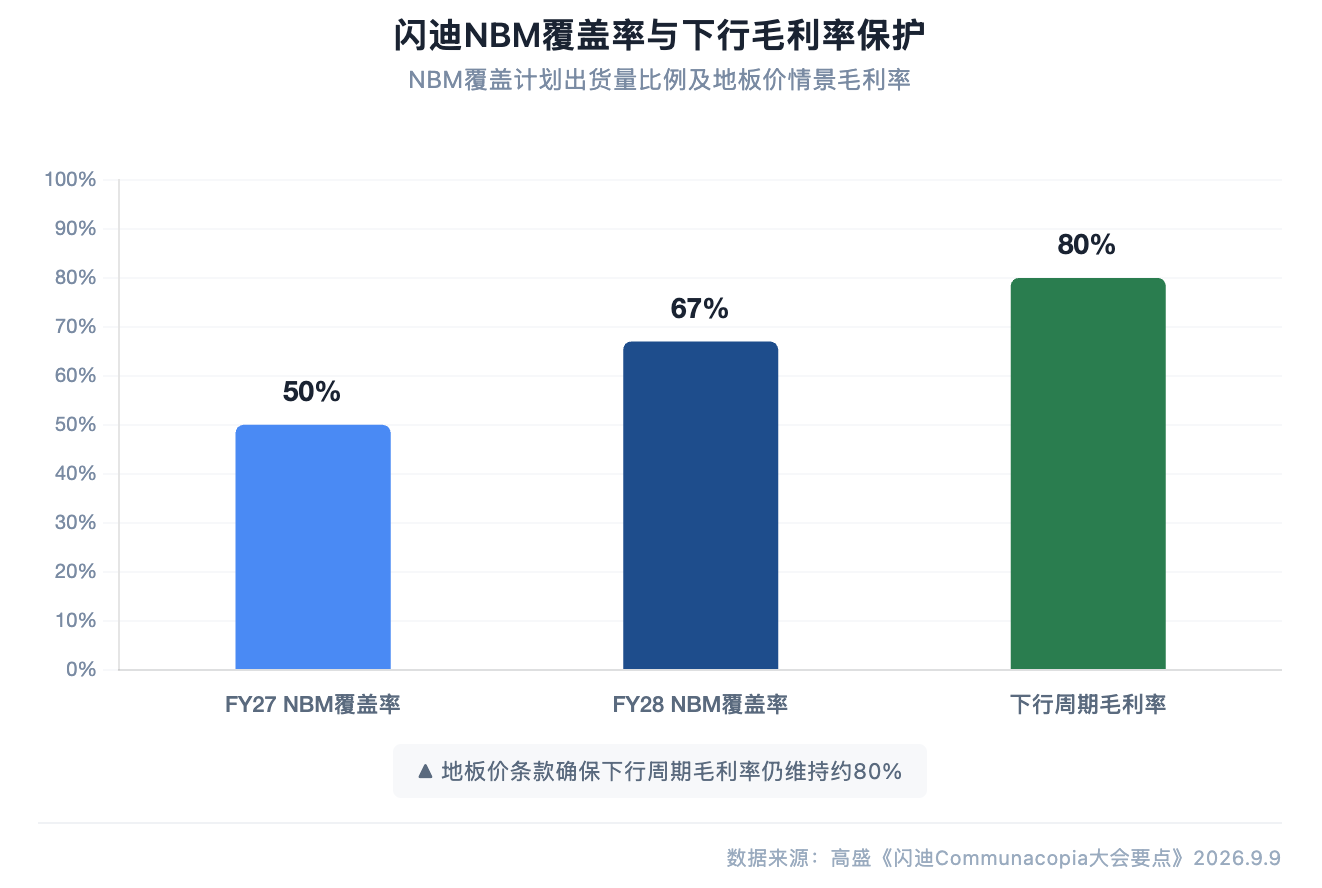
SanDisk revealed at the Communacopia conference that long-term agreements (NBM) have covered 50% and 67% of the planned shipments for FY27 and FY28, respectively. Even in a pessimistic scenario of declining NAND prices, these agreements' floor prices can still support around 80% gross margin. In a conference highlights report released on September 9, Goldman Sachs maintained a buy rating with a 12-month target price of $2,200, which implies a 26.6% upside from the current stock price of $1,738.
Goldman Sachs believes that SanDisk's core logic is shifting from cyclical strategies to structural upgrades. The NAND market is transitioning from short-term spot pricing to long-term agreements, with data center demand becoming the main driver. Supply-side growth is constrained while demand continues to expand driven by AI inference. SanDisk, with its joint venture platform with Kioxia and low capital intensity, possesses stronger profitability visibility in this cycle.
NBM locks in 80% gross margin
SanDisk's management detailed the financial elements of NBM at the conference. The floor price clause is central as it ensures that, in extreme scenarios where NAND prices plummet, the majority of the company's business can maintain a gross margin of around 80%. This protective mechanism has altered SanDisk's profit structure, making it no longer fully exposed to the severe fluctuations of spot prices.
In terms of coverage ratio, 50% of the planned shipments for FY27 have been covered by NBM, while for FY28 it rises to 67%. Goldman Sachs believes that this coverage ratio signifies a significant increase in revenue visibility for SanDisk over the next two years. The confidence of management in the long-term financial targets is built on the certainty provided by these agreements.
Supply constraints, Chinese production self-consumed
SanDisk's judgment on NAND supply is relatively tight. Management believes that NAND supply growth will remain sluggish in the foreseeable future, while the proliferation of AI inference is driving continuous demand increase. This supply-demand pattern provides support for prices.
Regarding capacity expansion by Chinese competitors, SanDisk believes that their new supply is mainly absorbed by the domestic market, with limited impact on the global market. Goldman Sachs also mentioned in its report that the roadmap iterations of YMTC pose potential risks, but current assessments indicate that the impact is manageable.
HBF opens long-term space
SanDisk's management is optimistic about the long-term prospects of HBF and KV Cache. HBF is seen as a potential solution to the AI "memory wall" problem, with its higher density meeting the dual demands of memory bandwidth and capacity for AI computing. KV Cache is critical for AI inference, and management has previously described it as a key component of the AI data center memory TAM.
Goldman Sachs cited management's estimates that, by 2032, KV Cache will account for about 35% of the 1.2 ZB AI data center memory TAM. This data suggests that SanDisk has long-term growth opportunities in AI storage that surpass those in traditional NAND.
Low capital intensity supports bit growth
SanDisk's joint venture agreement with Kioxia has been extended to 2034. Management emphasized that this arrangement, combined with IP ownership and R&D investment, enables the joint venture to have efficient manufacturing capabilities, where bit growth share is disproportionate to capital expenditures. SanDisk's capital intensity is about 5%, significantly lower than the industry average.
Management also stated that through the BiCS platform, the company can see the technological path for the coming years, which can support further bit growth under the same low capital intensity. Goldman Sachs believes that this cost advantage is a key differentiating factor that sets SanDisk apart from its peers.
Share buybacks dominate capital returns
SanDisk reiterated that stock buybacks are the primary way to return excess capital to shareholders. The company has executed about $4.5 billion in buybacks. Management is open to the future introduction of dividends, but buybacks remain the core tool at this stage.
Goldman Sachs' target price of $2,200 is based on a 20 times price-to-earnings ratio multiplied by a normalized earnings per share of $110. The current stock price of $1,738 implies a 26.6% upside potential. Goldman Sachs believes that the profitability stability brought by NBM, the supply-constrained industry landscape, and low capital intensity collectively support this valuation.
Downside risks include: failure to achieve long-term structural changes in NAND pricing; YMTC continuing to iterate its technology roadmap; SanDisk failing to gain market share in the eSSD market.
Disclaimer
This article is an organization and interpretation of the third-party brokerage report (Goldman Sachs, September 9, 2026) by Chao Xiang Research, combined with public market information. The ratings, target prices, earnings forecasts, and related judgments cited in the article represent the opinions of that brokerage's analysts and only reflect their institution's stance, not that of Chao Xiang Research, nor does it constitute any investment advice.
The market carries risks, and decisions should be made independently. This article should not be a basis for buying or selling any securities.
免责声明:本文章仅代表作者个人观点,不代表本平台的立场和观点。本文章仅供信息分享,不构成对任何人的任何投资建议。用户与作者之间的任何争议,与本平台无关。如网页中刊载的文章或图片涉及侵权,请提供相关的权利证明和身份证明发送邮件到support@aicoin.com,本平台相关工作人员将会进行核查。


