
Author: Nancy, PANews
Last night, Hunter Biden's Meme coin LAPTOP experienced a roller coaster market, plummeting over 99% after opening, and its crash was not unexpected. More worth noting is that this round of on-chain revelry led by Robinhood Chain seems to be cooling down earlier than the market anticipated.
Popular Meme Coins Adjust Collectively, Robinhood Chain Temporarily “Turns Off”
Recently, the popular high-heat Meme tokens on-chain generally welcomed a correction, and market sentiment began to cool down from its previous frenzy.
According to GMGN data, on Robinhood Chain, in the past 24 hours, Pons decreased by 12%, AI fell over 14%, CASHCAT dropped by about 5%, MEME declined nearly 22%, microduck fell by 48%, ORBIO dropped by 21%, and PAIR decreased over 34%; on BNB Chain, MarsCoin declined 11.7% during the same period, Niulai dropped over 25%, and 4Stock fell nearly 27%; on Solana, USELESS dropped over 19% and ZCAT declined approximately 15%.
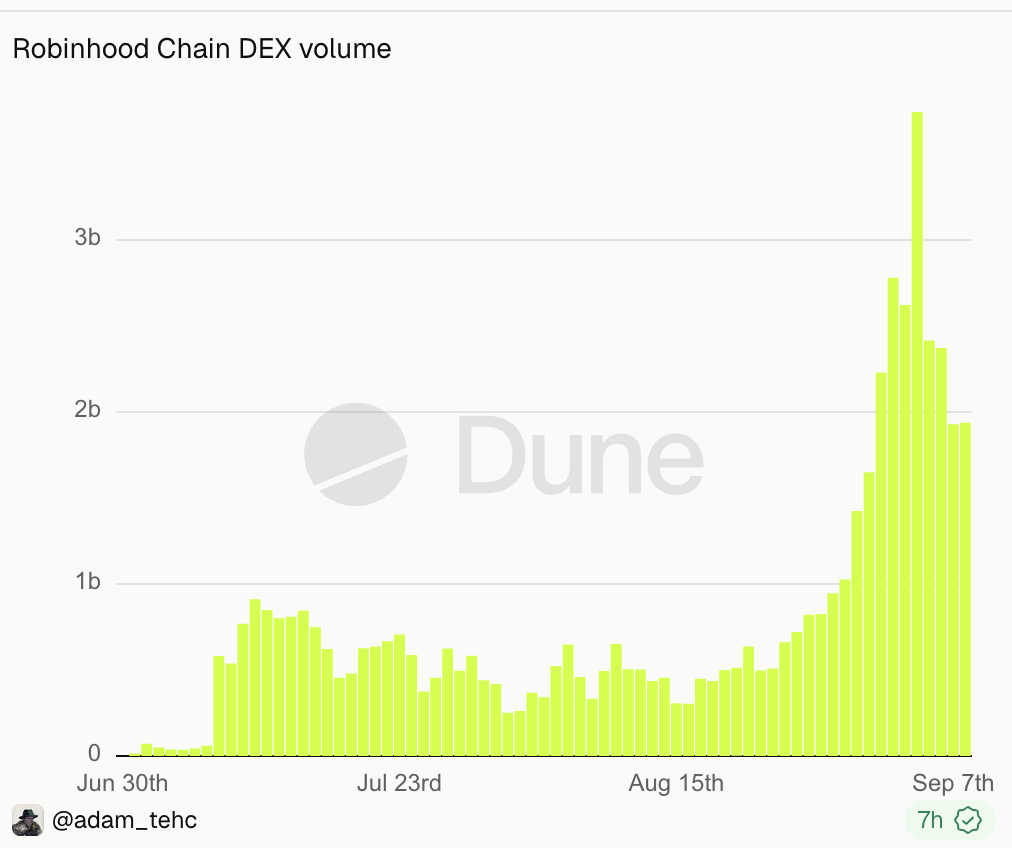
As the main ignition point of this round of on-chain frenzy, the cooling of Robinhood Chain is particularly evident. Dune data shows that as of September 9, the daily trading volume of DEX on Robinhood Chain decreased to $1.9 billion, more than 48.6% lower than the historical peak of $3.7 billion on September 4; although the number of Meme coins launched daily continues to climb, the daily trading amount has been falling back to $360 million, down over 56.9% from the historical peak of $850 million; the on-chain RWA trading amount has also dropped to $330 million, down 59.5% from its peak.
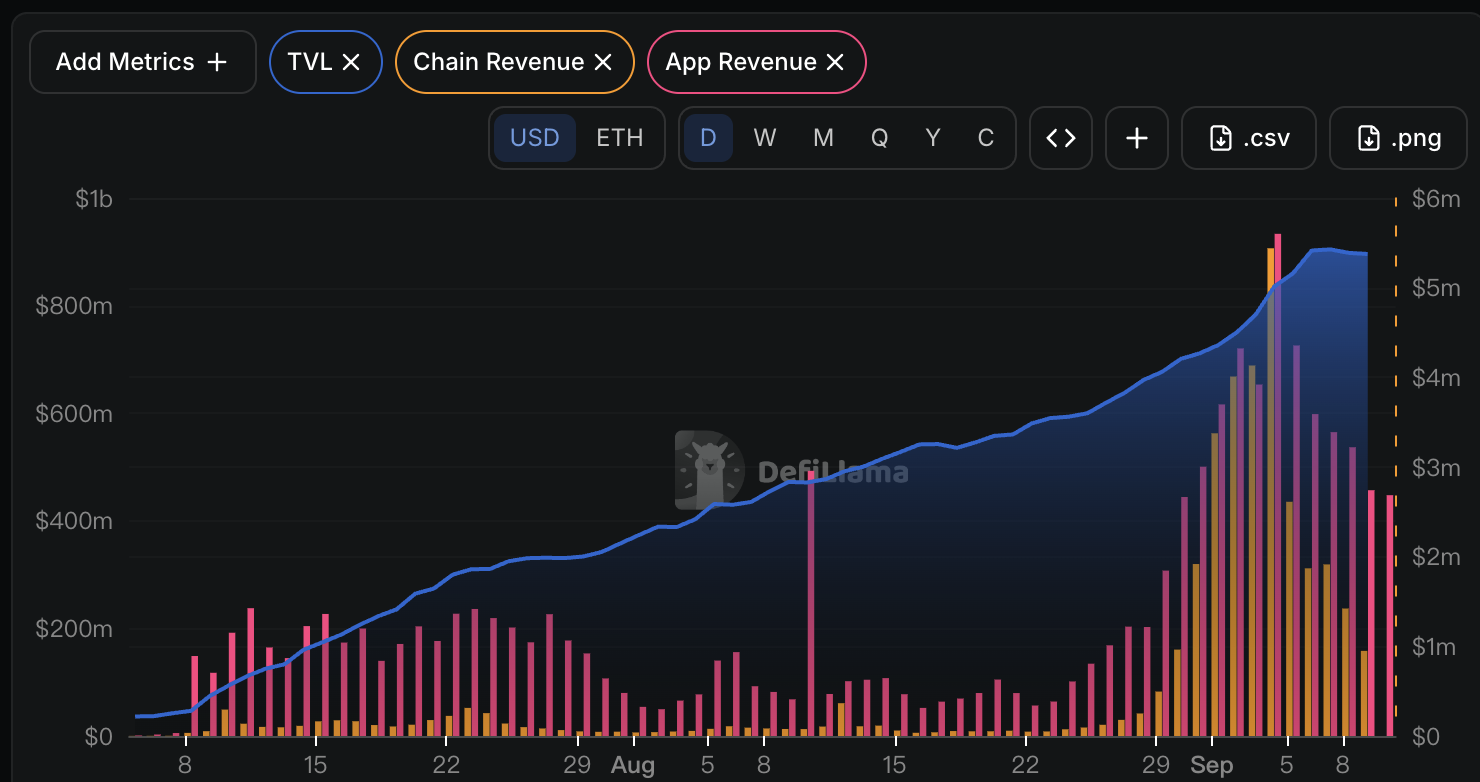
With the cooling of on-chain enthusiasm, income has also significantly decreased. DeFiLlama data shows that since the historical record of daily income on Robinhood Chain was refreshed on September 4, it has been on a downward trend, currently dropping to $1.42 million, nearly 74% lower than the peak of $5.44 million. During the same period, the daily income of applications also fell from $5.6 million to $2.69 million, a decline of 51.9%.
Well-known DeFi researcher Ignas pointed out that the current stock Meme narrative relies on trading volume and transaction fees, rather than fundamentals. Once trading volume shrinks, dividends, buybacks, and burn will follow suit, leading to a decline in traders' holding motivation, and usually, selling pressure will also come shortly after. Using the current wave of transaction fees to extrapolate annual returns essentially assumes that the market will never cool off, which is an unrealistic assertion.
However, from the perspective of TVL changes, the current TVL of Robinhood Chain has only decreased by 0.7% from its peak, and the scale of funds has not shown significant withdrawal, indicating that the decline in trading activity has not yet evolved into large-scale capital outflow.
Compliance Risks and Homogenization Competition Attack, Stock Meme Narrative Under Scrutiny
In fact, the current cooling of on-chain activity is not surprising.
On the one hand, the external risk appetite has decreased, and the cryptocurrency market has generally weakened, exacerbating the cautious sentiment of on-chain funds. On the other hand, after the previous massive gains, some funds began to realize profits, and at the same time, the launch of the Meme coin LAPTOP also intensified the fund-sucking and risk-averse effects to some extent.
More importantly, the stock Meme narrative itself is also beginning to face challenges.
The stock Meme coin BONER, which initially emphasized the short squeeze story on Robinhood Chain, once pushed market sentiment to a peak. A large amount of capital flowed into the stock token pairing pool, creating significant wealth effects in a short time, and also amplifying on-chain trading volume and stock token transactions simultaneously. However, as Meme coins like JINQIAN were unveiled as shelling operations, the rapidly dousing of the market's FOMO sentiment also called into question the Wall Street short-squeeze narrative.
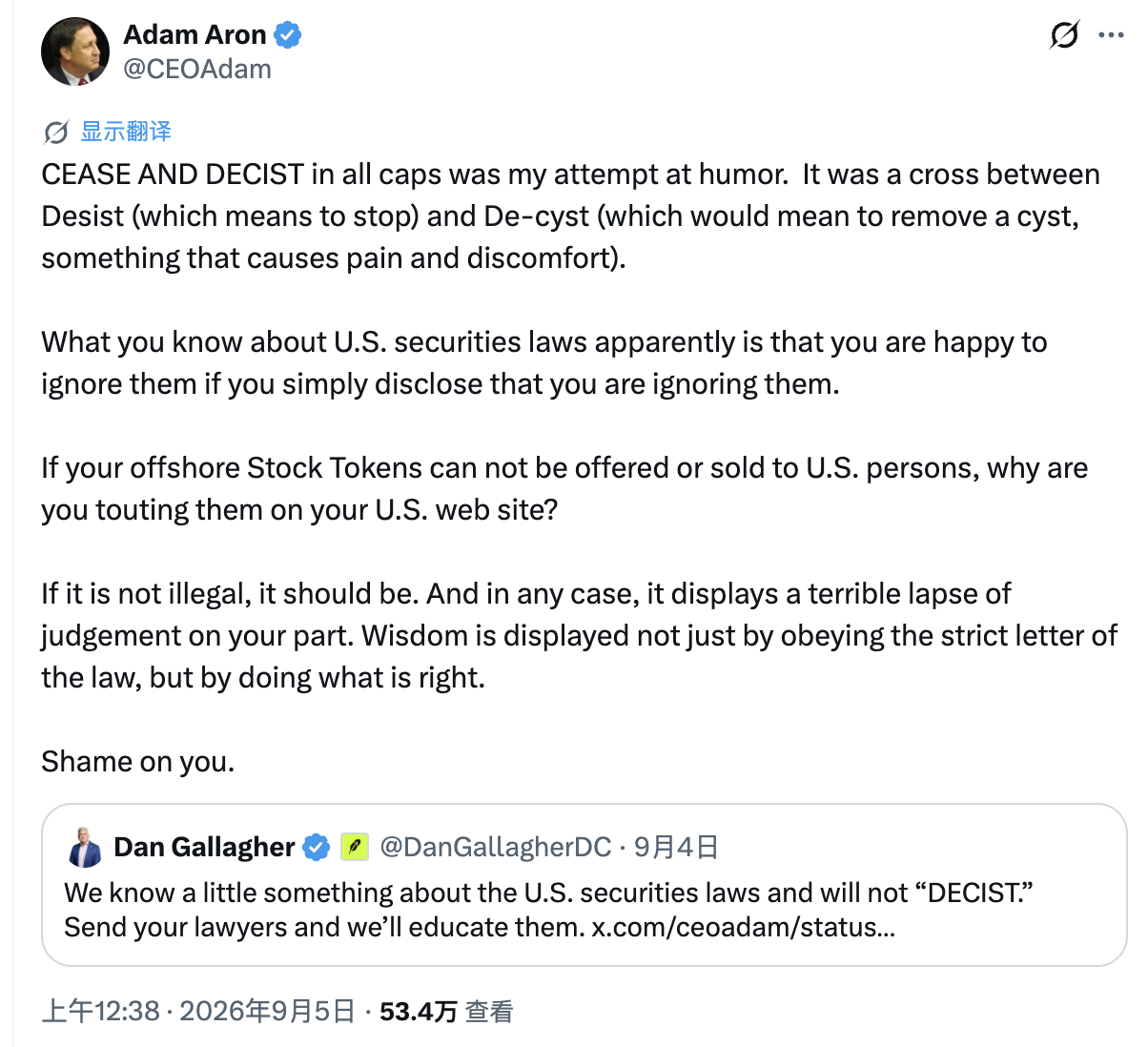
Moreover, the tokenized stocks on Robinhood Chain also face legal and compliance risks brought by public condemnation from listed companies. Previously, the much-hyped stock Meme coin MEME involved the listed company AMC, whose CEO Adam Aron publicly stated that AMC did not participate, authorize, or recognize such tokens linked to AMC stock, questioning their legality. He stated that the company would hire external securities lawyers to review the matter and might inquire with the SEC. Aron also harshly criticized Robinhood for promoting offshore Stock Tokens on its U.S. website, arguing that Robinhood is effectively circumventing the spirit of securities law, creating an unauthorized synthetic market.
In response, Robinhood CEO Vlad Tenev strongly asserted that once the company goes public, its shares will become transferable property, and other financial institutions should be allowed to create financial products referencing the relevant stock without the issuer's permission. Listing companies have the right to control their own rights and obligations regarding stock issuance, but cannot control other companies from issuing securities that reference their stocks. Robinhood's stock tokens are issued by independent entities and backed by underlying stocks, so they should not automatically require the approval of the listing company.
However, this standoff has not completely dissipated market concerns. Most tokenized stock products are essentially just a reflection of stock prices on-chain and do not correspond to legally valid ownership records. Previously, related Pre-IPO products from Anthropic and OpenAI were declared invalid for unauthorized SPVs and tokenized equity transfers, causing related tokens to plummet, further increasing market concerns regarding the legal attributes and actual rights of such products.
On the other hand, launchpads on BNB Chain, Solana, and Base have also progressively followed up with stock functions. For instance, the leading Launchpad Pump.fun recently launched custom trading pairs, allowing token issuance to be paired with tokenized U.S. stocks, mainstream crypto assets, metals, and more.
As more chains and platforms join in, the attention that was originally concentrated on a few leading projects on Robinhood Chain is beginning to be dispersed across multiple chains and numerous new launches. The vast majority of projects have very short lifecycles, and some leading projects are continually siphoned off by new projects, causing funds and attention to be diluted, while the higher mortality rate of new launches further dampens market participation willingness.
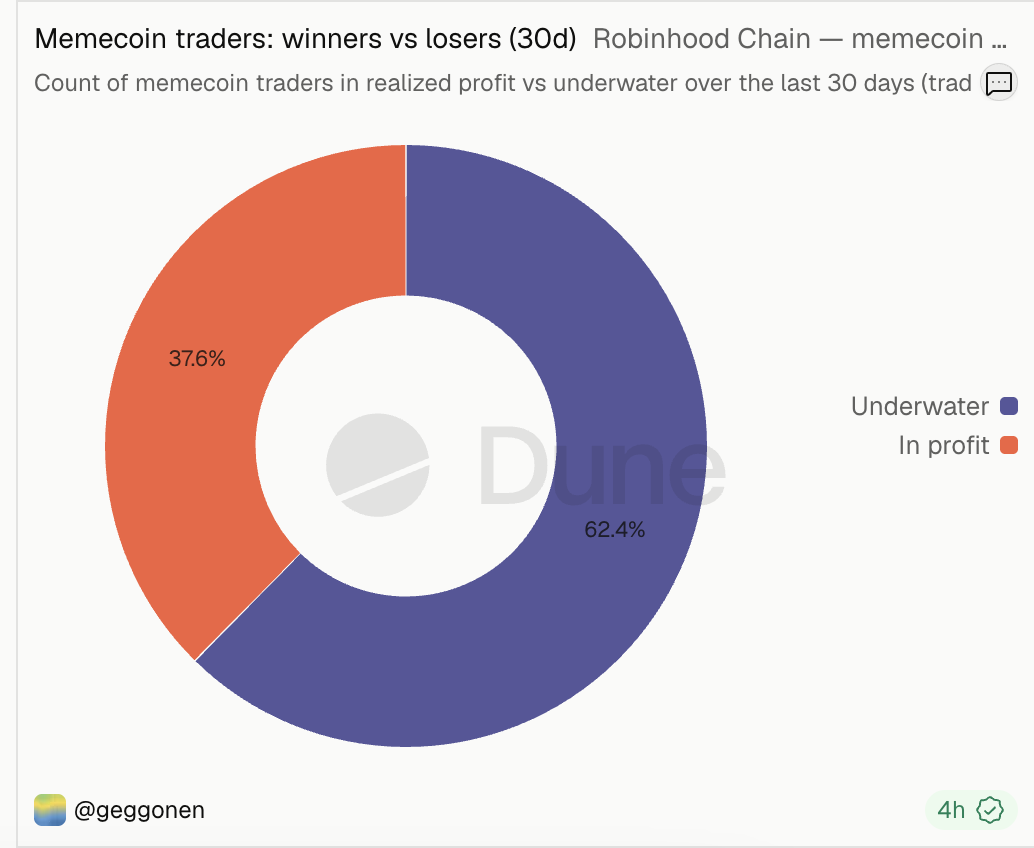
Additionally, the skyrocketing transaction costs on Robinhood Chain, coupled with limited actual profit margins, also undermine overall trading enthusiasm. Dune data shows that in the past 30 days, the ratio of traders making profits and losses on Robinhood Chain was 37.6% and 62.4%, respectively. Meanwhile, on Fomo, the proportion of loss-making addresses exceeds half, with profit-making addresses at around 45.4%, but most of these profit amounts are less than $100, with very few addresses realizing significant profits.
However, some stock Meme launch platforms are also beginning to seek new growth paths. For example, Nate, the founder of Long.xyz on Robinhood Chain, stated in a post that in the coming days, they would focus on building a distribution channel that does not rely on public chains, the crypto market, and Meta cycles. He believes that the market currently underestimates the potential of the stock market in terms of narrative, distribution channels, and capital scale. The top trading pairs on Long.xyz have already begun to form their own independent narratives and distribution channels. Once they no longer rely solely on Crypto Twitter (CT), the scale could increase by 1000 times and become more PVE.
The current cooling of Robinhood Chain may not mean the end of the stock Meme narrative, but whether it can attract liquidity and trading enthusiasm again remains to be seen.
免责声明:本文章仅代表作者个人观点,不代表本平台的立场和观点。本文章仅供信息分享,不构成对任何人的任何投资建议。用户与作者之间的任何争议,与本平台无关。如网页中刊载的文章或图片涉及侵权,请提供相关的权利证明和身份证明发送邮件到support@aicoin.com,本平台相关工作人员将会进行核查。


