Author: Jay Yu, Partner at Pantera Capital
Translator: Jiahua, ChainCatcher
Introduction
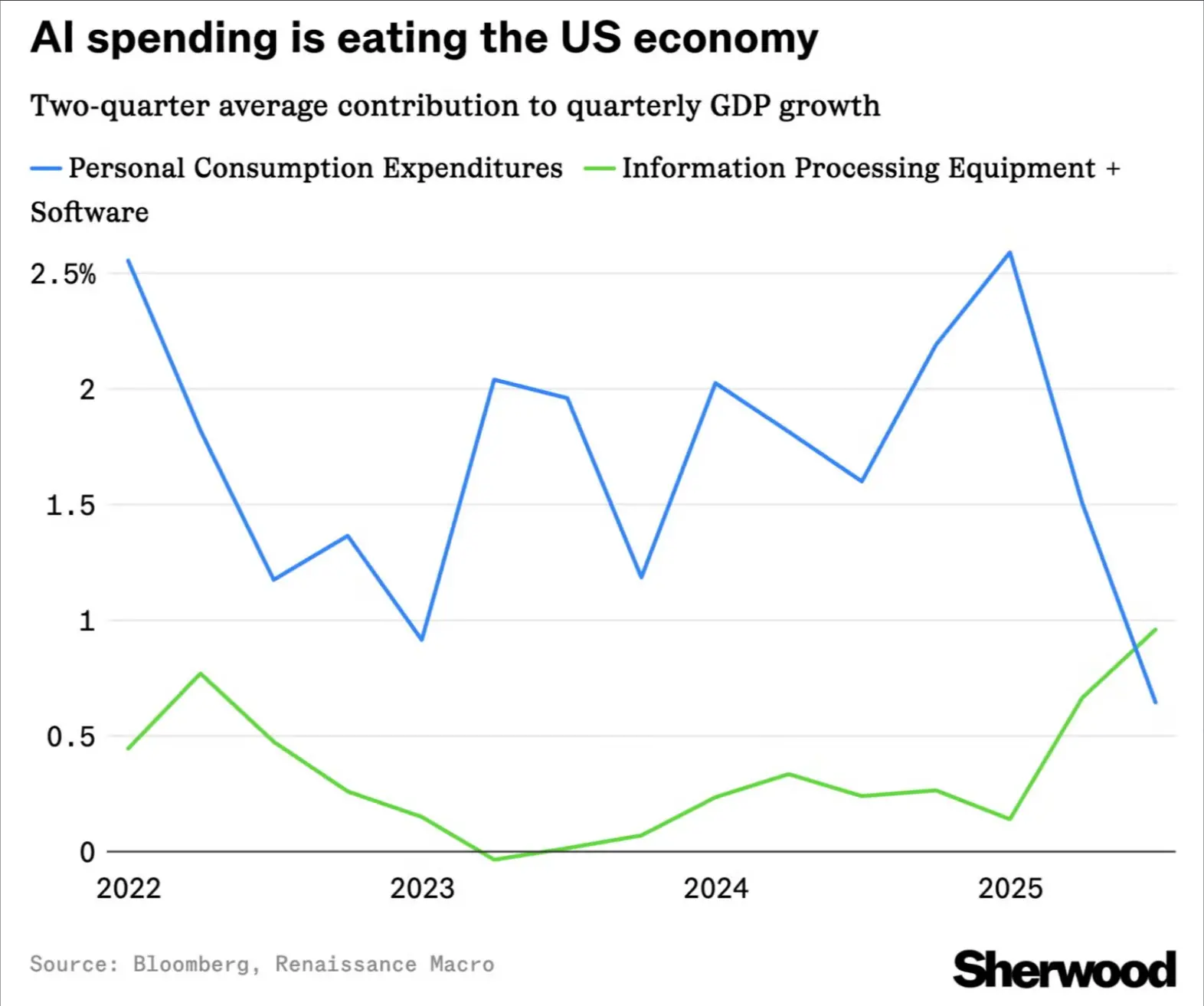
Spending on computing power and data center infrastructure has become a market worth trillions of dollars, comparable to U.S. consumer spending, and is gradually becoming an important pillar of U.S. economic growth.
However, as AI Agents gradually enter the real economy, the market's demand for computing power is continuously growing, while the way GPUs are procured remains quite traditional. Despite the emergence of computing power markets like SF Compute, Vast AI, and Runpod, the buying and selling of a large number of GPU nodes is still completed through group chats, over-the-counter brokers, and customized bilateral agreements.
At present, GPU computing power is still in the early stage of financialization. Similar to electricity, computing power is not a completely homogenous asset; it is constrained by factors such as chip models, delivery times, and geographical locations. However, in the next 5 to 10 years, computing power is likely to gradually become a commodity like electricity or oil, becoming a key resource supporting the operation of the global economy in the AI era.
This article will discuss how the computing power market can achieve this transformation, including insights from the electricity market, possible structures for the computing power market, products being built within the industry, and opportunities and issues in the process of commodity-based computing power.
1. Finding Answers from the Electricity Market
1.1 Structure of the Electricity Market
To understand how the computing power market may evolve in the future, one can first observe the underlying resources, specifically how the electricity market operates.
Like computing power, electricity is also an asset with heterogeneity, temporal attributes, and hub characteristics, and it is an important foundation for global economic growth.
Beginning in the 1990s, the U.S. electricity system gradually underwent privatization. The previously highly vertically integrated electricity utilities began to separate functions such as generation, transmission, and distribution.
Independent grid operators started to manage electricity systems in various regions of the U.S. Meanwhile, large interconnected power systems such as PJM-West (Eastern U.S.), ERCOT North (Texas), and CAISO SP15 (Southern California) eventually became commodities that could be traded on exchanges such as CME and ICE, forming important price benchmarks for the entire electricity asset class.
At the physical level, the electricity market can roughly be summarized as having a structure of "grid, operators, nodes."
The top layer consists of mutually independent regional grids. Under each regional grid, there are a number of system operators, including Regional Transmission Organizations (RTOs) and Independent System Operators (ISOs). These operators are responsible for managing multiple substation nodes in their area.
For instance, in San Francisco, a city may be powered by multiple substation nodes, such as Embarcadero, Larkin, and Mission.
Each node's electricity price is not necessarily the same; rather, it is determined by an algorithm called "Locational Marginal Pricing (LMP)." This algorithm takes into account generation scheduling, user demand, transmission costs, and the laws of electricity flow to calculate the optimal price under constraints.
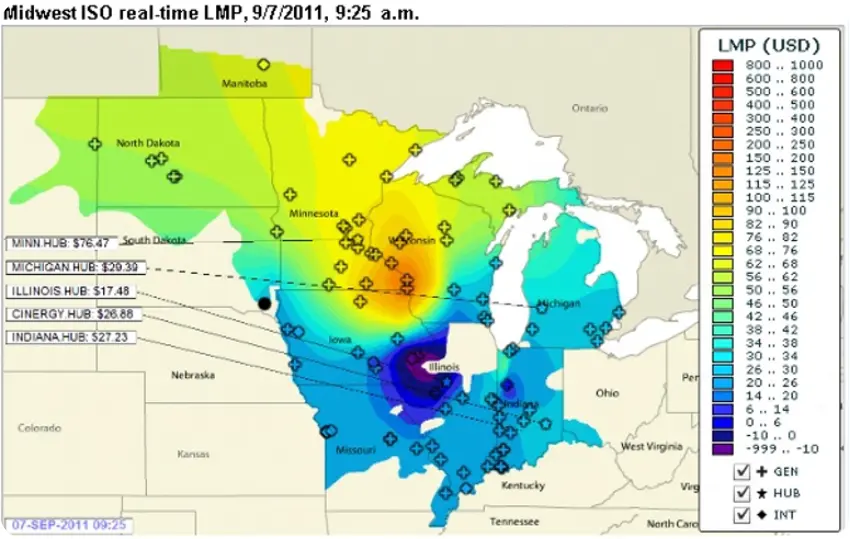
The LMP algorithm becomes a key link that connects the physical delivery of electricity with tradable electricity benchmarks like PJM-West.
The hub prices and index prices in the electricity market are essentially weighted averages of multiple terminal LMP node prices. The largest and most liquid price benchmark ultimately achieves stable trading depth on exchanges such as CME and ICE, becoming the reference price for the entire electricity asset category.
1.2 Possible Structure for the Computing Power Market
By observing the development of the electricity market over the past 30 years, several speculations can be made about the computing power market.
First, the computing power market may form a structure similar to that of the electricity market.
At the physical delivery level, the computing power market's "grid, operators, nodes" structure is most closely mirrored by "hardware, providers, clusters."
Just as there are multiple independent regional grids in the electricity market, the computing power market may also form multiple markets based on different hardware categories. H100, H200, B200, B300, and other chip categories may each have their own independent but interconnected price benchmarks.
At the operator level, computing power providers such as AWS, Nebius, CoreWeave, SF Compute, and Ornn may offer different pricing mechanisms for specific clusters. These clusters will similarly be influenced by time, location, and SKU, akin to the different nodes in the electricity market.
As for the counterpart of LMP in the computing power market, it could be a kind of scheduling or routing algorithm. This algorithm dynamically generates prices for computing instances based on the availability of a particular SKU.
Ultimately, benchmarks that become industry reference prices in the electricity market, such as PJM-West, ERCOT-North, and CAISO SP15, are usually connected with the most liquid physical delivery infrastructures. This is similar to other commodity markets like oil.
As more and more price benchmarks emerge in the computing power field, those benchmarks linked to highly liquid physical delivery sites are likely to prevail.
Furthermore, in the electricity market, generators and consumers sometimes directly hedge at the electricity exchange, but most transactions are still conducted by over-the-counter (OTC) departments operated by banks and trading firms. These OTC entities exchange node settlement prices with hub settlement prices, profiting from the spread, and hedging their own risks.
A similar market structure may also appear in the computing power market. The actual supply and demand sides of the computing power market, namely new cloud service providers and AI companies, may be more inclined to procure specific SKUs through brokers rather than directly hedging at computing power exchanges.
Finally, the computing power market may face more severe basis risk than the electricity market.
Under U.S. federal law, wholesale electricity prices must remain transparent under the supervision of the Federal Energy Regulatory Commission (FERC). However, there are currently no similar transparency requirements in the computing power market.
This means that the dynamic prices and indexes that the computing power market can establish may only be based on its own order book and the order book data provided by new cloud service providers it collaborates with. These collaborations may be achieved through revenue sharing, data procurement, etc.
2. Structure of the Computing Power Market
2.1 Three-tier Structure of Inference Demand
The electricity market exists because there is a persistent demand for electricity in the industrial system. Similarly, the fundamental driving force of the computing power market is the application demand for tokens, especially inference tokens.
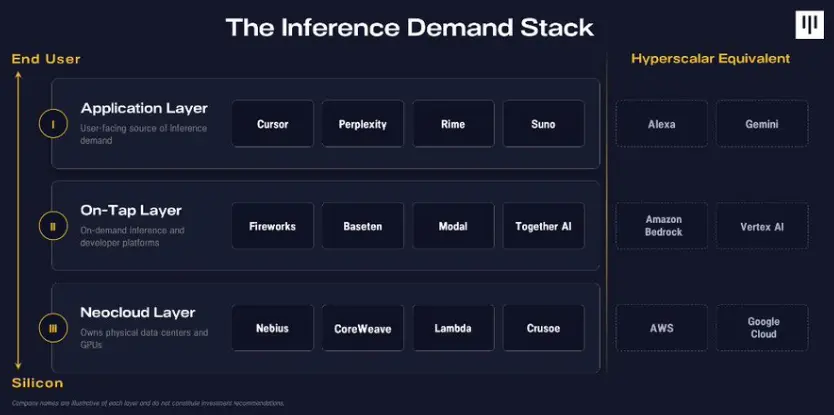
The current inference industry chain can be roughly divided into three tiers, which together form the structural supply and demand sides in the computing power market.
Layer of New Cloud Service Providers
Companies like Nebius and CoreWeave operate physical data centers, constituting the sellers of GPUs.
Ready-to-use Layer
Developer platforms like Fireworks and Baseten convert bare GPU environments into more complete GPU usage environments, allowing developers to run tasks directly or obtain inference tokens at any time; this layer represents the buyers of GPUs.
Application Layer
Applications like Cursor, Perplexity, and Rime utilize inference platforms to provide end products to users and enterprises. This layer represents the demand side for tokens, and the demand for tokens translates into demand for GPU computing power.
Although each company in the ecosystem has different GPU management strategies, generally, new cloud service providers are on the supply side of the GPU market, i.e., structurally short; while the ready-to-use layer and application layer are on the demand side, i.e., structurally long.
On the other hand, giant cloud service providers like Amazon and Google operate their products across all three tiers.
Regarding the profit flow within the industry chain, a rough rule of thumb is: when top-layer applications spend $100 on tokens, about $45 flows to the ready-to-use layer, $50 to the new cloud service providers or GPU layer, and the remaining $5 to routing layers like OpenRouter.
2.2 Structure of the Computing Power Capital Market
The token economic structure of participants in the AI industry chain will influence how the computing power capital market ultimately takes shape.
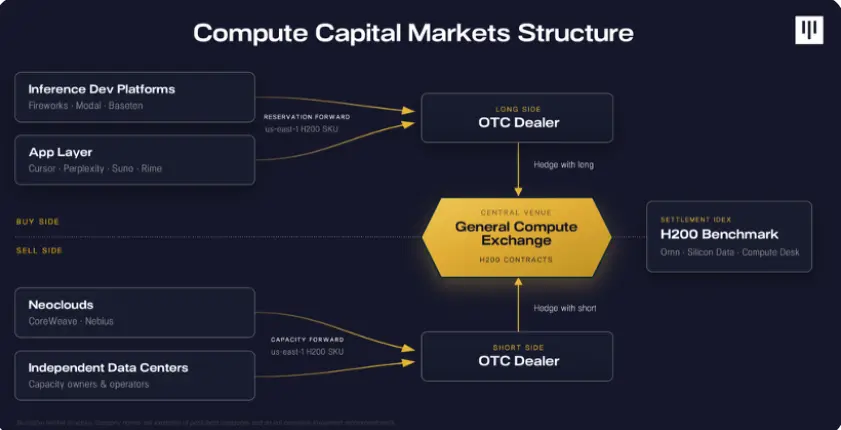
One possible structure is that demand-side developer platforms and application layers, as well as supply-side new cloud service providers, will trade specific SKUs through computing power brokers and OTC trading platforms like SF Compute, Runpod, and Compute Exchange.
Subsequently, computing power brokers and OTC trading platforms will manage inventory and bear the basis risk between specific SKUs needed by end token consumers and generic H200 products.
They can hedge through computing trading platforms such as Architect or Pluto.
The prices on these trading platforms are based on a computing power benchmark. This benchmark is weighted based on the order book prices of new cloud service providers and OTC platforms it collaborates with.
2.3 NVIDIA: The "Central Bank" of the Computing Power Market
Additionally, NVIDIA recently announced that it would allow the computing power from its AI factories to become an "investable asset class."
In the computation financialization system, NVIDIA can be seen as the "central bank" of the computing power market because it almost monopolizes the GPU technology stack.
Central banks typically have several core objectives:
Manage inflation in the economy;
Promote full employment;
Act as a lender of last resort in extreme situations.
NVIDIA is somewhat playing all three roles.
First, it manages "inflation." The "inflation" in the GPU economy can be compared to the depreciation cycle of GPUs, especially in terms of the depreciation speed relative to the latest generation chips. By controlling the pace of product releases, such as launching Vera Rubin, NVIDIA can influence the rate at which GPUs depreciate over time to some extent.
Secondly, it maintains high GPU utilization. High GPU utilization usually indicates strong market demand for tokens, and users will purchase more GPUs. Therefore, NVIDIA has the motivation to promote the financialization of GPU computing power, making GPU hours more liquid and thereby further enhancing GPU utilization.
Finally, it acts as a lender of last resort. NVIDIA has also announced that it will provide support for GPUs up to 25% of their remaining value. This can be seen as a form of rescue or insurance mechanism for the value of GPUs: when new cloud providers and other GPU suppliers face liquidity crises, such support can ensure the residual value of GPUs.
3. Opportunities and Challenges in the Computing Power Market
3.1 Product Forms in the Computing Power Market
As the financialization of the computing power market continues to increase, several main types of products may emerge in the industry. Each type of product has its own advantages and challenges.
Product One: Physical Delivery
Physical delivery refers to delivering actual GPU devices to end users who need computing power. Projects such as SF Compute, Hyperbolic, Vast, Runpod, and Compute Exchange fall into this product layer. This layer is the closest to the hardware itself and most directly connects the supply and demand sides of computing power.
Due to the high heterogeneity of computing power SKUs, many projects initially functioned merely as brokers, earning commissions by matching GPU demand with new cloud providers. In the long run, this layer's goal may be to establish some kind of "computing power spot exchange."
However, maintaining the quality of physical GPU delivery is a very challenging issue, especially for projects sourcing from decentralized networks. The computing power market might need a ratings agency similar to Moody's to certify the quality of the underlying deliverable GPUs to further mature this layer.
Although the competition in the physical delivery layer is very intense, it may possess the most enduring moat in the long run. Looking back at the oil and electricity markets, one can find that financialization systems usually develop around the physical delivery sites with the strongest liquidity, and only then do they gradually form financial products like indices, exchanges, and lending.
Therefore, whoever can first solve the issue of physical GPU delivery may reap enormous market rewards.
Product Two: Indices
This layer mainly refers to the "index curves" built on computing power, including the computing price indices launched by projects like Ornn, Silicon Data, Compute Desk, and Semianalysis.
Establishing an index is an important step towards further financialization and trading of assets like computing power. It can be said that many current discussions in the market about the "computing power market" began to heat up as computing indices gradually matured. Major exchanges like CME and ICE have also announced collaborations with relevant indices.
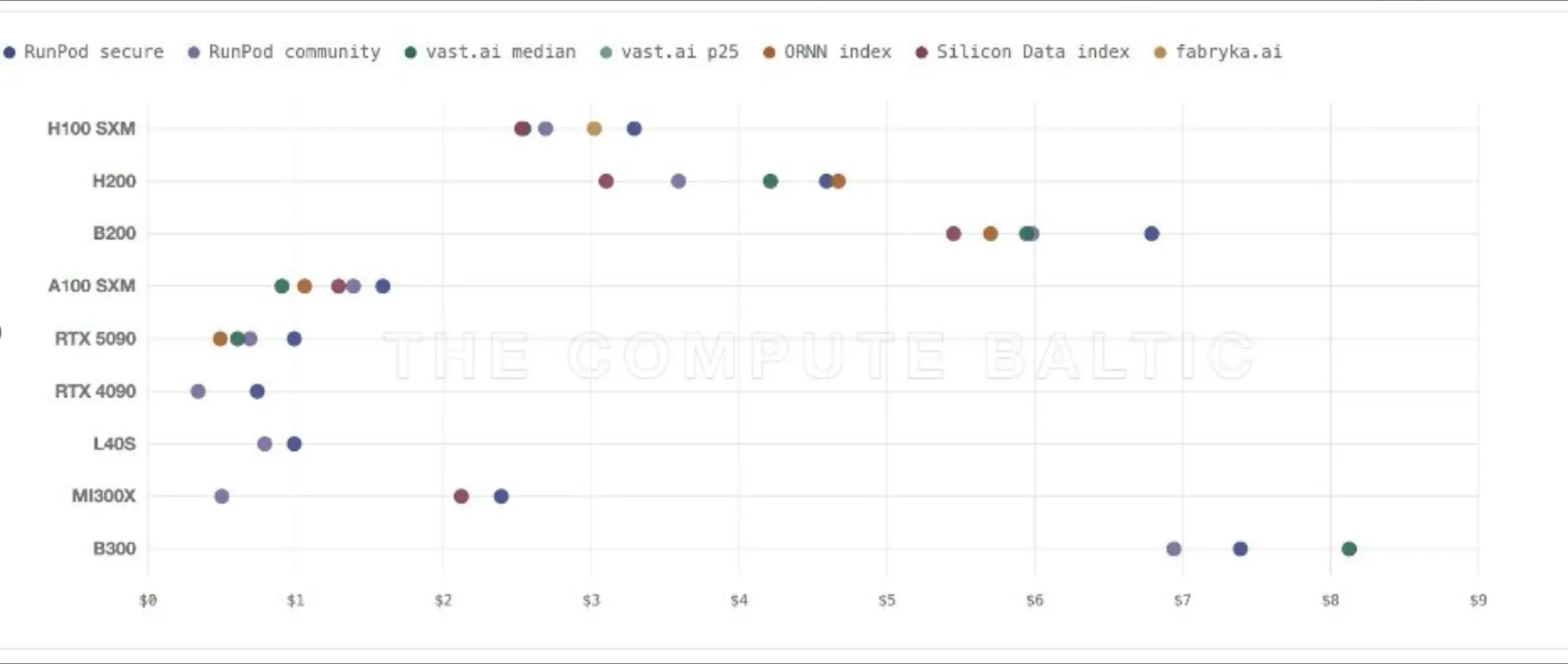
However, many computing indices still exhibit significant price gaps compared to individual GPU markets.
This price gap is primarily due to two reasons.
First, there are inherent differences in the underlying products themselves. Different computing power platforms often vary greatly in product stability, interruptability, and contract terms.
Second, the order books underlying different computing indices are not the same, and the computing power market lacks the transparency requirements seen in other asset classes. For example, FERC requires the electricity market to remain transparent.
Currently, many computing indices only bulk procure order book data from new cloud providers or establish initial data sets through partnerships and revenue-sharing agreements. Furthermore, the monetization ability of the index layer operating independently is weaker than that of exchanges and the physical delivery layer.
Therefore, while the index layer can generate noise and plays an important role in the computing power market system, it is simultaneously squeezed from both upstream and downstream:
The upstream physical delivery layer controls the price sources;
The downstream exchanges aim to take a portion of the revenue from the indices.
Product Three: Derivatives Trading Platforms
The third layer is derivatives trading platforms, usually offering cash-settled futures products. These platforms provide hedging tools for market participants based on computing power indices. Liquid Compute and Architect are currently developing related products.
In the long term, derivatives trading platforms may be the most anticipated product in the computing financialization system, as they can easily scale and monetize. However, this area is still in the early stages, and the trading volume has not reached significant levels.
Additionally, tradable products on cash-settled trading platforms are typically generic H200 instances, rather than specific SKUs that can be directly used for inference. Therefore, the entities currently actively participating in these trading platforms may mainly be OTC trading platforms and computing power brokers, rather than end enterprises in the AI industry chain. The former seeks to hedge their computing inventory on balance sheets, while the latter needs to manage their exposure to computing power.
Product Four: Financialization Tools
There may also emerge a broader category of financialization products in the computing field, providing financing support for data centers and new cloud service providers. For instance, lending protocols, Vault, and synthetic stablecoins like USD.AI may help data centers and new cloud service providers complete infrastructure construction.
Meanwhile, the market may also see risk transfer and insurance layers to smooth out basis risks in the GPU economy. Observing the aforementioned different layers reveals that the complete form that the computing power market may ultimately take is relatively clear.
The winners will be full-stack participants capable of achieving reliable physical GPU delivery. They will be able to formulate price indices from their physical order books, subsequently establishing a computing power futures exchange, making computing power an asset class that can be hedged.
However, the real divergence in the industry lies in the order of appearance of different products. Will the final winners start with physical delivery, or will they establish indices first, or will they launch trading platforms first?
3.2 The Frontier of Computing Power Token Economics
So far, we have primarily discussed the computing power market at the GPU level. However, we can also widen our perspective to observe the broader computing power token economics, including its historical evolution, value capture methods, and the competitive relationship with frontier model laboratories.
Historically, the computing power market is not a completely new concept. In 2023 to 2024, projects like SF Compute and Hyperbolic were already discussing this model, while decentralized projects like Akash and IONet were exploring similar directions.
Interestingly, many projects did not remain at the GPU market level. For example, Hyperbolic later became an inference service provider and began selling tokens directly; SF Compute began directly signing contracts and operating compute clusters.
From the perspective of the value chain, value flows from AI applications such as Cursor, Harvey, and Granola to routing layers such as OpenRouter, then to inference service providers such as Fireworks and Baseten, and eventually enters new cloud service providers and the computing power market such as Nebius, CoreWeave, and SF Compute before reaching data center operators.
If a company remains in the middle of the industry chain, it may simultaneously be squeezed from both upstream and downstream. To maintain a more stable profit margin, companies may ultimately need to extend upstream or expand downstream.
The token market also presents an interesting game theory perspective, where three unavoidable forces are at play.
The first force is NVIDIA, which controls the supply of GPUs and the speed of their depreciation.
The second force is cutting-edge model labs like Anthropic and OpenAI, which continuously release new models that may rapidly increase demand for tokens.
The third force consists of open-source models like Kimi, GLM, DeepSeek, and Qwen, which may exert downward pressure on inference profit margins.
These three forces collectively provide ongoing impetus and pressure for both the supply and demand sides of the GPU market and the token market. Each side can potentially rewrite the entire market's pricing curve by launching significant products.
For instance, the release of GPT 5.6 could become an event determined by enterprises autonomously, yet difficult for the market to predict in advance, producing ripple effects along the AI token value chain and causing fluctuations in token prices and GPU hardware prices.
Therefore, if a company can operate inference services and GPU hardware markets within the same system, it may be commercially more rational. This model can hedge against the risks posed by changes in the profit structures of the upstream and downstream of the industry chain.
Conclusion
Looking back at history, markets for commodities like oil and electricity initially focused on bilateral transactions facilitated by intermediaries, with opaque trading processes and a lack of uniform standards. However, over time, physical delivery gradually evolved to develop a series of protocols and financial infrastructures, including indices, trading standardization, and quality audits, ultimately transforming into a highly financialized asset class.
Today, the computing power market is undergoing a similar transformation. Numerous projects attempting to financialize foundational tools have emerged in the market, including computing power indices, cash-settled exchanges, lending products, and insurance products.
Meanwhile, the physical GPU market and cloud service providers are continually extending their reach upstream and downstream in the industry chain, aiming to capture the complete value in the token economy. As the underlying resource upon which the entire AI economy operates, computing power is gradually evolving from a simple infrastructure into an independent financial asset.
In the future, there may be multiple unicorn companies emerging in this field, each covering different layers of the market and forming various business models, including physical computing power supply, brokerage services, lending, risk management, as well as combinations with DeFi and TradFi capital markets.
Computing power could be a rare new type of tangible commodity in decades, and we may be witnessing its transition from the early trading facilitated by private matchmaking to the emergence of a complete asset class.
免责声明:本文章仅代表作者个人观点,不代表本平台的立场和观点。本文章仅供信息分享,不构成对任何人的任何投资建议。用户与作者之间的任何争议,与本平台无关。如网页中刊载的文章或图片涉及侵权,请提供相关的权利证明和身份证明发送邮件到support@aicoin.com,本平台相关工作人员将会进行核查。


