Stripe spent over seven billion to acquire OpenRouter, but the token routing alone is certainly not worth that price: the routing logic can be copied, cloud vendors can package it, and a 5.5% cut is likely unsustainable.
So what exactly did Stripe buy? It's not about "which model to send the request to," but rather an "overseeing perspective" that can see the flow across models and vendors. Sandeep Patil, a partner at QED Venture, articulated this more accurately from a fintech perspective after the deal:
Being in the flow itself is not a competitive moat; being able to see the flow and thus knowing better than others what the next step should be is.
The payment industry spent twenty years validating this statement, and token now has to walk the same path again.
Therefore, the point of this article is not technology, but finance: the framework that has surrounded the dollar for the past twenty years is now being replicated on token—routing and procurement, data and distribution, success rates and risk control, standards and assembly, account credit and foreign exchange.
Transporting tokens is merely a flow business, while the greater value lies above the flow.
1. Routing: First Solve Fragmentation
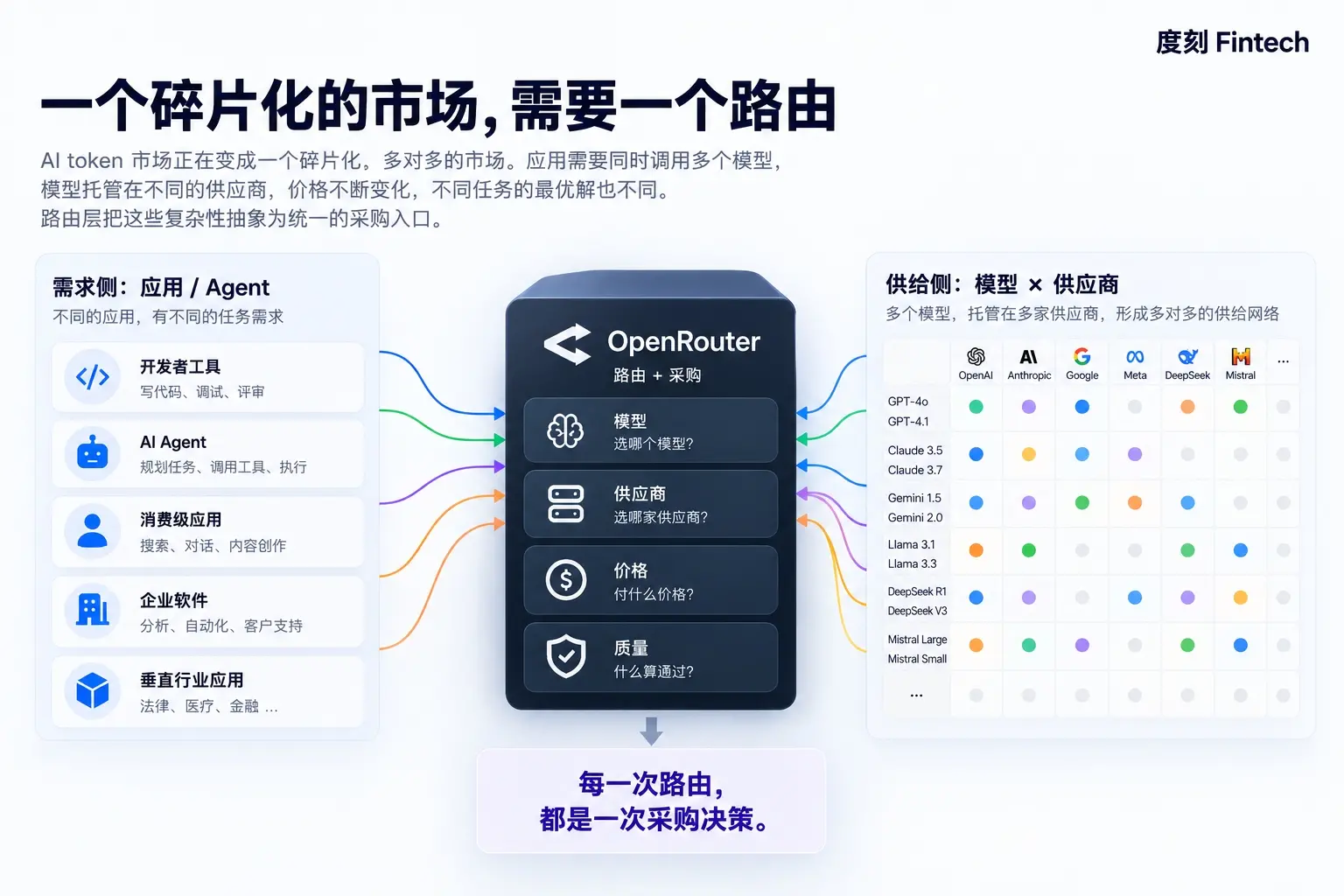
Token routing exists because the AI token market is becoming fragmented and a many-to-many market.
Applications need to coordinate several models simultaneously, which are hosted by multiple vendors. Prices are always fluctuating, and the optimal solution for different tasks varies. Open source is chasing closed source, cutting-edge models continue to push the frontier forward, and this instability will not disappear in the short term. Tying oneself to a single vendor is becoming less cost-effective—no application wants to rebuild its tech stack every time the optimal model changes.
Image
The traditional way the financial market handles fragmentation is to insert a layer of shared facilities in between: SWIFT among banks, card organizations between merchants and issuers, payment gateways abstracting the complex underlying channels.
Token routing is following the same path.
Moreover, it is not just about traffic scheduling; each routing decision is a procurement decision: which model to use, which vendor to service, what price to pay, and what quality counts as acceptable. After a billion transactions, the router will have a ledger of model consumption.
But having just routing is not enough.
In simple scenarios, changing a routing vendor might only involve altering a base URL. Routing logic can be replicated, and cloud vendors can package it into the basic infrastructure that companies are already purchasing; competitors can also transmit model prices at cost. The production environment is far from that simple; compliance, data residency, caching, observability, SDK, billing, and privacy all require attention.
2. Distribution and Integration: Data Only Exists After Integration
Stripe's later strength is not in the channels. It became the default choice for developers. Traffic distribution itself is a competitive moat.
This statement is often flipped around: it is not that data exists and thus is integrated, but that because it is first integrated, data comes into being.
On the token routing side, the most direct evidence is the model leaderboard from OpenRouter. Which models are seeing an uptick in usage, which are declining, where coding-related tasks are migrating to, how long it takes for users to switch when prices change—this is currently the only public usage data across models and vendors in the industry.
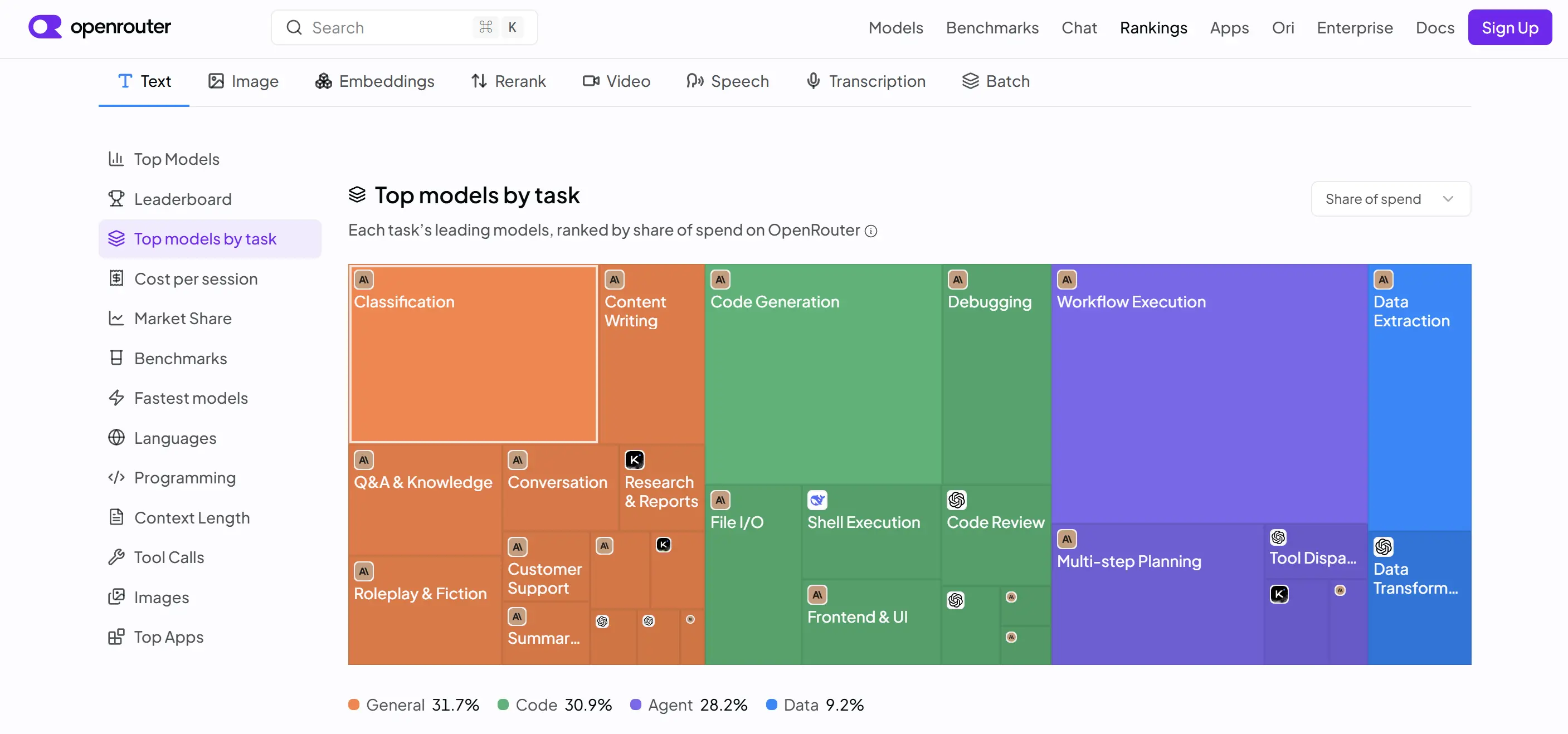
Interestingly, this data is nearly useless for routing itself. It won't make any specific request run more accurately. However, it turns OpenRouter into a scoreboard for this market, and scoreboards have bargaining power.
Model vendors cannot create such data: they only see their own calls, equivalent to only seeing their own ledger. Cloud vendors can see the infrastructure but not the intent.
The only place that can see the whole picture of cross-model behavior is the routing layer.
This creates a cycle: more traffic leads to better observations, better observations improve routing, and better routing brings in more traffic.
This is far more interesting than taking a five-point cut on tokens.
Being able to see is merely the output of this layer and is not inherently valuable; what is valuable is what one dares to do and what one can endure after seeing it.
3. Intelligent Routing: From Price Comparison to Bottom Line
The earliest routing in payments was very mechanical, simply delivering money to where it belongs. What developed later is much more valuable: automatic retries on failures, switching to the next vendor if one declines, continuously optimizing report fields, real-time risk control interception, and comparing prices between multiple pathways for the same amount of money. Different names, but essentially doing one thing—raising success rates.
Token routing is undergoing the same evolution, but the difficulties and opportunities are much greater.
Success in dollar payments is binary; either it arrives or it does not.
Token is not: whether a task is completed, and how well it is executed, is separated by a layer of judgment.
It is this layer of ambiguity that makes raising success rates on tokens far more valuable than in payments.
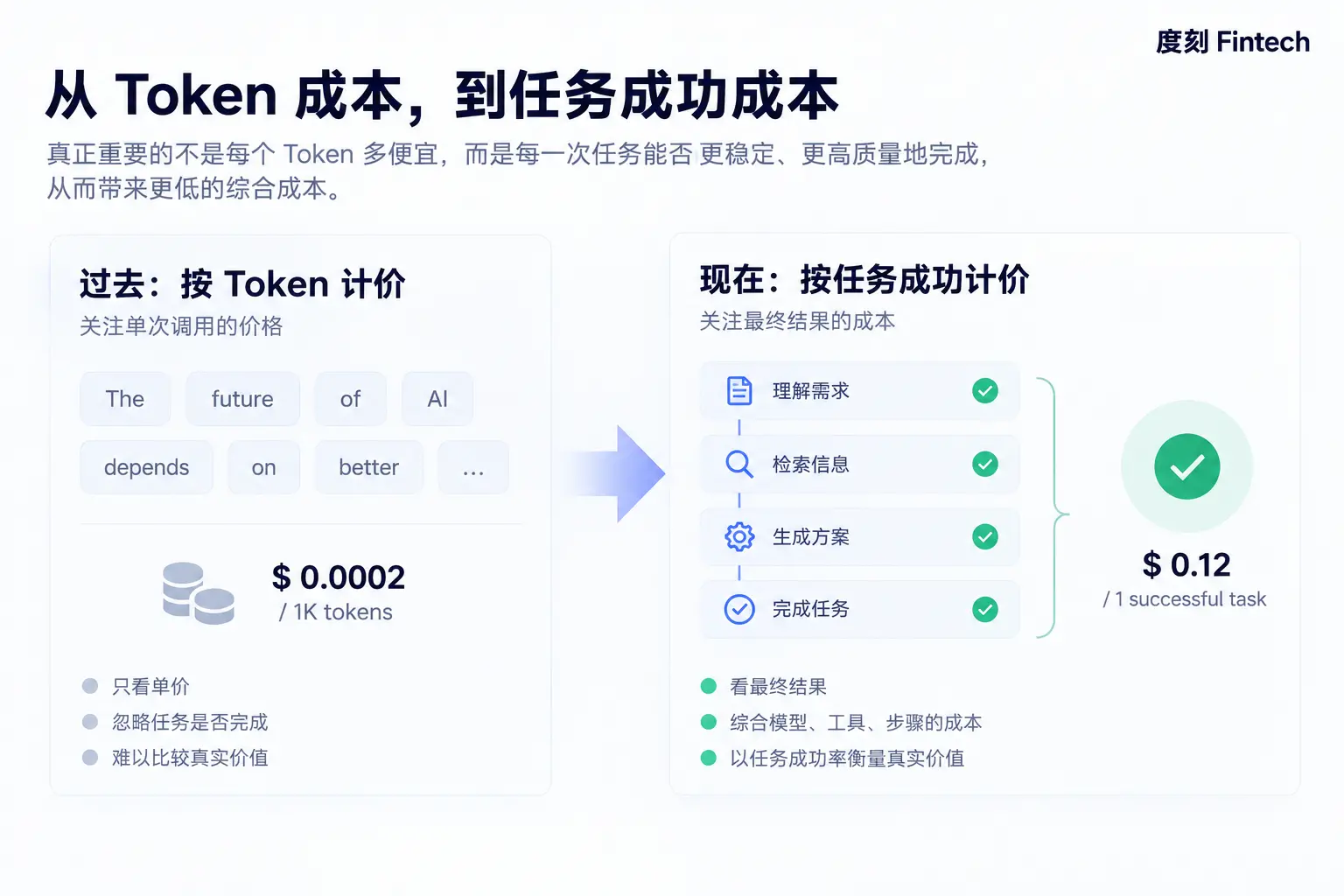
The easiest miscalculation also occurs here—cheap models are becoming more usable, leading routing to resemble a price comparison engine, sending each request to the cheapest capable model. But "sending to the cheapest model" has been a mistake from the start. An AI task is not a single inference; it involves an agent planning, generating, verifying, calling tools, retrying, and correcting errors. Failing twice with a cheap model is more costly than succeeding once with an expensive one.
Therefore, what should be considered is not the cost per token but the cost of successfully completing each task.
The costs of inference, retries, tool calls, validation, human guarantees, delays, and failure losses, all summed up and divided by the number of successful tasks. Once this is clarified, routing will no longer be a price comparison engine.
But clarifying this is just the first step. The firmer lesson from the payment industry is: whoever promises the success rate bears the cost of failure.
The reason gateways are willing to take on the labor of optimizing authorization is that they charge based on success rates; when failures occur, the clients seek them, not the underlying channels. They absorb complexity and risk as part of their pricing model. Clients are willing to pay a premium for "getting this done," and the gateway collects that premium, with the cost being their own burden in case of failures.
The ultimate goal of intelligent routing is to connect this as well. It is not about "sending requests to the cheapest model" but about "can this task be completed." Choosing a cheap model is merely a byproduct along the way.
This is something that only the routing layer can accomplish. Moving the entire set of tweaking prompts, context, parameters, inference decoding to the gateway layer has hardly been productized—these tasks today are scattered across the application layer, with each company writing their version. Yet they inherently belong to the gateway's responsibilities. Accomplishing this requires having samples of failures across models and task types, which a single application does not possess the perspective for.
Risk control is another side of the same logic. It is one of the things that cannot be moved away with just changing a base URL, and it is the most crucial type. Stripe mentions that about one-sixth of AI companies on its network are associated with multi-account arbitrage; Dax Raad, co-founder of OpenCode, claims they once cleared 7,013 fraudulent accounts, estimating a loss of $400,000 per month. A single model vendor can only see their own losses, but the routing layer can see how many times the same batch of individuals opened accounts with different entities. That is how Radar was developed.
4. Positions Unreachable by the Model Layer
For the past three years, discussions about AI have revolved around which model will win. Routing makes this question less significant.
As penetration deepens, coding will converge to one set of models, retrieval to one, customer service to one, and complex reasoning to another, often requiring an application to rotate through them to complete a task. By then, the phrase "the best model" itself will become obsolete, as no single task type will hold the determining power.
More importantly, it leads to the implication: no model vendor can monopolize an entire task. Once tasks cross models, the assembly layer automatically emerges. It is not something taken from someone else; it is relinquished by the model layer.
This scene has played out in financial services. Banks used to be a whole, bundling deposits, lending, payments, and foreign exchange under one license. In the past twenty years, Fintech has dismantled this into pieces and then reassembled them—licenses remain with banks while profits have gone to the assembly layer.
Model weights are that license. Scarce and expensive, but once accessed by multiple entities simultaneously, it merely becomes one of the components. In Sandeep's words:
At this point, model routing no longer looks like a pipeline but begins to resemble Fintech.
5. Left Hand Capital, Right Hand Receivables
When spreading out these five layers and looking against Stripe's product catalog, one finds it is rebuilding the same set of things on tokens that it once built on dollars:
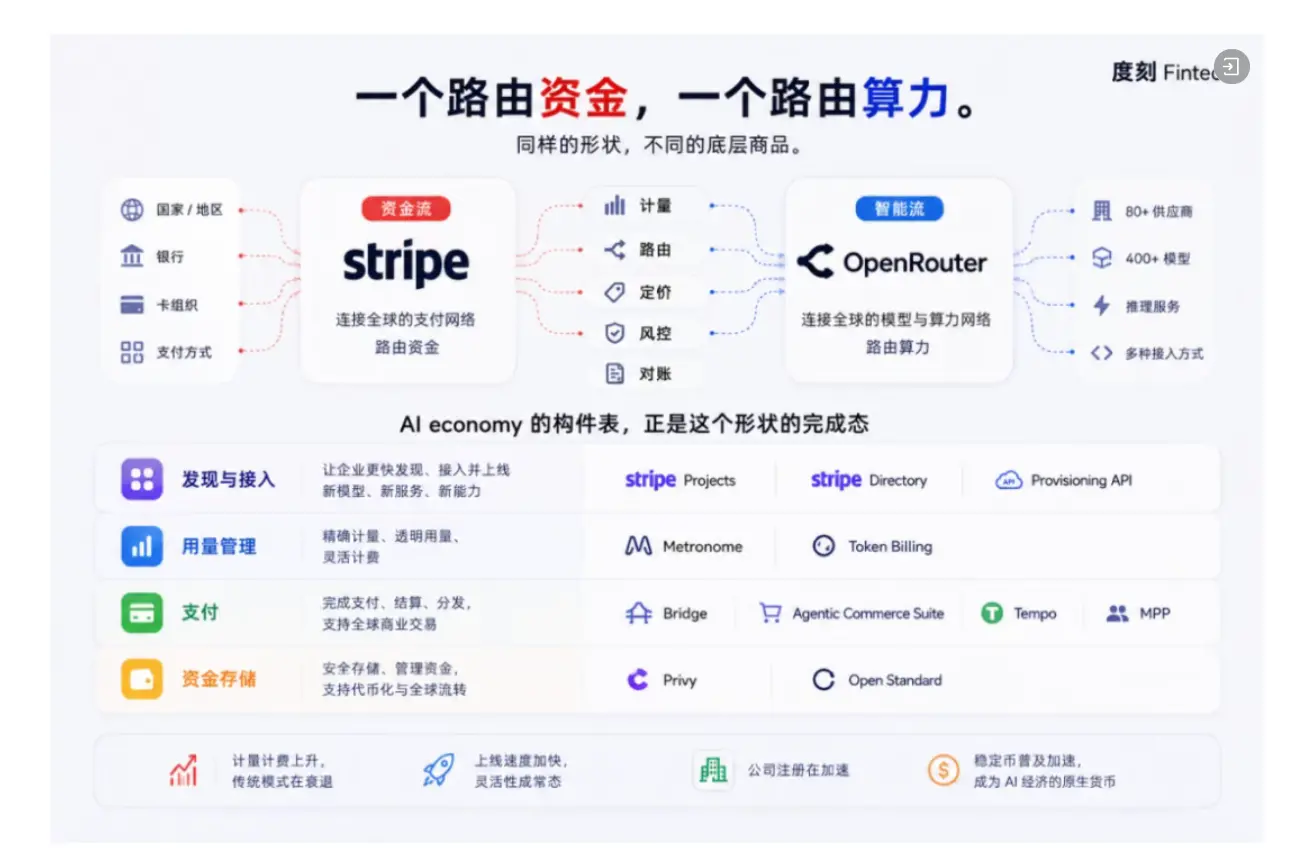
(Will token be Stripe's new dollar?)
The left column has mostly been built by Stripe itself, while the right column—Bridge, Privy, Metronome, OpenRouter—has all been acquired. The same company, the same shape, first self-built, then entirely bought. When first building, the shape did not exist, and they had to explore it themselves; the second time, the shape is clear, and the only question left is who will stand in the position first. The acquisition is not about revenue but time.
When Stripe acquired OpenRouter, what it essentially purchased was a measuring tool. The transition from measuring tool to balance sheet is the leap into the last cell.
First look at accounts. Today's token balance does not yet qualify as an account; it resembles a prepaid card: prepayable, non-transferable, not cross-platform, bound to a single issuer. However, OpenRouter's balance can be spent across over 400 models and dozens of vendors, marking a step away from a closed loop toward an open loop.
Prepaying means the platform receives cash upfront, with capital retained on the platform. Moving further toward an open loop touches upon the definition line of stored value payment tools. Should this float be earned? That is a question for the license to resolve.
Next, consider credit. Beyond prepay, post-pay credit terms are similarly common. In the cases we've encountered, credit rates fall between 1.5% to 2% monthly, with annualized rates between 20% to 27%, aligning with credit card standards. This is precisely the pricing appropriate for a market without credit scoring. The interest spread will first be compressed at the routing layer because only that layer can see who is opening multiple accounts, whose consumption curve is stable, and who runs off after taking advantage.
Finally, there is foreign exchange. With over 400 models, pricing is set for input, output, and caching, with prices constantly fluctuating; each routing instance is a currency exchange. It resembles foreign exchange but lacks one crucial element: there is no base currency. Any model's token cannot serve as a benchmark. This is not a currency exchange market but a multilateral barter of 400 types of goods, disguised as one market via a unified API interface.
Holding onto retained funds while displaying accounts receivable. This is not a developer tool's balance sheet but that of a payment company.
Tokens are measured, dollars are accounted for.
6. Who Quotes for Results and Pays for Certainty
Payments took twenty years to line up these five layers. Tokens do not require those twenty years.
The former questions survival, while the latter questions resources.
However, the real standard of assessment is: when a routing can dare to quote for “completing a task” rather than taking a cut per token, and pay for certainty.
At that moment, it will no longer be routing.
Crude oil has Platts, credit has S&P, but neither engages in the very things they measure—Platts does not produce oil, and S&P does not extend credit.
Intelligence does not yet have such an institution, even though billions of transactions occur daily.
This article is an analysis of industry structure meant for discussion purposes, not constituting investment or legal advice under any jurisdiction. All regulatory qualitative assessments should be based on the latest statements from relevant regulatory authorities and case facts; some data comes from single sources, and discrepancies in caliber have been noted. It is advisable to verify specific citations independently.
免责声明:本文章仅代表作者个人观点,不代表本平台的立场和观点。本文章仅供信息分享,不构成对任何人的任何投资建议。用户与作者之间的任何争议,与本平台无关。如网页中刊载的文章或图片涉及侵权,请提供相关的权利证明和身份证明发送邮件到support@aicoin.com,本平台相关工作人员将会进行核查。

