Written by: Rita
Oracle's remaining performance obligations (RPO) for F1Q27 reached $66.4 billion, an increase of $26 billion quarter-on-quarter and 46% year-on-year. Revenue from cloud infrastructure (IaaS) was $7.4 billion, up 121% year-on-year. JPMorgan reaffirmed its overweight rating in a report released on September 11, 2026, with a target price of $200. The market's debate over Oracle's funding issues has not subsided.
JPMorgan believes that new AI contracts exceed $30 billion, primarily signed under prepayment or bring-your-own-hardware (BYOH) structures, requiring no additional cash from Oracle. Investors continue to debate whether Oracle can navigate the peak in capital expenditures after FY28. Performance data has addressed doubts about the revenue path, while the funding path remains the focal point.
IaaS Growth of 121% Exceeds Consensus
Oracle's total revenue for F1Q27 was $19.35 billion, a year-on-year increase of 30%, surpassing JPMorgan's expectation of $19.25 billion and the market consensus of $19.13 billion. Cloud revenue was $11.6 billion, up 62% year-on-year, of which IaaS contributed $7.4 billion, a year-on-year growth of 121%. SaaS revenue was $4.2 billion, up 10% year-on-year, while software revenue was $5.6 billion, down 3% year-on-year.
Gross margin was 61.0%, below JPMorgan's and the market consensus of 62.0%, primarily affected by the ramp-up costs of data centers and the infrastructure mix. Operating profit was $8.15 billion, with a margin of 42.1%, in line with JPMorgan's expectations. Earnings per share were $1.92, higher than JPMorgan's expected $1.76 and the market consensus of $1.75, with the upside primarily coming from below-operating-line items.
Backlogged Orders Increase by $26 Billion Quarter-on-Quarter
RPO reached $66.4 billion, a year-on-year increase of 46%, with a quarter-on-quarter increase of $26 billion. This quarter added over $30 billion in AI cloud contracts, and management clarified that these contracts still require capital expenditure but do not require additional cash from Oracle, being fulfilled through vendor financing, hardware purchases by customers, or prepayments from customers. About half of the RPO is expected to convert into revenue within 36 months.
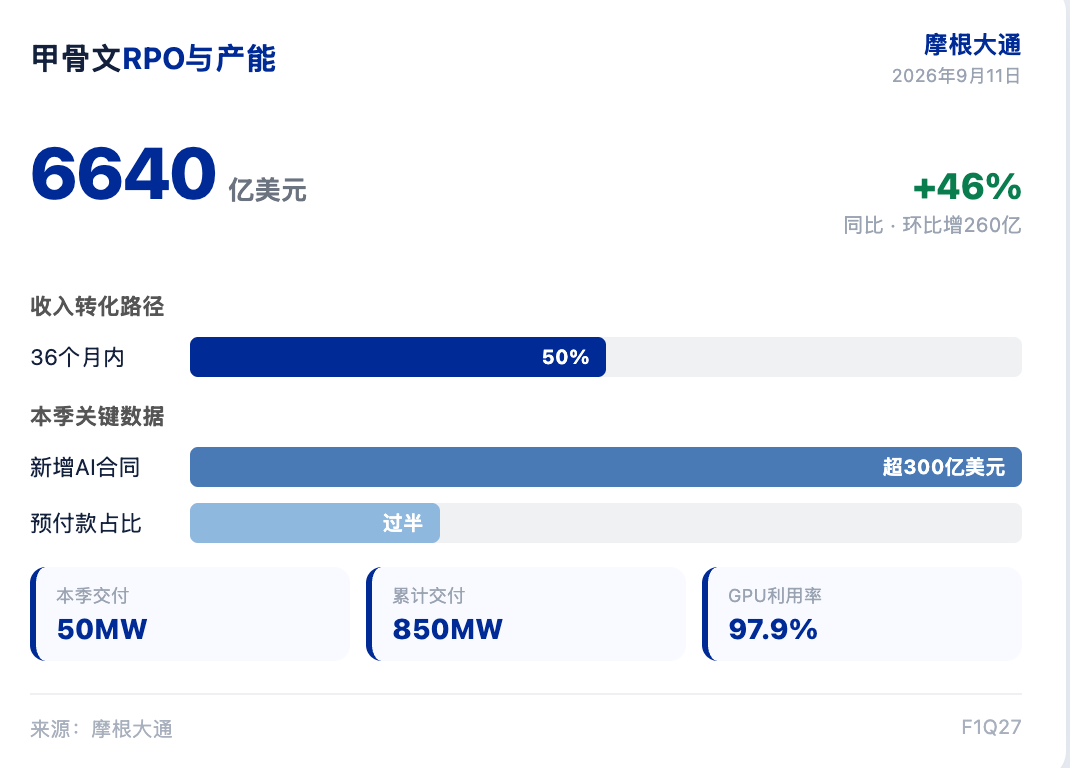
In terms of capacity delivery, this quarter delivered 50 MW, nearly three times that of the entire F4Q26, and did not include flagship sites that investors are concerned about. Since F4Q26, a total of 850 MW has been delivered, with an existing cluster GPU utilization rate of 97.9%. The Abilene site delivered 131,000 GPUs, which is 1.9 times that of F4Q, with 75% handed over. Construction in New Mexico is progressing as planned, and power design is underway for the Wisconsin grid.
FY27 Guidance Exceeds Consensus, Funding Uncertain
FY27 revenue guidance is at least $90 billion, a year-on-year increase of 34%, higher than the market consensus of $89.6 billion. FY27 earnings per share guidance is $8.10, above the market consensus of $8.0. Capital expenditure guidance is $90 billion to $95 billion, with net cash capital expenditures not exceeding $70 billion, indicating $20 billion to $25 billion from prepayments and vendor financing offsets.
Management reiterated that FY27 and FY28 are peak capital expenditure years but did not provide a timeline for turning free cash flow positive. JPMorgan expects Oracle to average over $20 billion in financing in the coming years, with free cash flow still negative until FY30. Investors are concerned that tightening access to credit markets or stock markets may force Oracle to slow down construction or finance with dilution terms.
Target Price of $200, Valuation at a Discount
JPMorgan's target price of $200 is based on approximately 13 times EV/adjusted operating profit, corresponding to a 2028 operating profit forecast of $62 billion. The current price is $152.94 (September 10, 2026), with an upside potential of about 31%. Oracle has a significant valuation discount compared to peers in AI infrastructure and enterprise software companies, and JPMorgan believes that profit growth and valuation reevaluation provide upside opportunities.
Risks include customer concentration, with OpenAI directly or through the Stargate project accounting for over 50% of Oracle's RPO. If key customers reorganize, reduce, or fail to meet their commitments, the RPO may overestimate recoverable revenue. Funding acquisition and capital costs, capacity delivery, and margin slope are also downside risks.
The revenue path for Oracle has become clear, but the funding path remains a hurdle that the market needs to overcome.
Disclaimer
This article is a summary and interpretation of third-party brokerage research reports (JPMorgan, September 11, 2026) by Chaoxiang Research, combined with publicly available market information. The ratings, target prices, profit forecasts, and related judgments quoted in this article reflect the views of the analysts at the brokerage and represent their institution's stance, not the views of Chaoxiang Research, and do not constitute any investment advice.
The market has risks, and decisions must be independent. This article should not be taken as a basis for buying or selling any securities.
免责声明:本文章仅代表作者个人观点,不代表本平台的立场和观点。本文章仅供信息分享,不构成对任何人的任何投资建议。用户与作者之间的任何争议,与本平台无关。如网页中刊载的文章或图片涉及侵权,请提供相关的权利证明和身份证明发送邮件到support@aicoin.com,本平台相关工作人员将会进行核查。


