Author: Bitquery Research
Translation: Deep Tide TechFlow
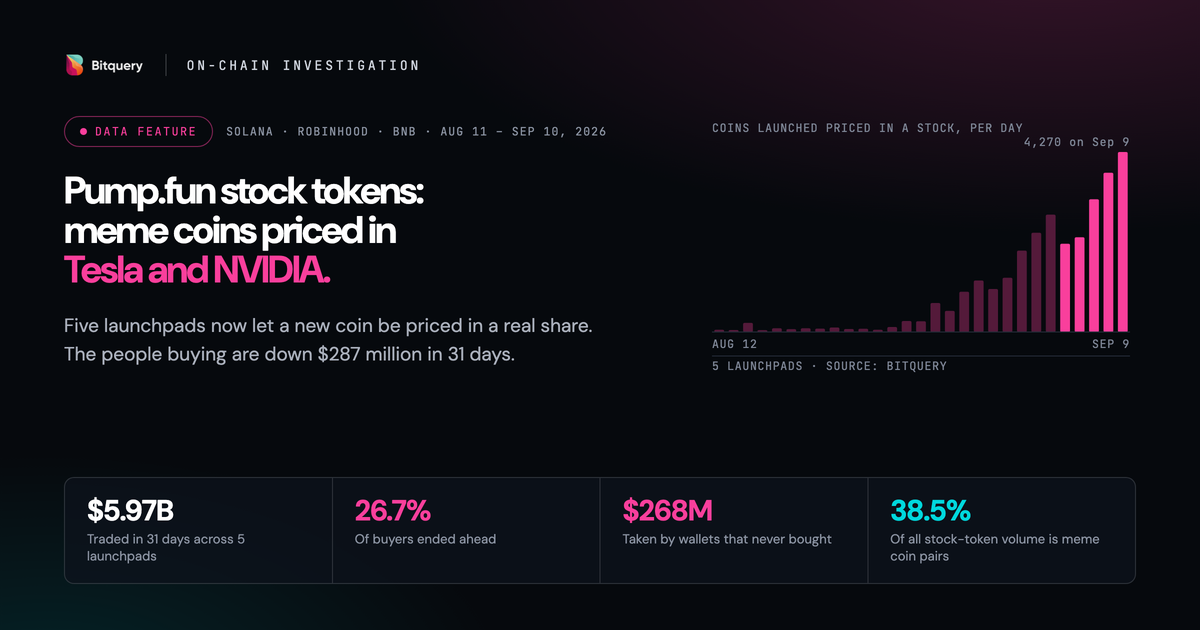
Deep Tide Overview: Pump.fun launched Custom Pairs on September 9, allowing creators to price meme coins using tokenized Nvidia, Tesla, and S&P 500. Bitquery reported 43.3 million transactions and 148,000 coins across five launch platforms in 31 days: nearly three-quarters of buyers are losing, with a total net loss of about $287 million; the only stable profit window is in the first 10 seconds after a coin's first transaction (yielding +18.4%); while meme coins have quietly claimed two-fifths of on-chain trading volume for tokenized stocks.
01 · The transaction you are actually making: buying a meme coin requires holding a tokenized Nvidia first
On September 9, just before 8 PM UTC, a player on Solana bought a meme coin but paid with a tokenized S&P 500 index. The payment was neither in SOL nor in USDC but in a token tracking that index.
This transaction was the first of its kind on Pump.fun. When people mention meme coins, they mostly refer to this launch platform. This feature, called Custom Pairs, allows anyone issuing a coin to choose how to price that coin: Tesla, Nvidia, Nasdaq, gold. Within 12 hours, hundreds of coins have done so.
Let’s clarify a few terms. A stock token is a token tracking real stocks, issued by a company that claims to hold that stock behind it. Backed calls it xStocks, Binance calls it bStocks, while Robinhood and Ondo use their own names. A launchpad is a site that mints new coins and immediately gives them a market. A quote asset is the underlying used for pricing the coin and something the buyer must hold before purchasing. Switching the quote asset from SOL to tokenized Nvidia means the buyer is effectively making two bets at once.
Bitquery indexed every transaction on Solana, Robinhood Chain, and BNB Chain. We took a 31-day record and picked out every transaction where one side is a meme coin and the other side is a stock token, totaling 43.3 million transactions, then tracked the funds put in and out for each wallet. We wanted to know if pricing coins with stocks would change their performance and what would happen to the buyers. Next, we traced the funds to the hands of the final recipients.
One limitation must be mentioned upfront. Our window starts from August 11 because this depth of transaction record can only go back to there. There is no full period data here; and Pump.fun’s own numbers cover just a day and a half.
02 · A competition no one announced: Five launch platforms, four weeks in time, Pump.fun arrives last
Pump.fun grabbed the attention. But it was neither the first nor the largest. Robinhood Chain’s Pons launch platform, starting from August 12, has priced coins using Robinhood’s own stock tokens, and currently, the number of similar coins is about 28 times that of Pump.fun. Raydium’s LaunchLab followed on Solana on August 24. Flap launched on BNB Chain in September. Four.meme has been quietly doing this on BNB Chain as well, calling this category Stock Memes.
Proportion is more important than number, as it indicates the real choices of creators. Today, on Raydium LaunchLab, four out of every five new coins are priced with stocks. On Flap, this proportion rose from zero to about half within three days.
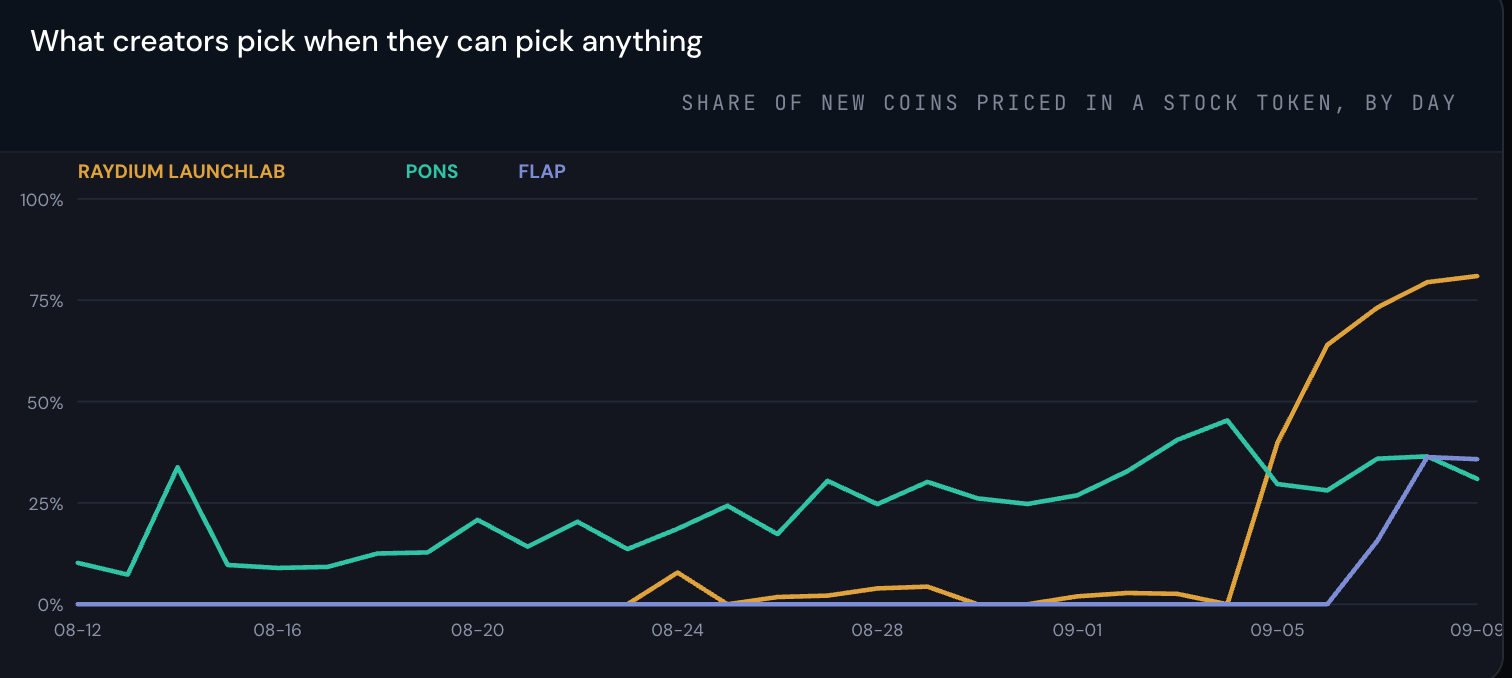
The chart: Raydium LaunchLab is the primary publishing platform, Pons is the mid-tier platform. And the Flap platform started operating in September. From August 12 to September 9, the daily issuance reached astonishing numbers: from 53 to 4,270. The chart shows data recorded until September 9, as only partial data was recorded on September 10.
Coins priced with stocks have a higher survival rate in the first hour and are more frequently listed on actual exchanges. On Pons, a typical coin survives for 14 minutes, not 5; while on all five launch platforms, a higher proportion of coins graduate from the bonding curve. Keep this in mind, as it does not necessarily indicate something good.
03 · Nearly three-quarters of buyers are losing money: $2.98 billion in, $2.7 billion out
All of the following are cash metrics. Actual dollars paid compared with actual dollars withdrawn, with no market value accounting, the reasons for which we will revisit in the methodology section.
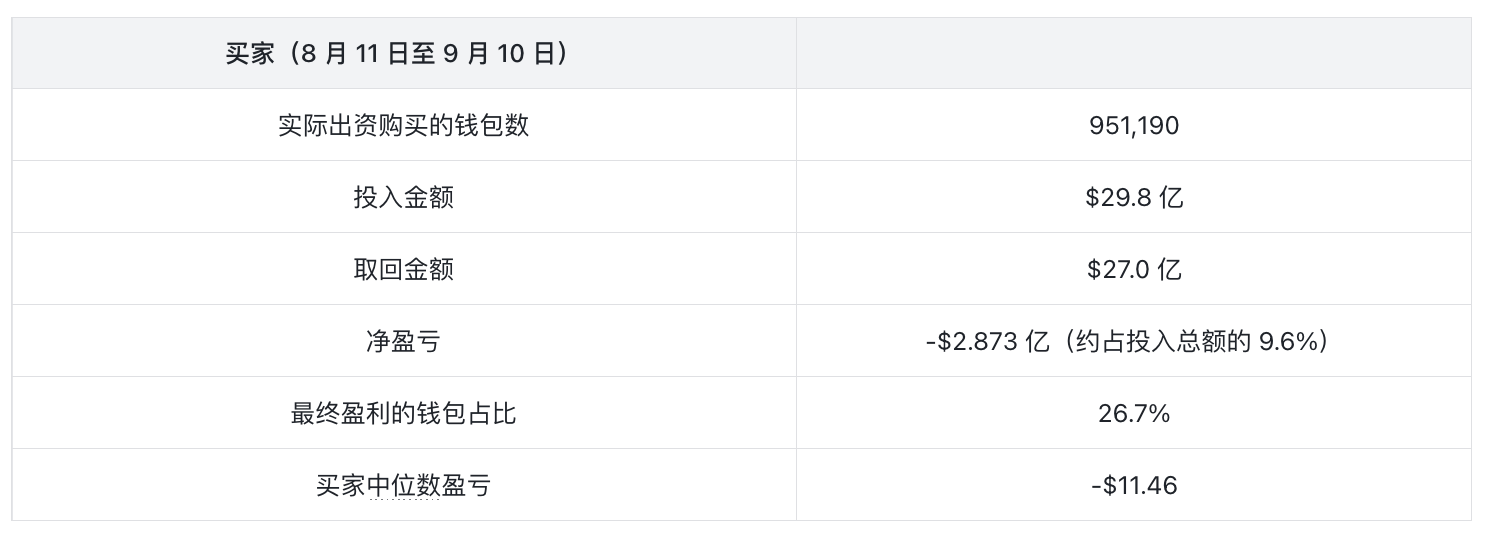
Nearly 500,000 wallets have bought at least one meme coin but never sold a single one. This group alone has lost about $302 million. Those wallets that did exit collectively netted $251 million, and this is the entire reason this market can continue to operate: enough people escaped, making it look like it can still be played.
Losses show little difference between different issuers. Whether priced using Robinhood tokens, Binance bStocks, Backed xStock, or Ondo’s products, the winning wallets ultimately account for only about one-quarter to one-third. This indicates the problem lies in the mechanism, not any single issuer. Depth is one reason: tokenized stocks are inherently thin, pushing a $10,000 order before you even add a meme coin on top of it. All of this is visible in regular DEX trading data.
Now back to the part that overturns the “survival” conclusion. On the only platform that operated two types of coins simultaneously and monthly, making a comparable analysis:
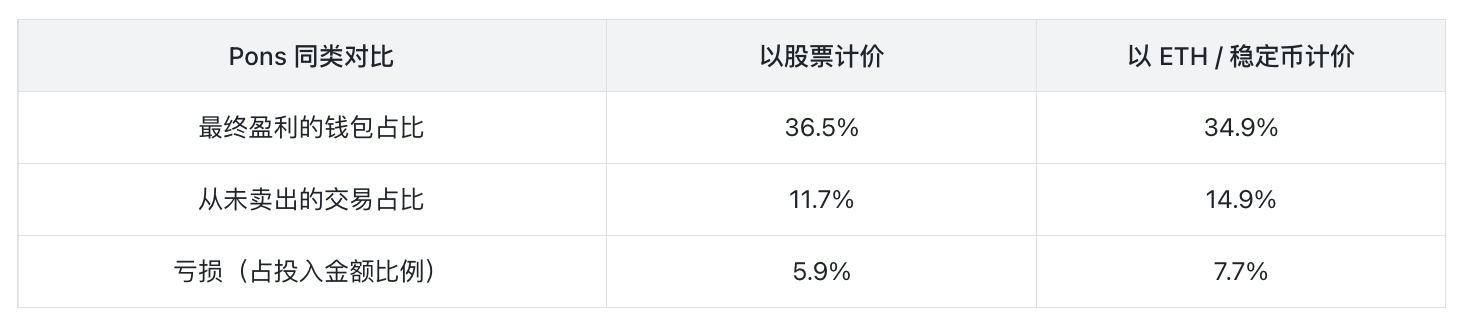
Coins priced with stocks have longer lifespans and more frequently appear on actual exchanges. But their buyers are still losing worse. A longer lifespan simply means more time to be distributed by others.
04 · On the other side of the wallets: 418 wallets took away two-fifths of the money
If buyers lost $287 million, then someone must have made money. Just find those wallets that sold a coin but never bought one, and the counterpart can easily be identified: creator chips, development team allocations, airdrops. There are about 264,000 such wallets, which took away $268 million without spending a dime. This is equivalent to 93% of the losses incurred by buyers, just in the opposite direction.
Funds are highly concentrated. A small number of wallets appear across thousands of different coins.
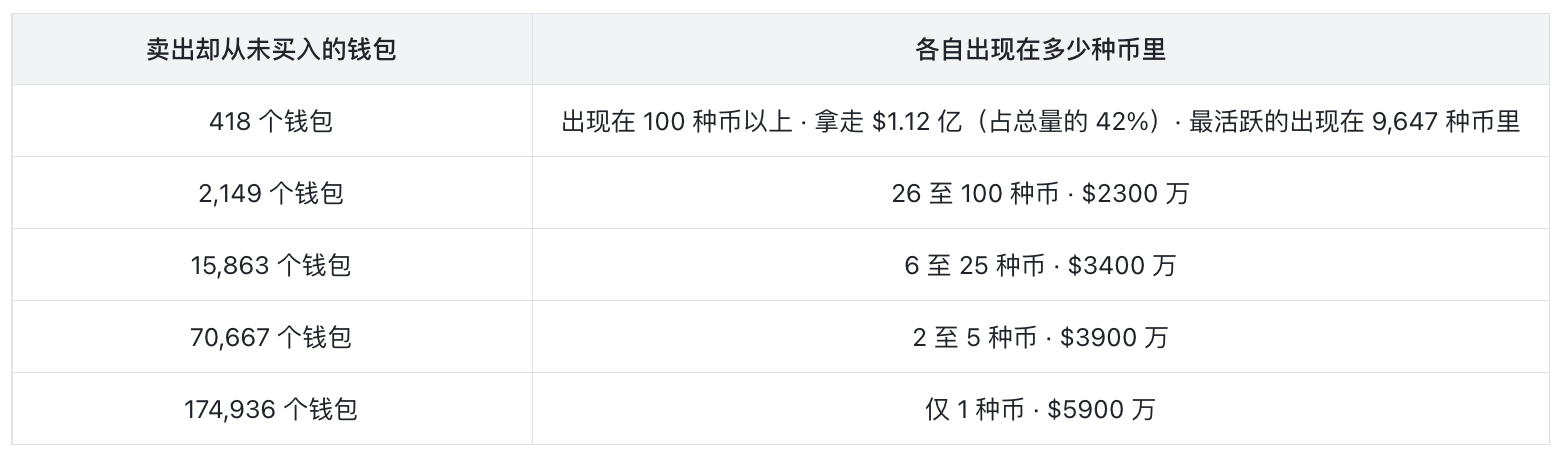
The head of this row is a scalable operation business. The long tail under it actually exists but is small. Once grouped by wallets, the funding flow tools make this shape clear at a glance.
05 · Ten seconds: the only profitable entry window
Sorting each transaction by how long after the coin's first trade the buyer arrives yields a cold and clear answer.
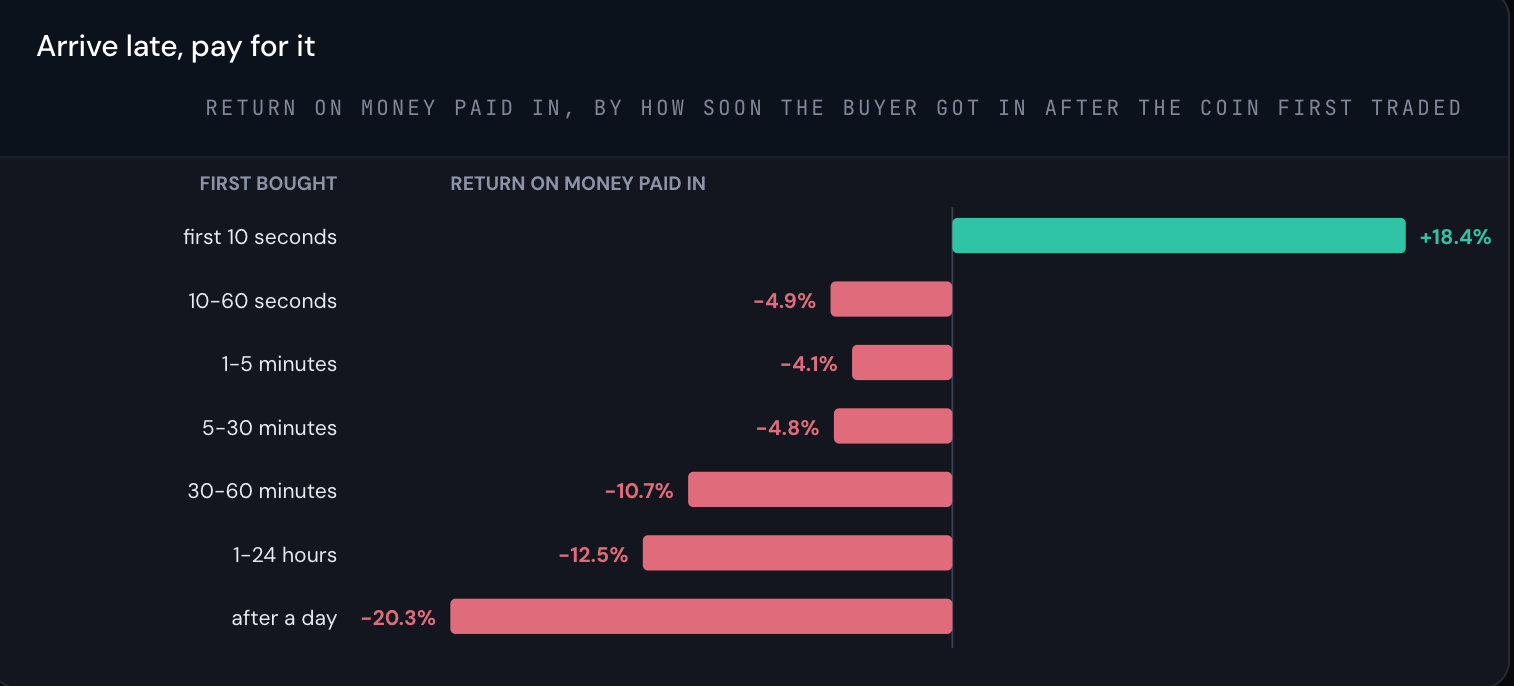
The chart: The first ten seconds is the only time that can yield positive returns. After that, price depreciation is monotonic: if a buyer waits a day to act, they will lose more than one-fifth of their investment amount. About one in ten transactions occurs in that initial time period, the time when others are trading.
Winning here relies on skill, and almost no one has mastered it. Splitting each active wallet’s transactions into two halves shows a win rate correlation of only about 0.5, so leaders often maintain their lead. The discrete degree of the win rate is more than twice what pure luck could produce. Even so, only about one percent of active wallets have a win rate exceeding 75%.
The volume itself is real; this is worth confirming before someone shifts the blame for wash trading. Cases where the same wallet buys and sells the same coin in a single trade account for less than 1% of total transactions, about 2% of the total volume, and it’s the same in Pumpswap or anywhere else. This volume is real people losing real money.
06 · The stock side has done almost nothing: you got a six-minute meme coin, not a stock exposure
Buying a meme coin priced with Nvidia is like making two bets: the coin against Nvidia and Nvidia against the dollar. These two bets are clearly separated; in 710,000 closed round-trip transactions, the second bet showed almost no fluctuation.
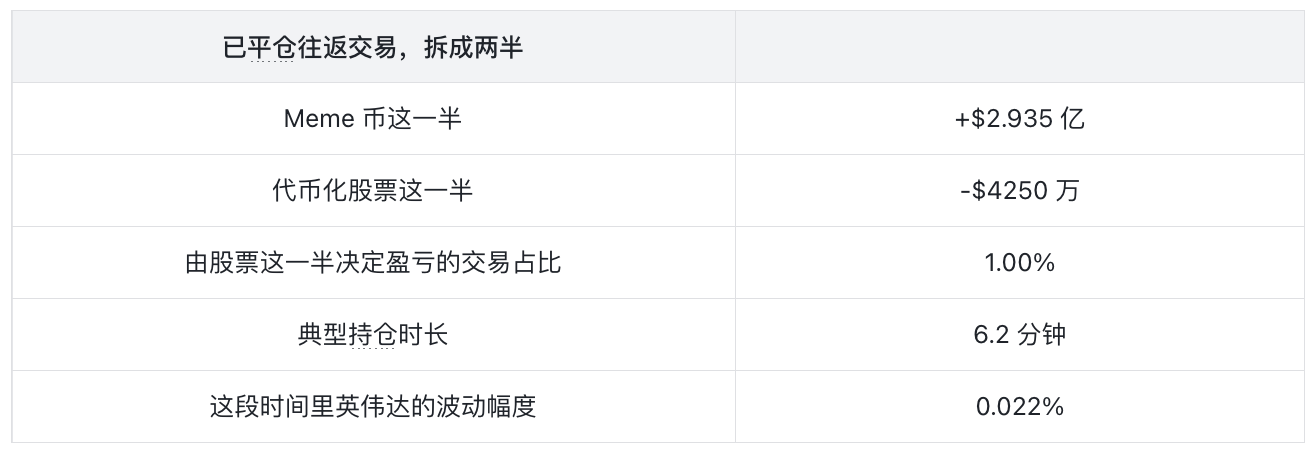
Six minutes is the entire story. A blue-chip stock hardly moves in six minutes, so the stock displayed on the face is more of a label than a position. On the stock side, it indeed costs money in the long run, about $23 million on trades held from one day to a week, and it has almost never chosen the right winner. The only exception is Four.meme’s tokenized Cea Industries: this is a very small, very volatile stock, fluctuating about 60 times more within the same holding time compared to a Nasdaq token, where the priced assets begin to take effect. The price sources make this easy to verify.
07 · A market ignoring trading hours: Four-fifths of transactions occur when the exchange is closed
The assets these coins are priced with can only be traded for about 32 hours a week elsewhere. Yet these coins trade around the clock.
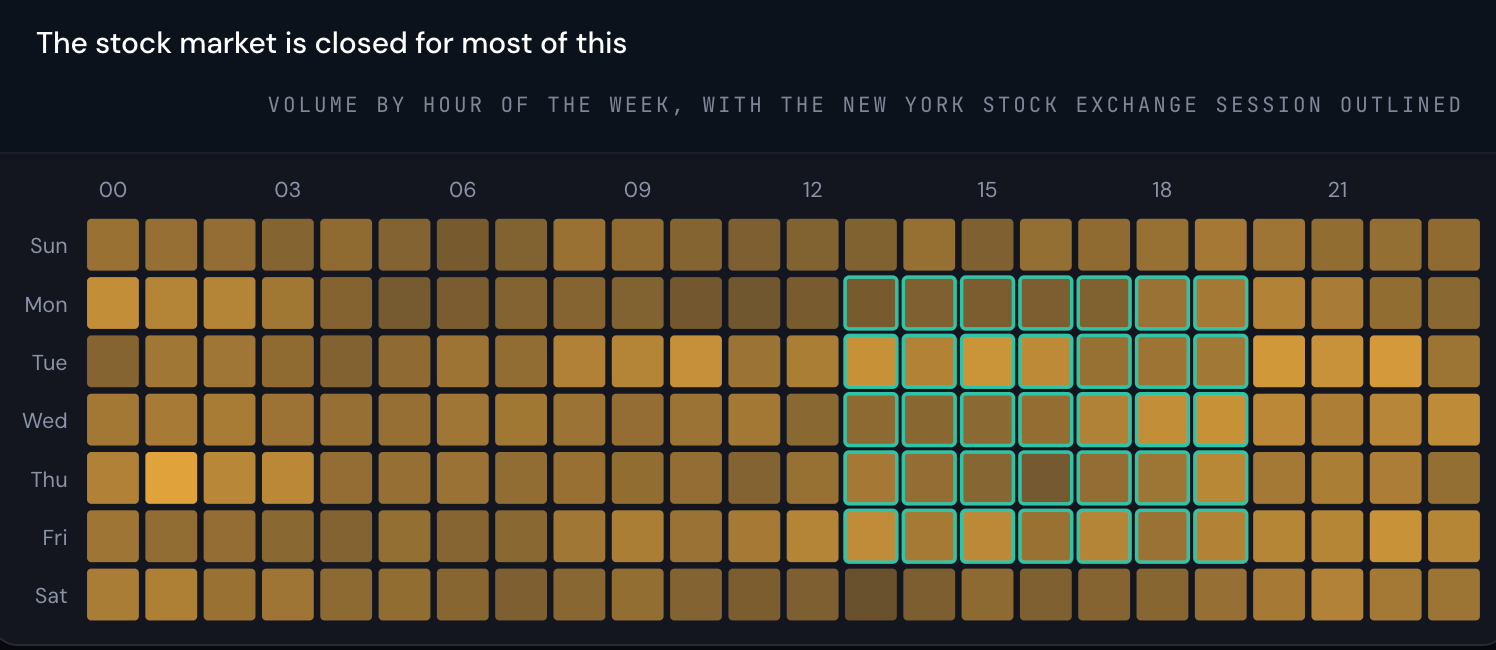
The chart: Each cell represents one hour of time, with shading indicating different levels of activity. Cells with outlines indicate time between 09:30 and 16:00 New York time. This period accounts for 19.3% of the week and 20.8% of total flow, so overall activity remains relatively stable in this entire period. Just the weekend period accounts for about a quarter of total flow.
No one is watching the opening bell here. When we observed Binance bStocks trading at 3 AM earlier, we saw the same thing; and now, listing a meme coin sharpens this pattern.
08 · What this means for issuers: Meme coins now account for two-fifths of the trading volume for tokenized stocks
This is the finding that should be spread the most, and it is not at all about meme coins. Taking every transaction touching these 403 stock tokens in the window, regardless of which side it is on:
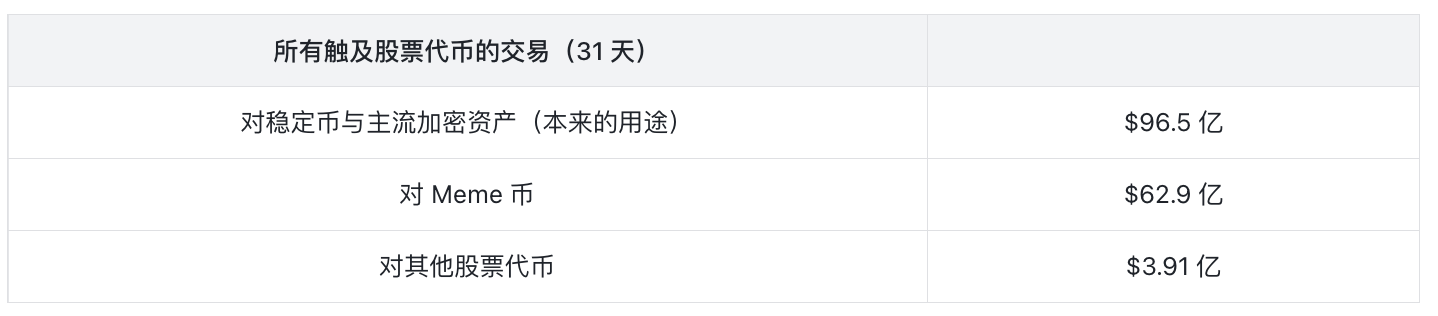
Now, two-fifths of on-chain turnover for tokenized stocks is settled with meme coins. For Backed, Ondo, Binance, Backpack, and Robinhood, this has become the largest head for their products to be truly used, with not a single launch and no press release. When we mapped the xStocks market on Solana earlier this summer, this channel was still just a footnote. On BNB Chain, Four.meme mints stock tokens whenever a code becomes popular, and now this has become the focus.
09 · How we calculate: sample scope, barriers, and discarded data
A quote asset only counts if minted by an issuer of a stock token: Robinhood Chain tokens, Binance bStocks, Backed xStocks, PreStocks, Backpack Securities, Ondo Global Markets, Four.meme’s stock tokens, and Robinhood’s pre-IPO and Korean listing targets. This totals 403 tokens. Searching by name here will fail because it will drag in meme coins called "Stock Cat" while completely missing Binance's bStocks. Those using plain company names like NVIDIA Corp have no issuer marking, accounting for 40% of the market.
Trading pairs were collected from both directions. Most venues treat securities as quote assets, reversing around 600,000 transactions with securities as base assets. These are in different funding pools and do not overlap data.
Four items have been removed, each of which would generate erroneous figures. Robinhood Chain's Uniswap v4 hook writes the fee for each swap as two additional swap records, accounting for over a quarter of that venue’s lines not being trades; this also incidentally exposes the fees, 1.14% per swap, totaling about $35 million over a month. Transactions between two stock tokens constitute a real market but are another market. A single funding pool has 201 lines, with amounts that the largest 64-bit counters can encompass, which is a decoding artifact. Valuing unsold holdings at the last transaction price would artificially create $2.39 billion in "profit", with one position showing a cost of $383 valued at $363 million, which is why there are no metrics based on market value here.
Two points we do not want to claim: the buyer comparison in section three comes solely from one launch platform, as it is the only one that operated both types of coins simultaneously for a whole month. Moreover, the Custom Pairs of Pump.fun are not only using stocks: alongside them are coins priced with PUMP, USDC, and wrapped Bitcoin. All this data was pulled using Bitquery’s trading API.
免责声明:本文章仅代表作者个人观点,不代表本平台的立场和观点。本文章仅供信息分享,不构成对任何人的任何投资建议。用户与作者之间的任何争议,与本平台无关。如网页中刊载的文章或图片涉及侵权,请提供相关的权利证明和身份证明发送邮件到support@aicoin.com,本平台相关工作人员将会进行核查。


