Author: Azuma, Odaily Planet Daily
From Strategy to Bitmine, in the past two years, we have witnessed the rise of many cryptocurrency treasury companies (DAT) — some have hoarded massive amounts of BTC through continuous financing, while others have made large bets on ETH and other alt-assets through different approaches, and some originally unremarkable listed companies have transformed into agents of crypto assets in the public stock market using this model.
This model was once quite effective; as long as the company's stock could obtain a premium above net asset value, it could continue to finance, continue to buy coins, and further boost market attention… But have you ever thought, if one day this game could no longer be played, how should a cryptocurrency treasury company exit?
Today, we are gradually witnessing the answer to this question with the UK-listed company Satsuma — sell BTC, close the business, return the majority of the capital to shareholders, and then actively exit the stock trading market.
With the planned delisting date of September 14 officially arriving, Satsuma is about to become the first case in the treasury craze of the past two years to complete the process of "liquidating BTC → returning capital → ultimately delisting" — although there have been similar cases before, Profusa ultimately maintained its listing status while facing delisting pressure, and DigiAsia chose to delist due to restructuring, which is different from Satsuma.
How did Satsuma reach this point?
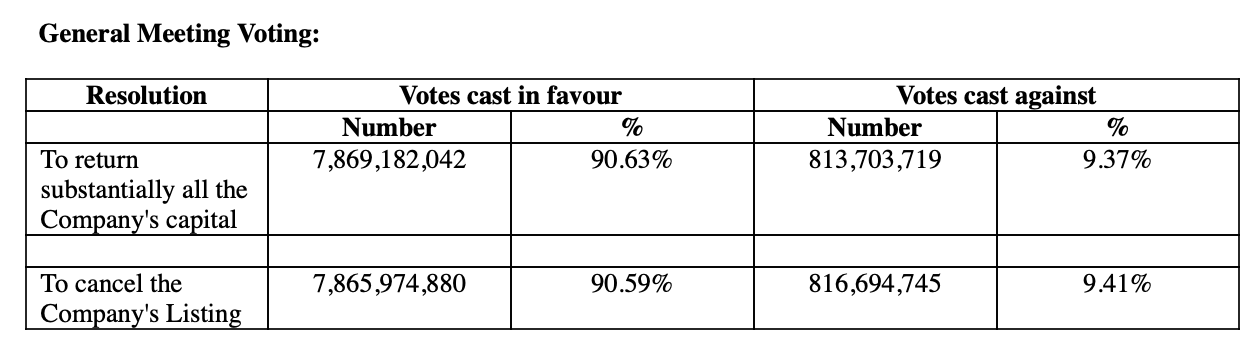
On July 20, 2026, Satsuma held a shareholder meeting to vote on two special resolutions: one was to return the vast majority of the company's capital to shareholders; the other was to cancel the company’s listing qualification on the FCA Official List.
The outcome was not surprising, the first resolution received 90.63% of votes in favor, while the second one gained 90.59% approval. After the shareholders voted in favor, the board began preparing to close the company's trading activities and proceeded to sell off the remaining 669 BTC holdings.
This was not a sudden decision. In fact, Satsuma’s BTC treasury strategy had long been in trouble. Since shifting to the treasury route, Satsuma had accumulated 1199 BTC, but with an average cost of over $113,000, as the price of BTC fell, the value of BTC assets on the company's books rapidly diminished, while the valuation given by the capital market continued to decline.
In December 2025, Satsuma sold 579 BTC in one go, accounting for about half of its holdings, raising around £40 million (at a unit price of about £69,084, equivalent to approximately $93,057 at the current exchange rate), but the purpose of this transaction was not to actively reduce BTC exposure, but to address liquidity pressures — the company needed to repay a convertible bond maturing that month, amounting to around £78 million. However, the subsequent situation did not improve, with BTC prices continuing to decline, leading to increased cash flow pressure for Satsuma.
At this point, the reverse drawbacks of the BTC treasury model began to fully expose themselves in Satsuma — when a company needs to rely on selling BTC to pay off debts, the original cycle of "financing → buying coins → refinancing" becomes very difficult to continue.
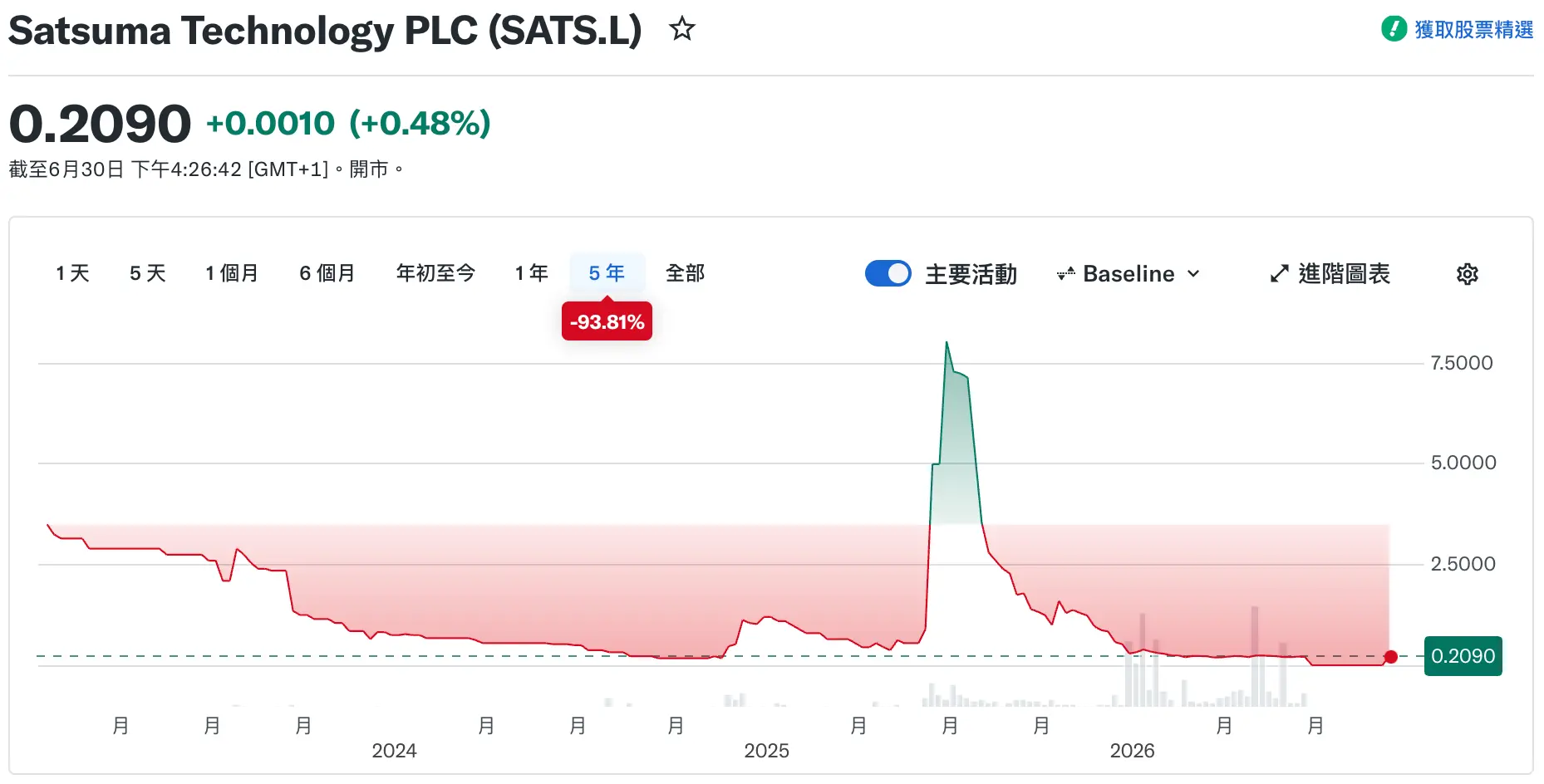
The performance on the stock side was even more dramatic; at its peak in June 2025, by the time of the delisting vote in July this year, Satsuma's stock price had cumulatively fallen by about 99%, and its market value even at times dipped below the value of the BTC it held.
In other words, the market was no longer willing to pay a premium for this BTC treasury company, thus the significance of maintaining this listed entity itself began to be questioned. In April 2026, one of Satsuma's largest institutional shareholders, Pantera Capital, publicly requested that the company abandon the treasury model, sell the remaining BTC, and return cash to shareholders. Subsequently, shareholders holding over 20% of the company's shares jointly requested a shareholder meeting, ultimately driving forward the capital return and delisting proposal.
In the end, over 90% of shareholders chose to support capital return and delisting, thus Satsuma officially ended its story as a BTC treasury company.
What steps does a DAT take to voluntarily delist?
The remaining question is how the delisting should be executed, and Satsuma has personally provided a complete demonstration for the market.
The first step is for the shareholder meeting to pass a special resolution. The company cannot simply decide to shut down the listed entity based on board decisions. Satsuma first needed to get shareholders to vote on whether to agree to return capital and cancel the listing qualification.
The second step is to determine the final shareholders entitled to capital return and the number of shares. Satsuma chose to conduct capital return through "B shares," and after the registration period, the final share count was confirmed at 11,235,874,700 shares. This is important, as the amount each share can receive ultimately depends on two variables — how much remaining asset the company has and how many shares participate in the distribution.
The third step involves selling BTC, shutting down operations, and cleaning the balance sheet, which is also the most crucial step in the DAT exit process, as it means transitioning from a publicly listed company holding BTC to a liquidation entity waiting for the remaining cash to be distributed. Between July 24 and July 31, Satsuma sold all remaining 669 BTC, raising approximately £31.91 million (at a unit price of about £47,667, equivalent to about $64,226 at the current exchange rate).
The fourth step, and also a final one, is for the court to confirm the capital return plan, which is a relatively unique part of the process under UK company law. On September 8, the UK High Court approved Satsuma’s cancellation of 11,235,874,700 “B shares” and returning approximately £30.72 million to shareholders, thus the return amount for each "B share" was determined to be £0.002734.
The fifth and final step is to delist and complete asset distribution to shareholders. According to the timeline previously announced by Satsuma, the company will complete its delisting on September 14, and eligible shareholders are expected to receive their “refunds” by September 28. Only at this point can a BTC treasury company truly be considered to have completed its exit.
Another challenge for treasury companies
The story of Satsuma cannot simply be understood as a failed sample of the cryptocurrency treasury model. After all, leading companies like Strategy and Bitmine are still continuously expanding their asset base, but for smaller DATs with limited financing capacity, when BTC declines and stock prices fall below net asset value, and even financing becomes difficult, "continuing to hoard coins" is no longer the only answer.
In a sense, how to buy BTC is just the first half of the treasury company; how to exit is the second half it must confront. Satsuma's process from shareholder voting to liquidating BTC, returning capital, court approval, and final delisting also provides a complete "exit manual" for its successors.
As more companies flock to the DAT track, the market may also need to start focusing on another metric: a treasury company must not only have the capability to buy BTC but also the ability to safely return assets to shareholders when the rules of the game change.
免责声明:本文章仅代表作者个人观点,不代表本平台的立场和观点。本文章仅供信息分享,不构成对任何人的任何投资建议。用户与作者之间的任何争议,与本平台无关。如网页中刊载的文章或图片涉及侵权,请提供相关的权利证明和身份证明发送邮件到support@aicoin.com,本平台相关工作人员将会进行核查。

