Author|Li Nan
WeChat|tqkm1510
In the 1950s, psychologist Skinner, concerned about education, attended his daughter's elementary school math class and found that some students had completed their exercises while others still did not understand. The teacher could only check and correct errors among dozens of children back and forth.
This led Skinner to consider that if each child's level of understanding differs, the feedback they receive at that moment and their next learning tasks should also be different. He later designed teaching machines hoping that they could at least provide instant feedback based on students' answers and arrange the next question. This became an early attempt in educational technology to scale personalized teaching.
However, implementing personalized teaching is far more difficult than expected. Human resources are limited, and skilled teachers have always been scarce. Even experienced teachers find it challenging to capture the subtle confusions each student has at every learning stage in a timely manner, let alone reorganize the teaching to meet these needs on the fly.
After various attempts, a new generation of AI, represented by large models, has opened new possibilities for personalized teaching.
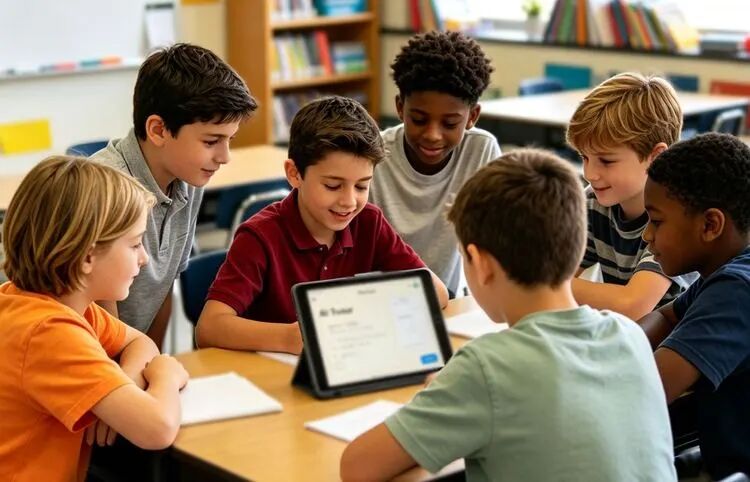
Alpha School is a radical example. It advocates that students rely on adaptive learning software and AI systems to complete core subjects such as mathematics and science in two hours every morning, and then spend the afternoon learning real-world skills such as entrepreneurship and programming for four hours. One important role of AI is to analyze students' learning status in real time and adjust the curriculum accordingly.
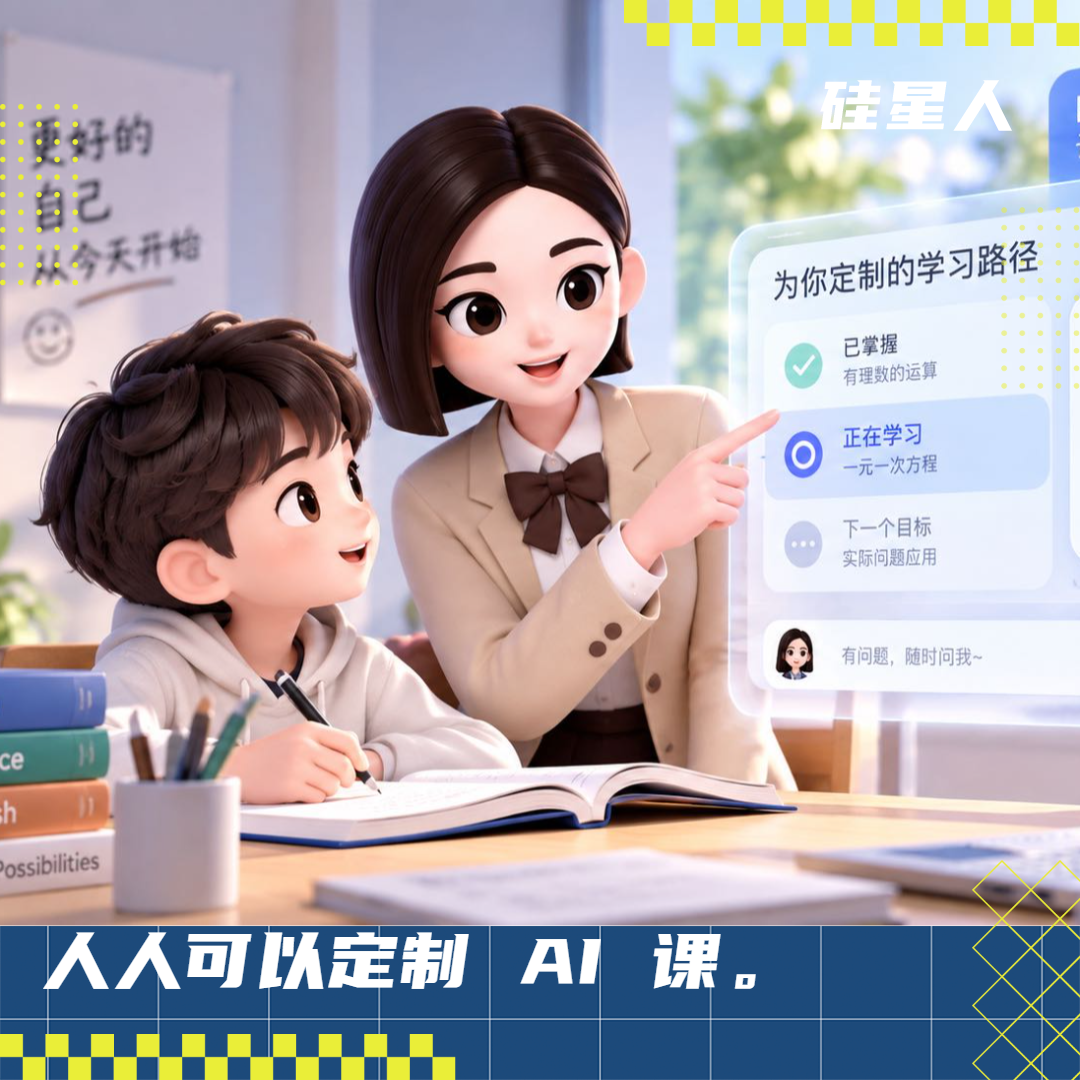
Domestic education platforms are also deeply integrating AI, with the latest example coming from Doubao Aixue. It implements personalized teaching through "one person, one solution" in various functional details of its products, not only making teaching more adaptable to each student's learning needs but also making the learning process more interesting.
1
Make every learning session receive more interesting guidance
Many industries are worth redoing with AI, and many courses are worth relearning with AI.
At the end of May, Doubao Aixue launched "Doubao Classroom," integrating the study of mathematics and ancient poetry into interactive AI courses. But more interestingly, Doubao Aixue has also achieved gamified course customization. By giving their ideas to AI, users can obtain a unique course with interactive graphics and text.
For example, merging mathematics into business practice allows users to visually understand mathematical knowledge. In one case, users transform into a young shopkeeper at an ancient pastry shop and experience "The Pastry Shop Challenge"—they must use the knowledge from math class to completely revive a nearly closed small shop in three days.
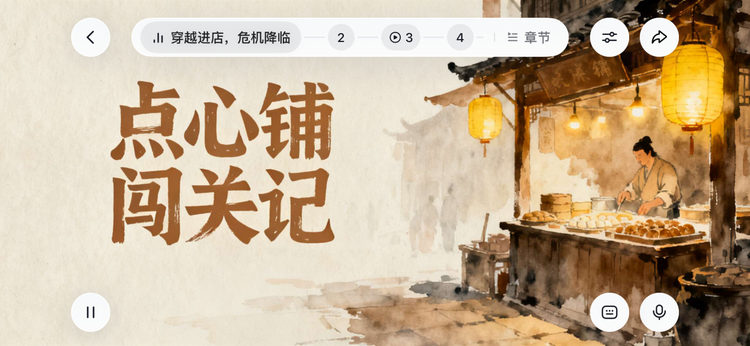
The first puzzle is "Why does osmanthus cake lose more money the more it sells?" Here, they must understand the relationship between cost and profit to ensure that selling pastries does not incur losses.
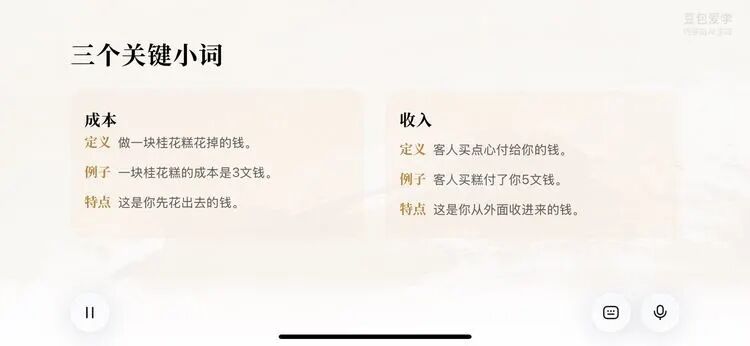
The second challenge is inventory issues. Here, they must learn to compare the possible leftovers or shortages that could arise from different stock quantities and understand how averages can help make judgments.
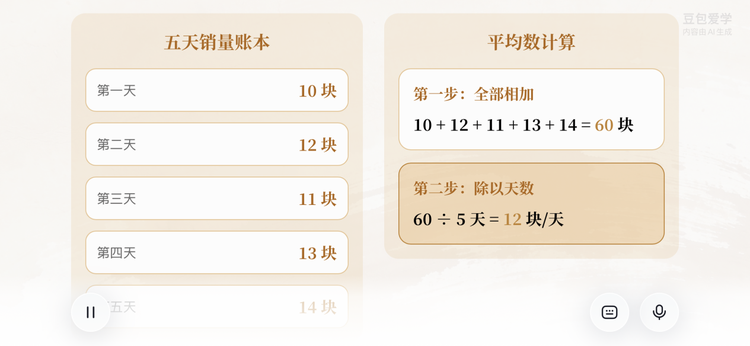
The third challenge is a promotional stage. Many business owners like to run buy-two-get-one-free promotions, but promotions aren't always wise. Here they use proportions, comparisons, and profit calculations to assess the feasibility of promotional activities.
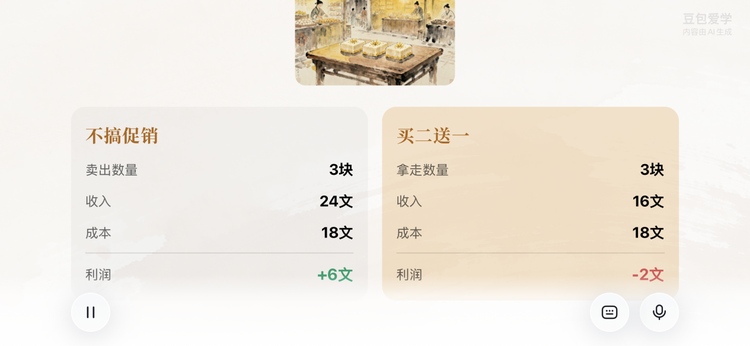
Finally, users will face the ultimate challenge. They must compile the knowledge learned over three days into a "Young Shopkeeper's Secret Manual," reviewing the calculations for pricing, inventory estimates, and promotional judgments, thus becoming a small expert in business.
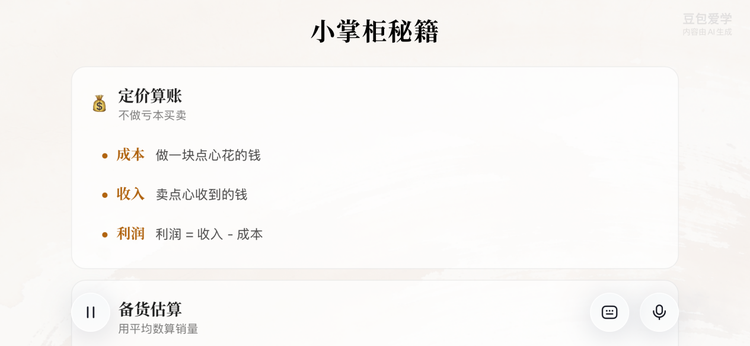
From an adult's perspective, this game might seem a bit childish. But from an elementary school student's viewpoint, the psychological satisfaction gained from the interactive challenge is far stronger than that of traditional learning processes. Moreover, this interactive course not only teaches users mathematical calculations but can also subtly promote business enlightenment, achieving multiple benefits.
Extensive educational research has shown that embedding knowledge within specific problem contexts helps enhance learning interest, as well as better train knowledge transfer, problem-solving, and comprehensive application abilities. For Doubao Aixue, AI interactive guidance can be widely customized.
In addition to Doubao Classroom, Doubao Aixue's "Q&A" page also provides personalized teaching. By opening the "Learning Mode" and entering various topics they wish to learn about, AI can call upon different abilities to provide answers.
I tried to revisit my middle school Chinese language class here.
First was Lu Xun's "From the Hundred Grass Garden to the Three Flavor Bookstore." Doubao Aixue first presented two learning options: either start from the perspective of childhood and follow the footsteps of young Lu Xun to feel the freedom and constraints of childhood; or start from an adult perspective to view Lu Xun's complex reflections on education and self hidden behind the childishness.
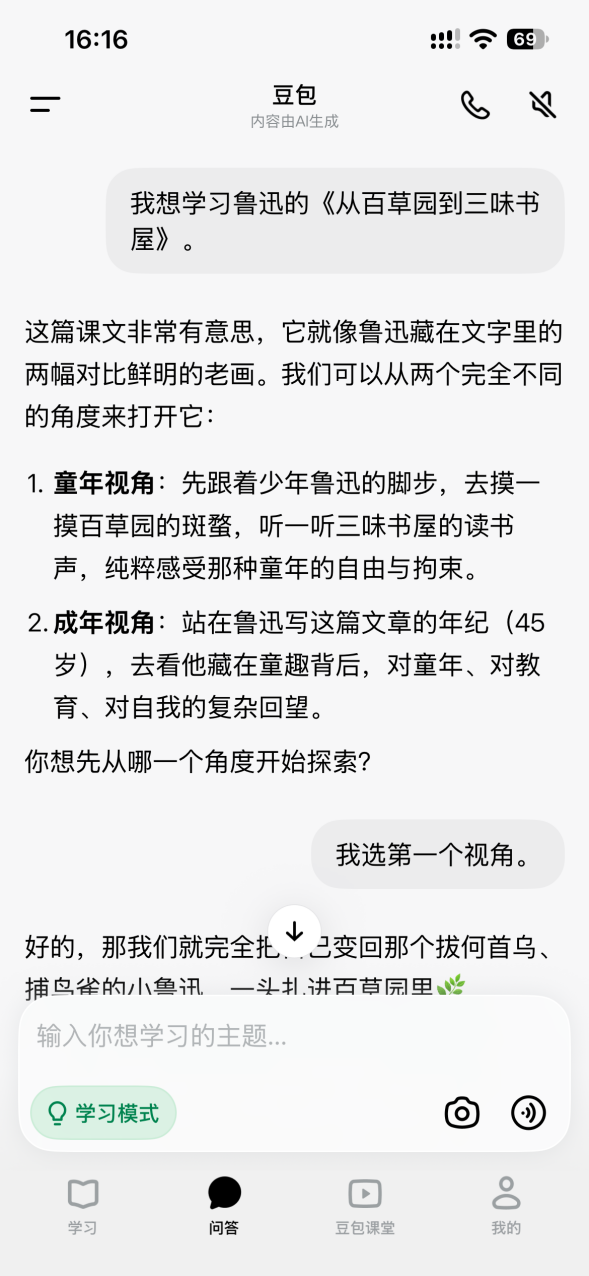
I chose the first perspective. Then "Teacher Dou" listed the wonders of the Hundred Grass Garden one by one, and then posed a question, asking me to think if there was a small corner in my childhood memories similar to the "Hundred Grass Garden." Clearly, this aims for students to resonate and empathize with Lu Xun, enhancing their understanding of the article.
I also attempted to learn poetry from "Dream of the Red Chamber." "Teacher Dou" first pointed out the uniqueness of Cao Xueqin's poetry—not for the sake of description but as "a metaphor for character fates + character stamping," and then provided three different difficulty levels to develop teaching interactions around the poetry from "Dream of the Red Chamber."
Overall, in the "Q&A," Doubao Aixue provides enlightening teaching based on the student's level of knowledge and interests.
In fact, Doubao Aixue's "Q&A" serves as a super entry point, integrating various learning skills beyond the targeted interactive guidance mentioned above. During the learning process, the system automatically calls upon different skills to generate tailored learning tools based on specific situations.
If a child needs to learn to write, it can generate stroke order learning components to visually guide how to write each stroke. When learning mathematics, it can outline vertical calculations to clearly present how to solve division problems. These small scenarios are extremely frequent during learning but have not been well addressed by general AI.
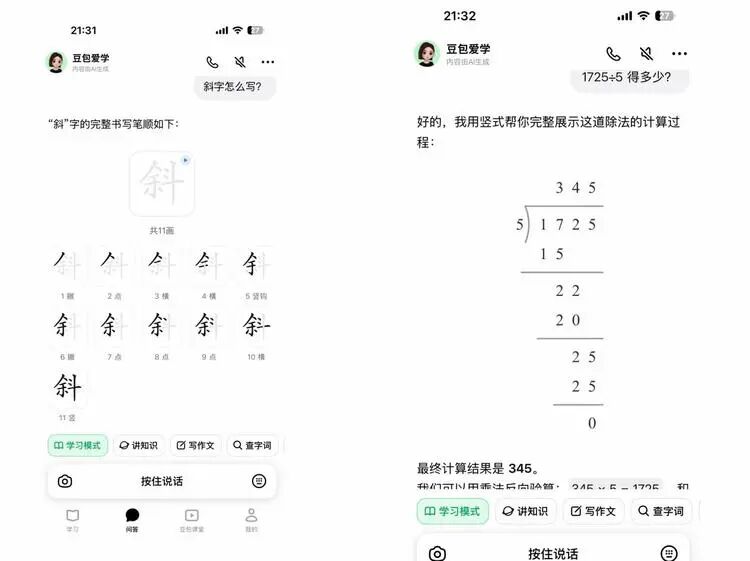
Furthermore, Doubao Aixue will recommend corresponding quiz questions during the Q&A interactive process based on the learning content and progress to reinforce learning results. In random learning experiences, I have also relearned about the "phases of the moon" in astronomy and the role of the Great Wall in history.
Additionally, it is worth mentioning that Doubao Aixue has introduced the ability of interactive webpages to enhance the effectiveness of personalized guided teaching. When dealing with knowledge such as functions and geometry, AI can generate learning pages with animations and interactions in real time.
Overall, Doubao Aixue has achieved personalized and engaging teaching guidance on any topic or knowledge point, providing teaching content that matches user needs.
1
Two Routes Converge, Expanding the Boundaries of Personalized Teaching
In the past year, mainstream products in the AI education sector have continuously promoted personalized teaching, with explorations roughly divided into two routes.
One route focuses on enabling AI to learn "teaching." Last July, OpenAI launched ChatGPT Study Mode. When a student seeks help with a problem, AI first asks what the student already knows and where they are stuck, then through prompts, probing questions, and comprehension checks, moves step by step downwards, avoiding providing all answers at once.
The previously mentioned Alpha School operates in a similar way. One of its core capabilities is to enable the system to more accurately judge what students know and do not know at present, as well as the pace at which they should progress in their learning.
The other route emphasizes the learning content itself. Google’s "Learn Your Way" reorganizes textbook content based on students' grades and interests, further generating mind maps, audio courses, and interactive quizzes. The same knowledge point can be presented with different difficulties, examples, and formats for different students.
Doubao Aixue integrates these two routes. It organizes the same knowledge point into different formats such as AI courses, interactive webpages, and situational tasks, and also selects different entry angles based on the questions raised by students, their current understanding, and learning preferences, guiding in steps and providing immediate follow-ups.
This integration can match different subjects, themes, and learning stages, allowing personalized teaching to enter a dynamic "atomized" phase: on one hand, the responsive unit of personalized teaching is narrowed down to specific learning needs; on the other hand, these teaching contents and actions can be generated instantly upon the emergence of needs, and continue to adjust based on student feedback.
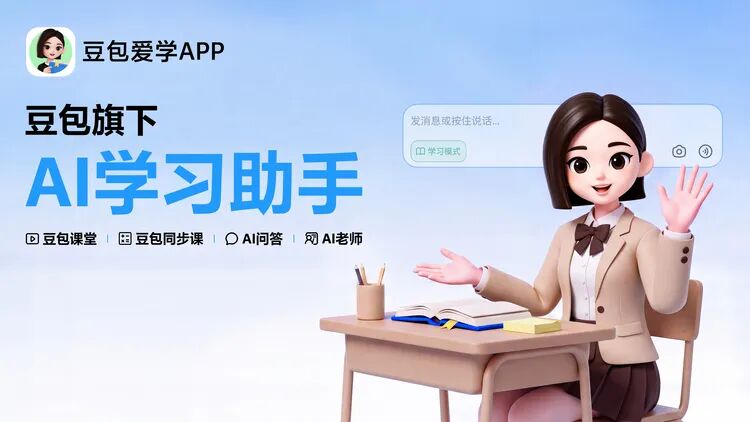
When students need to understand a theme systematically, Doubao Aixue can generate a course; when they are merely stuck on understanding a specific concept, it can provide a visual explanation; when students want to confirm whether their learning is well-grounded, Doubao Aixue can immediately push a testing link.
These guidance sessions do not require students to adjust skills themselves or wait for long. This was almost unimaginable in the past.
Additionally, all of the above guidance can be provided by Doubao Aixue's "Q&A," making the learning experience more convenient and smooth.
Now, back to the story at the beginning.
More than seventy years ago, Skinner designed teaching machines with the hope that the machines could determine what the next question should be based on whether the previous answer was correct or not. Today, AI can accomplish far more than this scholar anticipated.
Moreover, this evolution in AI education holds even more practical significance in the domestic context. One-on-one personalized teaching has once been popular in the country but has always remained a luxury vision for most people. Now with the help of AI, this "one person, one solution" teaching finally has the real possibility of becoming widespread.


Click the “Heart”, and then leave
免责声明:本文章仅代表作者个人观点,不代表本平台的立场和观点。本文章仅供信息分享,不构成对任何人的任何投资建议。用户与作者之间的任何争议,与本平台无关。如网页中刊载的文章或图片涉及侵权,请提供相关的权利证明和身份证明发送邮件到support@aicoin.com,本平台相关工作人员将会进行核查。