

In 2026, Shanghai was not aware of how many typhoons had swept through, while extreme weather was also disrupting global financial markets.
NOAA predicts that the probability of experiencing El Niño in the autumn and winter exceeds 90%, with the probability of the strongest El Niño since 1950 occurring in the fourth quarter rising to 69%. JPMorgan warns that a global food crisis may break out in 2027, and the next inflation shock might not occur at gas stations, but on supermarket food shelves.
Since July, as expectations for El Niño have warmed, agricultural products and agricultural stocks have ushered in a fierce surge, and the aesthetic of capital has also changed drastically: not long ago, it was all about the bright light, and in the blink of an eye, it shifted to the fields.
But the market came quickly and left just as fast.
At the moment when domestic and foreign securities firms were intensively releasing "El Niño" reports, agricultural products and agricultural stocks quickly fell back, and this round of what has been hailed as a historic El Niño market suddenly became elusive.
It was precisely at this time of divergent opinions that, after five years, Yuan Chuan once again engaged in dialogue with Liu Chuanxi, the chief meteorological researcher of Kaifeng Investment.
Liu Chuanxi is one of the earliest meteorological analysts in the domestic private equity market, having obtained his doctorate from the Chinese Academy of Sciences and later pursuing postdoctoral study at UCLA, where he was mentored by NASA Chief Scientist Gloria L. Manney, enabling him to join the NASA/JPL (Jet Propulsion Laboratory) founded by Qian Xuesen. In 2015, Liu Chuanxi had just joined Kaifeng Investment when he experienced an El Niño.
Five years have passed, and Liu Chuanxi says he has made progress. Compared to his initial focus on purely studying the weather, he has gradually learned to integrate his understanding of weather data with commodity supply and demand and the macro environment, seeking to find the relationship mappings between them. This practical meteorological analysis reminds one of Stagg from "Normandy 72 Hours."
In March this year, Liu Chuanxi anticipated a possible decline in the capacity of the Panama Canal along the El Niño transmission chain. In his reasoning, the interplay of global warming, frequent wars, and logistics disruptions pushed the impact of this round of El Niño towards an unprecedented outcome.
El Niño Amidst Gunfire
Yuan Chuan Investment Commentary: How does this round of El Niño differ from the past El Niños in 1997-1998 and 2015-2016?
Liu Chuanxi: First, global average temperatures might break historical records. Against the backdrop of global warming, global average temperatures could reach new highs during El Niño years.
Second, historically, droughts caused by El Niño have primarily occurred in equatorial regions, such as Southeast Asia, India, and the Caribbean. However, this year, in addition to these traditional areas experiencing droughts, extreme droughts have also appeared outside of the tropics.
For example, drought and heat waves in Europe have been unimaginable; in the U.S., El Niño years typically bring favorable weather for corn and soybean production with minimal reductions; but this July, parts of the U.S. mainland faced high temperatures and scant rainfall, with the average summer temperature setting a historical record and the southern plains suffering severe drought.
Yuan Chuan Investment Commentary: What uncertain variables has the war brought to El Niño?
Liu Chuanxi: At the beginning of the year, we believed the probability of El Niño was high. The Middle East war broke out at the end of February, driving up international oil prices, and energy prices were transmitted along the industrial chain to fertilizers. The Middle East is a significant sulfur export area, and both the cost and supply difficulties of fertilizers have risen.
We considered that in El Niño years, extreme weather is already frequent; now with high energy prices, the potential decline in fertilizer usage due to supply bottlenecks and cost increases may weaken the ability of agricultural areas to withstand extreme weather, further exacerbating the risk of reduced yields.
In March, we assessed that the war in the Middle East would amplify the global risk of reduced food and agricultural product yields, and in August, investment banks like JPMorgan echoed similar analyses.
Yuan Chuan Investment Commentary: What changes have exceeded the original expectations?
Liu Chuanxi: In July-August, the situation between Russia and Ukraine escalated again, with Ukraine attacking Russian refineries causing diesel supply tensions, while Russia attacked Ukrainian Black Sea ports, such as Odessa, which are crucial for grain exports.
A real contradiction is that while the planting area and yield in the Black Sea region have increased without abnormal weather, frequent conflicts have drastically reduced wheat and corn exports below expectations, further intensifying this year's global food and agricultural supply tensions.
Extreme weather combined with geopolitical black swans has jointly boosted the popularity of agricultural products and the agriculture, forestry, livestock, and fishery sectors.
Yuan Chuan Investment Commentary: The foreign investment banks have begun to intensively write reports; now that the war transmission chain has been outlined, does this prove that the positive aspects have been priced in?
Liu Chuanxi: Firstly, the situation on the Russia-Ukraine battlefield is not addressed in most investment research reports, and the uncertainty of the situation is significant. Whether the blockade continues until the end of the year or opens up immediately will have completely different implications for global grain prices.
Secondly, the current market is more focused on trading reduction expectations, but the actual reduction needs to go through a process of gradual confirmation or falsification.
The reduction in palm oil in Indonesia and Malaysia might only manifest 8-10 months after the drought, becoming apparent next year in the first and second quarters; while data disclosure of cotton and sugar cane production in India often lags, and usually needs to wait until the end of the pressing and processing season to validate specific yield reductions.
Moreover, this round of El Niño is still in a strengthening phase, with peaks typically occurring in November-December; its impact will not disappear immediately as El Niño wanes, and may continue into the middle of next year or even longer.
During this process, global extreme weather will likely maintain a high frequency, making it likely that we will continue to see reports of extreme weather events in the media. This is more likely to be a sustained market trend lasting 3-6 months or even longer, rather than a past pulse-like trend driven by speculation.
Another easily overlooked variable is that with frequent extreme weather events, many countries might take preemptive defensive measures, such as recent calls by Nordic countries and UK officials for the public to stock up on food and canned goods.
If multiple countries follow suit, it will elevate global apparent food demand, and a large amount of demand turning into end-user household stockpiles will lead to reduced supply in the trade links, resulting in a supply and inventory perception tighter than expected.
The Panama Canal and Crude Oil
Yuan Chuan Investment Commentary: In your recent article "Under Extreme El Niño, How Does the Energy Market Price Risk?" you mentioned that the water level of the Panama Canal indirectly affects the crude oil market?
Liu Chuanxi: That article was co-written with another expert; what I wanted to express is not that it will drive up energy prices but to highlight this year's unique situation.
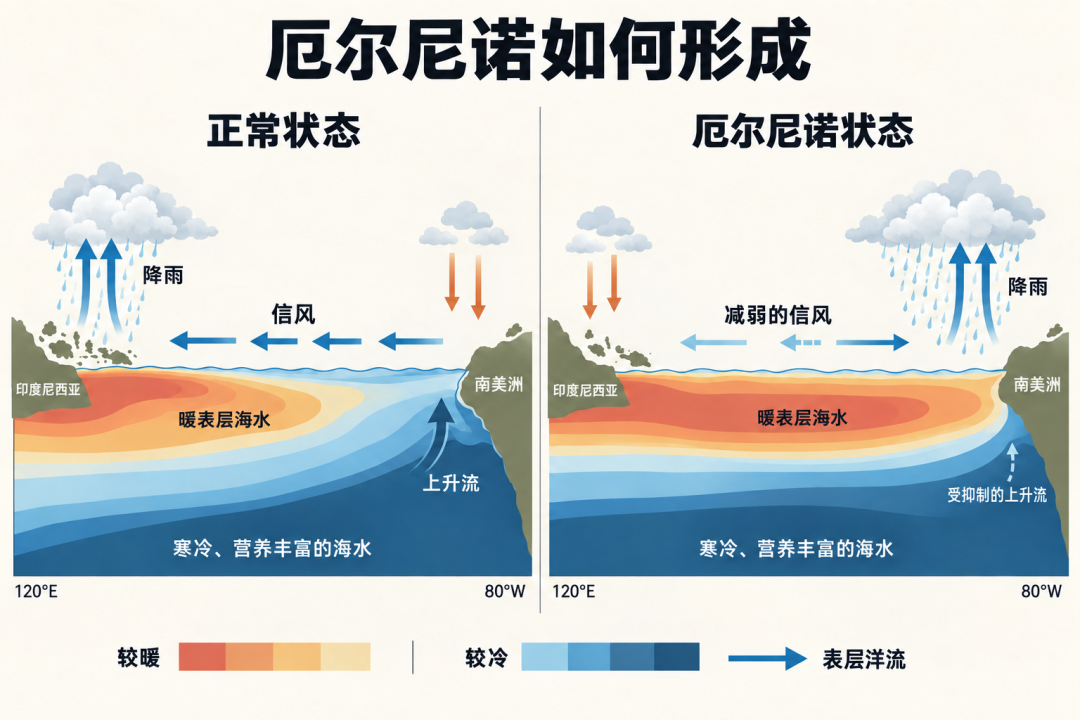
During an El Niño year, the Caribbean experiences droughts, leading to a decrease in canal water levels. The Panama Canal Authority restricts the draft depth for each vessel, limiting cargo weight and causing a decrease in the amount of cargo transported per ship. At the same time, the number of vessels allowed to transit each day is limited, meaning more ships are needed to transport the same amount of cargo, resulting in reduced capacity and increased freight costs.
This is the transmission logic of past El Niños, but this year's special circumstance is the Middle East war.
The Middle East is the most crucial energy hub globally, not just the Strait of Hormuz; recently the Red Sea and the Bab el-Mandeb Strait have been closed due to attacks by Houthi forces. This has led to a significant portion of energy procurement from Japan, South Korea, and other Asian countries shifting towards the U.S. from March onwards, resulting in a notable increase in crude oil exports to Japan and South Korea from the U.S. in the second quarter.
Demand for energy and chemical transport through the Panama Canal has surged, compounded by El Niño-induced drought. This could lead to increased congestion in the canal this year, affecting not just crude oil but also container ships, dry bulk carriers, and LNG carriers.
The uniqueness of the Panama Canal also lies in its non-equal queuing mechanism, with a certain percentage of slots auctioned for priority passage rights at a very high cost. Reports suggest that vessels carrying energy, crude oil, natural gas, LPG, LNG, etc., may pay fees ranging from $1 million to even $5 million to pass through.
This leads to a situation where vessels are willing to pay high fees to jump the queue while ships carrying low-value cargoes like soybeans, corn, and grain can't afford the hefty fees and must navigate around Cape Good Hope instead, leading to delays.
Transporting goods from the Gulf of Mexico to Japan and South Korea via the Panama Canal takes about 30 days, while it takes approximately 50 days to go around Cape Good Hope. Even without congestion, the maritime time and fuel costs increase by about 20 days, which translates to higher freight costs for the end market in Asia and in turn boosts inflation in demand countries.
Yuan Chuan Investment Commentary: It seems that the biggest impact of this round of El Niño is not on agricultural products; under the combination of war and supply chain disturbances, crude oil and copper may be more significantly affected?
Liu Chuanxi: Copper indeed will be affected; in July-August, frequent snowstorms in Chile impacted monthly mineral production and exports. However, overall, agricultural products remain the most sought-after in the market, and logistics issues will spread to a broader range of commodities.
Yuan Chuan Investment Commentary: The logistics aspect magnified the impact of El Niño.
Liu Chuanxi: One could say that. The fourth quarter is the tightest time for global logistics; winter sees increased energy import demand in Asia, and agricultural product exports are seasonal. The fourth quarter just happens to be the window for the U.S. agricultural product harvest, coupled with peak stocking demands for Christmas and Thanksgiving in the U.S., which leads to peak activity for container ships entering the market in the third and fourth quarters. The likelihood of congestion at the Panama Canal in the fourth quarter is high.
Prices Run Ahead of Weather
Yuan Chuan Investment Commentary: Why have agricultural products and agricultural stocks recently fallen so sharply?
Liu Chuanxi: Many research reports have been densely released recently, and that's what people are discussing a lot, but the core issue might still be the adjustment after a short-term surge in prices. Moreover, the biggest negative factor in the overall commodity and stock markets has stemmed from inflation in the U.S. leading to the Federal Reserve's interest rate hikes.
Yuan Chuan Investment Commentary: Excluding the war, from a pure climate perspective, are palm oil, rubber, and white sugar the most affected by El Niño?
Liu Chuanxi: Historically, during several El Niño cycles, these commodities are prone to reduced yields, mainly because they primarily grow in tropical regions concentrated in India and Southeast Asia.
However, the problem is that this year, many macro funds and non-industrial funds entered the market early, perhaps buying in around March or April when there were initial expectations of El Niño, leading to significant price increases. Now even those not particularly attentive to commodities are aware of these varieties.
It's like when everyone believes they should buy AI; often, that’s just the short-term peak of sentiment.
Yuan Chuan Investment Commentary: Is there a particular commodity that has risen but your data does not support it?
Liu Chuanxi: In the past few months, many commodities have traded based on El Niño expectations. Palm oil production isn’t poor, yet prices have been consistently rising. Both commodities are in a backwardation structure (where near-month contracts are priced lower than longer-term contracts), and natural rubber and white sugar exhibit similar traits.
Yuan Chuan Investment Commentary: We know that the effect of palm oil reduction has an 8-10 month lag; how does the market mismatch expectations and reality for rubber and white sugar?
Liu Chuanxi: International raw sugar has seen a surplus in global inventories; in the first half of this year, overseas managed funds held net short positions. The impact of El Niño on overseas sugarcane-producing areas may be more significant, while domestic production has increased this year with weak demand, leading to subdued price performance. Thus, while international raw sugar surged, domestic sugar's price increase was modest.
However, white sugar has the potential for a "dilemma reversal," depending on whether drought-driven reductions in Thailand and India can absorb global inventories. Additionally, sugarcane is a perennial crop; after being cut, its root system remains in the soil, allowing it to grow back next year, so this year’s drought might leave lingering issues affecting next year’s yield.
Therefore, white sugar doesn’t just operate on an annual cycle; if this year sees yield reductions in drought-affected areas like India and Thailand, it’s possible that weather will continue to negatively impact next year’s yields.
Rubber can be divided into three categories: domestic natural rubber, rubber from the Shanghai Futures Exchange No. 20 rubber (which benchmarks Southeast Asian rubber), and styrene-butadiene rubber (synthetic rubber impacted by energy prices).
This round of natural rubber prices is rising; on one hand, it’s due to the prolonged low prices before, leading to global rubber capacity contraction, itself entering a pricing cycle; on the other, it’s compounded by energy price increases driven by the Middle East war and El Niño expectations.
In reality, this year’s southern production areas in Indonesia and Thailand have experienced droughts, while the interior of Thailand and Vietnam have only seen temporary droughts. Moreover, the droughts in central and northern Thailand and Vietnam occurred during the rainy season, where moderately less rain can actually be favorable for rubber tapping during that time. Therefore, there hasn’t been a severe reduction in natural rubber this year.
However, Thailand’s natural rubber peak production season is concentrated in the fourth quarter, and if the drought impacts from El Niño persist into that quarter, it may lead to situations where regions become so dry that tapping rubber is impossible, introducing a degree of uncertainty to natural rubber output during the peak season.
Do Private Equity Funds Need "Children of the Weather"?
Yuan Chuan Investment Commentary: At the beginning of this year, what opportunities did you accurately see through your meteorological studies that were later validated by the market?
Liu Chuanxi: Mainly two types.
One category consists of targets with strong energy attributes. Among agricultural products, those with the strongest energy traits are vegetable oils, like palm oil and canola oil. In foreign markets, vegetable oils are blended into biodiesel at certain ratios for direct use as fuel for cars and trucks. Thus, with rising energy prices and El Niño expectations, vegetable oil prices would increase significantly.
The second category comprises nitrogen fertilizers and other fertilizers driven by rising energy prices. The main cost of producing urea overseas is natural gas, which may comprise 70% or even 80% of total costs. Fertilizer price increases have also led to a consensus on the rising costs of corn production, which has in turn driven up prices, making corn perform relatively well this year.
However, the direct driving factors are not solely due to cost. When the war broke out in March, preparations for planting in Northern Hemisphere countries were mostly completed—within a few months prior to sowing, fertilizers, seeds, and pesticides had been purchased; the war did not directly push up fertilizer costs for crops in the Northern Hemisphere.
In fact, the increase in corn prices was mainly because of reduced yields in the U.S. and Europe due to high temperatures, compounded by shipping disruptions at Black Sea ports, rather than market concern over rising fertilizer costs.
Yuan Chuan Investment Commentary: How does meteorological research coordinate with industrial research in Kaifeng's systematic macro framework?
Liu Chuanxi: In recent years, I have participated in building the company's investment research system and databases, which has involved some organization of key commodity and macro data, making it easier to grasp the intersection of weather research with commodities and macro aspects.
In the past, commodity researchers and investment managers would approach me with weather issues, or for verifying market rumors; but in the past couple of years, after clarifying the logic behind the major commodities and macro influences, I have often been able to provide early warnings.
For instance, in July 2024, when the employment and temporary unemployment rate data in the U.S. did not meet expectations, I pointed out that some of the data disruptions stemmed from the landfall of Hurricane Beryl in the Gulf of Mexico, which helped the company judge that this could be a case of extreme weather causing single-month data distortions rather than an ongoing problem with the U.S. economy.
Yuan Chuan Investment Commentary: Why does a macro private equity fund recruit a meteorological researcher specifically?
Liu Chuanxi: The professionalism of meteorological researchers largely manifests in their understanding and utilization of weather data; without sufficient experience, they might convey incorrect information.
For example, palm oil is a woody crop, differing from field crops like soybeans and corn. It has a cycle of more than 30 months, during which it may experience multiple La Niña or El Niño events, and only in specific growth stages (like the differentiation of female and male flowers, fertilization) will drought lead to reduced yields.
Rubber also doesn't necessarily reduce output simply due to drought. Tapping requires making incisions on the rubber tree trunk to let the latex flow out, which is then collected in cups; the freshly flowing latex is termed "latex," which solidifies into cup rubber.
During droughts, reduced water within the trees slows down latex flow rates, which could lead to decreased daily harvesting amounts. But rubber production is not solely influenced by drought; typhoons and floods can also affect rubber tapping, where what ends up in the cups may be rainwater rather than latex.
There are just too many weather variables; sometimes experience is needed more than anything. Different crops have their unique growth habits, and understanding their underlying attributes is essential for providing more accurate conclusions.
Yuan Chuan Investment Commentary: You mentioned before that the understanding of meteorological economics within China's financial circle is still quite limited; has there been any change now?
Liu Chuanxi: When I joined, there were hardly any dedicated meteorological researchers in the industry. However, in recent years, this situation has changed. Some investment institutions have begun to hire graduates with meteorological backgrounds, and some, although not hiring full-time positions, may source external professional consulting services.
As global climate warms, extreme weather is becoming more frequent. It can not only affect the supply and demand of bulk commodities but also disrupt logistics links like ports and canals, impacting financial markets with increasing regularity.
Previously, weather was like a black swan; now, it might be closer to a gray rhino.
Extreme weather likely will occur; it’s just uncertain when and in what way. In the past, many chose to endure and cope with weather disruptions. But now for macro private equity, there is an increasing need for proactive defense and even to actively utilize the volatility brought about by weather to generate profits.
免责声明:本文章仅代表作者个人观点,不代表本平台的立场和观点。本文章仅供信息分享,不构成对任何人的任何投资建议。用户与作者之间的任何争议,与本平台无关。如网页中刊载的文章或图片涉及侵权,请提供相关的权利证明和身份证明发送邮件到support@aicoin.com,本平台相关工作人员将会进行核查。


