Author: Thejaswini M A
Translation: Deep Tide TechFlow
Deep Tide Introduction: The Clarity Act did not pass, and the SEC has provided a temporary five-year path for tokenized US stocks through innovative exemptions: permissioned AMMs and liquidity pools can facilitate the trading of real stock tokens. But the opening is just the beginning—who verifies wallets, who provides stocks and cash, and who can stabilize prices under weekend news impact, is where true liquidity needs to fill the gaps. This article disassembles "how pools are filled" along Uniswap's permissioned pools, Superstate/Securitize registration layer, oracle and PropAMM, and financing.
The SEC was born because the United States discovered: a market can be extremely active yet may not be trustworthy.
Before the crash of 1929, companies could sell stocks with limited disclosure, traders could organize funds to manipulate prices, and exchanges were generally expected to self-regulate. The crash made the costs of such arrangements impossible to ignore. Congress first passed the Securities Act of 1933, requiring companies selling securities to provide meaningful information to investors.
Then came the Securities Exchange Act of 1934, which established the SEC to oversee exchanges, brokers, and the secondary market. The government set out to establish that a trade's claims of rights must be real, and that the market transporting this claim must abide by rules.
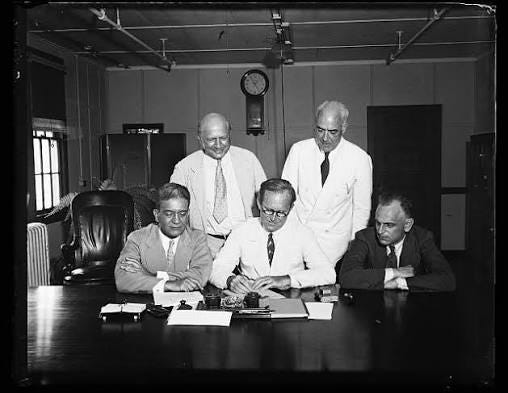
When equity certificates became electronic records and trading floors became data centers, the fundamental structure did not change. Issuers are still responsible for creating shares, transfer agents record who holds what, exchanges facilitate buy and sell orders, and market makers still provide counterparties to keep prices moving.
Blockchain can bring these operations closer together. Shares, ownership records, payments, and transaction pools can all operate through interconnected smart contracts.
Over the past decade, the SEC's obsession has largely been asking: when should a cryptocurrency token be considered a security? The Clarity Act did not make it through Congress—rest in peace—but the SEC has now opened a smaller, temporary path through innovative exemptions. It gives companies five years to experiment. Qualified tokenized securities venues (TSVs) can facilitate on-chain trading of tokenized US stocks through permissioned automated market makers and liquidity pools.
So, if a token is already a real stock, can it be traded through a crypto-style pool that only allows approved investors to participate?
The SEC's answer is yes, but existing protections must remain in place.
Tokens must carry normal shareholder rights.
The company behind the stock must be notified and can object.
Only approved wallets can trade.
If the stock stops trading on Nasdaq or the New York Stock Exchange, its tokenized version must stop as well.
Smart contracts must be public to allow regulators and investors to inspect what is happening.
Creating real stocks and approving pools is just the start of getting the market going. There must still be someone who provides shares and cash, maintains price accuracy, and assumes risk. This is exactly where we are heading today.
Traditional stock exchanges attempt to match those who want to sell with those willing to buy. Automated market makers (AMMs) provide a pool where both sides can trade against each other.
Sellers need sufficient cash in the pool. Buyers need sufficient shares. Whoever provides these assets earns a portion of the transaction fee.
This sounds simple, but imagine if Apple trades at $200 on Nasdaq, while its tokenized shares are only $198 in the pool. Traders could buy the cheaper token, hedge in the traditional market, and capture the price difference. This would pull the prices closer together, but the liquidity provider's pool would be selling the stock too cheaply.
The crypto space calls part of this impermanent loss. When stocks drop sharply, the pool may end up holding more declining stocks and less cash. When they rise quickly, the pool may sell stocks too early.
Traditional market makers rely on widening the bid-ask spread, making few trades, or hedging or withdrawing elsewhere to respond. Simple AMMs, however, follow rigid rules. This can be uncomfortable for listed stocks—they might jump after earnings reports, litigation, or a CEO posting when they should be asleep. A 24-hour pool doesn't sleep.
Innovative exemptions create space for these pools to operate, offering conditional relief to certain companies that fund with their own capital. They cannot guarantee that transaction fees will always exceed losses from stale prices, reverse trading, and inventory imbalances.
Once the market is viewed this way, the liquidity of tokenized stocks breaks down into three issues.
Trading venues must verify who is allowed to trade. Wallet addresses alone cannot show who the owner is, whether they have passed identity verification, or whether they are legally permitted to hold that stock.
The pool needs sufficient shares and cash. If the pool only holds a few shares, even a small trade can empty it, pushing the price away from Nasdaq.
Liquidity providers need enough capital to keep the pool operating. They must fund shares and cash, protect themselves during price fluctuations, and earn enough returns from fees or spreads to make the risks worthwhile.
I tracked who has the chance to repair these layers.
Uniswap can decide who enters the pool
Uniswap v4's permissioned pools directly address the first issue.
Uniswap v4 is usually permissionless. Anyone can create pools, swap, or provide liquidity. Regulated securities cannot operate that way, as their token contracts may be required to refuse transfers to wallets that have not been verified by the issuer.
Uniswap v4 keeps balances in a single PoolManager contract, updating virtual balances when people trade. If a restricted stock only checks wallets when real token transfers occur, it will not see what happens inside the pool. Unauthorized individuals may gain exposure without triggering the stock token's standard transfer checks.
The solution for permissioned pools is: check the wallet before allowing a trade itself.
Real stocks are placed in a separate smart contract approved by the issuer—Permissions Adapter. Uniswap then tracks transactions within the pool using a virtual version of those stocks. Before anyone can buy, sell, or add shares and cash, the adapter will query the issuer's compliance system to ask if the wallet is permitted.
It does not matter whether the issuer uses Securitize's DS protocol, Tokeny's ERC-3643, or its own investor registration. Uniswap only needs that system to provide a yes or no answer.
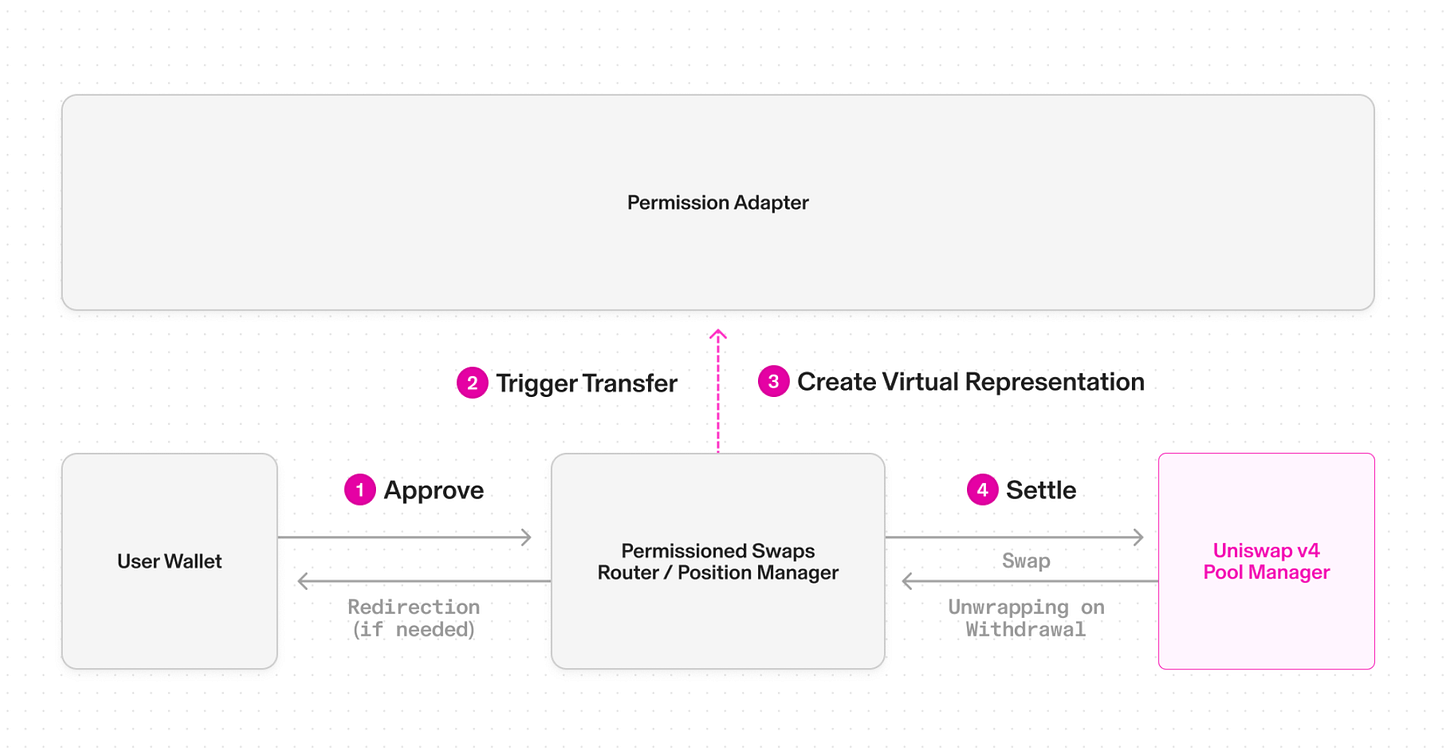
Trading permissions are also different from liquidity provision permissions. Someone may be allowed to buy tokenized stocks but not be permitted to provide shares and cash as a market maker. Uniswap checks traders before each swap and checks liquidity providers before accepting assets. Permissions can also be revoked afterwards. If a liquidity provider no longer meets qualifications, the issuer can close the position. The LP receives unrestricted assets (like USDC), while the tokenized stock is moved to an address designated by the issuer. Stocks will not simply forget they are regulated just because they entered DeFi.
The system is already live, and Uniswap states that Superstate, Securitize, and Dowgo are building on it. This does not mean they have been approved as TSVs. The SEC has not released a list of winners. The technology that Uniswap has built is functionally similar to the permissioned AMM that now makes this possible.
Stocks still need to come from somewhere
A token can carry the name of Apple and track its price, yet it does not make the holder a shareholder of Apple.
For example, Robinhood's Stock Tokens are debt securities issued in Jersey. They provide economic exposure to the underlying stocks, but Robinhood expressly states that holders do not acquire legal or beneficial ownership of these shares. The SEC's new exemptions require tokens to carry the same rights as traditional stocks. For now, let's bypass the awkwardness with Robinhood and see who currently holds that layer.
Superstate's Opening Bell helps public companies put real shares onto Ethereum and Solana. Galaxy Digital becomes its first significant case in September 2025, allowing shareholders to migrate their Class A common stock to Solana. These tokens are shares registered with the SEC and carry the same rights as traditional stocks. When tokens transfer between verified investors, Superstate updates Galaxy's official shareholder list in real-time.

As a transfer agent registered with the SEC, Superstate maintains shareholder registries between traditional booked shares, tokenized holdings, and supported DeFi applications. When a company has a transfer agent already, Superstate works alongside it and bridges existing records with the blockchain. Superstate also offers direct issuance programs: allowing public companies to sell newly issued shares directly to qualified investors at real-time market prices. Investors pay with stablecoins and receive real shares in token form in approved wallets.
Securitize covers similar territory. It issues and manages regulated digital securities, maintains investor records, and enforces rules about who can hold or transfer them. Uniswap's pools can query Securitize's DS protocol when deciding whether a wallet can trade or provide liquidity.
It is also the tokenization and transfer agent platform behind BlackRock's BUIDL Fund. BUIDL plans to open on-chain trading through UniswapX in February 2026, but it is not an AMM pool, rather a request-for-quote system: approved investors can receive quotes from whitelisted companies (including Flowdesk, Tokka Labs, and Wintermute). Securitize Markets facilitates trades, and every participant must be approved by Securitize. But we can see how these two layers can work together.
Securitize controls who can legally own and trade the security. UniswapX provides the technology to find quotes and settle them on-chain. These companies may not be competitors of Uniswap. The transfer agent records who owns shares and whether transfers are valid. Uniswap handles exchanges between approved participants.
The SEC requires tokenized securities venues to verify that each token carries the same rights as equivalent traditional shares. If an unrelated third party tokenizes a company's stock, the venue must notify the original issuer and provide an opportunity to object. If the stock stops trading on its primary exchange, its tokenized version must also cease trading.
The SEC's order also restricts the number of underlying securities and transaction volume available to each venue during the exemption period. There must still be someone providing enough shares and cash to make these permitted markets genuinely useful.
How to avoid ridiculous pricing?
Passive AMMs (such as standard Uniswap pools) are always open for trading. Their prices depend on how many shares and how much cash is sitting in the pool.
Concentrated liquidity allows liquidity providers to allocate most funds near the current price of the stock. This helps the pool give better prices without requiring so much capital.
A larger issue is the clock. Simple AMMs set prices from their own pool, and arbitrageurs push them closer to external markets by buying where it’s cheap and selling where it’s expensive. Suppose Nvidia closes Friday at $200. On Saturday, the company announces bad news. People now expect the stock price to fall, but there’s no fresh Nasdaq price to tell the pool how far it should fall. If the pool still buys near Friday's price, those who see the news can sell to it before the price adjusts. Those who put money into the pool end up holding potentially less valuable shares.
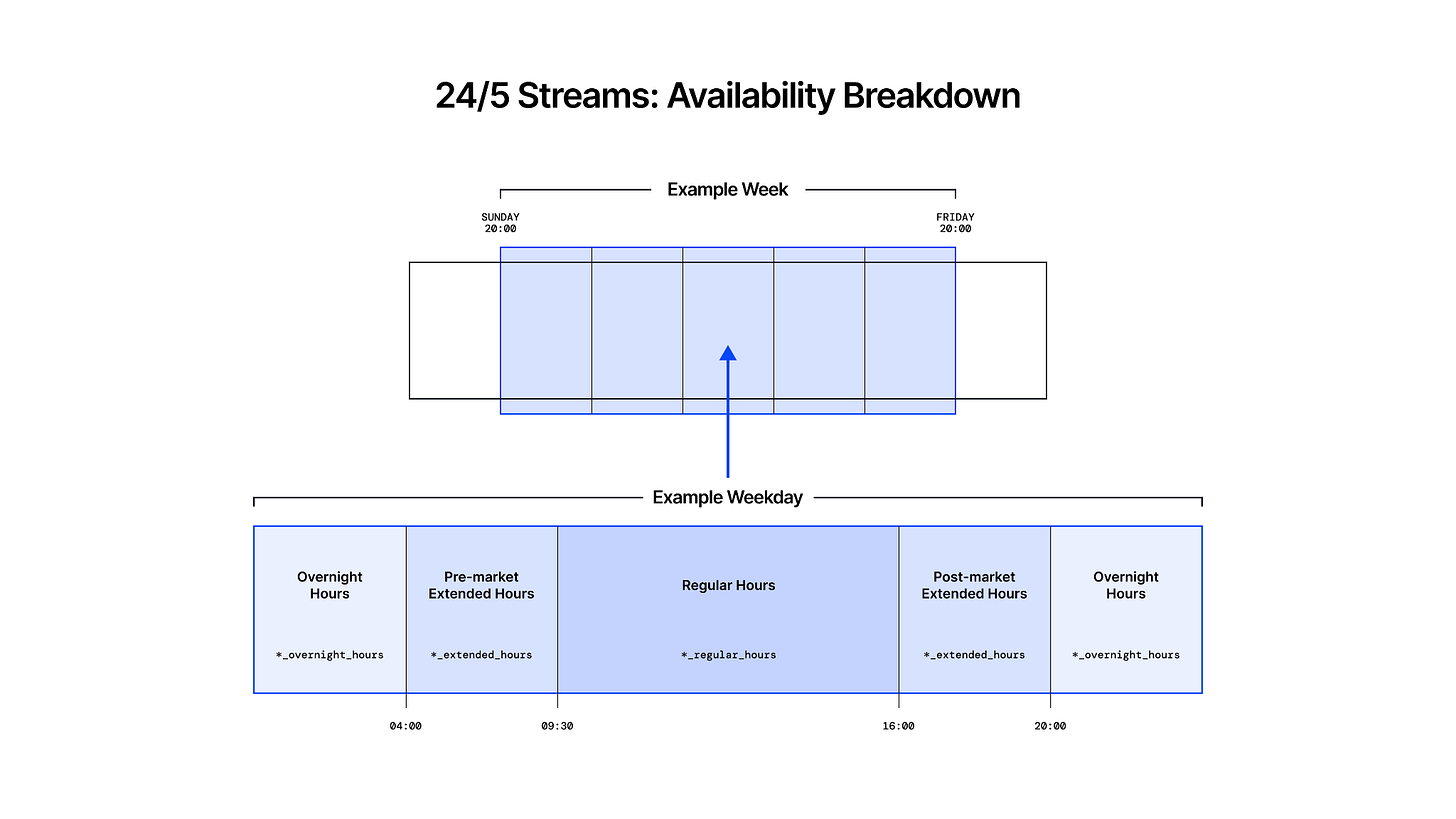
Marcin Kaźmierczak, COO of RedStone, points out that regular NYSE and Nasdaq trading only accounts for 32.5 hours out of a typical week of 168 hours. Pre-market and after-hours trading can provide more prices, but weekends still leave gaps.
Bringing external data into blockchain applications through oracles helps narrow this issue. Chainlink's 24/5 US stock data stream covers regular, pre-market, after-hours, and overnight periods. They report buy-sell prices, market states, and how stale the prices are. However, when the traditional market is closed due to weekends or holidays, these feeds carry outdated values. Applications can switch to using the prices of tokenized markets, but that will no longer be a real-time reference for the underlying stock market.
This leaves another decision for trading systems. While knowing the latest available price is useful, how much inventory should be offered at that price, and how cautious should one be when information becomes stale?
Byreal, a Solana exchange incubated by Bybit, addresses this by providing multiple possible paths for each trade. It compares concentrated liquidity pools with quotes from professional market makers provided through request-for-quote (RFQ). In other words, it directly asks trading firms: what price would you offer for the requested quantity?
Professional firms, considering their own inventory and prices elsewhere, might offer better quotes. Byreal can draw on its own pool, as well as external AMMs including Raydium, Orca, and Meteora, along with market maker quotes. The useful innovation is being able to compare these sources rather than relying on one pool to handle every order equally well.
BisonFi, from Jump Crypto, is a self-operated AMM (PropAMM) with an off-chain pricing engine that watches other markets and sends updated prices to on-chain trading programs. Assets and settlements still happen on-chain, but prices can change before anyone executes a trade at the quoted time.
Its programs will also react to inventory and information freshness. If it holds too much of a particular asset, it can adjust the price to encourage trades that restore balance. If the price updates are stale, it can widen the bid-ask spread or offer less inventory. These are ways to limit how much risk a firm takes while continuing to market-make.
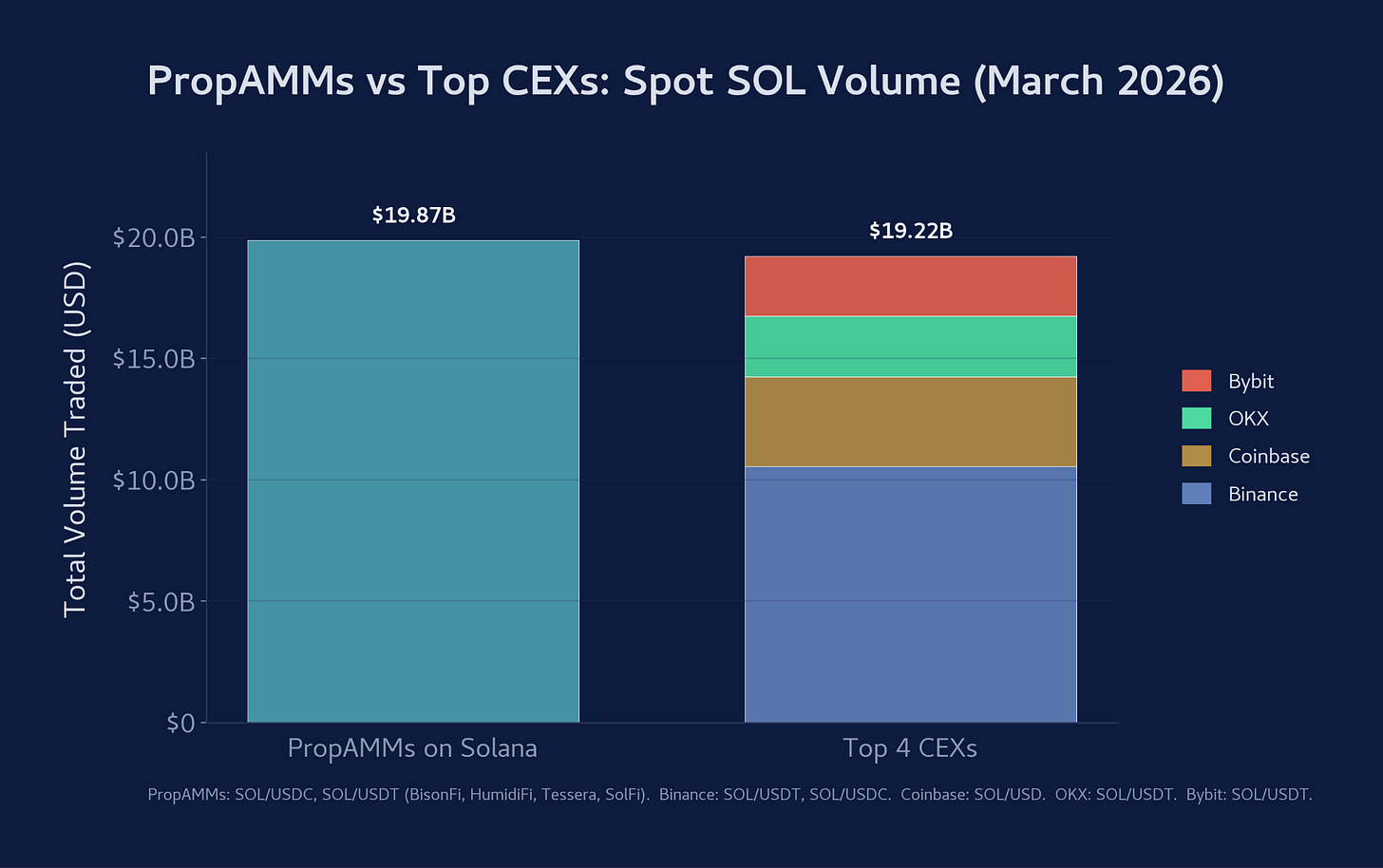
UniswapX tackles the same broader pricing issue through competition. Companies compete to fill traders' orders from different liquidity sources. Looking separately from Uniswap's permissioned pools, we can see how execution can improve when traders are not locked into a single pool's quote.
These solutions offer a better way to trade under uncertainty. For builders truly doing tokenized stocks, the opportunity lies in combining reliable market data, competitive quotes, and controls that respond when information is scarce. Existing crypto market capabilities provide a useful foundation, but wrapping them into SEC exemptions remains another task.
Assuming all else is ready. Tokens represent real shares, pools verify who can trade, and market makers know how to keep prices competitive. The company still needs enough shares to sell and enough cash to buy up others' sell orders.
A firm making markets on ten tokenized stocks might need to allocate shares and stablecoins across ten pools. Without financing, every dollar backing those quotes comes from its own balance sheet. Traditional finance has what they call prime brokers, who lend to trading firms. When deciding how much collateral a loan requires, they can consider multiple investments together. For example, one firm might hold shares while also holding a separate trade that would appreciate when those shares fall. Looking at both together offers lenders a better risk picture than looking at any one side alone.
Arkis brings this investment portfolio margin into the digital market. Lenders provide funds, and Arkis assesses the combined supported investments of borrowing companies and monitors the assets backing their debt. If those assets depreciate too much, the system can sell positions to help repay loans.
Arkis, close to tokenized stock liquidity, is not itself a stock AMM. But it can help finance companies that put shares and cash into trading pools. Market makers that can borrow against merged investments may be able to support more trading with existing funds.
There is still a great leap between that possibility and the exemptions. Arkis has not yet proven that these US stocks will be accepted as collateral, that TSV positions can enter its margin system, or that its lending structure meets relevant securities requirements.
The SEC has also provided temporary conditional trading exemptions for liquidity providers using their own capital, pricing, or committing capital in TSV pools. This removes a regulatory hurdle.
Individual stock trades can support several businesses. One maintains ownership records, another operates trading pools, and others provide shares, set prices, or lend funds.
They can earn management fees, trading income, or interest, so they are not all competing for the same payment. Who earns the most partly depends on where people choose to trade. Both buyers and sellers want a good price and sufficient shares and cash to complete orders. But the companies providing these assets also need enough customers to make the efforts worthwhile. Each party is waiting for the other.
When prices swing wildly, and someone wants to sell a large position, can the pool complete that sell at a reasonable price while keeping the companies providing shares and cash willing to continue doing so? Only then will we know if tokenization has created a market people can rely on.
We will never know. Robinhood is probably naming some feature.
免责声明:本文章仅代表作者个人观点,不代表本平台的立场和观点。本文章仅供信息分享,不构成对任何人的任何投资建议。用户与作者之间的任何争议,与本平台无关。如网页中刊载的文章或图片涉及侵权,请提供相关的权利证明和身份证明发送邮件到support@aicoin.com,本平台相关工作人员将会进行核查。


