
Written by: Xiao Bing
Kyle Samani, co-founder of Multicoin Capital, stated in an interview with Cointelegraph on September 21 that the market capitalization of SOL is expected to surpass that of ETH in this cycle. He also claimed that "no one is really using Ethereum today," and described the value capture capability of ETH, which has a market cap of about 300 billion dollars, as "questionable."
This was Samani's first major public statement since stepping down as managing partner of Multicoin in February of this year. At that time, he wrote in a later deleted tweet: "I used to believe in the web3 vision, but I no longer do."
In September, he returned in a new capacity, joining the U.S. board of the cryptocurrency trading platform Backpack.
Background to note: Multicoin Capital manages 5.9 billion dollars in assets and led the earliest financing rounds for Solana in 2018; SOL is the most core holding in its portfolio. Samani himself is the longest and most steadfast public supporter of Solana. Every public statement he makes about SOL is directly related to his position and interests.
What did Samani say?
There are mainly three core judgments:
"No one is really using Ethereum today." He believes that Ethereum still maintains its leading position primarily due to two things: the on-chain stablecoin supply and stablecoin lending collateralized by ETH. Aside from this, real user activity is shifting to Solana.
"The value capture of ETH is questionable." He said ETH is a 300 billion dollar asset, but its growth has stagnated, and he "does not understand why investors want to hold it at the current valuation," believing that there are many more reasonably priced investment opportunities in the market.
"The market cap of SOL will surpass ETH in this cycle." He anticipates that more and more crypto companies will switch their default network from Ethereum to Solana because Solana is "the most feature-complete network among all companies," making it easier to integrate business onto Solana.
Data Validation
Samani's argument is not without basis. However, looking at the data, the picture is more complex than he describes.
Fee Revenue: Solana indeed wins.
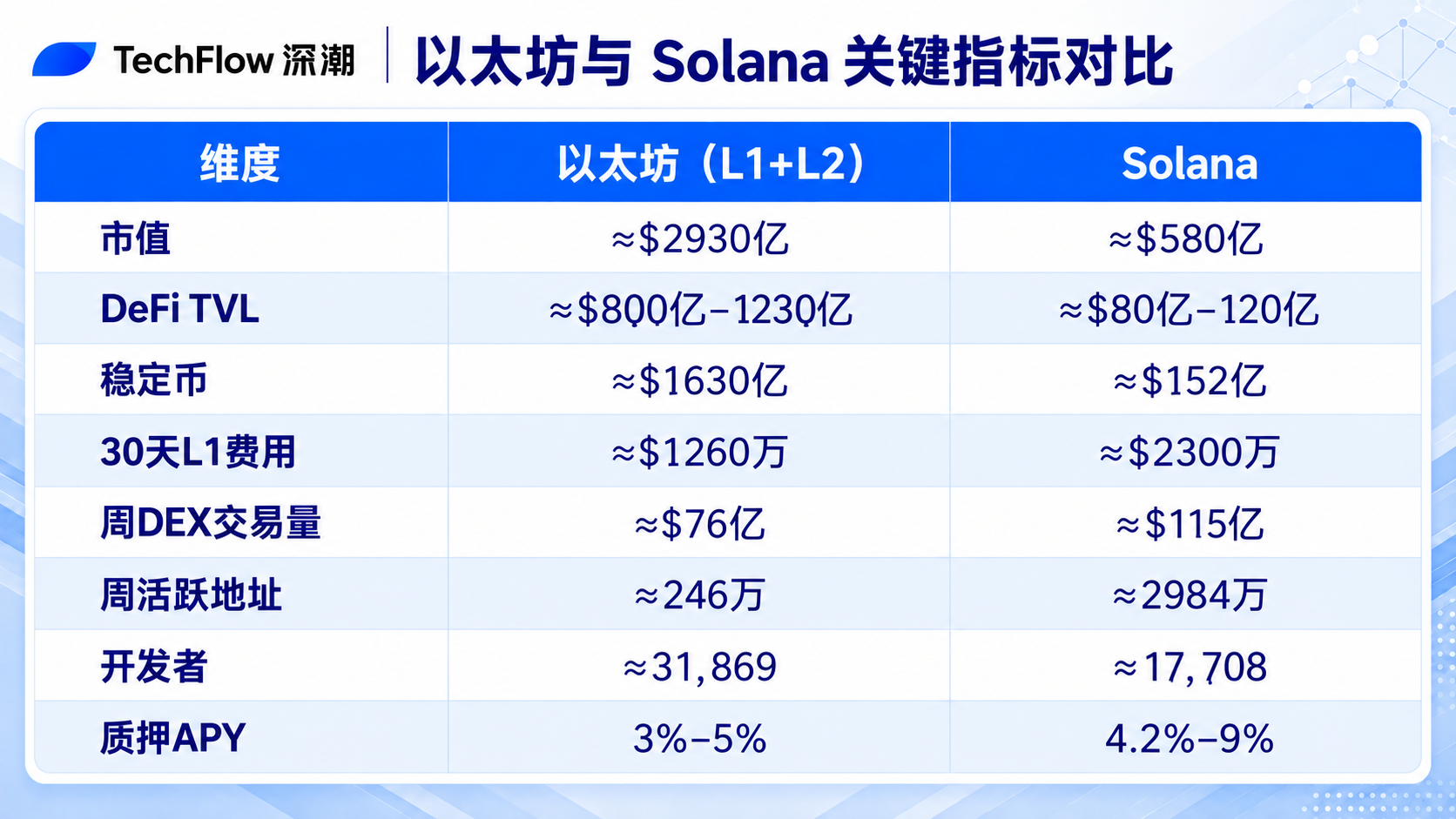
According to DefiLlama data, in the past 30 days, Solana generated about 23 million dollars in on-chain fees, ranking fourth in the network. Ethereum L1 only generated about 12.6 million dollars, ranking sixth.
This data directly supports Samani's judgment that "Ethereum user activity is declining." After Ethereum launches EIP-4844 in March 2024, the data fees paid from L2 to L1 will significantly decrease, leading to a shrinkage in L1's direct revenue.
User Activity: Solana significantly leads.
Solana has approximately 29.84 million weekly active addresses, which is 12 times more than Ethereum's 2.46 million. Weekly DEX trading volume is about 11.5 billion dollars, surpassing Ethereum's 7.6 billion dollars. If we define "usage" as "how many people are doing things on-chain," Solana indeed wins.
However, in terms of capital retention, Ethereum is still on another level.
The DeFi TVL of Ethereum L1 is approximately 55.6 billion dollars, and combined with L2, it totals around 80 billion to 123 billion dollars. Solana stands at approximately 8 to 12 billion dollars. The gap is between 7 to 10 times.
The disparity is even greater for stablecoins. Ethereum supports approximately 163 billion dollars in on-chain stablecoins, while Solana holds about 15.2 billion dollars. By 2025, the settlement volume of stablecoins on Ethereum will exceed 18.8 trillion dollars.
In the field of RWA and tokenized assets, BlackRock's BUIDL fund (2.87 billion dollars) is primarily deployed on Ethereum. The SEC has just released a "innovation exemption" for tokenized stocks requiring the use of public blockchains, with Ethereum and Circle's Arc being the current most eligible infrastructures.
Developer Ecosystem: Ethereum still dominates.
Ethereum has about 31,869 active developers, while Solana has about 17,708. Ethereum leads by a factor of about 1.8 times. The maturity of the Solidity ecosystem's toolchain and the scale of its developer community are still the largest in the industry.
Staking Returns: Solana is more attractive.
The staking APY for Ethereum is about 3% to 5%. For Solana, it's about 4.2% to 9% (including MEV acceleration). For investors seeking yields, SOL offers a higher holding return.
SOL currently has a market cap of about 58 billion dollars, while ETH is around 293 billion dollars. For SOL to surpass ETH, its market cap would need to expand 5 times, or ETH would have to shrink significantly, or both could happen simultaneously.
In the past month, ETH has risen by about 30%, while SOL has increased by about 34%. The trends are highly synchronized, and SOL's excess returns are limited. In the past year, ETH has fallen approximately 45%, while SOL has dropped about 59%, with SOL experiencing a larger retracement.
A summary chart is as follows:
Samani's narrative has a clear logic: wherever the users go, capital will eventually follow. Solana's leading position in retail activity is a fact, but whether this lead can translate into a sustained migration of institutional capital is the key variable in whether surpassing can occur.
Note: Kyle Samani is a co-founder of Multicoin Capital and has held a large position in SOL since 2018. The opinions cited in this article come from his public statements during the Cointelegraph interview and do not represent the views or investment advice of Shen Chao TechFlow.
免责声明:本文章仅代表作者个人观点,不代表本平台的立场和观点。本文章仅供信息分享,不构成对任何人的任何投资建议。用户与作者之间的任何争议,与本平台无关。如网页中刊载的文章或图片涉及侵权,请提供相关的权利证明和身份证明发送邮件到support@aicoin.com,本平台相关工作人员将会进行核查。


