If Jeff Yan were to start a new venture today, what would he do?
Recent updates point to the same direction: Options.

In an interview related to DAS Asia, Jeff compared the scale differences of Deribit, Derive, and Hyperliquid in the derivatives market. Perpetual contracts excel in expressing linear direction, but institutional funds still need to use options to express asymmetric odds and hedge tail risks.
The aspect that truly deserves attention is not that "Hyperliquid is about to launch options," nor the mention in a community post that "HIP-5 has been confirmed."
In fact, EvanCrypto17 later admitted that HIP-5 was a misused number that has not been utilized; the official Hyperliquid HIP list currently only includes HIP-1, HIP-2, HIP-3, and HIP-4, with no publicly available HIP-5 options proposal.
The really important question is: Why do options become the direction that Jeff Yan believes is worth starting over?
The answer relates to Hyperliquid's past growth logic. It has demonstrated that on-chain order books can support high-frequency, continuous, and global trading demands through perpetual contracts. The next step in further attracting institutional funds cannot simply offer "bullish or bearish" positions; it must also allow users to express volatility, tail risks, limited losses, and asymmetric returns.
1. Perpetual Contracts are Efficient, But They Only Express a Straight Line
The advantages of perpetual contracts are very clear.
Users do not have to wait for expiration and can go long or short directly; liquidity is concentrated in a single contract, not needing to be spread across multiple strike prices and expiration dates like traditional options; funding rates allow both long and short sides to settle continuously around the underlying price.
The Hyperliquid official documentation also clearly states that perpetual contracts have no expiration date, and liquidity is concentrated in one tool, making it easier for users to understand and trade compared to options that need to be scattered across different strike prices and expiration dates.
However, the expression method of perpetual contracts is essentially linear: if the underlying rises, the longs profit; if the underlying falls, the longs lose. The slope of the profit curve can change with leverage, but it does not automatically change to an options-like non-linear return.
It also comes with several ongoing costs:
- The position may incur or receive funding rates;
- The leveraged position has a liquidation line;
- Fast price spikes may lead to positions being liquidated beyond expectations;
- Hedging must continuously adjust the notional position;
- To protect against tail risks, it usually requires opening a sufficiently large opposite position on the other side.
This is not a flaw of perpetual contracts, but rather the boundary of the product.
Perpetuals are suitable for quickly eliminating current directional risk. Options allow users to pay for protection at a certain price range, for certain volatility events, or for certain tail scenarios, limiting maximum loss in advance.
2. Why Can't Institutions Rely Solely on Perpetuals?
For institutions, trading is not just about predicting price movements.
Market makers need to manage inventory risk. Funds need to control maximum drawdown. Mining companies or holding institutions may need to insure their spot positions. Structured products need to manage delta, gamma, and volatility exposure simultaneously.
This kind of demand cannot be solved simply by "opening a few more shorts."
For instance, an institution holding BTC spot fears a significant drop in the future. It can directly sell BTC perpetuals to hedge, but this would incur ongoing funding rates, margin occupation, and potential rebalancing costs. If it buys puts, the premium paid may become a clear insurance cost, but during extreme drops, the protection mechanism does not rely on continuously adding short positions.
This is the core value of options: it turns the risk curve itself into something tradable.
This difference is essentially about "convex returns" and "tail risk hedging." Here, "convexity" does not guarantee returns but refers to the non-linear changes in options' returns relative to the underlying price. Buyers typically pay a premium in exchange for greater potential returns or protection in one direction.
Of course, options do not equal greater safety. Buyers face time decay, implied volatility decline, insufficient liquidity, and widening spreads; sellers may bear far greater risks than the initial margin. Options simply provide more ways to express risk rather than eliminating it.
3. Deribit's Valuation Indicates Options Are Not a Niche Accessory
The institutional value of the options market can be observed from Coinbase's acquisition of Deribit.
In August 2025, Coinbase announced the completion of its acquisition of Deribit, stating that at that time, Deribit was the leading crypto options exchange globally based on trading volume and open interest. Coinbase disclosed that Deribit's open interest was approximately $60 billion, with July 2025 trading volume exceeding $185 billion and over $1 trillion in trading volume in the past year.
These figures are not future forecasts for Hyperliquid options and cannot be directly compared with data from other platforms without a unified standard. However, they at least indicate one thing: options have already become a core business large enough to be acquired by major trading platforms for billions of dollars, rather than just a decorative feature outside perpetuals.
The official description from Coinbase regarding the rationale behind the acquisition is also quite straightforward: if spot, futures, perpetuals, and options can form a more complete product suite on the same platform, there is the opportunity to expand the participant base and integrate liquidity.
This is precisely the next product question Hyperliquid needs to face.
It has already established a robust order book and margin base in perpetual trading. If options can also integrate into the same account, collateral, and risk management system in the future, the value is not merely "adding a type of contract," but allowing market makers and institutions to reduce the costs of cross-platform capital movement, inventory fragmentation, and separate risk management.
4. The Most Important Asset for Hyperliquid Now Is Not an Options Page
Whether options products ultimately succeed does not hinge solely on whether there are Calls and Puts on the interface.
More fundamental issues include:
- Whether there is sufficient liquidity for different strike prices and expiration dates;
- Whether market makers can manage combination delta and gamma;
- Whether options can undergo risk netting with spot and perpetuals;
- Whether settlement prices and oracles are sufficiently reliable;
- How liquidation and default handling will proceed in extreme market conditions;
- Whether users can understand premiums, volatility, and time value.
The current combination margin provided by Hyperliquid offers some critical groundwork. Official documentation shows that combination margin can unify spot and perpetuals into a single balance, allowing spot and perpetual profits and losses to offset each other; all HIP-3 DEXs are also incorporated into the combination margin, and in the future, HyperCore will support more asset classes and financial primitives.
This means that Hyperliquid is already addressing one of the most crucial preconditions for options products: how different trading legs can share collateral and risk calculations.
However, this does not mean that the existing combination margin supports a complete options portfolio. The official rules still include lending limits, collateral rates, interest, supply limits, and account liquidation conditions; upon reaching the limit, accounts may revert to non-combination margin behavior.
Thus, a more accurate judgment is: Hyperliquid is building financial infrastructure conducive to the expansion of options, but has not publicly confirmed the complete launch of an options product, nor has it confirmed HIP-5.
5. Future Options Might Resemble "Primitive Combinations" Rather Than Traditional Exchange Replications
Hyperliquid's past product evolution has shown a path different from traditional exchanges.
HIP-3 allows deployers to create their own perpetual markets. HIP-4 offers fully collateralized, outcome-settled Outcome Markets primitive. The official HIP list is currently available up to HIP-4.
If more options-like products emerge in the future, they may not necessarily appear as a "comprehensive options exchange officially launched by Hyperliquid."
Another possibility is that the underlying provides order books, margin, settlement, and risk tools, with developers or professional teams encapsulating different options expressions above it, including limited expiration contracts, interval outcome markets, protective puts, covered strategies, or more complex structured products.
The advantage of this route is greater innovation space. Different users can use diverse product packages.
The drawbacks are also evident: product responsibilities, oracle quality, liquidity, and settlement logic may be borne by different teams, and users cannot solely focus on the "options" label; they must also check the issuer, settlement method, and risk boundaries.
Therefore, if options become the next growth layer for Hyperliquid, it does not necessarily mean the platform will instantly transform into a replica of Deribit. Rather, it is more likely to mean: spot, perpetuals, outcome, and future options primitives are starting to be integrated into the same liquidity and risk management framework.
6. What Should Ordinary Users Observe First?
The most valuable aspect of the options market for ordinary users is not to provide a "limited loss, unlimited gain" compelling narrative.
This phrase, if divorced from premiums, winning probabilities, time value, and implied volatility, can easily turn into marketing jargon. Many options eventually go to zero, and sellers may also face massive losses in tail events.
A more practical observation approach is to first understand the underlying and risk environment:
- When BTC prices rise rapidly, does the implied volatility of options rise simultaneously;
- Is the perpetual funding rate crowded;
- Is OI growth coming from directional leverage, or from hedging combinations;
- Does a significant influx of spot come with protective options demand;
- Do liquidation and volatility in different markets start to correlate.
AiCoin mobile can serve as a tool for observing such information. First look at price and candlestick patterns, then combine OI, funding rates, large order movements, and liquidation data to judge whether the market is merely chasing upward momentum or building a more complex hedging structure.
If Hyperliquid truly launches more options or non-linear products in the future, the first question users should ask is not "Can the returns double?" but rather: What is the maximum loss? How is the premium calculated? Where is the liquidity? How will settlement occur at expiration? Who is responsible for liquidation during extreme conditions?
Conclusion: Options are a Step for Hyperliquid from "Trade Execution" to "Risk Expression"
When Jeff Yan talks about options, what he truly reveals is not a publicly announced product number.
What he reveals is a judgment about the next stage of demand in the trading market: perpetual contracts have solved efficient, continuous, and global directional trading, but institutional funds ultimately still need to manage inventory, volatility, and tail risks.
Thus, options naturally become the next product layer.
This path will not be easy. It requires deeper liquidity, a more complex margin system, more reliable pricing, and more mature user education. Hyperliquid has not currently announced HIP-5, nor has it confirmed a complete options launch timeline.
However, looking at the combination margin, HIP-3, and HIP-4 infrastructure that has already been made public, Hyperliquid is gradually acquiring the conditions to support more financial primitives.
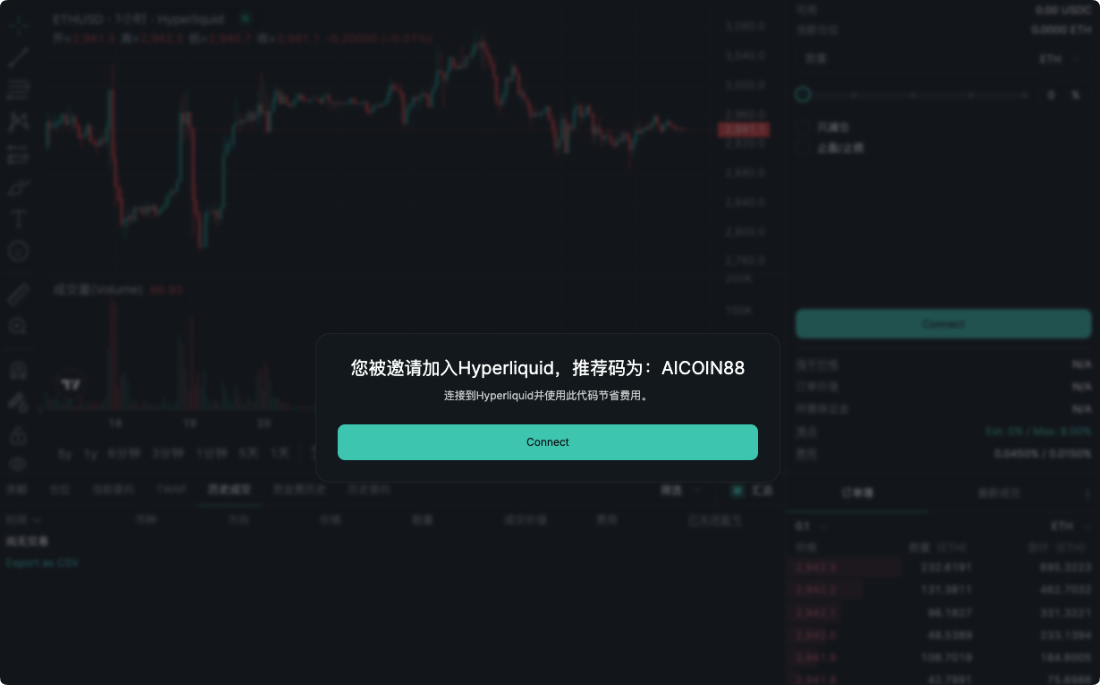
Exclusive Benefits for AiCoin Users
👉 Enter the invitation code AICOIN88 when binding your Hyperliquid account to enjoy a 4% rebate on fees.
🔗 Exclusive registration link:
https://app.hyperliquid.xyz/join/AICOIN88
📖 Beginner Tutorial:
“AiCoin PC Hyperliquid Authorization Trading Tutorial”:
https://www.aicoin.com/zh-Hans/article/514197
“AiCoin Mobile Hyperliquid Authorization Trading Tutorial”:
https://www.aicoin.com/zh-Hans/article/541383
“Beginner’s Guide! Detailed Illustrated Tutorial for First-Time Trading on Hyperliquid”:
https://www.aicoin.com/zh-Hans/article/510225
📖 Community Communication:
Telegram:
Discord:
AiCoin-Group Chat:
https://www.aicoin.com/link/chat?cid=N6OVMor5g
The content of this article only represents the author's personal views and does not represent the stance of this platform. The viewpoints, conclusions, and suggestions in the text are for investors' reference only and do not constitute any investment advice related to this platform. Investing in US stocks still requires self-borne market risk, regulatory risk, and compliance risk of local laws and regulations (especially foreign exchange controls, overseas investment reporting, etc.).
免责声明:本文章仅代表作者个人观点,不代表本平台的立场和观点。本文章仅供信息分享,不构成对任何人的任何投资建议。用户与作者之间的任何争议,与本平台无关。如网页中刊载的文章或图片涉及侵权,请提供相关的权利证明和身份证明发送邮件到support@aicoin.com,本平台相关工作人员将会进行核查。