Author: AiPlot Research Institute
Focus: RWA / Digital Assets / In-depth Analysis of Financial Infrastructure
Website: https://aiplot.com/?utm_source=aicoin
Solana's RWA ecosystem has just completed an important scale leap.
The value of Solana's RWA assets has grown from less than 1 billion dollars about a year ago to 5.19 billion dollars. As of October 29, 2026, the distributed RWA asset value on Solana is 5.19 billion dollars, with a growth of 20.75% over the past 30 days; the number of RWA holders has reached 848,306, an increase of 21.06%; the 30-day RWA transfer volume is 11.82 billion dollars, up 44.64%.
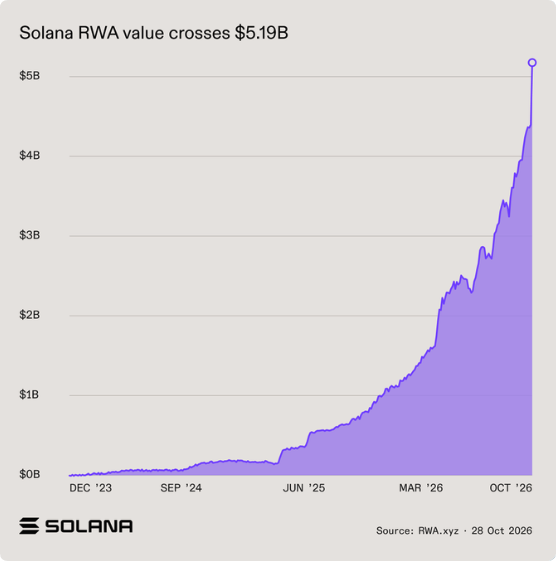
This set of data is enough to indicate that Solana's RWA is no longer a small market stuck in the proof-of-concept stage. The next challenge is not whether the numbers can continue to grow, but whether these tokenized assets have real demand and can be used continuously.
This is exactly what makes Solana RWA currently worth researching. Scale growth proves that issuance and distribution have occurred, while real adoption must prove that assets can enter transactions, payments, lending, collateral, clearing, and portfolio management.
1. What 5.19 Billion Dollars Means
First, it needs to be clarified that 5.19 billion dollars refers to the Distributed Asset Value on Solana; the same page also shows that the Represented Asset Value is approximately 126 million dollars.
This distinction is important. It means we cannot simply regard all "real assets that have appeared on-chain" as the same kind of asset. Different products may correspond to different legal structures, custody arrangements, investor rights, and redemption mechanisms.
From the growth rate perspective, Solana's distributed RWA asset value has increased by 20.75% over the past 30 days. Backtracking with the current data, the scale about 30 days ago was approximately 4.3 billion dollars. In other words, the nominal scale added in the last month was around 890 million dollars.
However, scale growth itself needs further breakdown. It may come from three different sources:
- New asset issuance, representing new funds entering;
- Migration of existing assets across chains, representing network distribution changes;
- Changes in asset prices, exchange rates, or statistical criteria, which may not necessarily represent new user demand.
Therefore, when studying Solana RWA, one cannot only look at the "asset value" metric. It is also essential to observe the number of holders, transfer volume, asset categories, issuers, and the usage of specific products simultaneously.
2. Quality of Growth Matters More Than Speed
A noteworthy relationship has appeared among several data metrics for Solana:
- Distributed RWA asset value: 5.19 billion dollars;
- RWA holders: about 848,000;
- 30-day RWA transfer volume: 11.82 billion dollars.
If a rough comparison is made, the 30-day transfer volume is about 2.28 times the RWA asset value. This does not equate to asset turnover rate and cannot directly prove that every dollar of assets has been fully traded twice, as transfer volume may include internal portfolio adjustments, cross-address transfers, double counting, or settlements between different products. But it at least indicates that RWA on Solana is no longer just sitting static.
More importantly, the growth in the number of holders is close to the growth in asset scale. With asset value increasing by 20.75% and holder growth at 21.06%, this indicates that this round of expansion is not entirely driven by a few large accounts.
However, the number of holders cannot simply equate to effective users. A holder may only possess a tiny number of tokens, or they may be a smart contract address, custody address, or passive distribution address. Therefore, moving forward, more detailed data is needed: active holders, repeat transaction users, holding concentration, average holding period, and cross-use among different assets.
3. Solana's RWA Has Expanded from Treasury Bonds to a Complete Asset Market
Solana's official review of institutional RWA mentions that the real assets on the network now cover tokenized treasury bonds, public stocks, private credit, reinsurance, sovereign debt, commodities, liquidity funds, and stablecoin settlement infrastructure.
This indicates that Solana's RWA ecosystem is moving from a single asset category toward a diversified market.
Treasury bonds and money market funds are the easiest starting points for institutional acceptance. They have shorter terms, relatively clear cash flows, and can be used as cash management tools or collateral. Products like BlackRock BUIDL, Franklin Templeton BENJI, Circle USYC, and Ondo USDY embody this direction.
Stocks represent another growth logic. They have stronger trading attributes and are easier to attract crypto-native users and global investors. However, the tokenization of stocks requires not only price synchronization but also handling custody, corporate actions, shareholder rights, investor qualifications, transfer restrictions, and redemption mechanisms.
Assets like private credit, reinsurance, and commodities have the potential for a larger scale, but they also have higher requirements for valuation, information disclosure, and risk management. The more non-standard the asset, the less tokenization is merely a technical issuance issue, but rather a matter of legal structure, cash flow management, and credit risk.
Thus, Solana's RWA scale expansion does not mean the market is already mature; it indicates that more different types of financial products are beginning to enter the same on-chain execution environment.
4. Why Solana Can Support This Round of RWA Growth
Solana's competitive advantage in the RWA space is not only transaction speed and low fees but also the simultaneous conditions of asset distribution, stablecoin settlement, and DeFi integration.
Solana officially positions itself as an "Internet Capital Market" and lists applications like tokenized stocks, debts, stablecoins, and real assets. The official page also emphasizes that institutional assets can be issued and transferred on-chain and linked with stablecoins and the DeFi market.
For RWA, low costs mean three things.
First, small holdings are easier to establish. If the costs for each transfer and transaction are high, assets can only cater to large institutions. When costs decrease, assets have the opportunity to expand their holder base.
Second, assets can be reconfigured more frequently. Cash management, portfolio adjustments, collateralization, and clearing all require a certain transaction frequency, and low costs can reduce friction in these operations.
Third, asset issuers find it easier to perform cross-product integrations. If treasury bond tokens, stablecoins, stock tokens, and lending protocols operate in the same execution environment, it can further form composite products instead of isolated asset pages.
The real competition for RWA is not “which chain can issue tokens,” but “which chain can allow tokenized assets to continuously enter financial activities.” From this perspective, Solana's ecosystem completeness is a significant advantage.
5. The Current Structure of Solana RWA Worth Watching: Institutional Issuance, On-chain Distribution
Official sources from Solana indicate that institutions such as BlackRock, J.P. Morgan, Visa, Franklin Templeton, Apollo, Hamilton Lane, VanEck, Ondo, and Securitize are already conducting or advancing related deployments on Solana.
This brings an obvious change: the growth of Solana RWA no longer primarily relies on anonymous teams creating assets, but increasingly involves participation from traditional financial institutions, asset managers, payment companies, and compliant issuance platforms.
However, institutional issuance does not automatically mean that assets will have liquidity. Large institutions can provide brands, product design, and compliance frameworks, but the activity in secondary markets still depends on:
- Whether there are enough investors to buy;
- Whether there are stablecoins as settlement assets;
- Whether there are market-making and liquidity incentives;
- Whether assets are allowed to enter lending and collateralization scenarios;
- Whether there are clear redemption and exit paths.
Thus, Solana's current competitive focus is shifting from “attracting institutions to issue” to “ensuring the assets issued by institutions are continuously used.”
6. The Real Demand in the Next Phase Should Be Observed through Four Indicators
1. Are Assets Entering Transactions?
The existence of continuous secondary trading after asset issuance is more important than the one-time issuance scale. Especially for tokenized stocks and commodities, if there is only holding without trading, the price discovery function of the on-chain market cannot be established.
2. Are Assets Entering Collateralization and Lending?
The financial value of RWA comes not only from its own yield but also from its ability to serve as collateral for other financial activities. If treasury bond tokens, money market fund tokens, and some stock tokens can enter the lending market within regulatory limits, their capital efficiency will significantly increase.
3. Are Assets Settled by Stablecoins?
Stablecoins are the settlement layer for RWA. If asset trading, redemptions, dividends, and cross-border allocations all rely on stablecoins, RWA will truly have the characteristics of on-chain financial markets. Solana's page shows that its stablecoin market cap is approximately 14.23 billion dollars, with a 30-day stablecoin transfer volume of about 382.47 billion dollars.
It is important to note that stablecoin transfer volume does not equal RWA transaction volume, but it reflects that Solana already has a large on-chain dollar liquidity base. This provides a potential settlement environment for RWA products.
4. Will Users Reuse?
An important sign of real adoption is that users do not just purchase a token once but continuously hold, trade, collateralize, exchange, or use it for payments. In the future, attention can be paid to whether the same address holds stablecoins, treasury bond tokens, stock tokens, and credit assets simultaneously.
If users only buy and then remain inactive for a long time, RWA is closer to a digital holding registry; if users can repeatedly use RWA across different financial scenarios, it begins to become an on-chain financial asset.
7. Insights for the RWA Market: Scale Rankings are Giving Way to Use Cases
The growth of Solana RWA will continue, but market evaluation standards will change.
In the early market, it was easier to focus on who had the largest asset scale and who issued the most. As we enter the next stage, investors and institutions will pay more attention to the effective circulation of assets, redemption depth, holder structure, and protocol integration.
This means that RWA projects may see three types of differentiation.
The first type involves products with high asset quality, credible issuers, clear redemption mechanisms, and continuous liquidity. Such products may become the foundational assets for cash management or trading markets on-chain.
The second type includes assets that genuinely exist but lack secondary markets and protocol integration. These products may have scale but may not possess high capital efficiency.
The third type primarily relies on incentives and short-term narratives to generate scale. Once subsidies decrease, holders and trading volume may rapidly decline.
For Solana, 5.19 billion dollars is an important milestone, but not the endpoint. It proves that Solana has the ability to support RWA assets but has yet to fully demonstrate that these assets have formed a mature financial market.
8. How to Use AiPlot to Track the Next Phase of Solana RWA
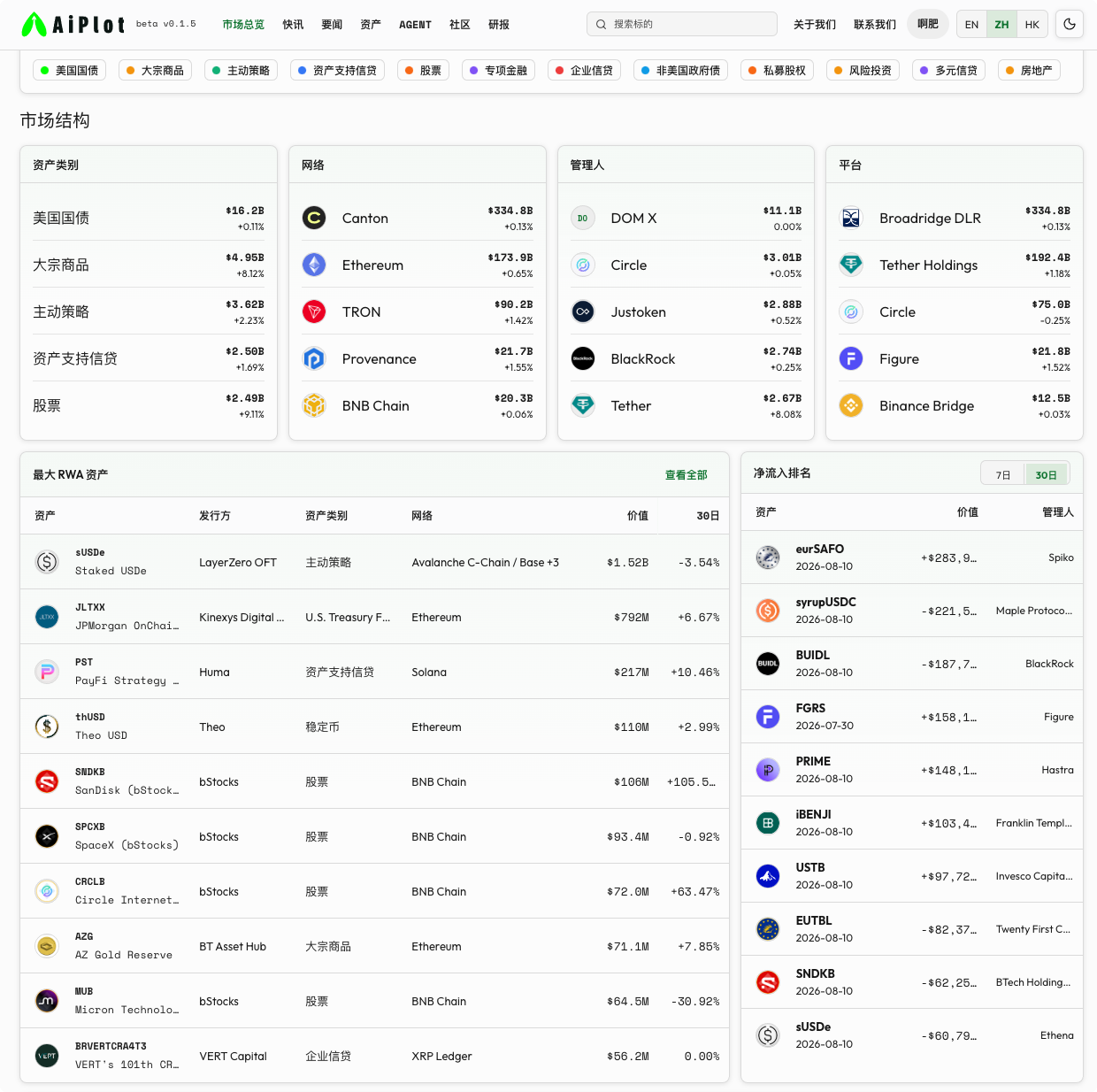
When studying Solana RWA, one cannot solely focus on individual news articles or single projects. The value of AiPlot lies in its ability to observe RWA asset categories, networks, platforms, managers, asset values, and on-chain activities within the same market view.
For Solana, it is recommended to continuously track four sets of data:
- Network Scale: Changes in asset value rankings within the Solana RWA network;
- Asset Structure: Changes in the proportions of treasury bonds, active strategies, stocks, commodities, and credit;
- Product Concentration: Whether scale growth comes from a few leading issuers or is driven by more small and medium-sized assets working together;
- On-chain Activity: Specific assets' transactions, transfers, changes in holders, and cross-chain distribution.
It is especially necessary to compare “asset scale growth” with “on-chain usage growth.” If asset scale continues to rise, but the number of holders, transactions, and transfers does not grow in sync, the growth may mainly come from issuance or migration. If the growth in holders and transfers continues to exceed asset scale, it indicates that the financial activities of assets are becoming more active.
This is also the practical role of AiPlot in RWA research: it does not replace the judgment of asset legal structures and issuer credibility but can help researchers promptly identify capital flows, changes in asset categories, and signals of on-chain adoption.
Conclusion: Solana RWA Has Passed the First Test
Solana RWA has grown from less than 1 billion dollars to 5.19 billion dollars, indicating that tokenized assets have become an important part of Solana's ecosystem.
However, the evaluation criteria for the next phase will shift from "how many assets have been issued" to "how many times those assets have been used." A true RWA market must simultaneously possess assets, users, liquidity, settlement, and financial applications, rather than merely on-chain balances.
Solana's current advantages are its large stablecoin liquidity, low transaction costs, an increasing number of institutional issuers, and a wide variety of asset types. The next competition is to enable treasury bonds, stocks, credit, and commodities tokens to enter transaction, collateralization, lending, and payment systems.
For more data and analysis, follow AiPlot:
https://aiplot.com/?utm_source=aicoin
📖 Community Discussion:
- Telegram:
https://t.me/+IIYMcJigBAo4Mjg1
The content of this article solely represents the author's personal views and does not reflect the stance of this platform. The viewpoints, conclusions, and suggestions in this article are for investors’ reference only and do not constitute any investment advice related to this platform. The market has risks, and investments should be cautious.
免责声明:本文章仅代表作者个人观点,不代表本平台的立场和观点。本文章仅供信息分享,不构成对任何人的任何投资建议。用户与作者之间的任何争议,与本平台无关。如网页中刊载的文章或图片涉及侵权,请提供相关的权利证明和身份证明发送邮件到support@aicoin.com,本平台相关工作人员将会进行核查。