Author: AiPlot Research Institute
Focus: RWA / Digital Assets / In-depth Analysis of Financial Infrastructure
Website: https://aiplot.com/?utm_source=aicoin
The most noteworthy aspect of RWA is not simply converting U.S. Treasuries, gold, stocks, or credit assets into tokens on the blockchain, but how it may reorganize the ways assets are issued, distributed, traded, collateralized, and settled.
An important judgment: Tokenization of U.S. Treasuries and gold tokenization are genuine demands, while many RWA project tokens may simply be valued through the narrative of asset tokenization.
If this judgment is further elaborated, the real question becomes: Do the wealth opportunities of RWA come from the underlying assets themselves, or from the new financial infrastructure built around those assets?
My judgment is that the next phase will not have just one explosive point, but will unfold into three layers of opportunities sequentially:
- Asset Layer Opportunity: Gaining revenue and price exposure to real assets;
- Infrastructure Layer Opportunity: Services for asset issuance, custody, compliance, data, and settlement;
- Financial Application Layer Opportunity: Enabling tokenized assets to enter trading, lending, collateralization, and automated finance.
The real potential for excess returns often does not come from the earliest recognized "asset tokens," but from the intermediaries that can turn assets into high-frequency financial instruments.
1. The First Value of RWA: Connecting Idle On-chain Funds to Real Revenue
In the past, the main choices for on-chain funds were usually stablecoins, lending, liquidity mining, or high-volatility assets. Stablecoins solve value accounting and on-chain settlement, yet typically do not directly pass on treasury yields to holders.
The value of tokenized U.S. Treasuries lies in providing a tool that brings on-chain funds closer to traditional finance cash management. Holders can achieve short-term treasury or money market asset exposure through compliant products, while issuers handle custody, subscriptions, redemptions, and investor access management.
This is not a small demand. AiPlot's RWA market page shows that U.S. Treasuries are currently the largest RWA asset class, with a scale of approximately $14.6 billion; active strategies around $4.34 billion, and asset-backed credits around $2.89 billion.
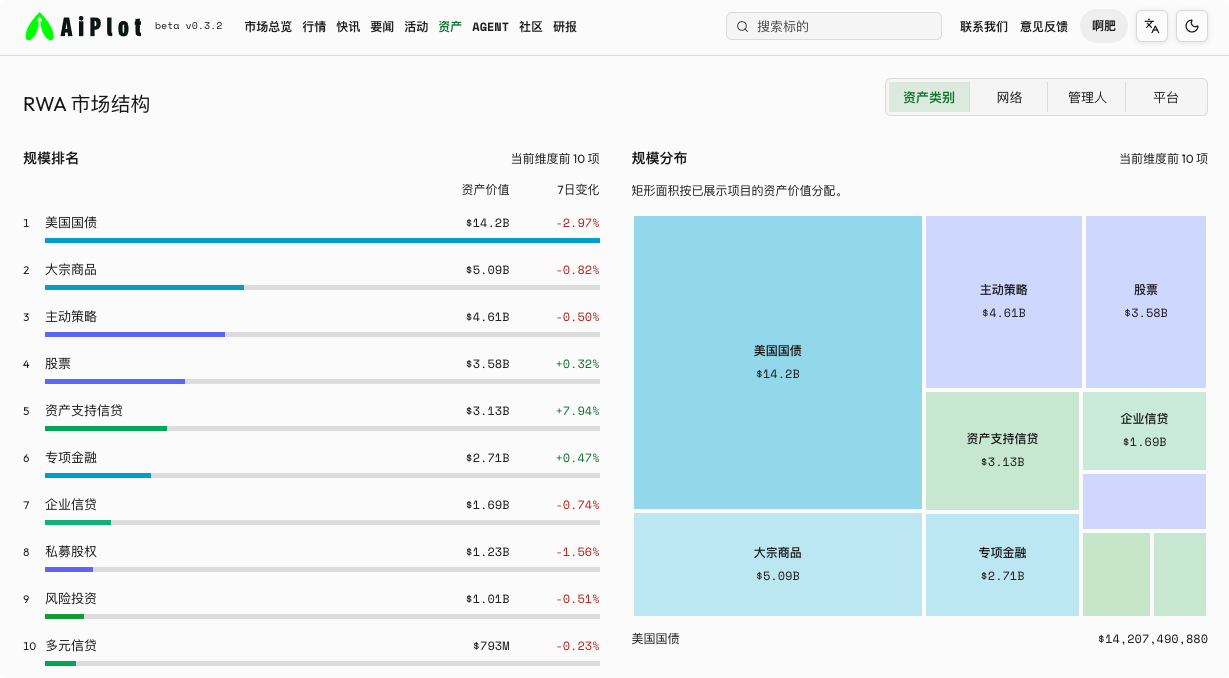
The ranking of RWA asset classes itself indicates that funds first need:
- Understandable underlying assets;
- Clear sources of income;
- Relatively stable valuations;
- Ability to be managed and settled on-chain.
This is also why treasury tokens tend to scale more easily than complex real estate or non-standard assets. They are not because the concept is more attractive, but because they can more easily become tools for fund management.
2. The First Type of Wealth Opportunity: Not Chasing RWA Concept Tokens, but Seeking "Asset Yield Spread"
The first opportunity at the asset layer is the differences in yield and usage efficiency between different financial systems.
When on-chain funds can purchase tokenized U.S. Treasuries, gold, or other income-generating assets, new paths for capital allocation will emerge in the market. For example:
- Cryptocurrency trading firms allocating idle stablecoin balances to short-term treasuries;
- DAOs transferring treasury assets from non-yielding stablecoins to income-generating assets;
- Global users gaining exposure to dollar assets in traditional markets through on-chain products;
- On-chain lending protocols using income-generating RWAs as collateral;
- Companies using stablecoins and tokenized cash management products for settlements across regions.
Here, the opportunity may not come from soaring asset prices but from improved capital efficiency.
An institution holding $100 million in stablecoins, if converting part of it into income-generating treasury tokens, is not acquiring a new speculative narrative but rather the interest income from idle funds. For individual retail investors, this yield may not be impressive; however, for trading platforms, corporate treasuries, funds, and payment institutions, when the capital scale is large enough, efficiency gains could transform into substantial profit sources.
Therefore, the asset layer is more suitable for seeking "stable compounding" and "capital migration," rather than expecting every RWA asset to generate high multiple markets.
3. The Second Type of Wealth Opportunity: Stablecoins Will Become the Liquidity Foundation for RWA
For RWA to truly circulate, there must be settlement assets. Stablecoins are just that settlement layer.
Tokenized U.S. Treasuries need stablecoins for subscriptions and redemptions, tokenized stocks require stablecoin transactions, on-chain lending needs stablecoins for disbursements and repayments, and cross-border corporate payments also need stablecoins for settlement.
This means that the growth of RWA will not only drive up the value of "asset issuance platforms" but will also promote the development of stablecoin wallets, payment interfaces, clearing networks, cross-chain bridges, enterprise financial systems, and on-chain accounts.
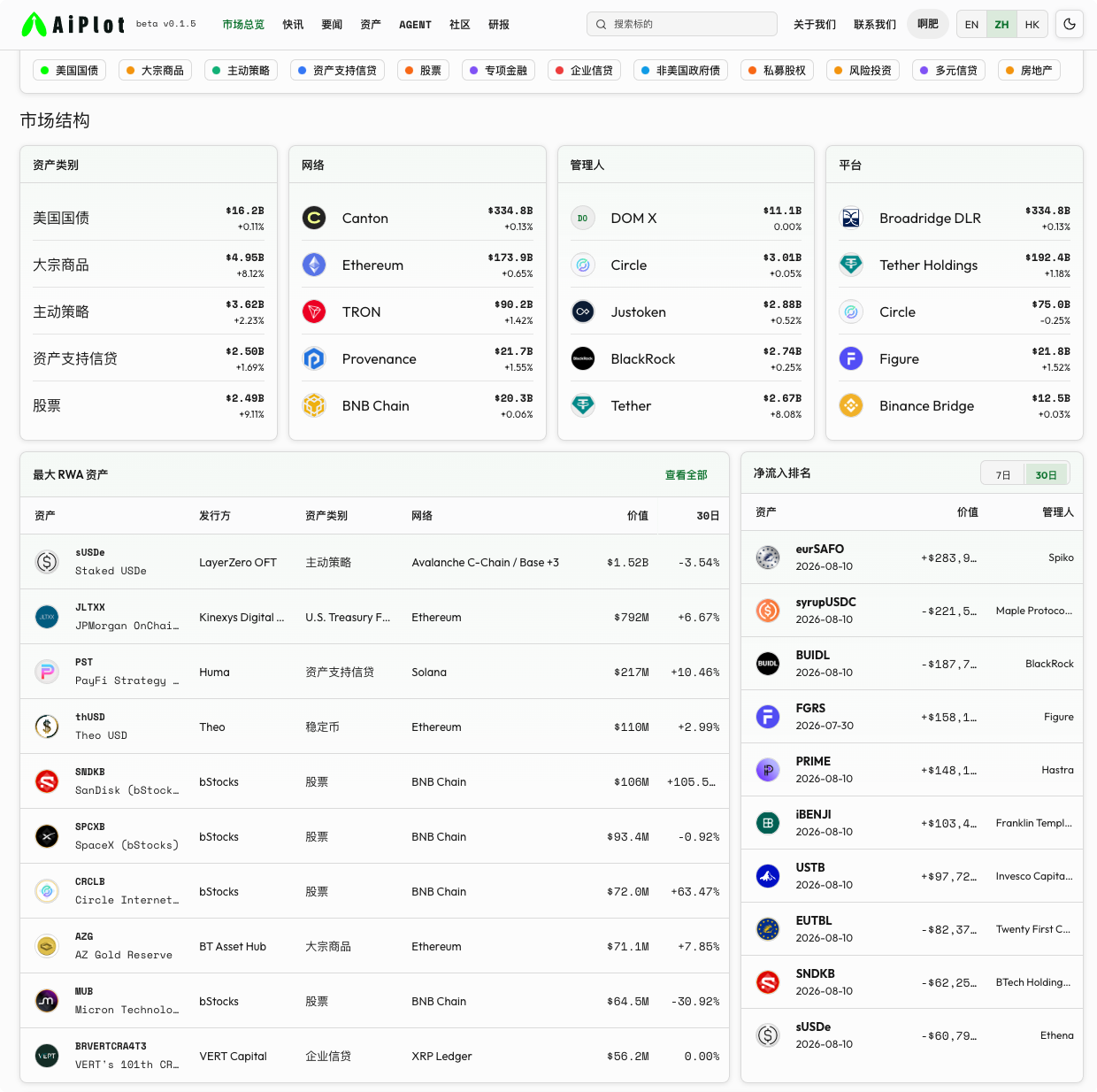
According to AiPlot's market data, stablecoins like USDT and USDC remain among the largest on-chain assets; in a broader RWA statistic, the total scale of stablecoins is about $286.24 billion, far exceeding the majority of individual tokenized funds.
This data emits an important signal:
The largest future entry point for RWA may not be a high-yielding asset but the financial infrastructure of stablecoins themselves.
Wealth explosions could occur in the following areas:
- Enterprise-oriented stablecoin payment collections;
- Multi-chain stablecoin clearing;
- Deposits and withdrawals between stablecoins and bank accounts;
- Stablecoin reserves and yield management;
- Providing programmable payments for AI Agents;
- Integrating stablecoins with foreign exchange, trade finance, and supply chain finance.
While the competition to issue stablecoins may be highly concentrated, there appears to be significant opportunities in the infrastructure supporting the liquidity of stablecoins.
4. The Third Type of Wealth Opportunity: Projects with Real Potential Are Not Issuing Assets, but Making Assets "Move"
Issuing assets onto the blockchain is just the first step. For assets to generate greater financial value, they must be used.
For example, a tokenized treasury that can only be held and redeemed is, in essence, a digital fund share; if it can be used for lending, margin, liquidity pools, and automated asset management, it begins to approach on-chain financial assets.
This is the most significant value leap of RWA: moving from "on-chain holding" to "on-chain circulation."
Current data from AiPlot indicates that the market no longer consists solely of treasuries and stablecoins. Active strategies, stocks, commodities, asset-backed credit, specialized finance, and corporate credit have all formed independent asset classes.
However, the growth quality of different assets varies. What truly deserves tracking is not which category's name is most popular, but the following three questions:
- Are assets experiencing continuous on-chain trading?
- Can they enter collateral and lending protocols?
- Can they be combined with stablecoins and other assets?
If an asset can only be issued and cannot be traded or collateralized, its financial efficiency remains limited. In contrast, an asset that may not be the largest in scale but has already become a foundational asset in lending, clearing, and portfolio management may possess stronger long-term value.
5. The Fourth Type of Wealth Opportunity: The True High Odds of RWA May Come from "Protocol Revenue" Rather Than Asset Scale
The most common error in the market is to observe the growth of a project's RWA asset scale and directly infer that its native token should rise.
However, asset scale and protocol revenue are not the same thing. A platform managing $1 billion in assets does not mean it possesses $1 billion in economic value. When studying protocol tokens, one must continue to inquire:
- How much issuance and management fees does the platform collect?
- Is revenue belonging to the issuing entity, fund manager, or on-chain protocol?
- Is revenue sufficient to cover compliance, custody, and operational costs?
- Do token holders have buyback, distribution, or discount rights?
- Is the token merely a governance voting tool?
- Can asset scale convert into sustainable trading and lending revenue?
This is the most critical value capture issue in RWA.
Therefore, the projects worth looking for in the next phase may not necessarily be those with the fastest TVL growth but rather protocols that meet the following conditions:
- Real underlying assets;
- Sustained growth in asset scale;
- The protocol has genuine revenue;
- There is a clear connection between revenue and token;
- Assets can enter more financial applications.
If a project only has asset scale without revenue; only governance voting without value capture; and only issuance without liquidity, it will struggle to form long-term compounding.
6. The Fifth Type of Wealth Opportunity: Data and Risk Control May Be the Most Undervalued RWA Infrastructure
The greatest difficulty of RWA is not writing tokens into smart contracts but continuously answering what is happening with the underlying assets.
For treasury products, one needs to know the underlying assets, maturity, duration, yield, redemption conditions, and custodian. For private credit, it is essential to understand the borrower, collateral, defaults, cash flows, and liquidation progress. Regarding real estate, it is vital to know property valuation, rental rates, maintenance costs, and rental income.
If this information cannot be continuously verified, the so-called on-chain transparency may only be "token transfer transparency," not "underlying asset transparency."
Therefore, there are several potential opportunities in the RWA data layer:
- Asset registration and holding proof;
- Independent audits and reserve verification;
- Mapping of off-chain assets to on-chain tokens;
- Risk scoring for issuers and custodians;
- Monitoring for redemption, liquidation, and defaults;
- Aggregation of multi-chain assets and holder data;
- Real-time risk APIs for institutions.
7. The Sixth Type of Wealth Opportunity: Tokenized Stocks Might Be the Breakthrough for RWA into the Mass Market
U.S. Treasuries and gold are the easiest assets to build trust in, but stocks may be the easiest assets to generate user demand.
The reason is simple: stocks inherently have stronger trading attributes, brand recognition, and price volatility. The demand from global users for investments in U.S. tech stocks, semiconductors, energy, and crypto-related companies far exceeds the demand for unfamiliar private credit.
However, stock tokens will also face more complex legal and product issues. What holders receive pertains to stock ownership, economic exposure, or contractual rights, which must be determined by the issuance documents. Ondo has also clearly stated that Ondo Stocks do not equate to the underlying stocks themselves and do not necessarily grant holders rights to hold or receive the underlying assets.
Therefore, the high growth potential of stock tokens coexists with high compliance thresholds. They may become an entry point for user growth in RWA, but will also be one of the most competitive fields regarding regulation and product structure.
8. The Three Types of Wealth Explosions Most Likely to Occur Next
Explosion One: Income-generating Dollar Assets Become Standard for On-chain Cash Management
As more trading platforms, companies, and funds convert their stablecoin balances into treasury tokens, tokenized treasuries may evolve from an investment product to the default balance of on-chain financial accounts.
The opportunities here belong not only to treasury issuers but also to wallet, custody, clearing, data, and asset management platforms. Whoever can create a smooth workflow for "stablecoin - treasury token - redemption - payment" could gain stable service revenue.
Explosion Two: RWA Enters Collateral and Lending, Leading to a Leap in Asset Turnover
The first phase of asset tokenization is issuance, the second is trading, and the third is collateralization and lending.
When treasuries, stocks, and fund tokens can become collateral within compliance limits, assets will shift from static holdings to credit-creating tools. At that point, the value of the RWA market will no longer be determined solely by asset scale but also by how much financing and trading the assets can support.
This could be a key point for generating larger incremental growth for RWA.
Explosion Three: AI Agents Start Using Stablecoins and Tokenized Assets
If AI Agents need to automatically purchase data, pay for APIs, manage funds, and execute trades, they will require programmable accounts and assets.
Stablecoins can become the payment medium for agents, treasury tokens can serve as tools for managing idle funds, stock and commodity tokens can become trading objects, while on-chain permission systems can regulate the agents' limits and risks.
Once AI Agents begin engaging in large-scale financial activities, the demand for RWA could shift from "whether human investors are willing to buy" to "whether software must use them." This might transition RWA from the investment product market into the software infrastructure market.
9. How to Discover Wealth Explosions in Advance: Look Beyond Price Increases, Focus on Five Leading Indicators
1. Is Asset Scale Sustaining Growth?
Scale is the most fundamental metric, but it is crucial to distinguish between new issuance, cross-chain migration, and price changes.
2. Are the Number of Holders Expanding?
If asset growth comes solely from a few institutions, it indicates that the market is still in the institutional allocation phase; a broadened number of holders and active addresses signifies the beginning of distribution capabilities.
3. Are Transactions and Transfers Exceeding Asset Growth Rates?
If transfer volumes, trading volumes, and redemption activities increase simultaneously, it indicates that assets are starting to be utilized rather than lying dormant on balance sheets.
4. Are They Entering Lending, Collateral, and Portfolio Products?
This step determines the capital efficiency of the assets. Assets that can be engaged in portfolios and collateralized typically possess greater financial value than those that can only be held.
5. Are Protocol Revenues and Token Value Capture in Sync?
This is key to determining whether a protocol token is worth studying. If asset scale rises but protocol revenue does not, or if protocol revenue increases while the token lacks any value transmission mechanism, careful interpretation is necessary.
Conclusion
The true value of RWA lies not in simply copying traditional assets into tokens, but in enabling assets to acquire new distribution methods, new settlement methods, and new financial uses.
Wealth opportunities will not be concentrated in one segment:
- The asset layer provides relatively stable revenue and price exposure;
- The stablecoins provide liquidity for settlement across the market;
- The issuance and custody platforms derive service revenues;
- The data and risk control platforms address asset transparency issues;
- Trading, lending, and collateral protocols enhance asset turnover;
- Tokens that can capture protocol revenue stand a chance to achieve genuine valuation support.
In the next phase, the most valuable projects to seek are not those that simply make the loudest RWA claims but those that have formed such a closed loop:
Real Assets → On-chain Issuance → Stablecoin Settlement → Continuous Trading → Collateral Lending → Protocol Revenue → Token Value Capture.
Once this closed loop is established, RWA can potentially shift from "on-chain packaging of traditional financial assets" to new financial productivity.
This is the aspect of RWA that deserves tracking in the next phase.
For more data and analysis, please follow Aiplot:
https://aiplot.com/?utm_source=aicoin
📖 Community Communication:
Telegram:
https://t.me/+IIYMcJigBAo4Mjg1
The content of this article represents the author's personal views and does not reflect the stance of this platform. The views, conclusions, and suggestions in the text are for investor reference only and do not constitute any investment advice related to this platform. The market carries risks; invest cautiously.
免责声明:本文章仅代表作者个人观点,不代表本平台的立场和观点。本文章仅供信息分享,不构成对任何人的任何投资建议。用户与作者之间的任何争议,与本平台无关。如网页中刊载的文章或图片涉及侵权,请提供相关的权利证明和身份证明发送邮件到support@aicoin.com,本平台相关工作人员将会进行核查。