
The Democratic Party swept the midterm elections in the United States, reshaping the global technology and industry landscape.
The Democrats won gubernatorial elections in key states such as Texas and Georgia, with some candidates explicitly promising a moratorium on the construction of data centers. This outcome has raised doubts in the market about the prospects for AI infrastructure expansion—Asian chip stocks generally fell on Wednesday, U.S. Treasury yields subsequently declined, and the Nasdaq index has accumulated a correction of about 8% over the past month.
For South Korean companies, the impact of these election results is mixed. Chip manufacturers like Samsung Electronics and SK Hynix are worried that stricter regulations on data centers will suppress demand for server DRAM and high-bandwidth memory; meanwhile, solar companies like Hanwha Solutions in South Korea are hoping for the revival of the clean energy tax credit policy under the Inflation Reduction Act promoted by the Democrats, which would benefit them.
Sentiment for Data Centers Rises, Tech Stocks Face Pressure
The scale of the opposition's victory regarding data centers in the midterm elections took the market by surprise. In Texas, GLJ Research estimates that the state will account for about a quarter of all data center capacity projected to be operational in the U.S. by 2030. Democrat Gina Hinojosa defeated incumbent Republican Governor Greg Abbott, ending three decades of Republican governance in the state; fellow party candidate James Talarico was also elected senator. In Georgia, data from commercial real estate service firm CBRE indicates that Atlanta is the most active market in the U.S. for data center construction. Democrat Keisha Lance Bottoms won the gubernatorial race in the state, ending over 20 years of Republican rule.
It is worth noting that the resistance to data centers is not solely based on partisan positions. Opponents criticize data centers for noise disturbances, high water usage, incredible electricity consumption, while also driving up local utility costs, and argue that the jobs created and tax contributions are disproportionate to the incentives provided by the state government. Even some Republicans have shifted to opposing such projects. Musk donated over $450 million to the Republican Party this time, joking on social media on election night that "building data centers in space seems quite appealing."
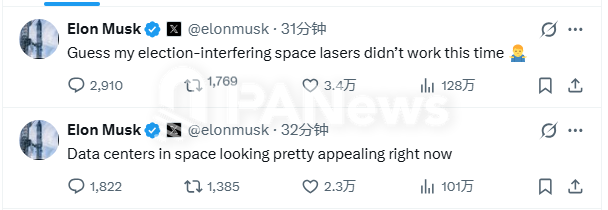
Aidan Yao, senior investment strategist at the investment research institute of Europe's largest asset manager, Amundi, stated: "In our view, the significance of this midterm election is more like a referendum on AI rather than a referendum on Trump. If certain restrictions are placed on the AI theme, the U.S. economy, U.S. inflation, and U.S. monetary policy will become extremely uncertain."
South Korean Chip Industry: Chip Bill Subsidies Likely to be Maintained, New Data Center Regulations a Concern
For Samsung Electronics and SK Hynix, the Democratic control of Congress sends mixed signals. The positive aspect is that the Democrats have the ability to balance attempts by the Trump administration to cut subsidies from the chip bill. The Trump administration has sought to renegotiate subsidy terms that were finalized during the Biden administration, and some Democratic lawmakers have criticized this stance. The subsidies linked to Samsung's investment in its Taylor, Texas plant amount to as much as $4.745 billion.
However, concerns are rising about stricter regulations on data centers. Industry insiders indicate that market worries center on tightening the approval process for data center construction on the grounds of AI safety, energy, and environmental issues, which could delay the start of new projects and ultimately drag down demand for server DRAM and high-bandwidth memory.
KB Securities analyst Kwon Hee-jin believes that stricter regulation may not directly lead to a shrinking size of investment. "Data centers have a significant impact on local taxes and regional economies, making it difficult for state governments to directly prohibit construction," he stated. "The more likely adjustment direction is to transfer electricity costs to data center operators or require them to ensure their power supply before starting construction." If so, tech giants would have to build their own substations, transmission networks, and power generation facilities, potentially increasing overall infrastructure spending and creating new demand space for South Korean electrical equipment manufacturers.
Automotive Industry: Tariff Barriers Likely to Persist
The automotive industry does not hold high expectations for policy relaxation. The 15% tariffs imposed under Section 232 of the Trade Expansion Act fall within the realm of executive power and are expected to remain unchanged regardless of which party controls Congress. Cho Sung-dae, head of the Trade Research Department at the Korea International Trade Association, stated: "Congress may strengthen its oversight of government policy execution, but the likelihood of major changes to tariff measures is very low." He believes that with Washington continuously focusing on protecting domestic industries and consolidating supply chains, the pressures from automotive tariffs and expanded production in the U.S. will continue.
However, Democratic control of Congress may inject new momentum into electric vehicle promotion policies, encouraging Hyundai and Kia to further deepen their electrification strategies.
Shipbuilding Industry: Cooperative Framework Likely to Continue, but Space is Limited
The key variables in the shipbuilding industry depend on the extent to which the U.S. allows its naval vessels to be built overseas. The National Defense Authorization Act passed by the House clearly prohibits funding for the construction of combat vessels in overseas shipyards, while the Senate Armed Services Committee version allows some non-combat vessels to be built abroad.
New Hanjin Securities pointed out that if the U.S. strengthens restrictions on building naval vessels abroad, the expectations of obtaining new shipbuilding orders through MASGA—Make American Shipbuilding Great Again, the Korea-U.S. shipbuilding cooperation project—are likely to narrow, with cooperation opportunities focusing on maintenance, module supply, and local drydock areas. However, as rebuilding the U.S. shipbuilding industry is a bipartisan consensus, and MASGA investment is driven by the executive department, there is a general belief that the overall cooperation framework will remain unchanged.
Renewable Energy: Policy Windfall Benefits Korean Companies
The renewable energy industry is the most optimistic about the election results. The Democratic Party's campaign platform centered around restoring the clean energy tax credits from the Inflation Reduction Act. Companies like Hanwha Solutions, which have large capacity bases in the U.S., are widely viewed as beneficiaries. The solar sector is particularly noteworthy—South Korean firms are thus positioned advantageously in the market.
U.S. Business Expansion, South Korean Companies Pay Close Attention to Congressional Political Trends
South Korean companies are highly sensitive to changes in the power dynamics in Congress due to a significant increase in the proportion of their U.S. business. A survey by corporate data provider CEO Score on 28 large corporate groups’ overseas subsidiaries revealed that as of the end of June this year, the number of subsidiaries in the U.S. reached 1,308, a 232.0% increase compared to 394 ten years ago, and the proportion of total overseas subsidiaries climbed from 13.0% to 26.5%.
The number of U.S. subsidiaries owned by Samsung, SK, Hyundai, LG, and Hanwha rose from 240 to 888 during the same period. Among them, Hanwha demonstrated the most remarkable growth, expanding from 63 to 374 due to its aggressive expansion in solar and energy storage; SK followed, increasing from 40 to 243; Hyundai grew from 55 to 112.
免责声明:本文章仅代表作者个人观点,不代表本平台的立场和观点。本文章仅供信息分享,不构成对任何人的任何投资建议。用户与作者之间的任何争议,与本平台无关。如网页中刊载的文章或图片涉及侵权,请提供相关的权利证明和身份证明发送邮件到support@aicoin.com,本平台相关工作人员将会进行核查。


