Original Title: The most lucrative AI business to start in 2027
Original Author: Dan Koe
Original Translation: Liu Boss
The most profitable skill has always been attracting attention.
The reason is simple.
If your goal is to make more money, then it doesn’t matter how good the software you develop is, how long you spent writing a book for three years, how many drafts you overturned, or how hard you work to improve yourself for better career opportunities.
If no one knows who you are or what you can offer, how are they going to pay you?
This means that regardless of what job you work in or what business you start, attracting attention and acquiring customers will be the primary factor determining your success.
This applies to your own business and to others' businesses as well.
Moreover, others are willing to pay a hefty price for you to do this for them.
As job stability declines, people face three choices:
- Complain about how unfair life is and do nothing.
- Enhance skills, relearn, and look for better job opportunities.
- Start the business they have always wanted to do.
Astonishingly many people will choose the third path.
You probably guessed it, just like everyone on social media is loudly proclaiming, they will start this business by building a personal brand.
Why?
Because attention is a limited resource and will only become scarcer. People can earn more money but can never reclaim the attention they have already spent.
In this letter, I will teach you how to master the ability to attract attention on social media. This way, at least for the next few years, you won’t have to worry about making money.
With this knowledge, you can start your own business and use social media to drive its growth; or you can become a "one-person creative team" for other companies and receive high compensation for your skill set.
Promotion: "Second Renaissance" Workshop I will collaborate with Hussain Ibarra—whose Substack subscribers have grown from 2,600 to 20,100—to teach you how to write newsletters and articles that people actually want to read. If you’ve thought about running a Substack or want to write X articles better, you can sign up here. The fee is $49, but it will teach you skills that can earn you far more than that.
1. You either become a creator, pay creators, or earn money working for creators
This data is hard to ignore.
Goldman Sachs predicts that the creator economy will nearly double, growing from $250 billion in 2023 to $480 billion in 2027.
By 2025, creators are projected to earn around $185 billion in advertising revenue. This is the first time they will surpass traditional media.
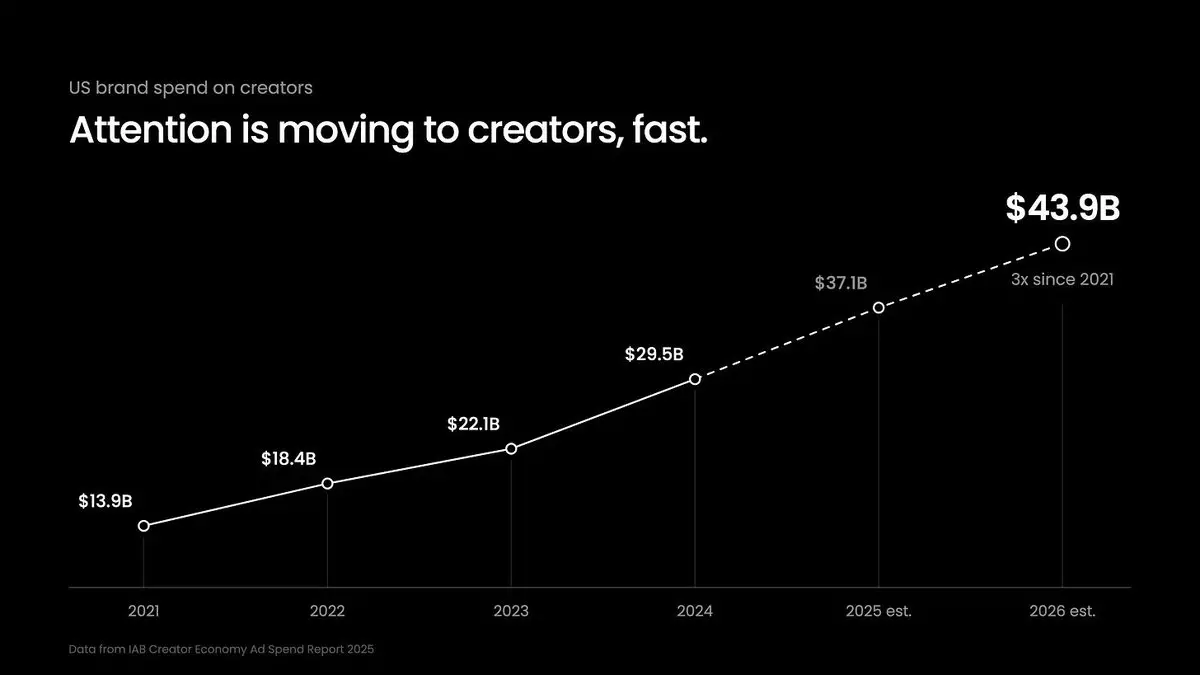
In 2021, American brands spent $13.9 billion on creators. The Interactive Advertising Bureau (IAB) estimates that this figure will reach $43.9 billion by 2026, growing nearly threefold in five years.
It's outrageous.
I myself am a creator, have worked for creators, and also pay creators. From my experience, the offers people receive are indeed astonishing. A significant amount of venture capital is invested; a Reels short video, or a 60-second ad slot in a YouTube video can earn thousands of dollars—even though these ads fail to produce results 90% of the time.
The key is that attention is now concentrated on social media, rather than broadcast television or news media. When you want to start any business, whether it’s a small business based on personal interests or the next unicorn startup, creating content has almost become a necessary option for attracting paying audiences.
When companies want to expand, they invest millions in affiliate marketing and co-promotions. I keep seeing ads from Hormozi, who claims they pay creators over a million dollars a month to promote Skool. Not to mention, Hormozi himself is a creator, which greatly helps Skool’s growth.
"Founder-led marketing" has become a buzzword in the startup community. Basically, it means that the newest and most effective way for your startup to grow is... you guessed it, building a personal brand and then publishing content. By the way, most of them do a poor job of it. You might want to start researching with Eden to establish differentiation and publish content.
What does this mean for you?
Whether you plan to work for yourself, already have a business, or want to work for other companies, the most worthwhile and profitable skill to learn is attracting attention. In the digital world, the most profitable skill is creating content—quality content, not endless junk content.
Unfortunately, just because you can master the methods of gaining attention doesn't mean you've actually captured attention.
If a tweet or short video gets a million views but your other posts only get 1,000 views each, then that viral moment is of no use. It means your content is decent, but your brand hasn't been built at all. We need both.
You can endlessly chase virality. Most people do this, and it’s also the reason most people fail miserably. Or, you can build a content world that makes people want to keep exploring.
I will teach you how to do that.
2. One-person creative team
The content industry is undergoing a massive transformation.
I am the founder of Eden. It is a tool that creators and digital business operators can use to research viral ideas, plan content, schedule releases, sell digital products, and operate email subscription lists.
I mention this not to promote, but to point out that we possess almost no other relevant data. Through billions of posts, we know what themes, opening hooks, and content styles are effective.
Additionally, freelancers and service agencies also use it to operate clients’ personal brands, covering content, email marketing, digital product launches, and building marketing conversion funnels.
When we converse with these content service agencies and media teams, we hear similar statements. Here’s the gist:
"We haven't laid off anyone yet, but we can take on many more projects without expanding the team because everyone’s output has increased."
"Creators and founders hire us because they simply don’t have time to think about content. They need to manage teams and run businesses, which requires focus. AI can write content for them, but they still know they need a strategist or creative director who can utilize AI better than they can. This still requires creativity and thought."
"AI still can't create the best posts, and I believe it never will. But it can analyze what content performs well, understand strategies, and write initial drafts that are already quite close to the requirements. Nowadays, all my work is reviewing and rewriting those drafts. Now I can finish it in 4 hours a day, whereas it used to take 12 hours."
In my view, the two most lucrative AI business directions an individual can pursue are:
First, become your own creative team. Build a personal brand, grow an audience, develop digital products, and establish email subscription lists, among other things. Just focus on doing those things. Trust me, even with AI, this is a full-time job. If you're a creator without a team, you probably can't simultaneously develop software.
Second, become someone else's creative team. Help companies, founders, or even creators who lack sufficient creative energy produce irreplaceable content. Most founders are still publishing "announcement-style" content and have no idea what it takes to build influence online.
In other words, you want to be the creative director of your brand or someone else's brand.
If you can do this, I see no reason why you can't charge a fee that amounts to part of the cost of a full team. Serving 1–3 clients with a monthly income of $10,000 to $75,000 is not out of reach—provided you’re skilled at it and practice continuously. Don’t let yourself think this is another get-rich-quick scheme. For business owners who invest millions in marketing, this price won’t even make them blink.
So what exactly does a one-person creative team look like?
What skills do you need to learn?
Responsibility 1: Brand Strategist
Brand strategists are responsible for positioning and how people perceive the brand.
They will first tell you: don’t just chase trends, and don’t try to make every post a viral hit. Growth and engagement are important, but not at the expense of trust and authority.
By the way, I’ll show you how to do these things well below.
Responsibility 2: Content Strategist
This is not the same as a brand strategist.
Content strategists research which content performs well within different topics and niches and suggest what the creator should post next. They delve into post formats, YouTube thumbnails and title structures, audience retention, and content virality.
They excel at growing accounts, but if they don’t consider brand strategy, once a creator stops posting, no one will care where they went.
Responsibility 3: Content Writer/Social Media Manager
This person is responsible for drafting tweets, YouTube or Reels video scripts, X articles, and Substack newsletters, as well as planning and publishing.
They take the ideas from the content strategist and the direction from the brand strategist, ensuring the final content aligns with both.
You can probably see why most people fail to create anything enduring with AI. They still treat AI as a quick route to wealth. They think that as long as they have Claude endlessly generate scripts without direction or data, they can magically connect with audiences.
Almost no one considers brand strategy.
Some people consider content strategy.
Most people merely transform random ideas into posts and then pray they perform well.
These are your competitors. It’s not hard to stand out from them.
3. If you were my client, this is how I would help you build an irreplaceable personal brand
Let’s do an interesting exercise.
I will assume you are my new client entering the collaboration process.
This way, if you want to become a creator, you can execute this process yourself. If you want to provide content services for others, such as ghostwriting tweets or writing Substack articles for brands, this is also the way to onboard new clients. Later, I will share an excellent strategy for landing your first client.
Step 1: Conduct a kickoff interview to outline the client's unique thought identity
To make the client’s brand and content distinctive, you need to understand a lot of background information about them.
After securing the client, schedule a call to collect all the information you need through the interview. Record the call and save the transcript for reference and AI utilization later.
If you are doing this for your own brand, I have prepared a usable questionnaire/prompt, along with a 30-day creator sprint course. It will integrate the currently trending content with your uniqueness to formulate a strategy. You can try it out here.
The following questions can be used to ask clients or to ask yourself. You can also paste them into Claude to have it prompt you for information and save it as a brand document for easy AI reference later.
All these questions shape your brand.
They can lead to content themes that will become the content you publish continuously for the next 6 to 12 months. Some people may ask here, "How can I convey all this in a single post?"
You can’t. This is a long-term game, and that’s why most people fail miserably. They want to achieve attention and authority quickly. Good luck to them.
Because the content is long, I have compiled these questions along with more content into a complete prompt that you can save or copy into your workspace.
Who do you help
- Who do you want to help the most? Describe a real person.
- What does a bad day look like for them right now?
- What would they say when complaining to a friend? Use their words.
- What have they tried that hasn’t worked?
Your story
- What are some experiences you have also gone through that your audience is undergoing?
- What moment changed your circumstances? It can be small.
- What have you accomplished, tried, failed at, and learned from? List everything big and small; every item has value.
- What achievements can you showcase for yourself or for the people you have helped?
Who shaped your thoughts
- Whose books, posts, or videos do you never miss? List specific names and titles.
- What perspective of theirs do you often reflect on? Why?
- Who changed your way of thinking, even if you no longer agree with them now?
Content pillars and unique perspectives
- What topics can you talk about for hours? List them all, even if they seem unrelated.
- Which 2-3 are most important to you?
- For each one, how is your angle different from others? For example, “from a psychological perspective” or “from the view of a former nurse.”
- What do people often consult you about?
- What topics do you frequently find yourself explaining over and over again?
Mission and beliefs
- In one sentence, what do you want to help people achieve?
- What do you believe that most people in your field do not?
- What common advice in your field do you think is wrong?
What do you oppose
- What lifestyle is harming the people you want to help?
- What kind of life do you want to help them escape from? Answer in your own words.
- If you could, what misconception or habit would you eliminate? Note that it's a habit or belief, not a specific person or company.
Why is this important now
- What change has just happened in the world that most people haven't noticed?
Where do you want to take them
- What will their daily life look like in 5 years if they focus on you?
- How would they proudly describe themselves in their profile?
- What role do you play in their story? Are you the guide, the documenter of the journey, or the person who has emerged and returned with a map?
Rules and terminology
- What does your ideal reader believe and do every day? List 5-12 guiding principles.
- Have you ever named your views, methods, or issues? Write down each name and its meaning.
- Keep this information safely stored somewhere, like in Eden’s brand board, so you can refer to it whenever brainstorming posts.
Step 2: If the client is already posting content, extract their best-performing content
I think we can all agree that AI cannot fully replicate a person's expression style.
Even if it gets close, there is always some subtlety that feels off.
But that’s not our goal. AI can handle corporate expression styles well, but there’s a reason why a personal brand is called a "personal" brand. It needs that unique flavor.
During our interviews with clients, we collect their best content, not to automate the entire process. We are building a knowledge base that encompasses everything unique or noteworthy about the person. When you use AI for brainstorming, drafting, or ideation, this makes the process much easier than starting from scratch.
To collect the client’s best-performing content across all platforms, you can connect Eden to Claude or ChatGPT using MCP so it can access the client’s posts or those that others are going viral. Provide the client's social media accounts, then use a prompt like the following:
markdown
Please gather the best-performing content from [@account list]. Extract 10-20 posts from each platform they are active on. Then, record the core insights that differentiate them, the uniquely personal aspects of their expression style, and conjecture about their worldviews or life philosophies that resonate with others. In short, document all the elements that contributed to their growth and organize them into a document.
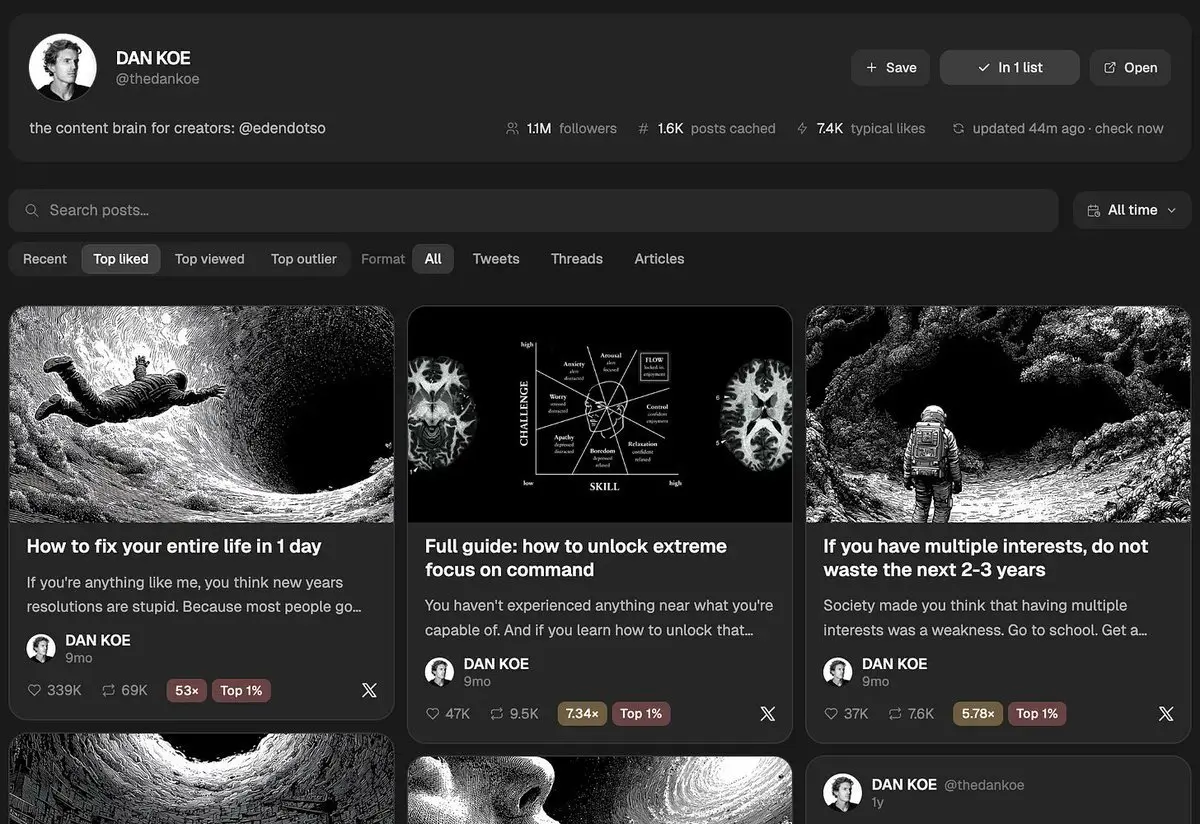
You should personally look at their best-performing posts across various platforms to identify reusable patterns.
Step 2.5: If you haven’t started posting content yet
For beginners, this might be one of the most worthwhile actions to take.
You must understand that your thoughts have always been shaped by those who have influenced you the most. Your best ideas—the ones that will drive your growth—come from how you understand and interpret the perspectives absorbed from others.
It’s a bit like "stealing like an artist," but that’s actually how thinking operates.
When you are exposed to a new idea, the ability to replace the old beliefs and thoughts dominating your thinking is a core manifestation of wisdom. Holding onto beliefs or ideas that yield no beneficial results is a sign of foolishness.
My thoughts, to a large extent, are a blend of perspectives from Naval, Leo Gura, Mihaly C, Steven Kotler, Ken Wilber, and others. The interplay of these perspectives in my mind, coupled with my own life experiences, is what makes my thoughts "mine."
So, if you haven’t posted content yet, list the 5-10 people who have influenced you the most.
If they are creators, even better. Organize them into a list for easy access to all their content or to engage in conversations about it with AI.
Then, use the same prompt above, just replace the accounts with theirs. If they don’t have social media accounts, have the AI gather their best ideas from the web and their books. Save the results into a document for safe keeping.
Step 3: Create a research-backed content map
So far, we have:
- Gathered sufficient brand background information to create unique content.
- Documented optimal insights that can be reused, repurposed, and repositioned.
Now we need to shift to a marketer’s perspective.
Actually, more accurately, to an artist’s perspective.
Most "creative workers" feel repulsed at the thought of researching viral posts, examining the best-performing YouTube titles, or creating based on things that are more likely to succeed. But that’s because your perspective has clouded your understanding of the essence of this.
You are gathering reference materials.
That’s what artists do. They build inspiration boards, gather references to help shape their work. They don’t replicate things one-to-one; instead, they refine patterns and principles to make their works more likely to perform well.
Because ultimately, you want your work to succeed. You just feel like looking at data is somewhat unpleasant, as if it doesn't belong in the creative process. Stop thinking that way.
Here’s how to do it concretely.
(Just to clarify, I mention Eden in this letter several times because frankly, nothing else can accomplish this task. Social content scraping tools cannot examine which content performs well across multiple accounts simultaneously; applications like GrokBot are great but can only be used for X. Moreover, to obtain unique ideas, it’s best to research platforms where you have not published content.)
The process is simple: use the prompt below and provide the two documents you prepared earlier along with it.
I hope you create a research-backed content map: set up 3-4 unique and broad content pillars, each branching out into 5-7 topics. These topics should be based on proven insights and integrate [@brand document] and [@content document], reflecting my unique perspective. Under each topic, further branch out into 5-10 potentially high-performing ideas; and under each idea, extend into 4-5 angles.
Read my brand document and content document to extract potential content pillars and my perspectives, then use Eden to research what high-performing content exists around those topics across different platforms. We need a unique content map while incorporating validated patterns from the past 6-12 months.
Organize the results into an easily digestible document.
Now, you have about enough content ideas to last for 6 months. You can get Eve or AI to draft content based on the previously organized background information and verify the structure of posts by referencing high-performing content.
I think it’s hard to argue that such a process won’t yield results; it will also place you far ahead of those who haven’t done this.
As mentioned earlier, here’s a document/prompt you can copy and use that includes the complete process. It may take some time to finish, but it’s very comprehensive.
4. How to land your first client
A few years ago, my friend JK Molina sent me a direct message. He essentially kicked off the trend of “Twitter ghostwriting.”
His message conveyed something like:
“Dan, I know you don’t want anyone else writing content for you, but I still wrote 10 tweets for you. You can try posting them. If you like them, let me know and I can keep writing, or you can give me a recommendation.”
Before doing social media, I was a freelancer, and reaching out to unfamiliar clients was hell for me. I hated it.
But after receiving that DM, I realized this must be one of the best strategies to land content clients paying $2,500-5,000 per month. You can target those busy creators, founders, or people who are struggling for growth.
You can integrate everything we mentioned earlier into a prompt, take your ideal client through the process, have the AI draft 10 tweets, and then polish them seriously, followed by sending out 10 DMs every day.
If you do this, I find it hard to believe you wouldn’t land at least one client within a month.
This is the “Permissionless Apprentice” method.
First, do some work for ideal clients for free, then find ways to get them to see it.
If DMs don’t work, showcase publicly like the example below. This can generally be done on X, Substack, or any other platform.
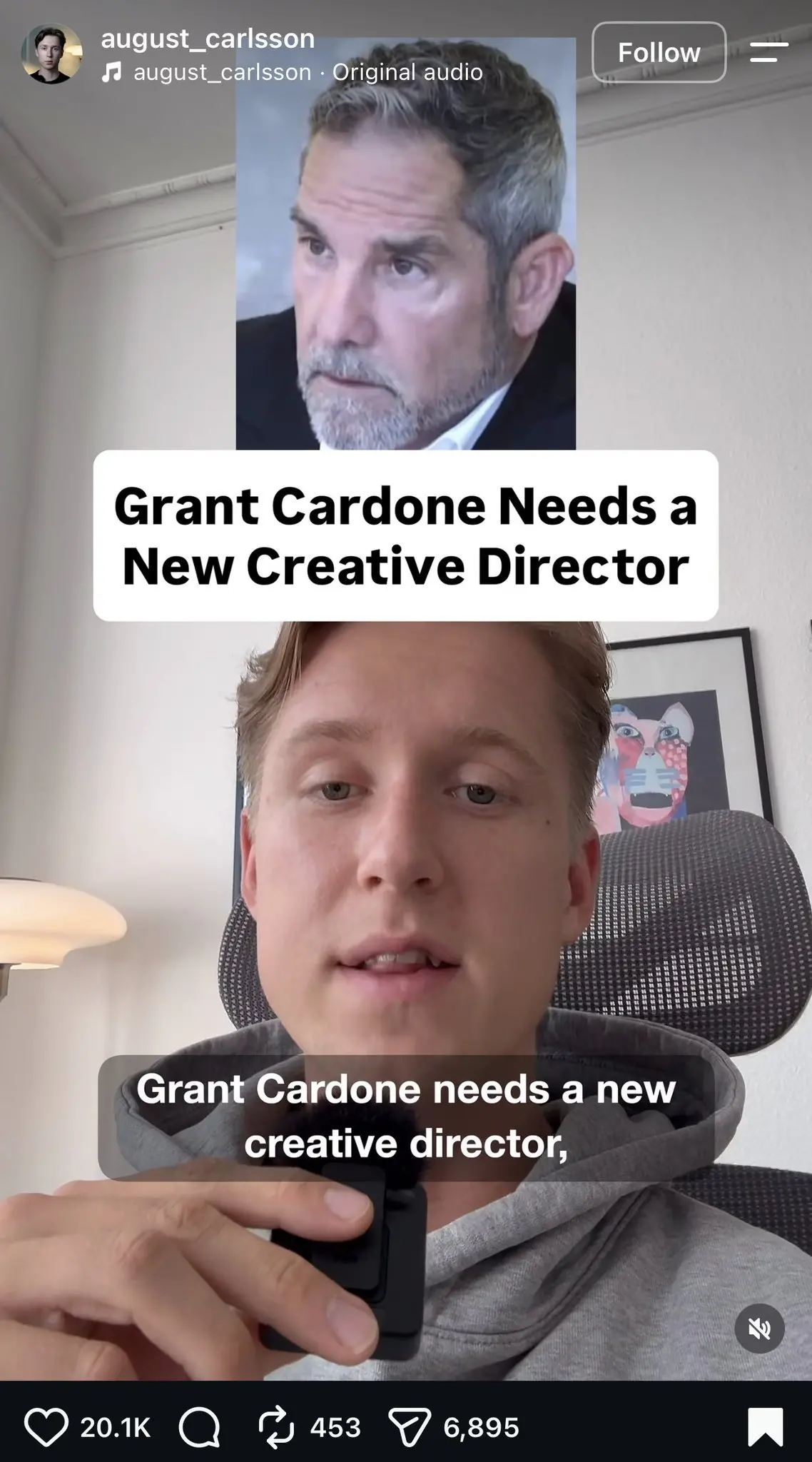
In that short video, he attracted attention with this line:
“Grant Cardone needs a new creative director, and this is my application piece. His content seems stuck in 2016.”
Grant Cardone replied, “Contact me, I am indeed stuck.” I believe this response, along with the interaction metrics of this post, proves most points in this letter. Right now, it’s a massive opportunity. And you already have all the tools needed to land these clients, kickstart collaboration, and create exceptional content for them.
I hope this helps you.
——Dan
As a reminder, the workshop on how to write newsletters/articles that people can’t help but read will be held on November 10. If you’re interested in mastering long-form content creation as a skill, you can sign up here.
免责声明:本文章仅代表作者个人观点,不代表本平台的立场和观点。本文章仅供信息分享,不构成对任何人的任何投资建议。用户与作者之间的任何争议,与本平台无关。如网页中刊载的文章或图片涉及侵权,请提供相关的权利证明和身份证明发送邮件到support@aicoin.com,本平台相关工作人员将会进行核查。


