The U.S. Treasury Department has quietly revised its guidance on bond issuance, removing a key phrase that opens the door for cuts in long-term Treasury bond issuance starting in 2027. This is the latest move by Secretary of the Treasury Scott Bessent in a series of measures aimed at suppressing long-end yields.
On Wednesday, the Treasury announced in its quarterly refinancing statement that it would maintain the scale of nominal fixed-rate bonds and floating rate note auctions for the coming quarters but removed the word "at least," which had been used since early 2024. This subtle change in wording means that the Treasury has left room to potentially reduce the scale of long-term bond issuance as early as 2027.
In terms of market impact, this move is one of a series of actions Bessent has been pursuing over the past few months. Just two weeks after the August refinancing statement was released, the Treasury unexpectedly expanded the scale of its Treasury buybacks significantly, but this measure failed to curb rising long-end yields, with the 30-year Treasury yield last month reaching its highest level since 2002.
Traders had markedly different views on what changes Wednesday's statement would bring, with some institutions believing that the scope of adjustments was limited given that yields have retreated from the highs reached in early October.
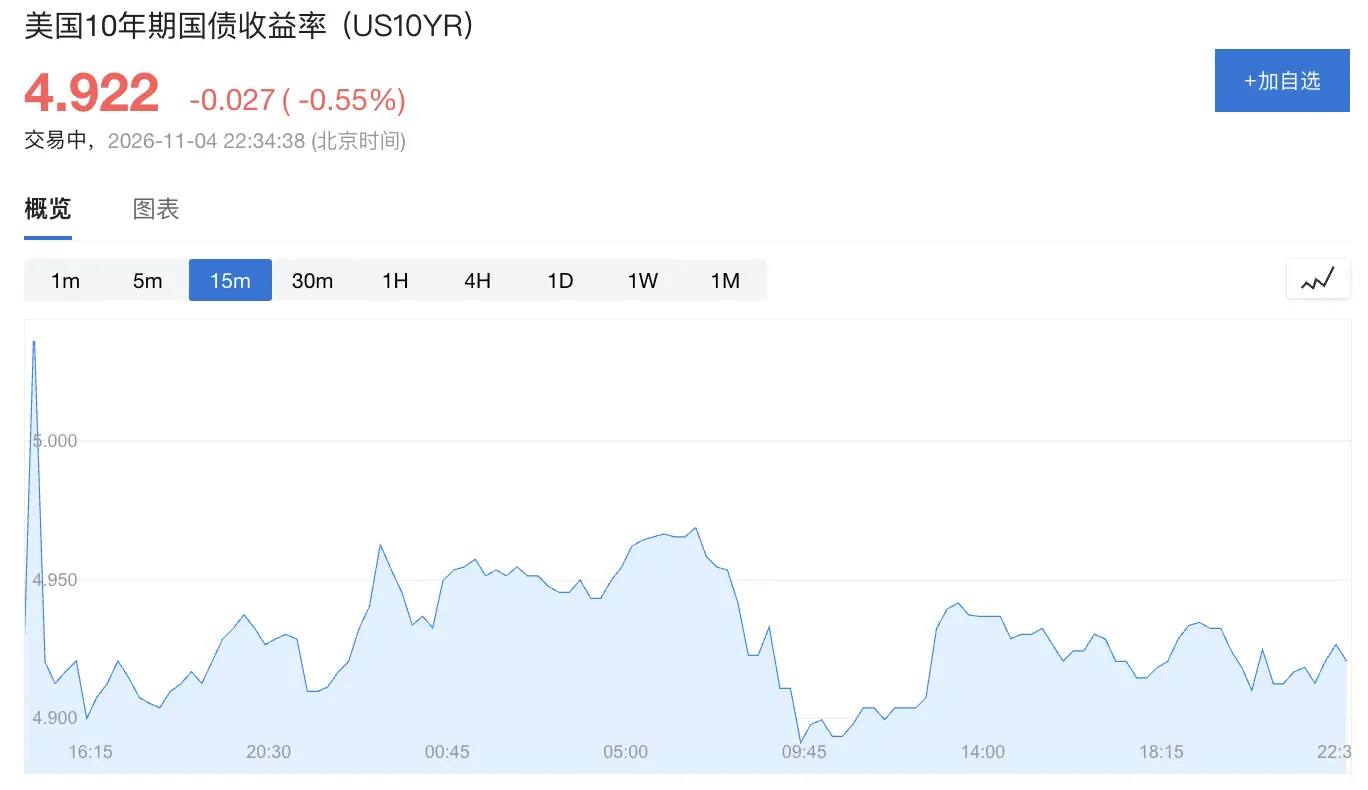
On Wednesday, the 10-year Treasury yield fell by 3 basis points to 4.922%.
Change of Wording: Removal of "At Least"
This adjustment in wording may seem minor, but it is significant.
Since early 2024, the Treasury had stated that the scale of fixed-rate bond auctions would remain "at least unchanged in the coming quarters," which had been interpreted by the market as excluding the possibility of reducing supply in the near term. By removing "at least," the Treasury has effectively retained flexibility to make adjustments at any time.
As early as February 2025, the Treasury Borrowing Advisory Committee (TBAC)—an advisory group made up of bond investors, dealers, and other market participants—had already recommended that the Treasury delete or modify its guidance.
In August of this year, TBAC again advised the Treasury to "consider updating the forward guidance language to preserve operational flexibility prior to the fiscal year 2027."
On Wednesday, TBAC officially recommended that the Treasury modify its forward guidance language, emphasizing that "clear communication and a regularly predictable operational framework are crucial for helping market participants adapt to future changes."
It is noteworthy that in the prior August 5 refinancing statement, the Treasury had made a preparatory adjustment, changing the assessment of bond and floating rate note scale adjustment from "increases" to "changes," leaving a hint for potential future supply reductions. The removal of "at least" is a further clarification of this signal.
Buyback Operations: Scale Maintained at Triple Level
Regarding bond buybacks, the Treasury stated on Wednesday that the upcoming long-term Treasury bond buyback operations would have a maximum single purchase limit of $6 billion, consistent with recent practices. This scale was already three times the previous limit.
The Treasury also indicated that it would "continuously evaluate the potential for improvements in buyback operations, including adjustments to the maximum purchase limit, buyback scheduling and frequency, bond eligibility determination, and execution processes," suggesting that there may be further expansions of operations in the future.
However, the increase in buyback scale has not achieved the expected effect of lowering long-end yields. The 30-year Treasury yield still rose to a high level last month not seen since 2002, indicating a limited market response to this series of actions by the Treasury.
Supply-Demand Imbalance: Demand for Long-Term Assets Weakens from Fixed Income and Pension Funds
In this quarterly refinancing, the total amount for next week's auctions remains at $125 billion, unchanged for the 11th consecutive time, specifically comprising: $58 billion of 3-year Treasuries on November 9, $42 billion of 10-year Treasuries on November 10, and $25 billion of 30-year Treasuries on November 12.
A deeper issue lies in the fiscal deficit. The U.S. government's annual fiscal deficit is about $2 trillion, leading to continued rising demand for Treasury issuance.
To address this, the Treasury is increasingly relying on short-term Treasury bills with maturities of no more than one year. However, the current proportion of short-term Treasury bills in the total outstanding debt has exceeded historical normal levels. As short-term bonds must be refinanced according to prevailing market interest rates, the sensitivity of national debt repayment costs to interest rate shocks is increasing.
At the same time, the Federal Reserve recently resumed interest rate hikes for the first time since 2023, with investors anticipating further actions in the coming months.
On the long-term demand side, both officials and market participants have noted that institutional investors such as fixed income pension funds have shown a continual weakening in demand for long-term assets in recent years.
During the preparation of this statement, the Treasury systematically assessed the supply-demand situation for long-end bonds by surveying primary dealers about the "structural changes" in Treasury investor demand and how "future auction sizes should be adjusted."
Since the current forward guidance framework was established by Bessent’s predecessor, Janet Yellen, traders had generally expected that the supply scale of fixed-rate bonds would eventually return to growth. This revision of guidance marks a fundamental shift in that expectation, with the framework for communication between the Treasury and the market entering a new phase.
Risk Warning and Disclaimers
Investments carry risks, and investors should exercise caution. This article does not constitute personal investment advice and does not take into account individual users' specific investment goals, financial situations, or needs. Users should consider whether any opinions, views, or conclusions in this article align with their particular circumstances. Any investment based on this is at the user's own risk.
免责声明:本文章仅代表作者个人观点,不代表本平台的立场和观点。本文章仅供信息分享,不构成对任何人的任何投资建议。用户与作者之间的任何争议,与本平台无关。如网页中刊载的文章或图片涉及侵权,请提供相关的权利证明和身份证明发送邮件到support@aicoin.com,本平台相关工作人员将会进行核查。


