Author: Curry, Deep Tide TechFlow
Ethereum L2 Scroll released a progress update at the governance forum on September 8, announcing plans to gradually transform the public chain into a private application-specific network built around the AI product Compass over approximately 9 months. The SCR token will simultaneously migrate to the Ethereum mainnet, with the token economics remaining unchanged.
At the same time, Sophon, which is also part of the ZK Stack technical route, has confirmed a permanent shutdown of its mainnet on November 30, with the withdrawal deadline set for November 25; Abstract, under Igloo, the parent company of Pudgy Penguins, has announced a shutdown on December 15, with the CEO admitting operational losses of "8 figures." Various events coming together constitute the most concentrated signal of clearing in the general Ethereum L2 track this autumn.
Scroll from Titan L2 to Transitioning to AI
Scroll has not announced a shutdown, but its actions acknowledge one thing: under the current environment, general-purpose ZK L2 is hard to sustain as a business.
Recently, the Scroll team clearly stated in the governance forum that they no longer believe maintaining a general public chain is the best differential path for the project. The plan is to gradually transition the network from a public general-purpose to a private application-specific network built around Compass and AI product systems, with an overall transition expected to last about 9 months.
This AI product system consists of several parts:
Compass provides AI models and functionalities such as VPN, eSIM; Compass API offers routing services for over 30 large language models; CENO uses ZK technology to provide a trust layer for credentials, context, and privacy computing for AI agents; USX is responsible for payments and settlements; SCR continues to undertake governance functions.
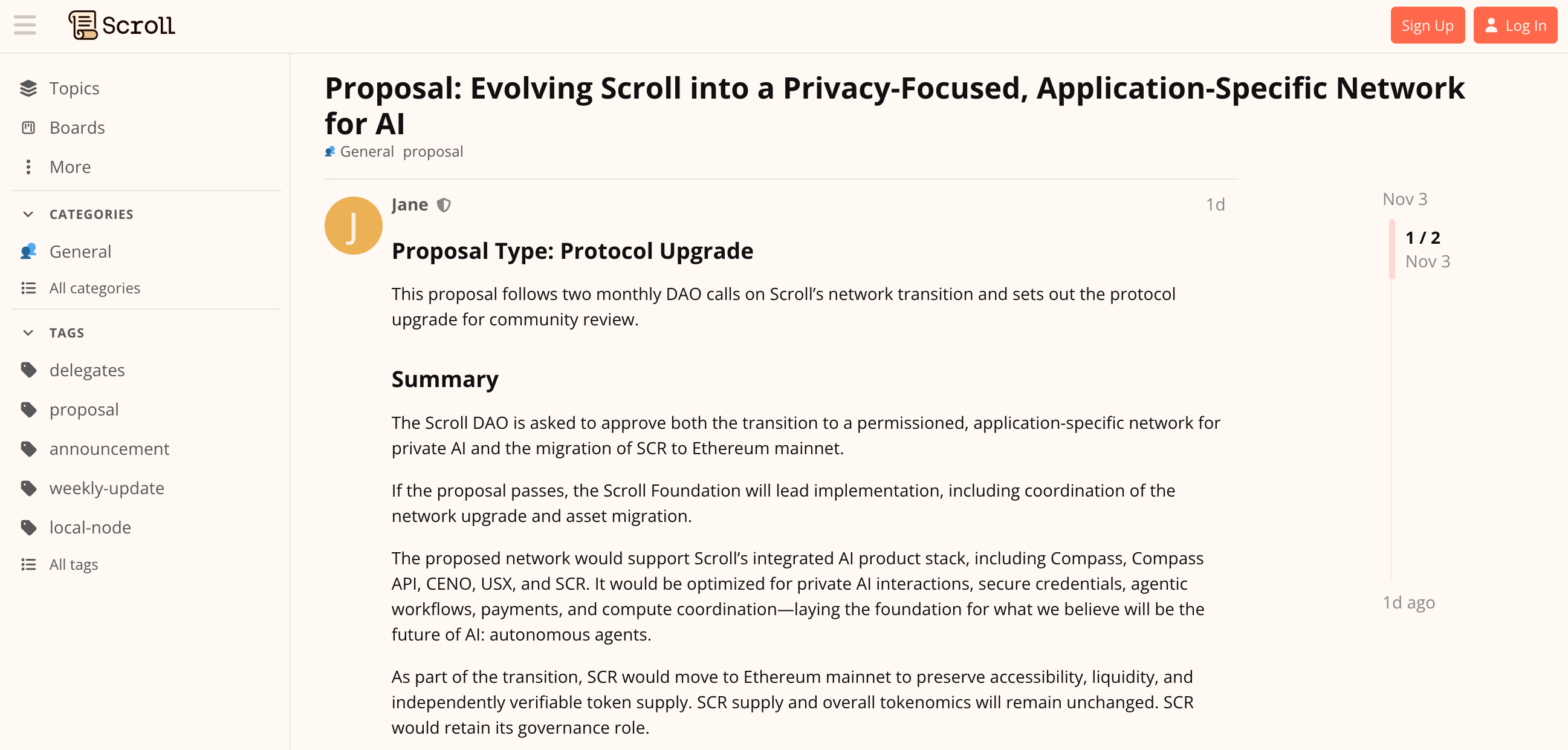
Scroll officials stated that CENO currently has over 30 potential customers, with 12 undergoing proof-of-concept testing; Compass is still in the early consumer validation phase.
The team clarified that this governance forum update is a progress report, not an official proposal, and does not trigger a vote. Detailed information on the network transition will be submitted for DAO consideration afterward.
Meanwhile, on-chain data had already indicated the issues before the proposal was released.
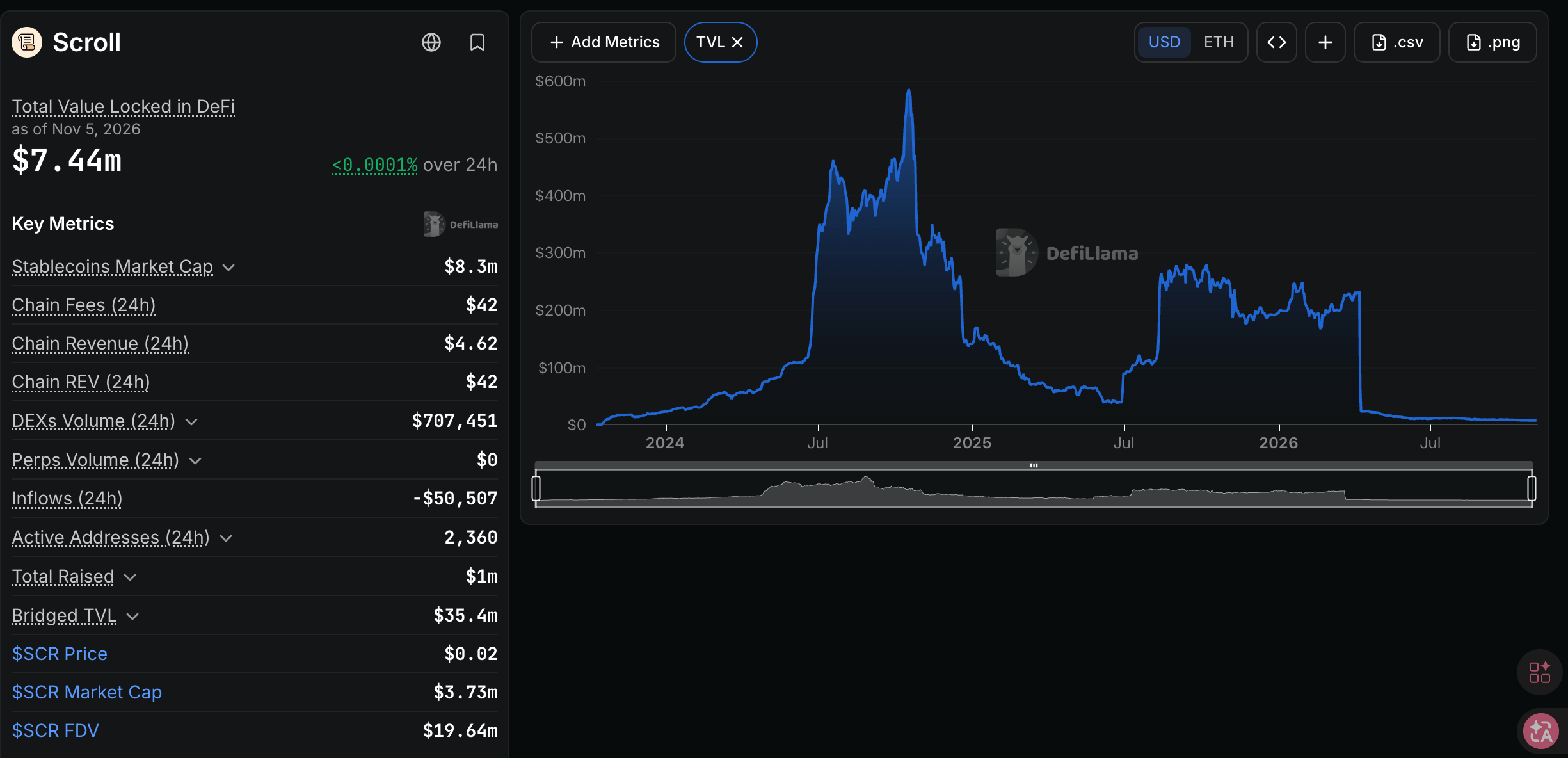
According to growthepie data, Scroll's daily transaction volume is about 9,700, with daily active addresses at 584, and daily on-chain revenue at $41.78, down 75.6% from the previous week, ranking 21st among the 27 tracked chains.
DefiLlama shows its TVL is about $3.6 million. The SCR token has fallen over 98% from its historical peak of $1.43 in December 2024, currently trading in the range of $0.019 to $0.02.
ether.fi moved its core product to OP Mainnet in February this year, taking with it about $160 million TVL, marking a direct node of Scroll's drastic drop in activity.
Sophon and Abstract: Direct Shutdown
If Scroll's transformation still leaves a question mark, Sophon and Abstract provide a more direct answer.
Both chose the ZK Stack technology stack and encountered a drastic drop in activity after financing, ultimately opting for chain shutdown while leaving the tokens alive on the Ethereum mainnet.
Sophon has announced November 25 as the final cutoff date for asset withdrawals; afterward, key infrastructure and related websites will begin to shut down in succession, with the mainnet officially shutting down on November 30, leaving assets on-chain potentially permanently inaccessible.
Sophon had raised about $70 million and sold 121,000 nodes, planning to build consumer applications on Base after the transition, with the SOPH token continuing to circulate on Ethereum and Base.
Abstract, operated by Igloo Inc., the parent company of Pudgy Penguins, has confirmed that the company has incurred tens of millions of dollars in losses on this project. The on-chain environment will officially close on December 15, after which assets remaining on-chain will become inaccessible, and the official will provide two migration paths: Migration Hub and native bridge. Abstract cites the reasons for closure as:
Thin liquidity, limited DeFi activity, limited institutional participation, and increased competition; the independent chain operating model is no longer sustainable.
Both share the commonality of having chosen the ZK Stack (a modular technology stack provided by Matter Labs) to build L2, and both showcase that having a good technical foundation does not equate to a sustainable on-chain economy.
The Business Model Dilemma of General L2
The situations of the three crypto projects point to the same structural problem, in my opinion.
The revenue of L2 comes from transaction fees paid by users, less the data costs submitted to the Ethereum mainnet and the costs of generating ZK proofs, resulting in very thin net income. The daily revenue figure of $41 for Scroll is an extreme representation of this logic; this amount doesn't even cover the salary of a single engineer for a day, let alone the computational costs of proof generation.
As the daily revenue of $40 has become a joke within the crypto community, a decent transformation may be a better development direction.
Before closing, Sophon had estimated that maintaining independent L2 operations would cost over $3 million annually. Abstract directly stated their losses as "8 figures." Although Scroll has not disclosed operating costs, from the wording in the governance forum, "the demand for a general network is difficult to guarantee, and infrastructure costs are high," is an officially acknowledged reason for the transition.
The counterexample of Base illustrates the other side of this logic:
The user flow and brand endorsement from Coinbase give Base a cold start advantage that independent L2s cannot replicate. Without this layer of backing, most general L2s essentially subsidize on-chain activities with financing funds, while financing will not last forever.
Token Holders Need to Pay Attention to SCR Token Migration
The transformation proposal of Scroll has two direct impacts on SCR holders.
The first is token migration: SCR will migrate from Scroll L2 to the Ethereum mainnet, with the team stating that the supply and token economics remain unchanged, governance functions are retained, and can be extended to new scenarios such as staking.
The second is the change in network nature: Scroll transitions from an open public infrastructure to a private permissioned network, meaning the value support for SCR will shift from "transaction activities of general L2" to "governance and usage demands of the AI private network," neither of which currently has verifiable revenue data.
The transformation proposal is still in the DAO review process; the final execution situation and the commercial landing progress of AI products are two variables that will determine whether this judgment holds.
免责声明:本文章仅代表作者个人观点,不代表本平台的立场和观点。本文章仅供信息分享,不构成对任何人的任何投资建议。用户与作者之间的任何争议,与本平台无关。如网页中刊载的文章或图片涉及侵权,请提供相关的权利证明和身份证明发送邮件到support@aicoin.com,本平台相关工作人员将会进行核查。


