Author: Curry, Shenchao TechFlow
Do you still remember Treasure DAO?
If you are an old player, you surely know this name that was repeatedly mentioned during the boom of blockchain games and NFTs from 2021 to 2022. It originated from Loot derivative projects and quickly built a gaming and metaverse ecosystem on Arbitrum using MAGIC as the universal currency, and was called "the Nintendo of Web3" by outsiders. Names like Bridgeworld, Smolverse, and Legions were familiar to those who were immersed in Discord and OpenSea at that time.
The early NFT market once contributed considerable trading volume, and the project token MAGIC reached a historic high of about $6.30 in February 2022.
Now, when hearing about it again, many people's first reaction might be: "Is it still around?"
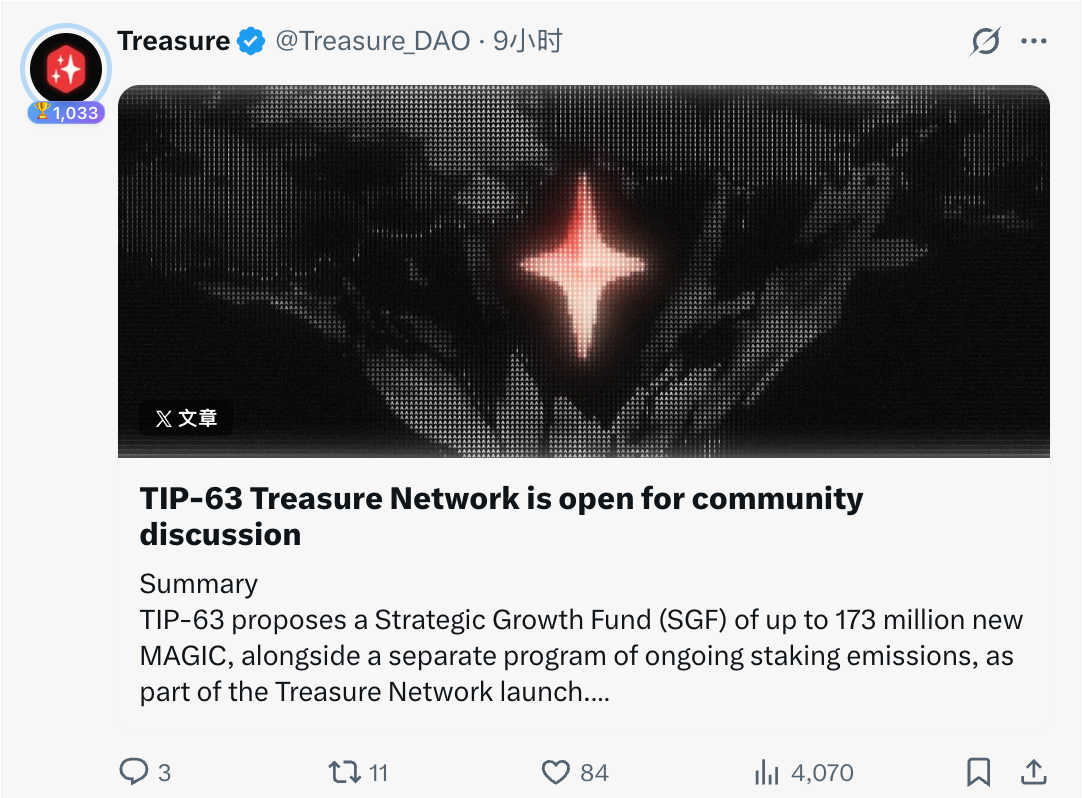
Yes, it is. But it may be seeking a new path for survival. On November 4, Treasure released TIP-63 proposal on the governance forum, proposing to establish a strategic growth fund of up to 173 million MAGIC, accounting for about 50% of the current maximum supply (approximately 348 million).
If fully issued, the total supply of MAGIC will rise to about 521 million (excluding additional staking emissions). This fund will be used to launch a new Treasure DePIN network and shift the project's focus entirely towards AI Agent direction.
Details of the issuance and milestones
The issuance of the MAGIC token will not be a one-time release. According to the proposal wording:
- 100 million will be minted to the Treasure Foundation on February 3, 2027, as a cybersecurity budget, institutional partnerships, market-making, and development resources.
- The remaining 73 million will be tied to milestones of this newly developed network, unlocking 7.3 million each time a planned milestone is reached. These advancements include completing audits, the official launch of the network, reaching a certain scale of nodes, and achieving operational AI Agent counts of 10,000, 50,000, and 100,000, as well as meeting requirements for MAGIC staking ratios and token burn amounts.
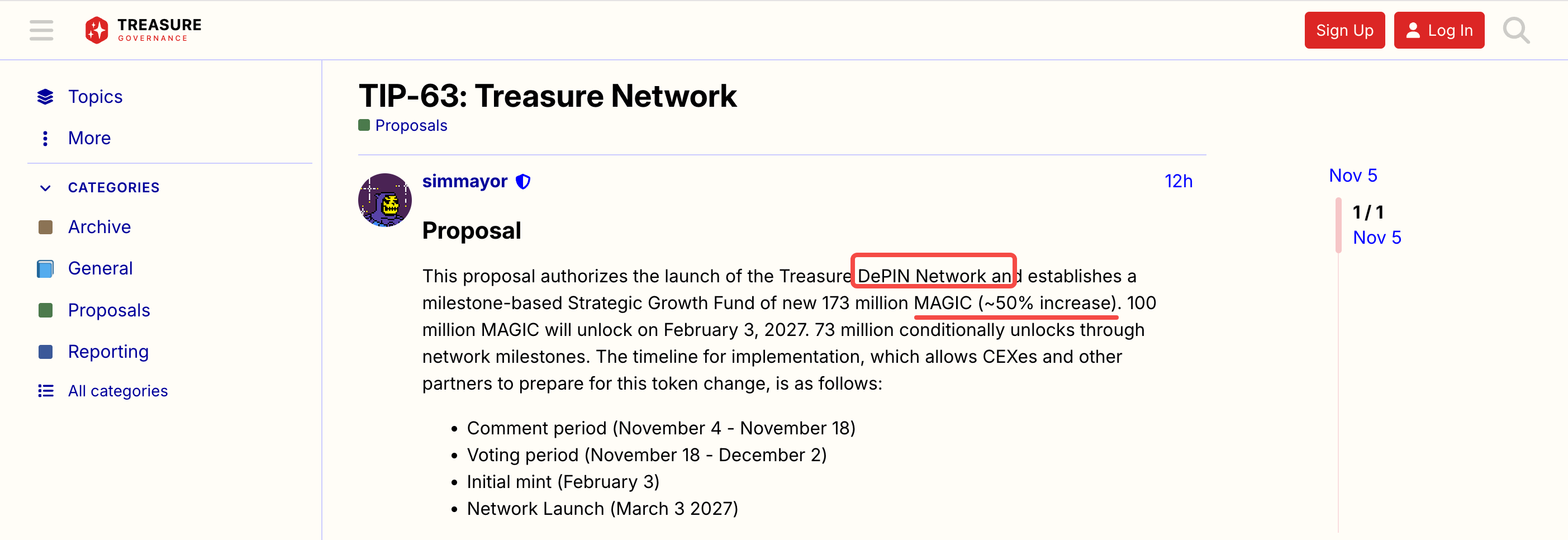
The timeline is also quite clear, with discussions on the proposal running until November 18, voting from November 18 to December 2, and the network expected to launch on March 3, 2027.
The proposal also authorizes the minting of 500 Legions Genesis NFTs to the DAO treasury, 50 of which will be handed over to the Foundation for network staking and cannot be resold. The network will also introduce additional staking inflation, aiming for an annual inflation rate that gradually decreases from about 5% in the first year to 2.5% starting in the fourth year.
The proposal is currently still in discussion. The recent price of MAGIC is around $0.084–$0.085, with a circulating market cap of about $28–$29 million, down approximately 98.7% from its historic high.
Common paths after narrative disproof
In today's cryptocurrency industry, narrative disproof is not uncommon.
Blockchain games, metaverse, self-built chains, and other directions have largely failed to fulfill early imaginations under the retreat of liquidity and cost pressures. Treasure itself has actually walked this transformation path before:
In 2025, it closed its self-built chain, Treasure Chain, due to operational costs and financial pressures, with disclosed cost data at about $450,000 per year, and ceased its game publishing business.
Many projects do not end with "an abrupt exit," but choose to pivot towards directions with more narrative premium; AI Agents and DePIN are one of those.
AI Agents and DePIN are currently still high-profile tracks in the market. The former emphasizes autonomous execution and economic interaction, while the latter focuses on the coordination of distributed physical resources.
Treasure's new design attempts to combine the two. In simple terms, it wants to create a network that can continuously operate AI roles. NFTs held by ordinary users represent an AI Agent, while nodes are responsible for actually running these Agents.
Nodes need to stake MAGIC and specific NFTs to participate. As long as someone continues to pay computational fees for these Agents, the virtual world or game state they maintain can continue to exist, even if the original developers have left. Agents pay with stablecoins for computational resources, part of the fees goes to the nodes, and another part will be used to buy back and burn MAGIC.
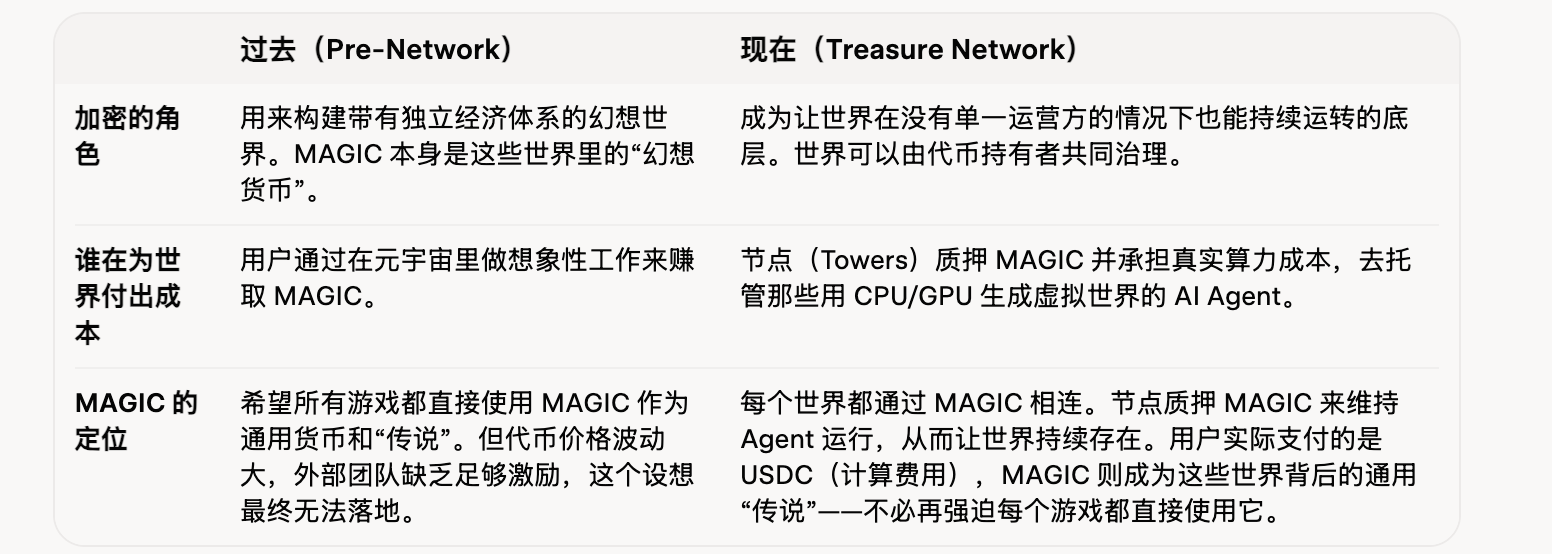
The logic of the proposal is that MAGIC upgrades from a "game utility token" to a "network token," using fees generated from Agent usage, staking demands, and the burn mechanism to hedge against inflation in the long term.
This essentially re-embeds the project in the larger wave of AI infrastructure, becoming a part of it, rather than attempting to build a complete "gaming empire" on its own.
For such transformations, narrative appeal can only explain short-term attention; what truly determines whether a project can remain in the AI wave must come down to observable data. The number of Agents, actual paid usage, node activity, fee income, and burn amounts are all details that need to be examined later; pure narrative transformation no longer has much speculative space;
After all, the industry has seen too many declarations of "turning to AI," and ultimately, only those projects capable of converting declarations into on-chain verifiable activities may avoid being discarded by the narrative cycle again.
Finally, there is a sentence in the original proposal from Treasure that reads somewhat like self-summary:
It believes that it has not given up on the original idea from 2021 but has only found the execution layer that was missing at the time. I believe most cryptocurrency readers will have a knowing smile at this statement; the true correctness may only be judged after the network truly runs.
免责声明:本文章仅代表作者个人观点,不代表本平台的立场和观点。本文章仅供信息分享,不构成对任何人的任何投资建议。用户与作者之间的任何争议,与本平台无关。如网页中刊载的文章或图片涉及侵权,请提供相关的权利证明和身份证明发送邮件到support@aicoin.com,本平台相关工作人员将会进行核查。


