The dust has settled on the U.S. midterm elections, and major trading institutions on Wall Street are collectively issuing buy signals to clients.
The Democratic Party has taken control of both chambers of Congress, and Trump has accepted the election results, causing uncertainty to dissipate and triggering a significant market rebound. The S&P 500 index rose nearly 2% in a single day, the Dow Jones index increased by over 3%, and the VIX fear index recorded its largest single-day drop since April 2025. The technology and communication services sectors led the gains, while oil prices plummeted over 8%, and the consumer sector also performed strongly.
Against this backdrop, institutions such as JPMorgan, Nomura, HSBC, and Citadel Securities have successively released bullish reports, sharing a highly consistent core logic: institutional positions had already been significantly reduced before the elections, short positions were close to a five-year high, and combined with seasonal patterns and the reopening of corporate buyback windows, they created favorable conditions for a rebound before the year-end.
Fidelity believes that one important change resulting from the midterm election is that the U.S. government will enter a state of divided governance: the Democrats control Congress, while the Republicans continue to hold the White House. This political landscape may limit the government's ability to advance certain policies, reducing some policy uncertainty, and the market generally tends to welcome this kind of checks and balances.
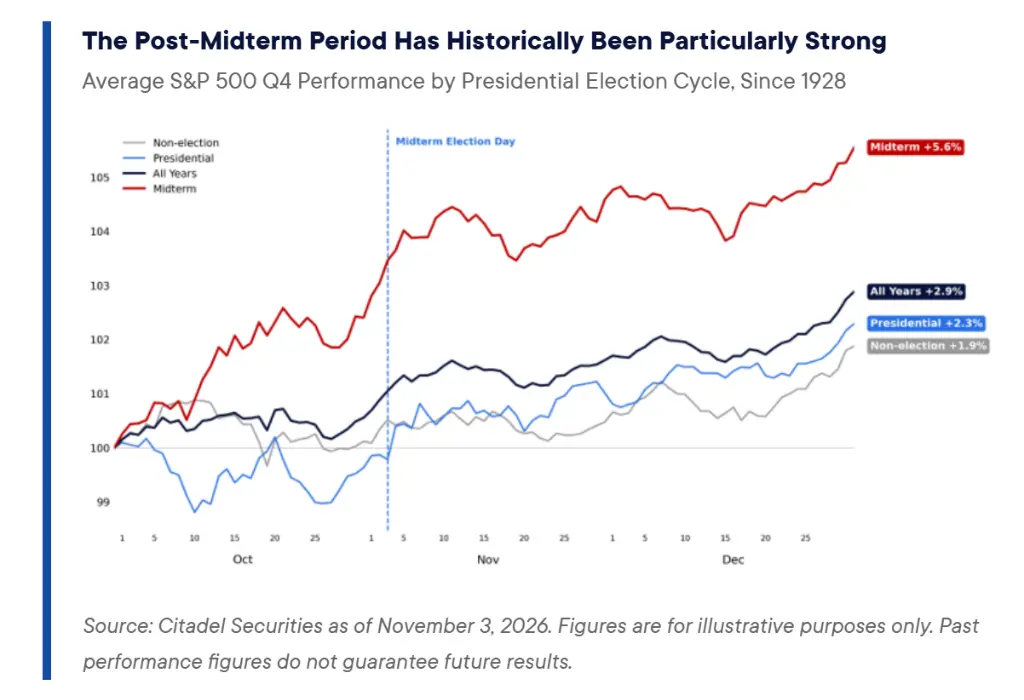
More noteworthy is the historical performance. Fidelity's statistics show that since 1938, the S&P 500 index has risen in 95% of the years in the 12 months following midterm elections, with an average increase of about 14%.
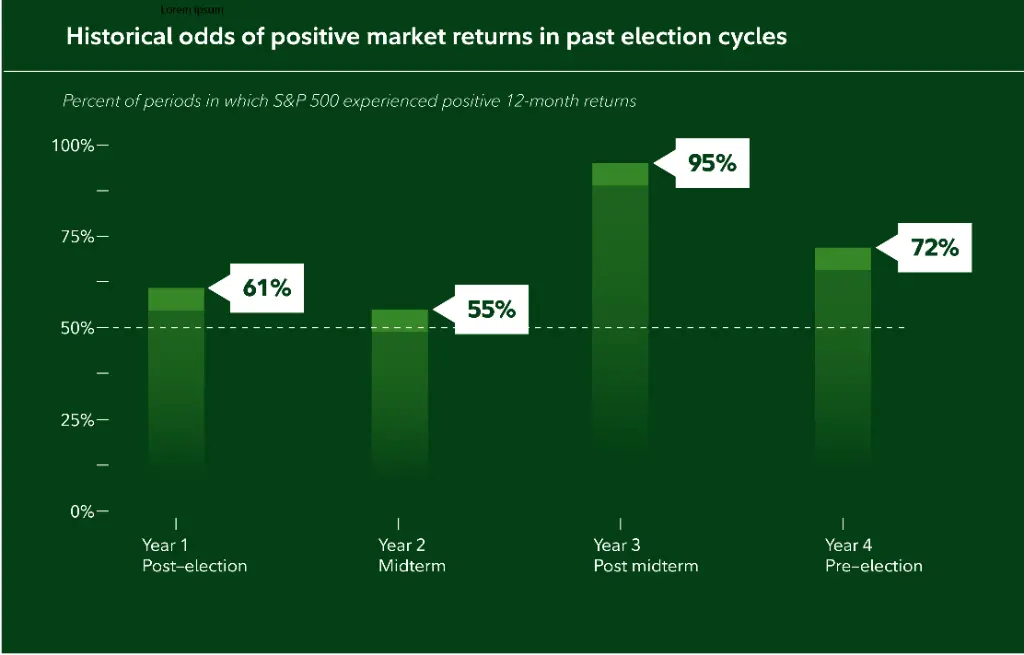
Institutional Position Reset, Short Squeeze Releases Upward Space
The core of this bullish logic lies in the fact that investors completed large-scale de-risking before the election, providing ample "fuel" for the market rebound.
Hedge funds have continuously reduced their exposure to U.S. stocks and increased their short positions before the November voting, with stock market short positions once approaching five-year highs; systematic investors also synchronized their position reductions.
JPMorgan stated that the hedge fund deleveraging and AI position liquidation in October have created a more favorable background for U.S. stocks. The bank's U.S. market intelligence team, led by Andrew Tyler, maintained a tactical bullish stance in a report on Wednesday and recommended a "barbell strategy" favoring technology stocks and cyclical stocks.
Scott Rubner from Citadel Securities wrote in a client report:
"With the election over and volatility expected to normalize, there is ample room for investors to rebuild their risk exposure. We believe the path of least resistance for U.S. stocks before the year-end is upwards."
Data from Citadel Securities shows that systemic trend-following strategies (CTA) currently have a net position in U.S. stocks of about negative 3.3 standard deviations, in the 10th historical percentile since 2018, marking the lowest level since March 31 of this year, a significant drop from the positive 1.7 standard deviations recorded three months ago. Once the market stabilizes at key technical levels, the trend-following strategies are expected to trigger systemic reloading.
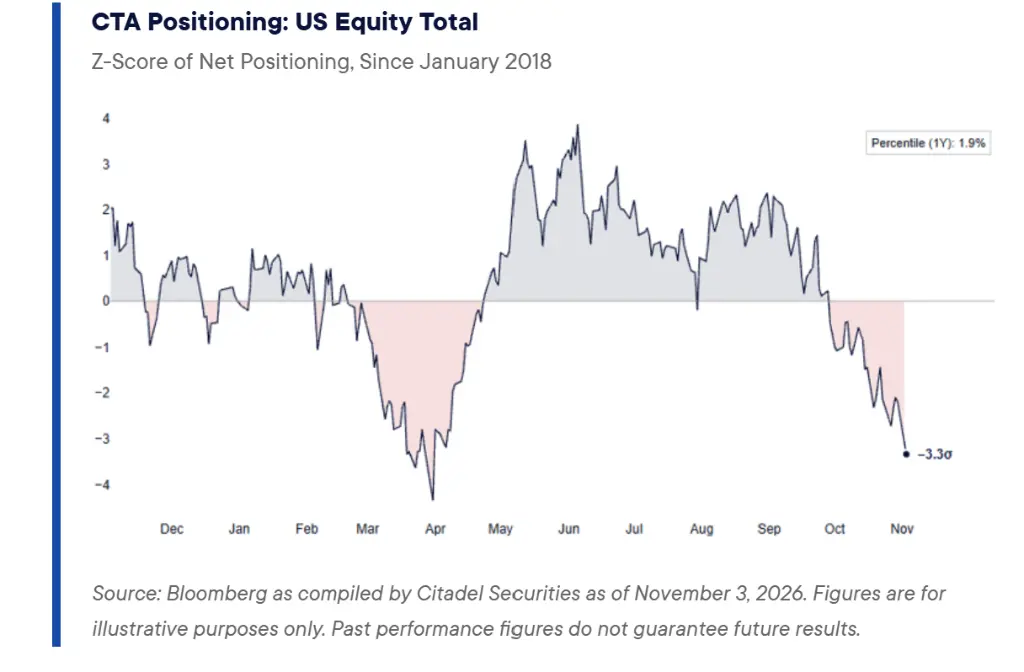
Retail Investors and Buybacks as Dual Drivers, Structured Support for Purchases Evident
The demand side is also showing positive signs, as retail investors and corporate buybacks are forming a synergistic effect.
According to data from Citadel Securities, since October 5, retail investors have net purchased U.S. stocks for 22 consecutive trading days, accumulating nearly $33 billion in purchases, creating the sixth-longest and fifth-largest purchase record since 2017, with the daily average purchase scale 40% higher than the past year's average. It is noteworthy that this buying occurred against the backdrop of a simultaneous decline of about 2% in the S&P 500 index. Year-to-date, retail investors' cumulative net purchases of U.S. stocks have reached $251 billion, surpassing the total record for 2021.
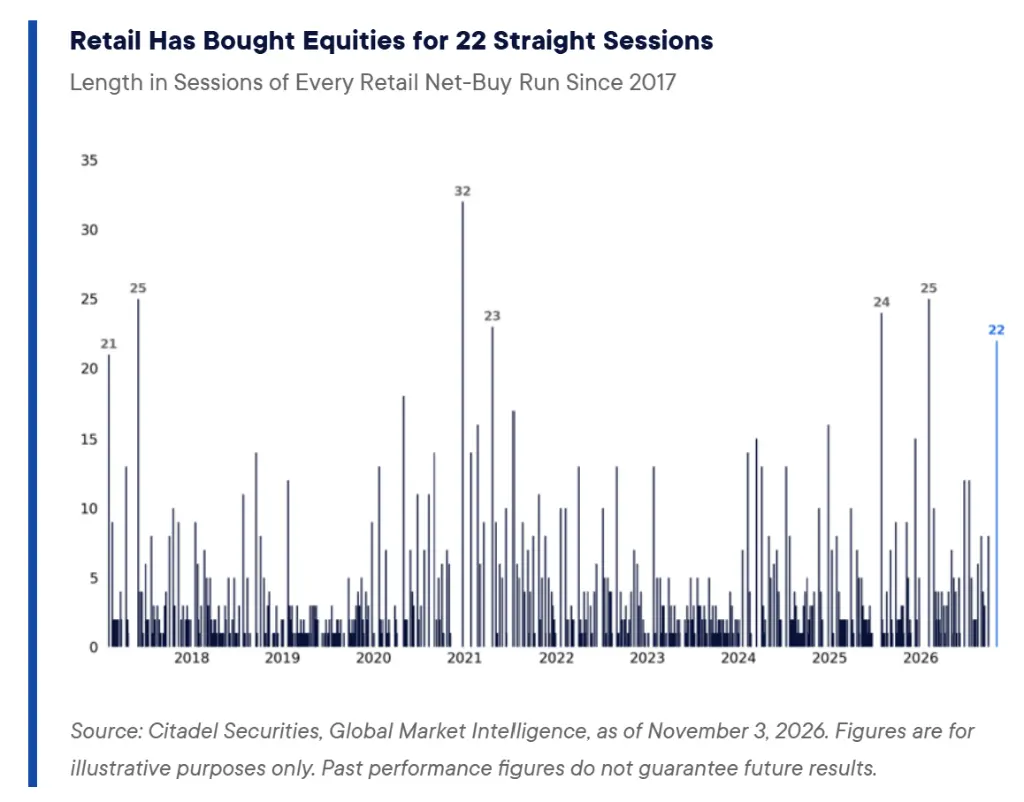
Regarding corporate buybacks, as the window for releasing third-quarter earnings reports gradually closes, buyback purchases are returning on a large scale. Citadel Securities estimates that in mid-October, only about a quarter of the market capitalization of S&P 500 constituents was in a repurchasable state, but by election day, that proportion had risen to about two-thirds, expected to further increase to 85% before November 9. As of November 2, the new corporate buyback authorizations for this year have reached $1.5 trillion, surpassing previous annual records. In October alone, there was a new authorization of $166 billion for buybacks, more than double the historical monthly average level.
Tech Stock Valuations Compressed Significantly, Value for Money Becomes Apparent After Repricing
Beyond technical aspects, the sharp compression of technology sector valuations is also an important basis for institutions to go long.
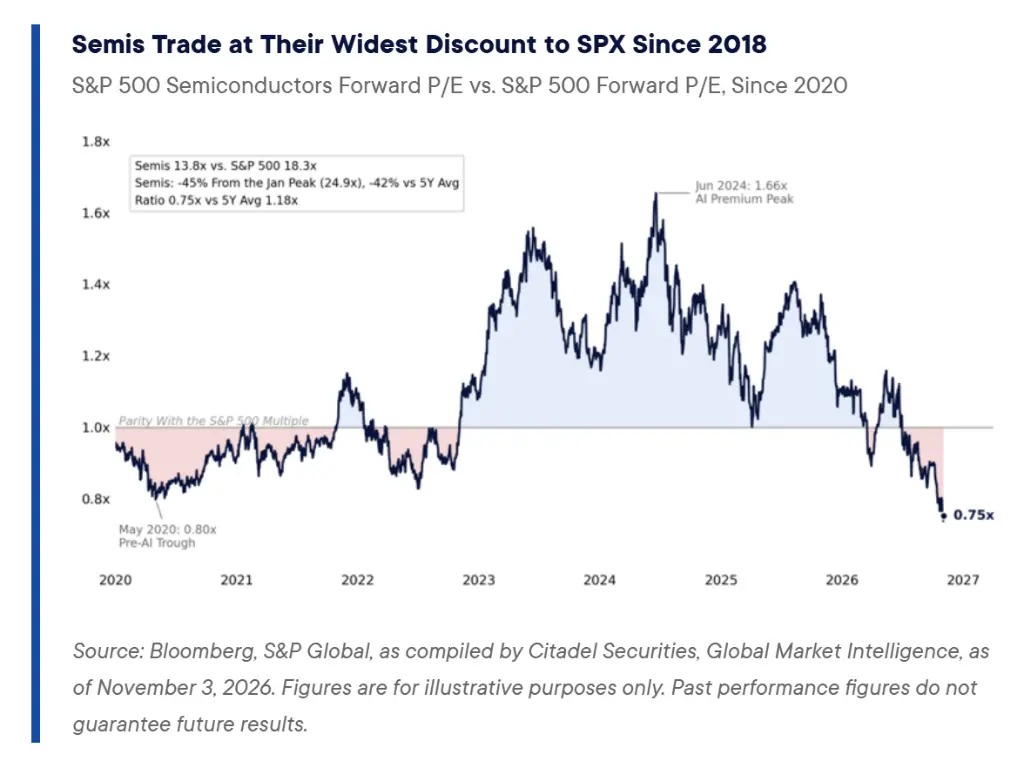
Data from Citadel Securities shows that the current price-to-earnings ratio of the Nasdaq 100 index has dropped to 19.1 times, the lowest since October 2022, at a 24% discount from the January peak; compared to the S&P 500 index, the Nasdaq's premium is down to just 5%, the lowest since January 2017, far below the approximate 20% ten-year average. The valuation compression in the semiconductor sector is even more drastic, with the price-to-earnings ratio of S&P 500 semiconductor constituents dropping to 13.8 times, a 45% decline from the January peak, marking the lowest since July 2022, and trading at a 25% discount to the S&P 500, the deepest discount level since December 2018.
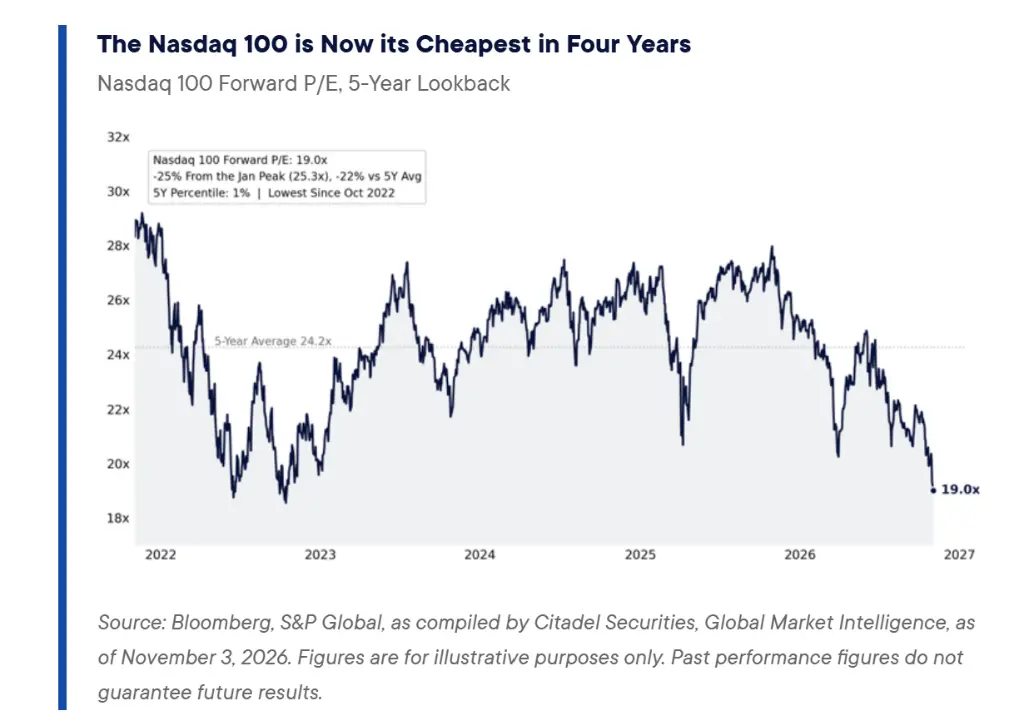
This valuation reset occurs against the backdrop of continuously rising earnings expectations. Since June 30, the forward earnings expectations for storage, AI infrastructure, and semiconductors have been revised up by 32%, 31%, and 30%, respectively, while their corresponding price-to-earnings ratios have contracted by 50%, 36%, and 35%. So far in the third-quarter earnings season, 83% of companies have exceeded earnings expectations, above the historical average of about 75%, ranking among the top ten in comparable terms since 2005.
Max Kettner, Chief Multi-Asset Strategist at HSBC, stated:
"(The current market situation) is not just a correction of the October decline; it is essentially a broad buy into everything."
Policy Landscape Changes, AI Infrastructure Regulatory Expectations Tend to Ease
The market has initially digested the policy implications of the Democratic Party controlling Congress, and some investors believe that its impact on AI investments could be mixed.
Nomura's cross-asset strategist Charlie McElligott pointed out that the Wednesday rebound partly reflects investors unwinding their hedging positions after the election, with both VIX futures and the VVIX index measuring options market volatility dropping significantly, showing that the protective demand accumulated due to election uncertainty and AI worries is rapidly fading.
He wrote that the market believes the election results will lead to "a forced slowdown in the pace of U.S. data center construction, which alleviates worries about an 'arms race' style of unlimited capital expenditure by hyperscale cloud providers," thus reducing the credit and equity financing pressures required for the AI frenzy. Fidelity's Global Macro Director Jurrien Timmer also noted that the Democratic blue wave may limit data center expansion, "which could benefit the already dominant hyperscale cloud providers, as well as core members of the 'Mag 7'."
JPMorgan strategist Nikolaos Panigirtzoglou warned that hedge funds, having gone through a painful sell-off in October, may need weeks of market stabilization before redeploying into AI positions.
Anthropic IPO Becomes Key Node for "Full Bullish" Shift in Tech Stocks
In addition to the aforementioned multiple positives, institutions are also waiting for a node regarded as the "ultimate clearing event" for tech sentiment.
HSBC's Kettner stated: "For me, the real clearing event is the Anthropic IPO. Once the Anthropic IPO is announced and smoothly completed, I believe it's time to fully go long on tech stocks and sell off those defensive assets that rose sharply in October." This transaction is expected to be one of the largest IPOs in history and carries significant signaling implications for the overall sentiment towards tech stocks.
Historical data also supports the year-end market outlook. Data from Citadel Securities shows that since 1950, the S&P 500 has risen in the six and twelve months following each midterm election, with a median increase of 14.5% over twelve months. Historically, the fourth quarter of midterm election years has been the strongest quarter within the presidential term cycle in the U.S., with an average increase of 5.6% for the S&P 500, exceeding the average of 2.9% in all years. This year, as the market enters the post-election phase, it is lagging behind the typical seasonal trajectory of midterm election years, where nearly 60% of the historical lows in the fourth quarter occurred in October, followed by a median increase of nearly 10% before the year-end.
Risk Warning and Disclaimer
The market carries risks, and investments should be made cautiously. This article does not constitute personal investment advice, nor does it take into account the specific investment goals, financial situation, or needs of individual users. Users should consider whether any opinions, views, or conclusions in this article are suitable for their specific circumstances. Investing based on this is at one's own risk.
免责声明:本文章仅代表作者个人观点,不代表本平台的立场和观点。本文章仅供信息分享,不构成对任何人的任何投资建议。用户与作者之间的任何争议,与本平台无关。如网页中刊载的文章或图片涉及侵权,请提供相关的权利证明和身份证明发送邮件到support@aicoin.com,本平台相关工作人员将会进行核查。


