Author: 100y, Four Pillars
Translation: Deep Tide TechFlow
Deep Tide Introduction: As Kalshi receives regulatory approval in the U.S. to launch single-stock perpetual contracts, trading volume in prediction markets reaches historic highs, and the scale of stablecoin settlements surpasses one trillion dollars, the crypto industry seems to be ushering in an unprecedented wave of mainstream acceptance. However, behind this facade of prosperity lies a hidden and brutal reality: the core business logic of these sought-after phenomenon products is almost entirely unrelated to blockchain.
100y incisively analyzes the "pipeline conundrum" currently faced by the crypto ecosystem. Whether it is the compliance-driven prediction markets with centralized matching and clearing or the RWA and stablecoins relying on traditional financial backends, blockchain merely serves as the underlying financial pipeline for fund deposits and asset transfers. More severely, based on the historical patterns of technological diffusion and value accumulation, commercial value is being entirely redirected to distribution platforms that control end users, while the underlying on-chain infrastructure and token economics fail to capture the true value return.
This article not only systematically outlines the structural differences between Kalshi and Polymarket but also confronts the ultimate future pathways for the crypto industry. When the "next-generation financial pipeline" is insufficient to support the industry's vision, what kind of native applications do we need to redefine the truly indispensable value of blockchain?

This article records some recent scattered thoughts of mine about the blockchain industry. It is based on the logic of my previous article "Why Today's Crypto Businesses All Look Alike".
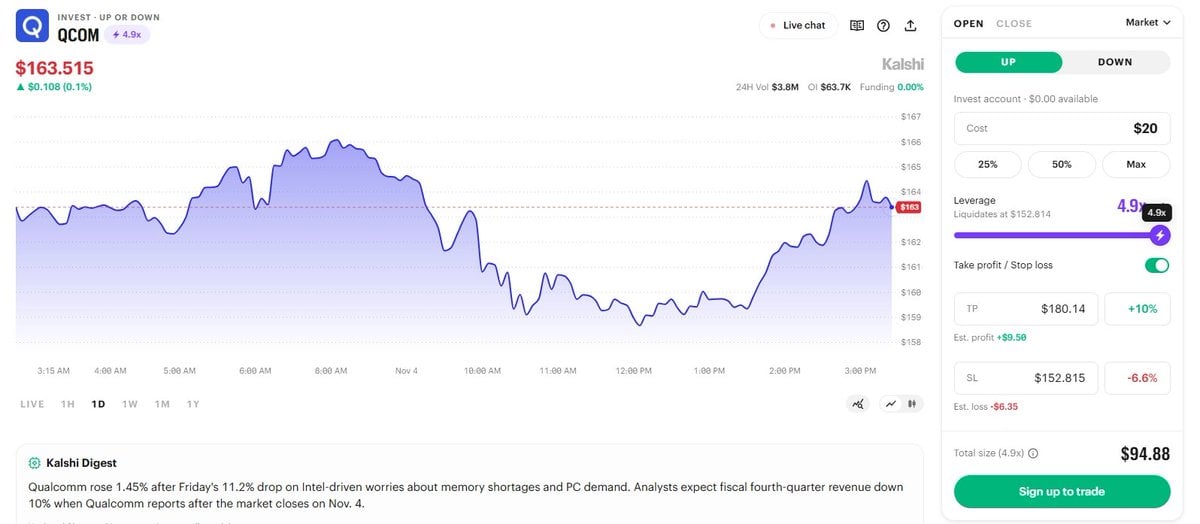
Image: Kalshi receives CFTC approval to launch single-stock perpetual contract trading (Source: Kalshi official website)
Today marks a significant announcement for the crypto industry. The U.S. Commodity Futures Trading Commission (CFTC) has announced that it will allow trading of single-stock perpetual futures (Equity Perps).
This is not just a policy announcement at the regulatory level. The compliant exchange Kalshi actually launched the real-time trading functionality for stock perpetual contracts on the same day.
But wait a moment. Is this really news for the crypto industry?
Understanding Kalshi: The Misread "Crypto Native"
It is well-known that Kalshi is a centralized derivatives exchange regulated by the U.S. CFTC, offering prediction market and perpetual contract trading services.
People tend to regard Kalshi as a company deeply tied to the blockchain industry. However, the harsh reality is that Kalshi's actual connection to blockchain is surprisingly limited.
Kalshi does not utilize blockchain technology to drive its core products, including its prediction markets and perpetual contracts. Orders are matched off-chain through its proprietary matching engine, and clearing and settlement are uniformly handled by the derivatives clearing organization Kalshi Klear, which is CFTC-registered.
The actual connection between Kalshi and blockchain is quite limited. Users can deposit and withdraw using stablecoins, and their prediction market positions can be tokenized and seamlessly accessed through Solana-based platforms (like DFlow and Jupiter).
So, why do people associate Kalshi so closely with the blockchain industry? I believe there are several core reasons for this.
First, it is a direct competitor to Polymarket. When Polymarket initially offered prediction markets to users outside the U.S., it indeed used the Polygon network and UMA oracle as the underlying components for adjudicating market outcomes and settling trades.
This created a profound stereotype in the outside world that prediction markets are an integral part of the blockchain industry. But even the U.S. version of Polymarket, operating under CFTC regulation, is almost as disconnected from blockchain as Kalshi.
Second, John Wang joined Kalshi. In August 2025, John Wang officially became the head of crypto business at Kalshi. He previously worked as a researcher for top crypto venture capital firm Paradigm.
Finally, it is the launch of perpetual futures contracts. Perpetual contracts are another financial primitive that people often instinctively assume is intrinsically linked to blockchain, similar to prediction markets. This association is not without merit.
Perpetual contracts initially emerged as a new type of trading tool within cryptocurrency exchanges. The 24/7 trading nature of crypto assets makes it a natural breeding ground for perpetual contract mechanisms.
We now also have excellent pure blockchain-based decentralized perpetual exchanges like Hyperliquid and Lighter. Therefore, perpetual contracts indeed have deep roots in the crypto world.
However, from a purely technological architecture perspective, offering perpetual contracts does not require blockchain at all. Strictly regulated U.S. compliant exchanges like Kalshi and Coinbase do not use any blockchain technology in executing or clearing their perpetual contract trades.
The core bottom line is quite clear: prediction markets and perpetual futures are trading products with deep connections to the crypto industry, but fundamentally, neither requires blockchain for their underlying operations.
Blockchain is Deteriorating into a Pure Financial Underlying Pipeline
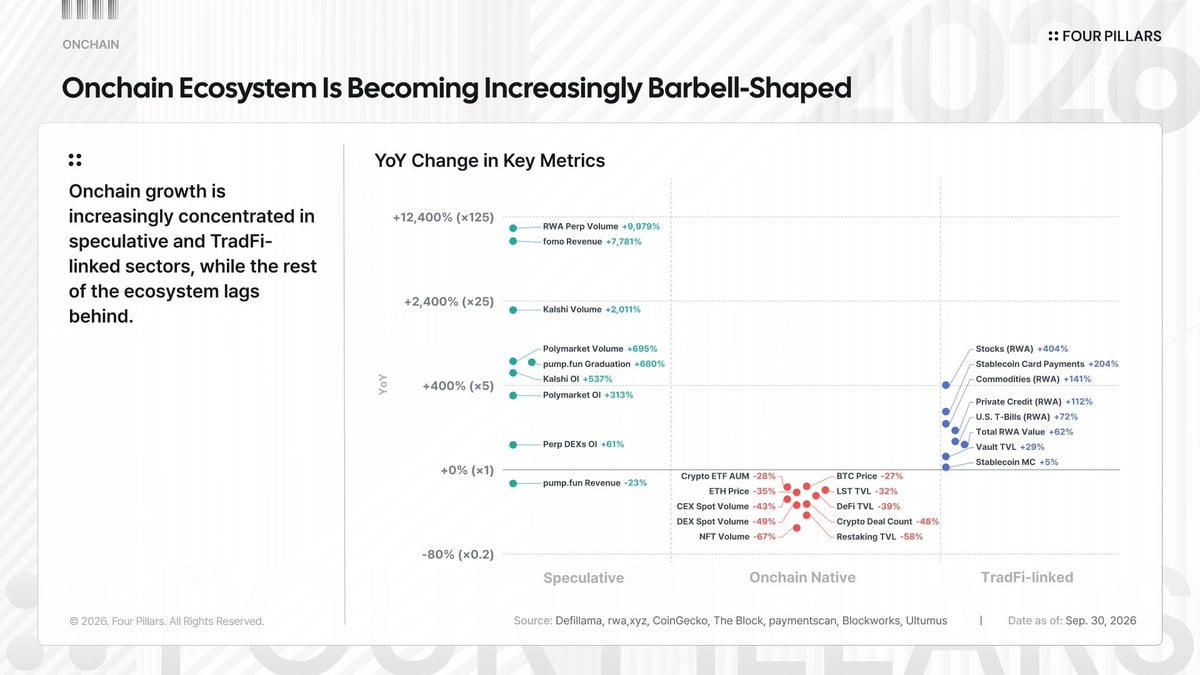
Image: The Polarization Pattern and Financial Infrastructure Pipeline Evolution in 2026
In my previous article, I argued that the on-chain ecosystem is becoming increasingly polarized. Looking at the performance of major sectors in 2026, the overall industry landscape has become quite clear.
On-chain native sectors like native DeFi are underperforming. Meanwhile, the sectors achieving meaningful growth are essentially concentrated at two extreme ends.
On one end of the balance is speculation-driven sectors, such as prediction markets, perpetual futures, and Meme coins; on the other end are sectors closely connected to traditional finance, including stablecoins, real-world assets (RWA), and on-chain vaults.
Considering that 2026 is one of the most challenging years in the history of the crypto industry, the significant growth of these sectors indicates that they have at least found a true product-market fit (PMF) to some extent.
At first glance, these two extreme sectors seem completely different. However, they actually share a critically important common feature: the vast majority of them merely use blockchain as a financial underlying pipeline.
As we discussed earlier, prediction markets and perpetual futures do not fundamentally need blockchain to exist. Blockchain primarily provides infrastructural utility for deposits, withdrawals, and the tradability of assets.
Meme coins are similar. Blockchain allows anyone to issue tokens freely and trade publicly at very low costs, which embodies their core utility.
At the other end of the balance, stablecoins and RWAs likewise primarily view blockchain as the next-generation financial pipeline, replacing the outdated and inefficient backend settlement infrastructure of traditional finance.
It must be made clear that I am not denying the tremendous value of financial pipelines. On the contrary, this value is evident.
A globalized financial backend that allows anyone to trade and utilize a wide range of assets 24/7 is a significant leap compared to traditional financial infrastructure. This capability alone is a core differentiation advantage.
However, there is a phenomenon that I find particularly thought-provoking: in the tracks where blockchain has truly found PMF, blockchain itself has almost never been the core pillar of the business model. The core pillar is often something else.
The true business logic lies elsewhere; blockchain merely makes the business easier, faster, or lowers the barriers to entry.
Value Aggregating Towards Distribution Layers: Where Does the Blockchain Industry Go from Here?

Image: Comparison of the Value Capture Curve of Technological Origins and Distribution Channels (Source: The Commanding Heights)
A recent article titled "The Commanding Heights" has garnered significant attention in the San Francisco venture capital circle, proposing a deeply enlightening argument.
Historically, commercial value does not necessarily settle where a technology originates. Value tends to aggregate significantly where the distribution channels of that technology are controlled. The article argues that the AI industry will follow the same evolutionary trajectory.
I believe this phenomenon has been vividly playing out in the crypto world. Blockchain has indeed found PMF, but the problem is that the created value has not flowed back into the on-chain ecosystem or back to the underlying crypto infrastructure.
The vast majority of commercial value is being captured by front-end distribution platforms that have direct user relationships. For these platforms, blockchain is not the core business logic; it is merely another ordinary feature in their product stack.
So, where should the blockchain industry go from here? Currently, blockchain has proven its utility as a financial pipeline and has found its footing in that role. But I believe we need much more than that.
We need those "truly irreplaceable by blockchain" native businesses. In these businesses, blockchain should not merely be a supporting tool; it must sit at the very center of their core business logic.
Of course, we have previously encountered narratives like this. Many once-ambitious projects started with such aspirations, attempting to build disruptive products that could only exist on blockchain and be fundamentally different from past solutions.
However, most of those projects have long since faded away. Even so, I believe we must continue to explore in this direction with great effort.
If the utility of blockchain remains confined to acting as a "next-generation financial pipeline," then amid the tide of hyper-financialization, the blockchain industry will most likely ultimately descend into one among many mediocre financial infrastructure providers.
To be fair, this is not a bad ending. But if we want the blockchain ecosystem to grow into something much larger and greater than it is today, we must present a more convincing answer.
Perhaps in the future, a brand new category of native applications will emerge, exceeding all of our expectations and resolving this dilemma; or perhaps, the catalyst for breaking the deadlock will not come from the technology itself, but from political or social changes fundamentally reshaping the public's perception of blockchain, allowing existing native applications to regain the spotlight.
I do not know where the future will lead, but I firmly believe that this is exactly the focus that each of us must pay close attention to at this moment.
免责声明:本文章仅代表作者个人观点,不代表本平台的立场和观点。本文章仅供信息分享,不构成对任何人的任何投资建议。用户与作者之间的任何争议,与本平台无关。如网页中刊载的文章或图片涉及侵权,请提供相关的权利证明和身份证明发送邮件到support@aicoin.com,本平台相关工作人员将会进行核查。


