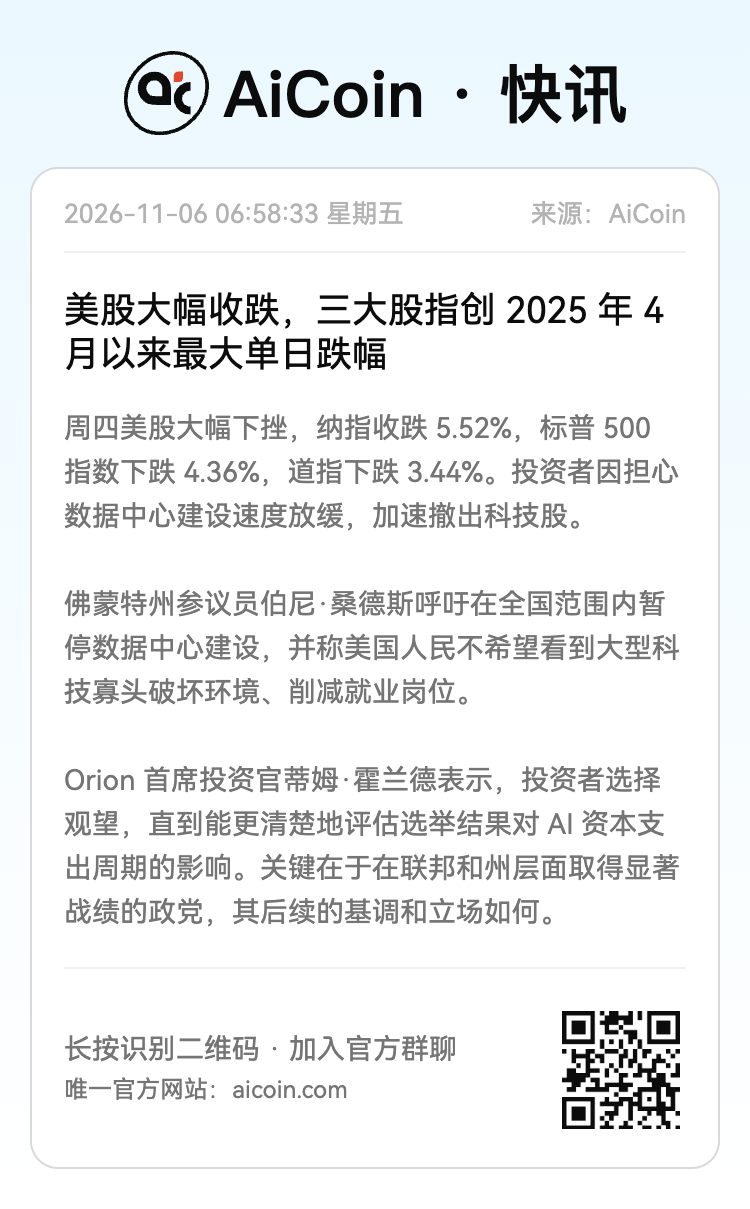
On November 5, U.S. stocks faced a severe sell-off. The Nasdaq fell sharply by 5.5%, the S&P 500 index dropped by 4.4%, and the Dow Jones fell by 3.4%. Nvidia declined by 9.3%, AMD plummeted by 17.3%, with the AI and semiconductor sectors becoming the hardest hit by the sell-off.
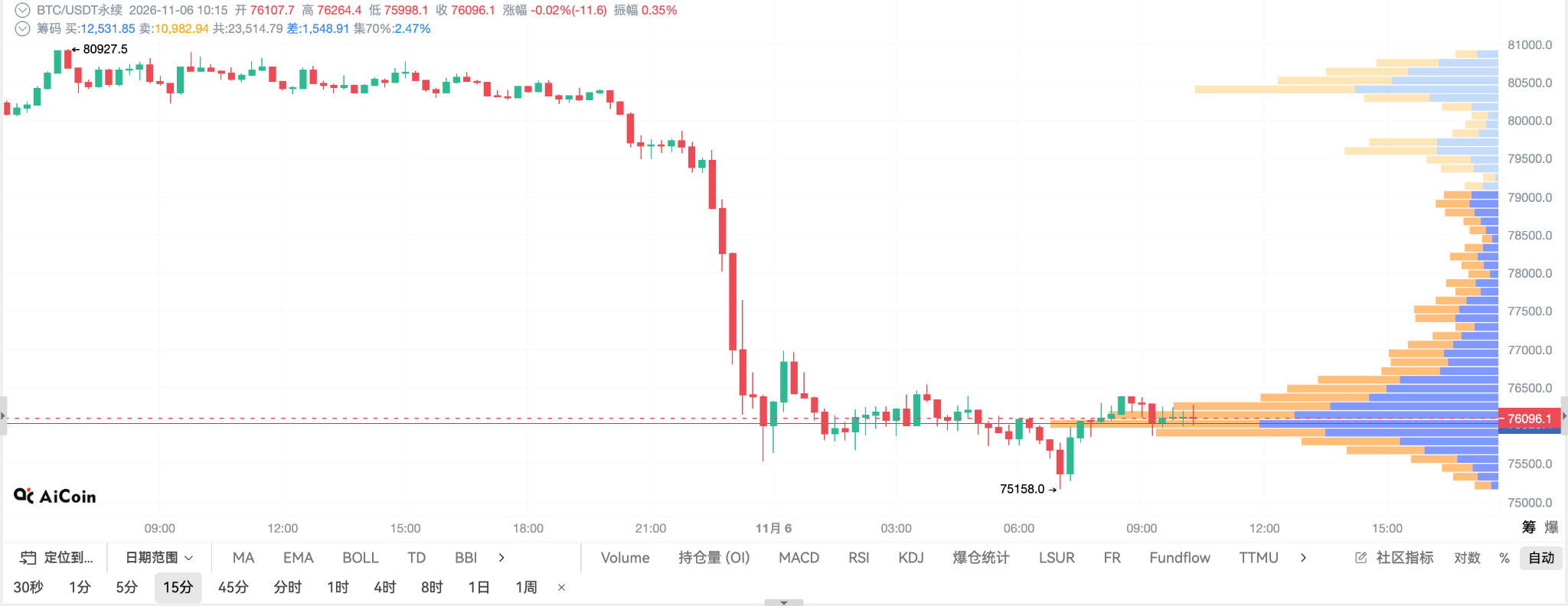
The crypto market also did not escape unscathed. Bitcoin temporarily fell below $76,000 and is currently fluctuating around that level, with mainstream crypto assets like Ethereum and Solana also weakening. In the past 24 hours, the crypto derivatives market saw liquidations over $1 billion, with long positions under greater pressure.
Market sentiment quickly turned cold. The Crypto Fear and Greed Index dropped from 50 on November 5 to 28 on November 6, a decline of 22 points in one day, shifting from neutral to fear.
Concerns over AI investment returns, policy uncertainties, and the concentrated exit of leveraged funds are all factors affecting risk assets.
Is this round of decline a concentrated adjustment or the beginning of a larger-scale sell-off? What signals should Bitcoin pay attention to next?

1. Why did the Nasdaq suddenly drop?
The most obvious characteristic of this drop in U.S. stocks is the severe decline in technology stocks, especially in the AI and semiconductor sectors.
On November 5, the Nasdaq Composite Index fell 5.5%, retreating about 12% from recent highs. Nvidia dropped 9.3%, AMD fell 17.3%, and the semiconductor sector also faced concentrated selling.
Two main concerns lie behind this adjustment.
First, the issue of AI investment returns has become a focal point again.
For some time now, AI has been a significant driving force behind the rise of U.S. stocks. Chips, cloud computing, data centers, and power infrastructure have all benefited from the continuous investment by large tech companies.
However, as the scale of investment grows, the market begins to question: how much revenue and profit can these investments ultimately bring?
As long as AI business growth is fast enough, the market is willing to give related companies higher valuations; but if investment returns fall short of expectations, or if profit realization takes longer than expected, valuations may face re-adjustment.
The AI industry chain, previously favored by the market, has thus shown clear differentiation.
Second, changes in U.S. politics have increased the uncertainties surrounding data center construction.
After the midterm election results were announced, the market began to reassess the policy environment for the AI industry.
Some Democratic candidates proposed limiting data center expansions and strengthening regulations during their campaigns. Investors are concerned that data center construction may face stricter approvals, energy, and environmental requirements in the future.
This does not mean that the U.S. AI industry will stop developing, but the market is already starting to consider: if the pace of data center construction slows down, will the growth expectations for chip, power, and cloud service companies need to be adjusted as well?
When high valuations meet uncertainties in investment returns and policies, funds often choose to reduce risk exposure first.
This is why this drop is not limited to a single tech company but has quickly spread throughout the entire AI industry chain.
2. Why does the drop in U.S. stocks also put pressure on the crypto market?
There is no fixed correlation between Bitcoin and U.S. stocks, but when market risk appetite declines significantly, both tend to be influenced by similar fund sentiments.
Especially when investors begin to concentrate on reducing risk exposure, tech stocks and crypto assets may face fund withdrawals.
This drop exemplifies that transmission.
After significant declines in tech stocks, Bitcoin also quickly retreated from its prior rebound above $80,000, temporarily falling below $76,000. Assets like Ethereum and Solana, which are more volatile, also saw noticeable declines.
Another noteworthy factor is the chain liquidations in the derivatives market.
When market prices drop rapidly, leveraged long positions may be forced to liquidate due to insufficient margins. Concentrated liquidations can increase market selling pressure, further amplifying short-term price volatility.
On November 5, the crypto market saw more than $1 billion in liquidations over the previous 24 hours, with long positions accounting for most of it.
This means that the market decline is not solely due to active selling; some selling pressure also comes from passive exits of leveraged positions.
It is important to note that liquidation data reflects changes in derivatives positions and does not equate to an equal scale of spot fund outflows. However, large-scale long liquidations in a short period generally indicate that market positions are under significant pressure.
3. Can Bitcoin stabilize around $76,000? Focus on these 4 signals
Moving forward, whether Bitcoin can stabilize should not just be viewed through a single price position but should be observed in conjunction with capital flows, market positions, and the external environment.
1. Can it hold near $76,000?
On November 5, Bitcoin temporarily fell below $76,000, then fluctuated repeatedly around that price level.
What needs to be monitored next is whether the price can gradually stabilize around this area, and whether it can regain volume support during rebounds.
If the price quickly encounters selling pressure after a rebound, it suggests that market support remains limited; if it can gradually recover lost ground and the retracement begins to narrow, it would be more favorable in alleviating short-term pressure.
2. Capital flow in the U.S. spot Bitcoin ETF
ETF capital flow helps observe the demand dynamics in traditional financial markets.
Previously, the U.S. spot Bitcoin ETF recorded about $74.6 million in net inflows on November 4, but on November 5, funds turned to net outflows again, with a single-day net outflow of about $325 million.
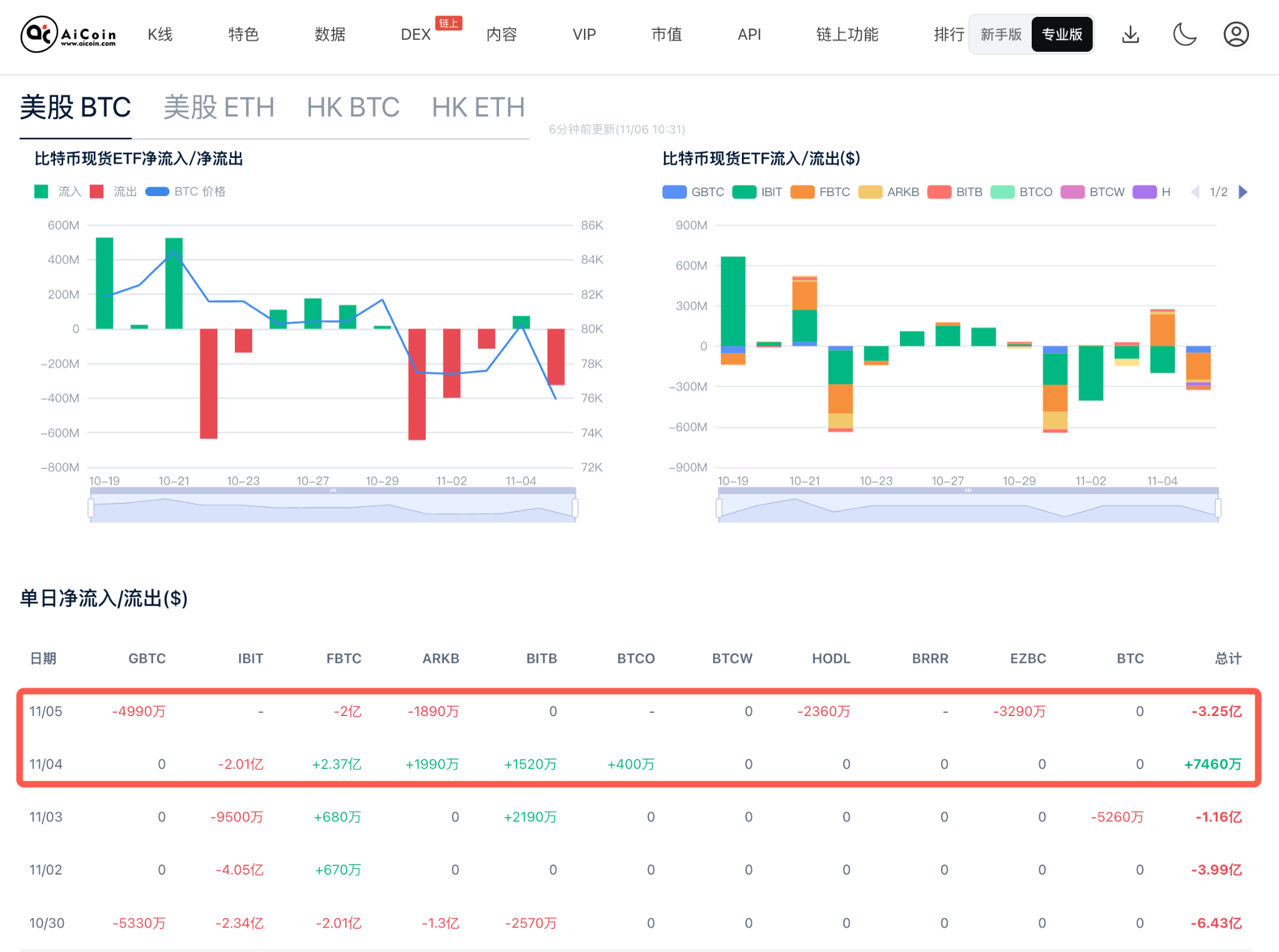
This indicates that institutional capital's attitude remains unstable, and a single day's inflow is insufficient to confirm that capital has returned.
The next focus should be whether ETF funds can achieve continuous net inflows. If Bitcoin's price rebounds alongside ongoing ETF capital inflows, it would indicate that market demand is improving; if funds continue to flow out, the sustainability of the rebound still needs to be observed.
3. Whether contract open interest and funding rates cool down
During this drop, a large number of long positions were liquidated, indicating that the leveraged risks accumulated in the market are being released.
The next indicators to watch are:
- Open Interest (OI): Observe whether the scale of contract positions in the market has significantly declined.
- Funding Rate: Observe whether the cost of holding positions for both bulls and bears and market sentiment gradually return to equilibrium.
If the open interest declines significantly after the price drop, it indicates that some leveraged positions have exited; if the funding rate also gradually restores to normal, the market may be undergoing a position adjustment.
However, if leveraged positions rapidly increase again during price rebounds, the market may still face significant volatility risks.
4. Can U.S. tech stocks stop falling?
This pressure on the crypto market is clearly time-related to the significant drop in AI and semiconductor sectors of U.S. stocks.
Therefore, attention must also be focused on the performance of tech stocks like the Nasdaq, Nvidia, and AMD.
If tech stocks continue to fall, market risk appetite may be further suppressed; if the AI and semiconductor sectors gradually stabilize, at least it would help alleviate the external market's drag on crypto assets.
Of course, stabilization in U.S. stocks does not necessarily mean that Bitcoin will rise simultaneously. The crypto market also has its own flow of funds, regulatory, and industry event influences.
4. How long will this round of adjustment last?
It is still too early to determine whether the market has hit a bottom or find certainty in further declines.
Currently, the market needs to digest at least three questions:
First, can the high investments in the AI industry continue to be converted into actual profits? Second, will changes in U.S. policies impact data center construction and the growth expectations of related companies? Third, have the leveraged positions accumulated in the crypto market been sufficiently released?
If these uncertainties gradually alleviate, risk assets have the opportunity to regain attention from capital.
Conversely, if tech stocks continue to decline, ETF funds keep flowing out, and large-scale long liquidations occur again in the crypto market, Bitcoin may still face further pressure.
For average investors, rather than rushing to judge whether a certain price level is the bottom, it is better to clearly observe what is happening in the market: whether the price has stabilized, whether funds have flowed back, whether leveraged risks have decreased, and whether the external market has stopped deteriorating.
5. When the market is volatile, idle funds can also be arranged
In unclear market conditions, there is no need to rush to trade with every fluctuation. If you have crypto assets that are temporarily unused, consider paying attention to Binance's recently launched second phase of the "Community Rebate" financial activity.

Qualified users participating in U finance can enjoy a maximum annual rate of 10% and have a chance to share a reward pool of 40,000 USDC, as well as rewards equivalent to $500,000 in SXT.
Users without a Binance account can complete registration through the link below and learn about the related products and participation conditions.
👉 Binance registration link:
https://jump.do/zh-Hans/xlink-proxy?id=3
(Invite code: aicoin668, enjoy 10% rebate)
Users with existing accounts can choose suitable products according to their capital usage plans.

The activity has specific participation thresholds, limits, and duration, and rewards as well as actual annual rates are subject to Binance's activity page. Financial products are not bank deposits and do not guarantee principal or returns. Please understand the relevant rules and risks before participating.
Conclusion
The Nasdaq fell 5.5% in a single day, and Bitcoin temporarily dipped below $76,000, reminding the market once again: when risk appetite changes, the interconnections between different assets may happen faster than expected.
AI investment returns, U.S. policy environment, ETF fund flows, and derivatives positions will all influence the market performance going forward.
Short-term volatility may continue. Instead of being driven by daily up and down movements, it is better to focus on the changes in these key indicators.
Market conditions can fluctuate, but the basis for judging the market cannot rely solely on emotions.
Join our community to discuss and grow stronger together!
Official Telegram community: https://t.me/aicoin_support
AiCoin Chinese Twitter: https://x.com/AiCoinzh
Binance benefits group: https://www.aicoin.com/link/chat?cid=gmLgwvKD1
Risk Warning: Crypto asset prices are highly volatile, and contract trading carries leverage and liquidation risks; references to annualized returns from financial products do not guarantee returns. Please read the product rules carefully before participating.
免责声明:本文章仅代表作者个人观点,不代表本平台的立场和观点。本文章仅供信息分享,不构成对任何人的任何投资建议。用户与作者之间的任何争议,与本平台无关。如网页中刊载的文章或图片涉及侵权,请提供相关的权利证明和身份证明发送邮件到support@aicoin.com,本平台相关工作人员将会进行核查。