The first week of November 2026 is bound to be a week that will go down in the history of the U.S. capital market. On one side is the historic breakthrough of the Democratic Party in key states during the midterm elections, and the next day the U.S. stock market experienced its worst single-day decline since March 2020.
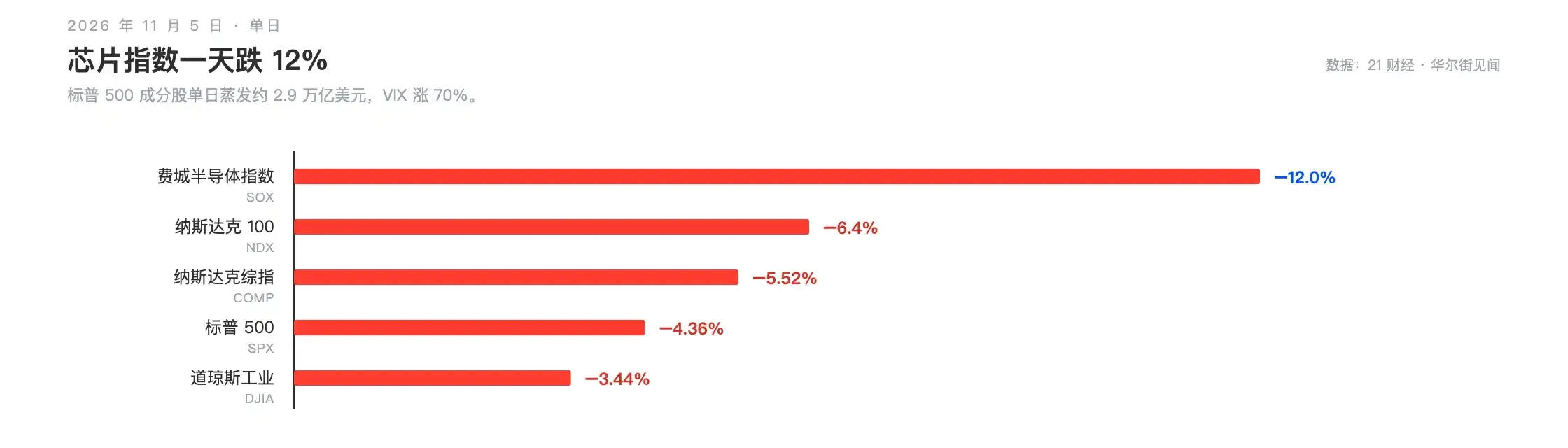
The S&P 500 index fell by 4.36%, with the market capitalization of component stocks evaporating by approximately $2.9 trillion in a single day. The Nasdaq Composite index dropped by 5.52%, pulling back 11% from the historic high set in October, entering a technical correction. The Nasdaq 100 index plummeted by 6.4%, marking the largest single-day decline since March 2020, with around $2.3 trillion in market capitalization wiped out in one day. The Philadelphia Semiconductor Index crashed by 12%, the largest drop since 2020. The Dow Jones Industrial Average fell by 3.44%.
In fact, the market did not start declining on November 5; it began to drop as early as October when expectations for the Republican Party in the midterm elections were not high.
In October, Goldman Sachs data indicated that short-selling bets on individual stocks surged to nearly a five-year high; Morgan Stanley's data showed that stock-picking funds significantly reduced their positions in October, marking the largest active reduction in over a decade, with net market exposure falling by about 9% since June. By the end of October, more than 40% of funds had seen their year-to-date gains erased or turned negative.
Global hedge funds averaged a loss of about 3% in October. It sounds not too alarming, but that's the average. Looking deeper, large multi-strategy and stock-picking funds were almost all affected.
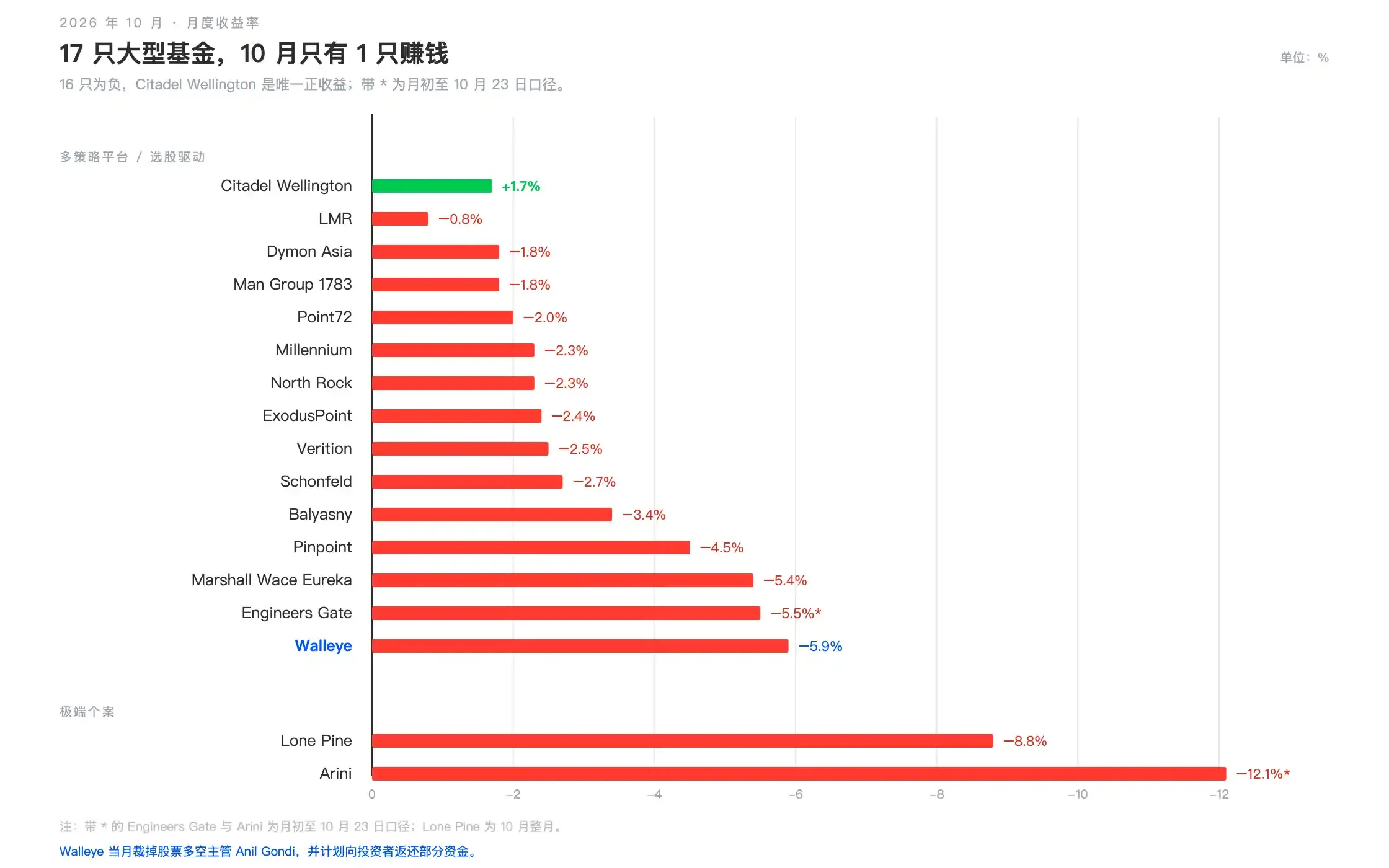
In the same report, Citadel's Wellington fund was one of the few gainers, up 1.7% in October and 15.3% year-to-date. The vast majority were negative: LMR −0.8%, Dymon Asia −1.8%, Man Group's 1783 fund −1.8%, Point72 −2.0%, Millennium −2.3%, North Rock −2.3%, ExodusPoint −2.4%, Verition −2.5%, Schonfeld −2.7%, Balyasny −3.4%, Pinpoint −4.5%, Marshall Wace's Eureka strategy −5.4%, Engineers Gate −5.5%, Walleye −5.9%.
In extreme cases, Lone Pine dropped 8.8% in October; the credit bond firm Arini had already fallen 12.1% as of October 23, marking its worst monthly performance since inception.
Millennium, Point72, Schonfeld, Balyasny, ExodusPoint, Verition, Pinpoint, North Rock, Dymon, Man Group, LMR—these names are usually associated with "stability, low volatility, double-digit annualized returns," but in October they lined up with negative returns.
One month, wiping out an entire year
Just how devastating was October?
A multi-strategy fund managing several billion dollars, with a long-term annualized target of around 10%–15%, typically sees monthly fluctuations of about ±1%–2%. However, October's drop was between 2%–6%, which is two to four times the normal month's range.
For a fund like Walleye, with a size of about $17 billion, a −5.9% return means approximately $1 billion evaporated in a month.
An even more intuitive calculation is to compare October's losses to the gains accumulated over the first nine months of the year.
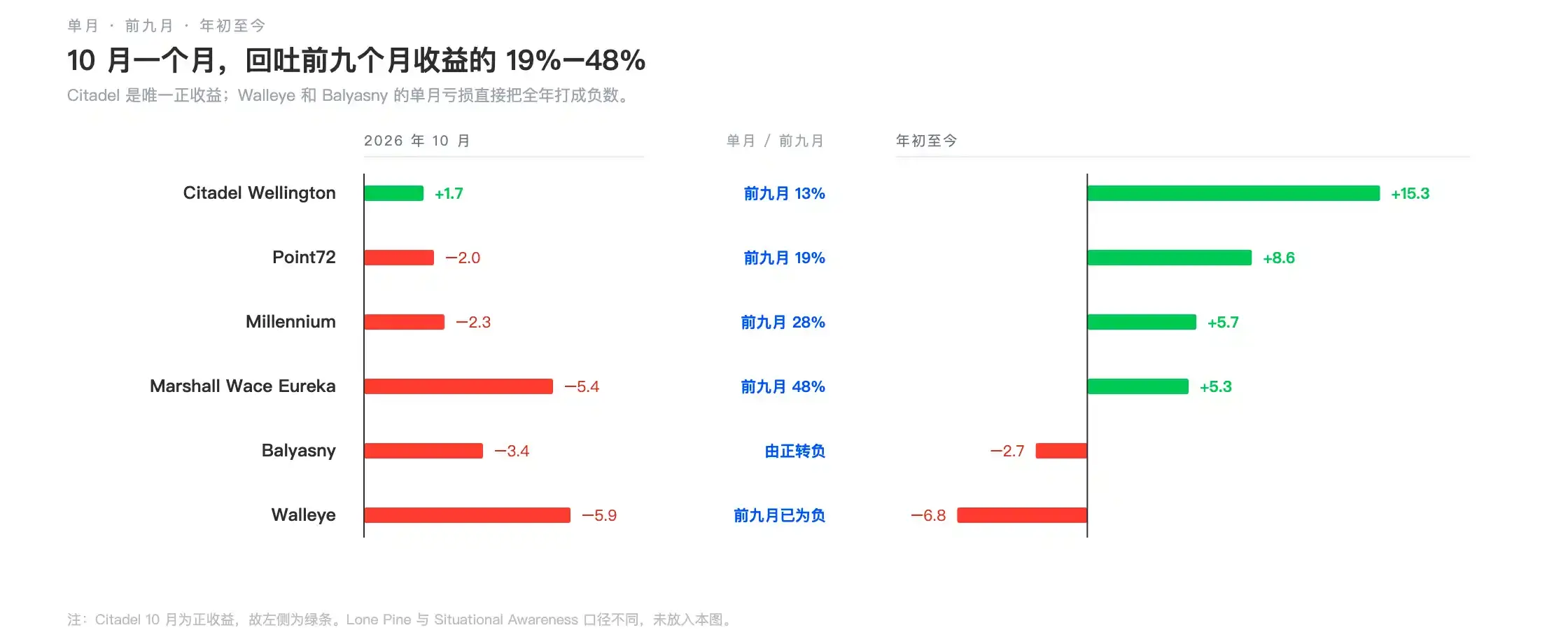
· Citadel Wellington: October +1.7%, Year +15.3%—the monthly gain corresponds to 13% of the previous nine months, barely affecting annual returns.
· Millennium: October −2.3%, Year +5.7%—this indicates a loss of 28% of the accumulated returns from the previous nine months.
· Point72: October −2.0%, Year +8.6%—this indicates a loss of 19% of the accumulated returns from the previous nine months.
· Marshall Wace Eureka: October −5.4%, Year +5.3%—this indicates a loss of 48% of the accumulated returns from the previous nine months.
· Walleye: October −5.9%, Year −6.8%—the single-month loss directly turned the annual return negative.
· Balyasny: October −3.4%, Year −2.7%—the first nine months were still positive, but the single month turned negative.
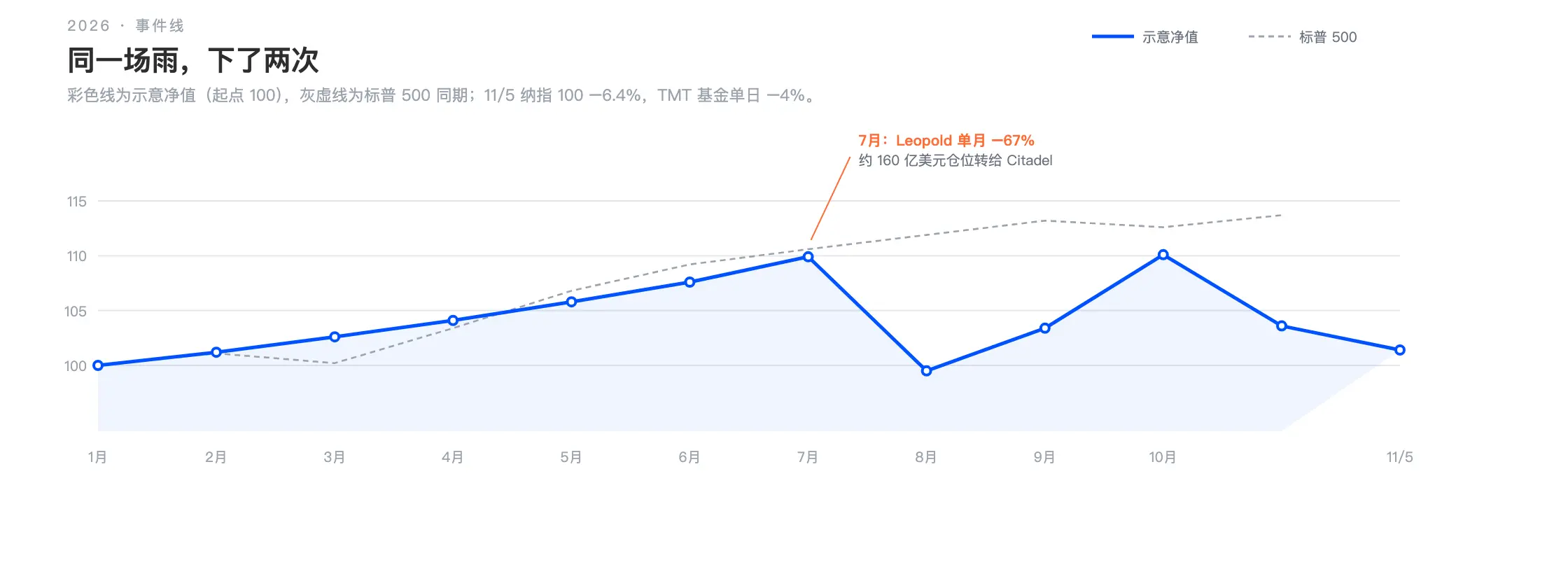
Not to mention Situational Awareness, which didn't even last until October, having lost 70% in July, resulting in a complete collapse.
Forced to refund, lay off, and shut down strategies
Losing money, of course, has its own chain reactions, leading to the withdrawal of entire strategy lines and returning funds to investors.
1Walleye Capital: Laid off the head of long/short equity and returned part of the funds
Laid off Anil Gondi, the long/short equity head, and "a significant portion" of the internal long/short team. Gondi joined in July 2025 after a long tenure as a long/short equity manager at Balyasny Asset Management and founding 6elm Capital.
CEO and Chief Investment Officer Will England acknowledged in a letter to investors that the investments made over the past few years to improve the internal equity business (including the introduction of new senior executives) "have not produced the expected results," with the opportunity cost and resource consumption significantly higher than the returns. Additionally, they plan to return part of the funds to investors.
Engineers Gate: Laid off most of the Synthesis equity team
After a 5.5% loss in October, Engineers Gate laid off most of its equity team named Synthesis, including the team leader, keeping only five fundamental managers. In their client communication, they stated: After the sharp turn in AI and tech stocks, this team's performance was insufficient to continue in its current form; the company also reduced capital or terminated partnerships for a few investments.
Samlyn Capital: Sold off almost all positions outside financial stocks
With a managed scale of about $7 billion, Samlyn sold off almost all industry holdings outside of financial stocks, laid off several senior analysts, and shifted focus to the global financial sector.
免责声明:本文章仅代表作者个人观点,不代表本平台的立场和观点。本文章仅供信息分享,不构成对任何人的任何投资建议。用户与作者之间的任何争议,与本平台无关。如网页中刊载的文章或图片涉及侵权,请提供相关的权利证明和身份证明发送邮件到support@aicoin.com,本平台相关工作人员将会进行核查。


