On Thursday, Goldman Sachs' phone was about to explode.
"The pain level is extremely high."
This was a statement from Goldman Sachs' top stock trader John Flood in a report sent to clients on Thursday. His phone, in his own words, was "exploding".
The Nasdaq 100 index closed down 6.4% on Thursday, wiping out approximately $2.3 trillion in market value in a single day, marking the largest daily drop since March 2020. The S&P 500 fell 4.4%, and the Philadelphia Semiconductor Index plummeted 12%. The "fear index" VIX surged 70%, and Nvidia's gains for the year were entirely erased, while Sandisk plunged 22% in a single day.
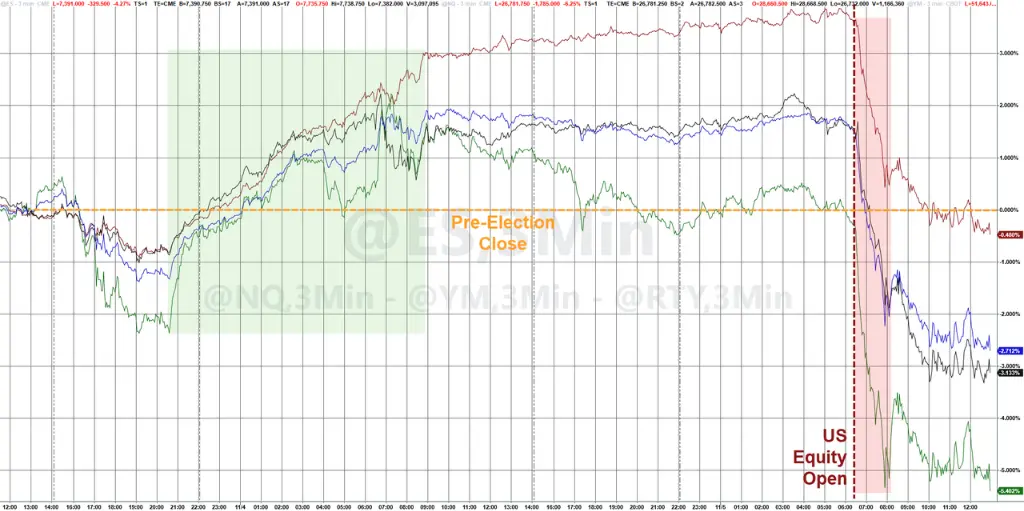
The direct trigger for this crash was the Democratic Party sweeping both houses of Congress in the midterm elections. Goldman Sachs immediately warned that this "blue tsunami" would result in approximately 45% of US planned data center expansion capacity facing a halt — the core narrative supporting AI tech stock valuations was suddenly questioned overnight by political realities.
However, the severity of the market's declines far exceeded what the policy shock alone could explain.
Charlie McElligott, a derivatives strategist at Nomura Securities, provided another layer of explanation in a report released during Thursday's trading session — a substantial part of this crash was caused by "the smartest people" stepping on their own toes.
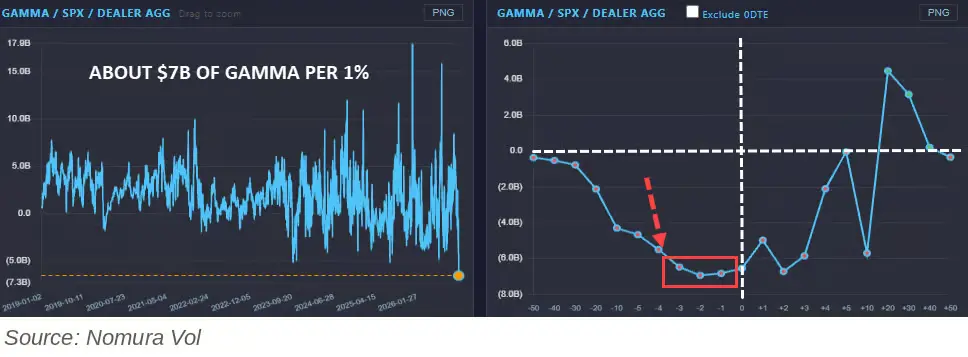
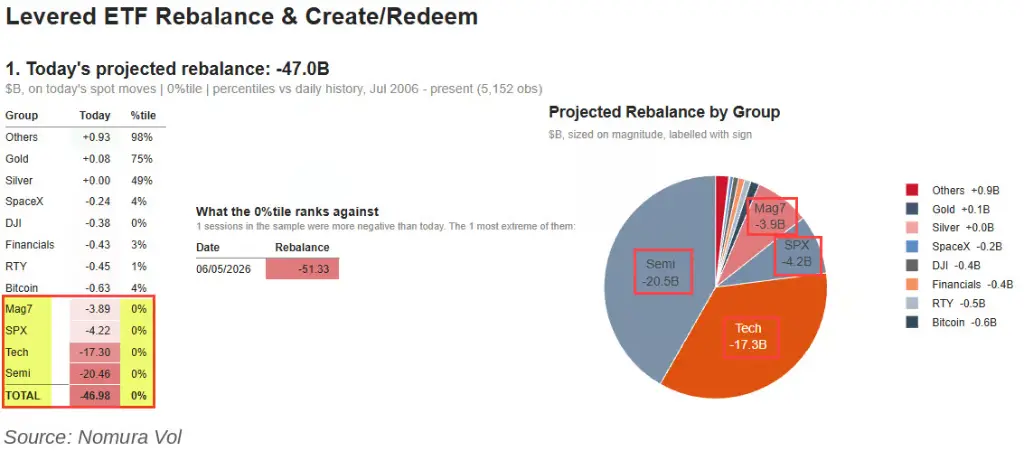
McElligott described a market paradox: during Thursday's trading, when Morgan Stanley calculated its $52 billion forced selling before the close at noon and the whole Wall Street knew about it, everyone tried to sell early to buy back at lower points, ultimately making the early sellers a driving force behind the decline. He warned that if the typical "low point around 2-3 PM followed by a rebound" did not occur, the early sellers themselves would also become a force driving the decline. Indeed, the close that day was a disaster. A massive forced sell-off from leveraged ETFs totaling $47 billion, a $61 billion volatility control fund, and negative gamma from dealers resulted in more than $100 billion of mechanical selling pressure, which would continue into Friday.
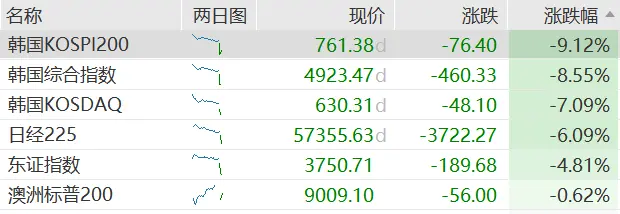
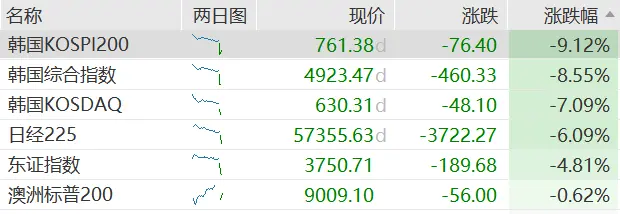
And today, the Asia-Pacific market's drops in South Korea and Japan are answering this question.
A $100 billion time bomb, known by the entire Wall Street
To understand McElligott's logic, one must first understand a mechanism.
There is a type of product in the market called leveraged ETFs, such as "2x long Nasdaq". Before market close each day, they must perform one task: rebalance their gains and losses to the target leverage ratio. When the market plummets, it means they have to sell a large number of stocks before the close — the worse the fall, the more they must sell; this is passive, mechanical, and unavoidable.
Another category is the volatility control fund (Vol Control), which systematically reduces stock positions when market volatility surges — similarly mechanical and typically executed one to two days later.
On Thursday, these two forces combined to a frightening scale.
Morgan Stanley's derivatives team calculated at noon on November 5: assuming prices remained at the level of 1 PM, the forced selling from leveraged ETFs was approximately $52 billion before the close. The semiconductor sector alone was set to absorb $21 billion, while the Nasdaq 100 would take another $15 billion.
McElligott's figures were slightly lower but still shocking: leveraged ETFs were near $47 billion, which is the second-largest single-day rebalancing in Nomura's database, second only to the $51.3 billion on June 5 of this year. He added that this sell-off was "especially painful" because 86% of the assets were concentrated in technology and AI-related stocks.
Combined with approximately $61 billion in volatility control fund sell orders and about $7 billion of selling pressure from dealers every 1% drop, the market's mechanical supply easily exceeded $100 billion.
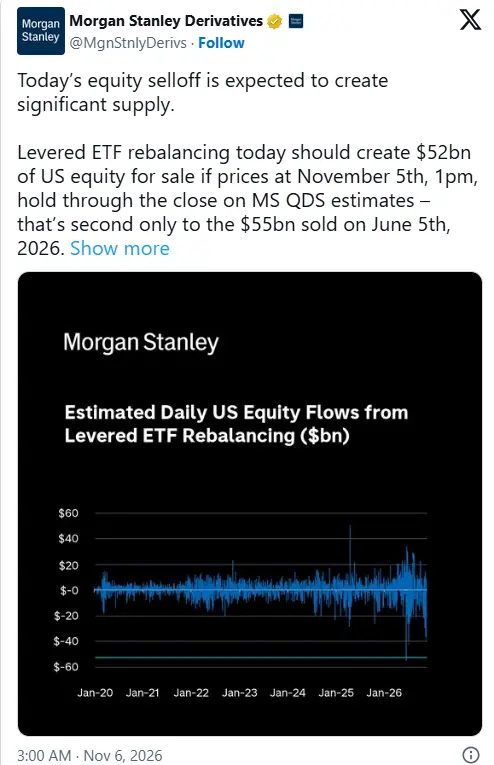
The key characteristic of these figures is that they can be calculated in advance.
Once Morgan Stanley calculated the $52 billion figure at noon, to quote McElligott, "on Wall Street, no information is kept secret for more than 45 minutes" — this figure quickly became "known throughout Wall Street".
The clever money’s plan: sell early, wait for the dip, and buy back
Upon learning about this mechanical selling, what was the reaction of the traders?
McElligott stated that proactive traders usually attempt to "rush to sell" in the face of such mechanical flows.
The logic is simple: since there will be a large-scale passive sell-off before the close, I'll sell now and wait to buy back at a lower price after it crashes.
Moreover, this strategy has been effective recently. McElligott noted in his report that during several recent days of "large daily fluctuations," the market often hits a low point between 2 PM and 3 PM EDT, after which early sellers and hedging positions start to reverse, take profits, and close their positions, driving the market to rebound before the close, ultimately closing higher than the expected mechanical sell-off implied extremes.
Just last Thursday, McElligott had just warned the market that "it's happening again" — at that time, leveraged ETFs were facing a $35 billion sell order, and the market had indeed exhibited the classic pattern of "low point around 2-3 PM + closing rebound".
During the June collapse of the South Korean market, the US stocks also followed a similar script.
On the day of the tariff suspension in April, this mechanism operated in reverse: McElligott calculated the largest historical +$34.3 billion pre-close buy rebalancing, early sellers bought ahead, ultimately driving the market sharply up.
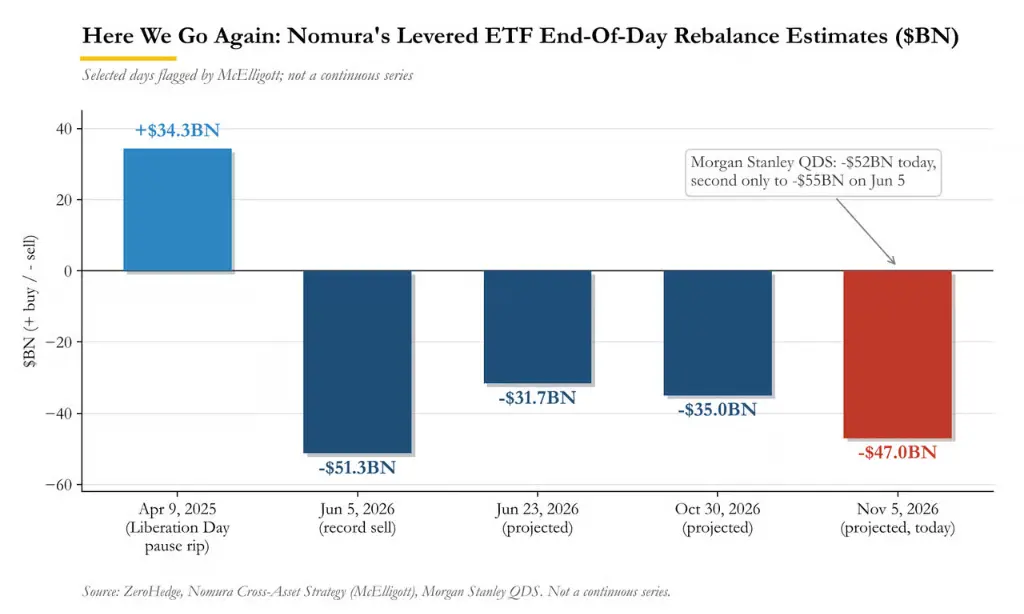
So on Thursday, when Morgan Stanley's $52 billion figure spread across the street at noon, every trader who knew this number was calculating the same thing: sell now, wait for the 2-3 PM low, then buy back.
The trap of reflexivity: the cavalry is the one selling
Then McElligott wrote a chilling concern in the report: "What if that 'hypothetical low point around 2-3 PM followed by a rebound' doesn't appear at all?"
Clearly, the terrifying part now lies in the fact that these figures are so large that 'in case' we do not see that almost taken for granted late trading 'pre-knowledge of low points followed by rebounds' (by one or two percentage points from the low point), failing to rebound during the standard 2-3 PM 'TWAP' window, instead creating a new low... and closing at the lowest point after misleading assumptions about the market 'rebounding in the last hour'.
This is the core of the reflexivity paradox.
When everyone is aware of the same script and acts on the script simultaneously, the script itself becomes ineffective.
The $100 billion mechanical sell orders meant to concentrate near the close got distributed throughout the day by early sellers — these early sellers themselves thus became the force driving the market down.
Meanwhile, the sell orders from volatility control funds lag by one to two days — Thursday's crash will trigger continued selling from these funds on Friday. McElligott wrote that the selling volume corresponding to the afternoon drop around 3 PM was about $61 billion, and if the drop extends to 10%, that number will swell to $70 billion.
Even more deadly is that when all early sellers have sold out, waiting for "that low point" — who will take the other side?
McElligott used a meme in the report to describe this scenario: everyone sits in chairs, waiting for the same rebound — but there aren't enough chairs.

ZeroHedge summarized:
"Sometimes the cavalry arrives at 3 PM. Other times, the cavalry is the one selling."
On Thursday, the cavalry did not come. The market closed at the lowest point of the day: the Nasdaq 100 dropped 6.4%, and the S&P 500 fell 4.4%
The stampede scene: this year’s best trade was swept away in 48 hours
Before the reflexive mechanism was detonated, there was another powder keg waiting for a fuse in the market.
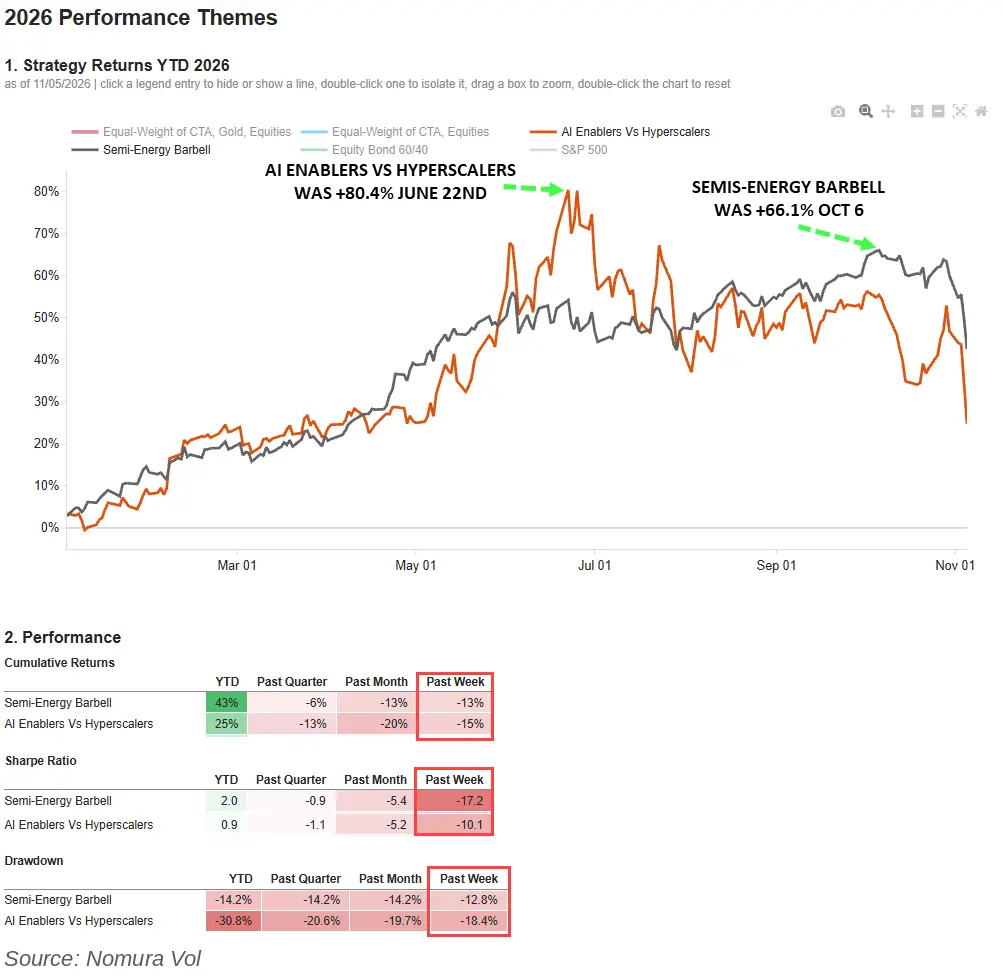
McElligott referred to Wall Street's "best trade of the year" as the "semiconductor-energy dumbbell strategy" — going long on semiconductors (benefiting from AI computing demand) while also going long on energy (geopolitical risk premium + inflation hedge). This strategy had an accumulated return of as much as 66% just weeks ago, with a Sharpe ratio of 3.3.
Then, in the past 48 hours, both legs were taken down simultaneously:
Energy: down 10.2% this week
Semiconductors: down 13.1% this week
Weekly Sharpe ratios were -17.2 and -10.1 respectively.
The collapse of the energy leg stemmed from the market’s revaluation of the situation in Iran — McElligott observed that the White House released signals that it might be "softening" on the Iran issue, and the war premium was swiftly removed, with Brent crude oil falling to its largest weekly decline since the outbreak of the pandemic.
The collapse of the semiconductor leg was prompted by market concerns over data center regulation following the Democratic Party's sweep of Congress.
With both directions collapsing simultaneously, funds holding the dumbbell strategy faced not just losses but were also forced to close out positions. The mentality described by McElligott of "preserving this year’s profits and surviving into next year" was thoroughly shattered at this moment.
On the same day, Walleye Capital announced the return of client funds and the dismissal of its stock department head, describing it as the worst month since the pandemic began. Goldman trader John Flood described institutional buying "stuck again", with massive cloud computing positions acquired in previous rebounds being quickly dumped, noting, "We currently do not see buyers stepping in to take over."
Abnormal trading volume at the ETF level confirmed the level of panic: SPY volume was 160% above the 20-day average, QQQ was up 100%, and the semiconductor ETF SMH increased by 150%.
According to Vanda Research's senior stock strategist Jai Malhi, on Thursday the scale of sell orders from retail investors "is expected to become the largest retail liquidation since the end of July last year."
Bonds squeezed out, another leg is also bleeding
There was another neglected leg simultaneously breaking.
CTA trend funds had accumulated large short positions in bonds this year, which is part of the "shorting bonds/going long on inflation" trade and is an implicit complement to the dumbbell strategy.
The stock market crash triggered safe-haven buying entering the bond market, causing US bond prices to surge, forcing bond shorts to cover. McElligott's calculations show that CTAs faced a "massive short squeeze" in the bond direction: if US bond prices rise another 2%, it will trigger about $225 billion of forced bond buy-ins globally, including approximately $48.5 billion in US 2-year bonds, about $69.5 billion in Eurozone 2-year bonds, and about $23.9 billion in Japanese 10-year bonds.
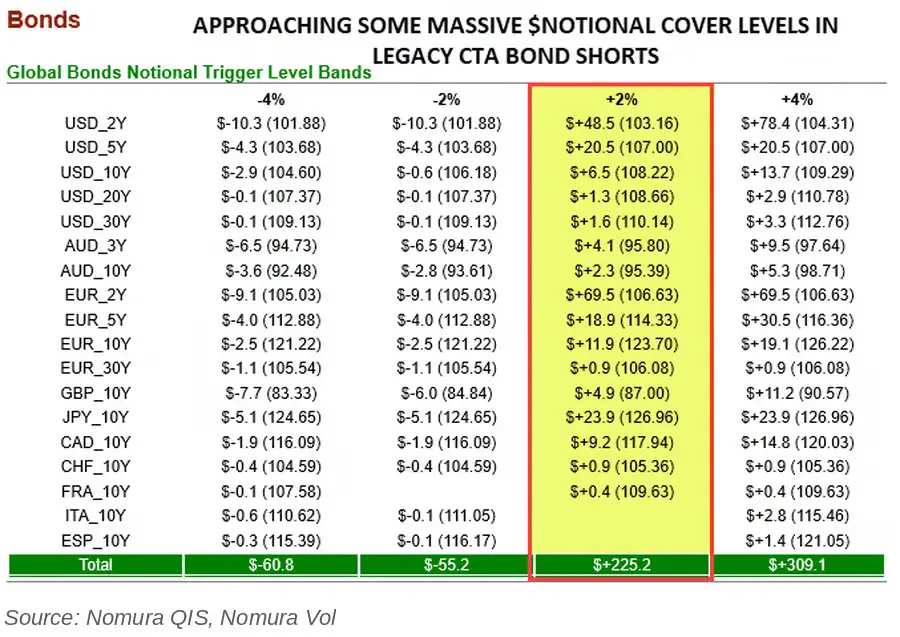
This means that the bond shorts' squeeze itself is also becoming a force pushing the bond market up, further pressuring stock longs — another reflexive cycle.
The crash is not over: Friday's lagging selling pressure
Thursday's close does not mean the end of this round of mechanical selling pressure.
The execution of volatility control funds lags behind. McElligott wrote that Thursday's market decline will continue to trigger these funds' sell orders on Friday — "Today's drop is further loading into the queue."
UBS's estimates are more direct: its risk control rebalancing model shows that if the S&P 500 drops by 2%, the systemic funds' selling scale will reach $95 billion to $105 billion.
The Asian markets are already answering this question.
On Friday morning, South Korea's Composite Index plummeted by 8.8%, breaching the 5000 point threshold and triggering a circuit breaker — a level that was seen by South Korean President Lee Jae-myung as a milestone for economic recovery, now swiftly breached. The Nikkei 225 index fell nearly 5.8%, dipping below 60,000 points intraday, falling more than 20% from its June peak, officially entering a technical bear market.
US stock futures saw a slight rebound in early Asian trading, with Nasdaq futures briefly turning positive, indicating some investors began to buy the dip. However, UBS warned that the systemic selling pressure has not yet been fully released.
Another variable on Friday is that the US October non-farm payroll report will be released that day, with market consensus expecting 59,000 new jobs added and an unemployment rate holding at 4.2%. The direction of the data will determine whether this adjustment can find a window to breathe.
Risk reminder and disclaimer
The market carries risks, and investment requires caution. This article does not constitute personal investment advice and does not take into account individual users' specific investment objectives, financial situations, or needs. Users should consider whether any opinions, views, or conclusions in this article align with their specific circumstances. Any investment based on this is at their own risk.
免责声明:本文章仅代表作者个人观点,不代表本平台的立场和观点。本文章仅供信息分享,不构成对任何人的任何投资建议。用户与作者之间的任何争议,与本平台无关。如网页中刊载的文章或图片涉及侵权,请提供相关的权利证明和身份证明发送邮件到support@aicoin.com,本平台相关工作人员将会进行核查。


