The long-accumulated concerns about the AI bubble suddenly exploded in the face of an election result.
The Democratic Party’s overwhelming victory in the U.S. midterm elections should have been a signal for "risk clearing" — and the stock market initially reacted that way. But within 24 hours, Wall Street completed a dramatic flip from celebration to panic. On Thursday, the Nasdaq 100 index recorded its largest one-day decline since March 2020, evaporating $2.3 trillion in market value in a single day; from the peak on October 6, the cumulative market value loss in the U.S. stock market has reached $5.7 trillion. The VIX fear index soared from 16.6 points to nearly 28 points, marking one of the most intense volatility events recorded from a calm starting point.
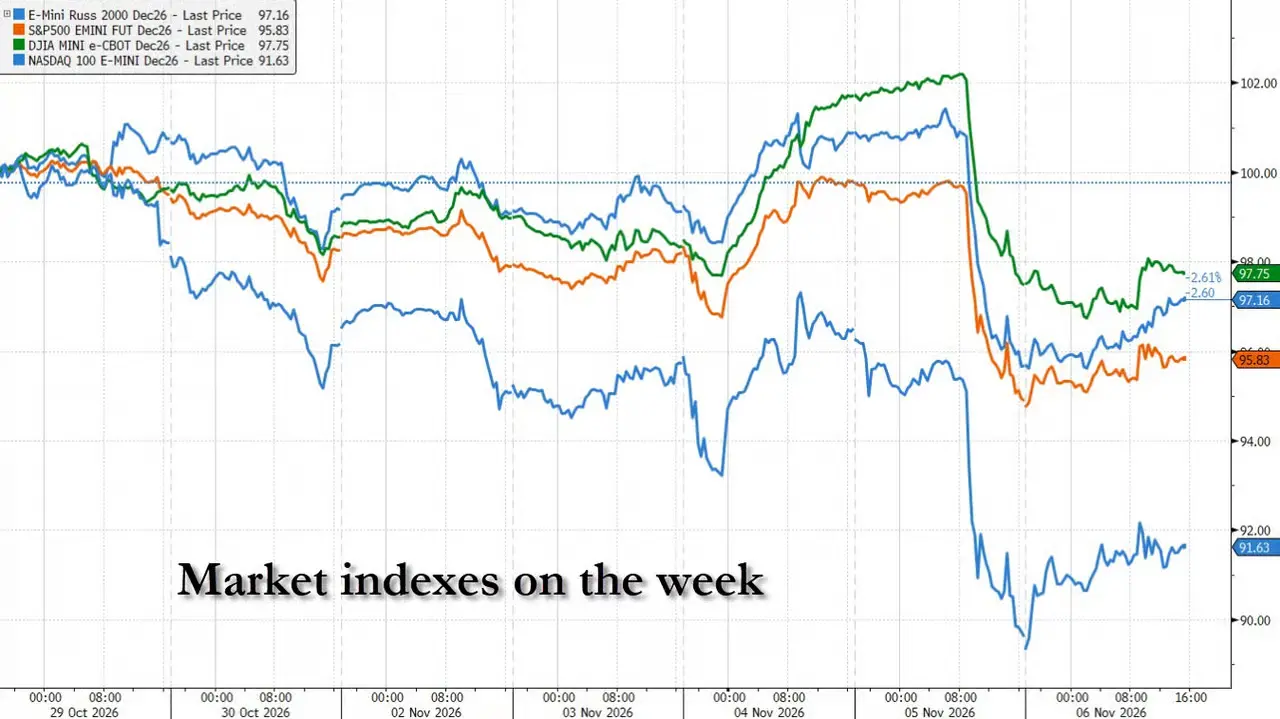
The trigger was the market’s repricing of the Democratic Party's policy stance — particularly the latter's deep skepticism about the large-scale expansion of AI data centers. This political variable, combined with highly crowded AI trading positions, created a rare phenomenon of retail investors, hedge funds, and quantitative strategies all simultaneously stepping back. The destructive power of this sell-off was remarkable as it left almost no reaction time for anyone, starting with retail investors fleeing first, followed by hedge funds, and then mechanical liquidations by quantitative strategies — all completed within just a few hours.
Election Night: From Celebration to Confusion
On Tuesday night, the Democratic Party's overwhelming lead exceeded expectations. According to the Wall Street Journal, Ben Emons, head of an investment research firm, was in his Manhattan office, and from 9 PM until midnight, the phone was almost non-stop ringing. He answered client calls while doing push-ups at his desk to stay alert. "People were taken by surprise," he said, "this is a real shock event."
At that time, stock index futures initially dipped during preliminary voting, but as the Democratic lead became clear and Trump publicly stated he would accept the election results, futures quickly turned positive. George Mateyo, chief investment officer at Key Private Bank, was home watching the live broadcast while texting colleagues, and his judgment was that the risk of intense disputes following the election had dissipated, and the market should welcome this.
This judgment was confirmed Wednesday morning. Sectors of the "real economy," such as construction and retail, surged, and the Dow Jones recorded its best single-day performance since April. Wall Street momentarily breathed a sigh of relief — thinking that the uncertainty of the election had been resolved.
However, this rebound was quickly proven to be a false breakthrough.
Retail Investors Flee First, Panic Spreads on Social Media
The sell-off on Thursday was ignited first by retail investors.
In the first half-hour after the market opened, the Nasdaq index plummeted, and the net sell-off scale by individual investors set a historic record. According to data from Vanda Research, the net selling scale by retail investors on Thursday was only second to two trading days during the COVID-19 pandemic shock in March 2020. Morgan Stanley's market intelligence department pointed out that retail selling deviated from normal levels by more than three standard deviations.
"I started working at 7 AM," said Raphael Monges, a graduate student at Columbia University and a member of the Columbia Options and Futures Trading Club. "I saw the market open, and the Nasdaq was falling rapidly, then the S&P followed. The Nasdaq was crazy; all AI stocks were crashing. My phone started vibrating non-stop; everyone was staring at their stocks, all in red."
Kevin Xu, an investor and content creator from San Francisco, glanced at the market at 10:30 AM on Thursday and was stunned. The Nasdaq had dropped 4%, and his retirement account had evaporated six figures overnight. "There’s nothing I can do," he said, "I can only watch." In his social media feed, other retail investors were sharing memes, venting with all capital letters, and even posting mental health hotline numbers.
Joel Rieger, a 50-year-old retail trader from California, did not adjust his position amid the volatility. "My portfolio from yesterday took a heavy hit; it’s all red," he said, "it will be painful in the short term."
Hedge Funds Follow Suit, Institutional Sell-off With No Buyers
The escape of retail investors was just the prologue. As the market direction was established, hedge funds and long-term asset managers joined the sell-off, while there were almost no buyers on the other side.
According to Bloomberg, "Institutional investors have exited the market, and retail and systematic strategies are aggressively selling," wrote Vanda Global Macro Strategist Viraj Patel in a report, "This liquidity flow dynamic is extremely rare outside of periods of true market stress."
Ron Adler, co-head of global equities trading at JPMorgan Chase, witnessed the whole process at the cash trading desk — the trading volume that day surged by 50% compared to normal. "What we witnessed part of was portfolio pain and indiscriminate selling," he wrote in a report to clients, "The extent of today's capital flow candidness is reasonable in direction but staggering in scale."
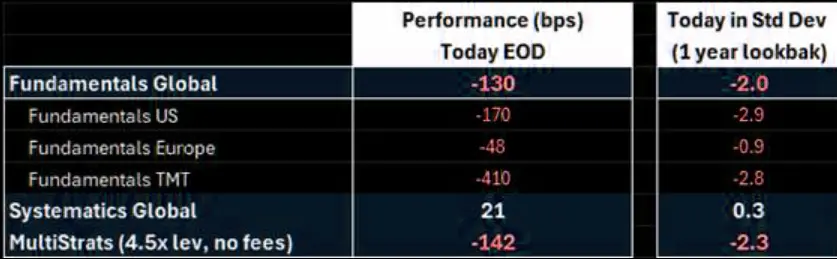
According to estimates from Goldman Sachs' prime brokerage, fundamental long-short hedge funds lost 1.3% in a single day on Thursday, marking a two-standard deviation event; tech-themed funds dropped more than 4%, reducing their year-to-date returns to nearly zero. Momentum strategies suffered a loss of 3.7 standard deviations. Morgan Stanley's data showed that the overall leverage ratio of hedge funds has decreased the most since June's peak in over a decade.
Quantitative Liquidations Trigger Systemic Selling Pressure
Once the market downturn was established, a series of quantitative trading mechanisms were triggered, pushing the selling pressure to new levels.
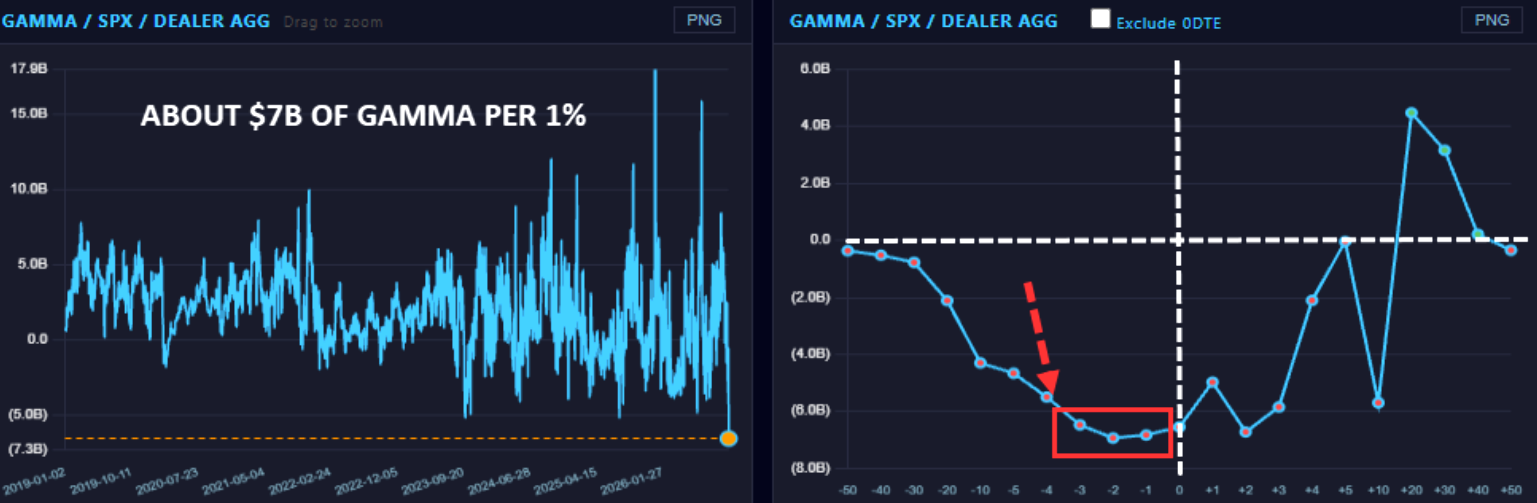
Charlie McElligott, managing director at Nomura Securities overseeing cross-asset strategies, estimated that during Thursday's trading session, the negative gamma exposure of options traders was about $7 billion for every 1% market volatility — meaning every 1% drop in the stock market required traders to sell an additional $7 billion worth of stock to hedge risk. Meanwhile, volatility control funds need to sell about $61 billion worth of stocks, of which $25 billion came from positions not yet closed on Wednesday; the rebalancing of leveraged ETFs would contribute approximately another $47 billion in selling.
Trend-following quantitative funds (CTAs) were also withdrawing in sync. According to Vanda's estimates, CTAs sold approximately $13 billion in S&P 500 and Nasdaq futures, reducing their positions to near historical lows.
Barclays estimated that volatility control funds reduced their stock exposure by 30 percentage points in a single day, marking the largest one-day decline since the COVID-19 shock in February 2020. "Conversations with clients suggest they have an even stronger motivation to further reduce this risk at this point," McElligott wrote, "The feedback theme is: preserve whatever is left of gains year-to-date, and survive to enter the new capital and risk cycle next year."
By 3 PM, the Nasdaq had dropped by 4.5%, and some traders were still hoping for a rebound in the final hour. Instead, the sell-off further intensified, and the S&P 500 index closed near its daily low, registering its largest single-day decline since April of last year.
AI Sector Faces Liquidation, Damage Concentrated and Severe
This sell-off's destructive power was highly concentrated in AI-related sectors.
Sub-sectors like storage chips, optical networking, data centers, and AI semiconductors all saw single-day declines of 12% to 15%, representing extreme volatility of five to six standard deviations. About ten AI stock baskets posted their worst single-day performances since the launch of ChatGPT in November 2022. Among them, the most heavily hit baskets for storage and optical communication have been halved from their June peaks, a decline greater than any correction in the past four years.
As of Thursday's close, 57% of Nasdaq 100 component stocks had fallen more than 20% from their peaks, a proportion even higher than when the index itself entered a bear market in March 2022.
The drama of this collapse was also intensified by its sudden emergence from calm. The VIX on Thursday opened at just 16.6 points, below the yearly average; by the close, it had approached 28 points. Since 1980, there have only been 48 instances of the S&P 500 dropping more than 2% the day after rising 1.5%, almost all occurring during bear markets or crises.
Political Shocks Combine with Old Concerns, AI Narrative Faces Repricing
The market's intense reaction reflects deep investor anxiety over the logic of AI investments.
Before the election, doubts about the sustainability of AI trading had already emerged: continued expansion of tech giants' capital expenditures, shrinking cash reserves, and mounting debt on data center operators' balance sheets. The Democratic victory added a new layer of political risk — the Democratic Party's strong resistance to the expansion of data centers, especially in states like Texas, Ohio, and Georgia, which have become key battlegrounds for data center construction, casting a shadow over the prospects for AI infrastructure development.
Bofa analyst Michael Hartnett pointed out that among surveyed voters, as many as 76% oppose building new data centers near their communities, which is becoming a serious obstacle to the expansion of AI infrastructure.
Matt Rowe, senior portfolio manager at Man Group, stated that the election results provide "quantifiable evidence that there is real public resentment toward data center construction," which "is beginning to change my judgment about the probability of these projects getting off the ground." "If all conditions remain unchanged, these projects will take longer to advance, and costs will be higher."
Joe Gubler, portfolio manager at Causeway Capital Management, noted, "There will always be losers; not everyone betting on capital expenditure will win."
On the other side, investors who left early were able to avoid the storm. Jeff Muhlenkamp nearly cleared his fund of all AI holdings before the crash, and his $275 million portfolio has remained largely flat since November, outperforming the S&P 500 for the year. "We sold the expensive and popular, and bought the cheap and forgotten," he said, "when momentum turned, we benefited."
The Market Searches for An Escape
As AI trading faced liquidation, investors were looking for new safe havens — but the path was not smooth.
Even before the election, funds had begun rotating into lower-valued defensive sectors such as utilities and essential consumer goods. In October, growth stocks underperformed value stocks by 10 percentage points, marking the largest monthly gap since 2001. However, the crash on Thursday indicated that these newly favored sectors also failed to withstand the shockwaves from the tech stock collapse.
Some investors positioned themselves early, allowing them to escape unscathed. Fund manager Jeff Muhlenkamp had cleared nearly all AI positions before the crash, and his $275 million portfolio was flat in November and has outperformed the S&P 500 year-to-date. "We sold the expensive, hot stocks, and bought the cheap, forgotten ones," he said, "when momentum turned, we benefited."
On Friday, chip stocks rebounded first, with the Nasdaq 100 index briefly rising over 2.6%, but all major indices still finished the week down, with the S&P 500's weekly decline at 2.68%. Senior trader Sinisa Sorgic at Bright Trading shorted TSMC's U.S. stock on that day, but he was "burned" as TSMC rebounded over 7.8% during the session. He summarized his feelings for the week: "Yesterday was a bloodbath. The market is too crazy now; I don't dare to go all in to bottom-fish."
Market divergence has emerged. Mateyo at Key Private Bank believes that state-level regulations will delay but not prevent the construction of data centers, and public doubts about AI may gradually fade as actual usage becomes widespread. However, Casaletto from Wellington Management takes a cautious attitude, believing that a trend of slowing AI expansion has already been established.
Whether this storm is a violent shake in the midst of an AI bull market or the beginning of a deeper cyclical transition remains undecided on Wall Street. But one reality has become clear: when political winds and crowded positions turn simultaneously, the buffer the market can provide is far thinner than imagined.
免责声明:本文章仅代表作者个人观点,不代表本平台的立场和观点。本文章仅供信息分享,不构成对任何人的任何投资建议。用户与作者之间的任何争议,与本平台无关。如网页中刊载的文章或图片涉及侵权,请提供相关的权利证明和身份证明发送邮件到support@aicoin.com,本平台相关工作人员将会进行核查。


