
Author: Jae, PANews
On November 12, a notice from global index provider MSCI finally brought down the boot that had been hanging over the cryptocurrency market for nearly a month.
MSCI officially confirmed the removal of two major Bitcoin DAT (Digital Asset Trust) Strategies, MSTR and Metaplanet, from its index list, while Ethereum DAT SharpLink Gaming was placed on the watch list. All adjustments will take effect after the market closes on November 30.
Now, Wall Street is undergoing an identity assessment. When a listed company's balance sheet is dominated by asset investments and its core business becomes merely decorative, it transforms into an investment fund packaged as a stock.
Reconstruction of MSCI index rules has foreshadowing for the removal of crypto trusts
MSCI's action to exclude Strategy and Metaplanet from the index list had already been prepared for a long time.
Last October, MSCI proposed targeted terms. Listed entities where digital assets account for more than 50% of total assets would be excluded from the index and the weight adjustment of related companies would be suspended. The announcement sparked collective opposition from the crypto industry and some institutional investors, leading MSCI to retract this crypto-specific rule earlier this year.
However, the matter did not end there. In August this year, MSCI launched a general rules consultation aimed at all "non-operational companies," finalizing the rules on October 15. This set of rules adheres to one core standard: is the company's value derived from the genuine operation of products and services, or from fluctuations in the fair value of asset prices?
The entire framework is built on "operating asset screening" and "five-dimensional financial ratio testing." If a company fails the operating asset test, and more than four out of five financial indicators are non-compliant, it will be classified as a "non-operational carrier."
To ensure the stability of the index, MSCI has also set up a buffer mechanism: newly applied component stocks will be rejected if their financial results do not meet standards for a single period; existing component companies will only enter the watch list for a single non-compliance period, and will be removed only if they fail to meet standards for two consecutive full fiscal years.
Strategy and Metaplanet just happened to cross all the red lines.
As of November 8, Strategy held 850,364 bitcoins with a cumulative purchase cost of approximately $64.16 billion. In stark contrast is its original business: the enterprise software business, which only generated $125.4 million in revenue in the third quarter of 2026 (Q3). The software business still exists, but the key variables determining the company's asset scale, profit fluctuations, and stock price trends have long since become Bitcoin. In mid-October, Strategy's chairman Michael Saylor stated that MSCI's removal of Strategy from the index was not important, as the funds they controlled were relatively small. He criticized that MSCI considers oil, natural gas, land, and machinery as capital, but does not include Bitcoin, which is a biased value judgment imposed on digital assets.
Japan's Metaplanet took a similar path. This small-cap company originally engaged in hotel and entertainment businesses, but after an aggressive transformation and continuous financing, it accumulated 44,000 bitcoins, while its traditional main business became marginalized. In response to the news of being excluded from MSCI's Japan small-cap index, CEO Simon Gerovich stated that the index adjustment would not disrupt the company's normal operations or its Bitcoin strategy, and management would continue to promote capital allocation to serve long-term holding goals.
SharpLink Gaming, led by Ethereum co-founder Joseph Lubin, temporarily escaped a fate worse than death. Its transition to Ethereum Trust is still recent, and during MSCI's lookback period, only the most recent financial report did not meet standards, allowing it to enter the watch list thanks to the existing two-year tolerance period for component stocks. However, if the next financial report still cannot prove the profitability of its core business, following in the footsteps of Strategy and Metaplanet would just be a matter of time.
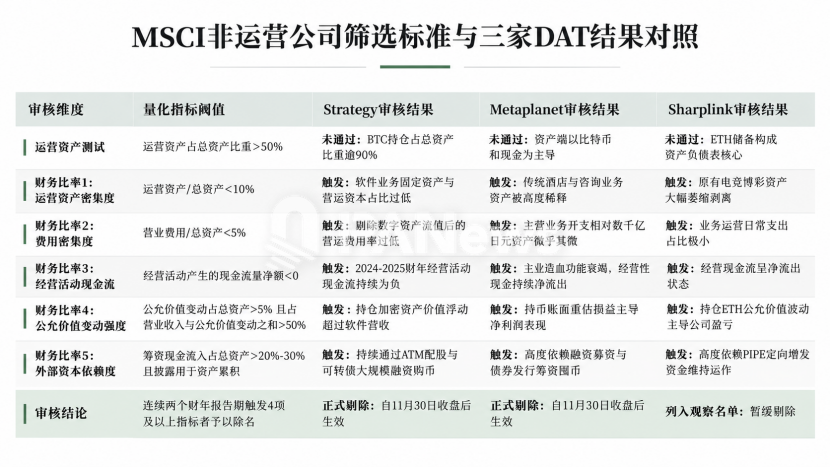
It is noteworthy that the UK uranium investment company Yellow Cake was also excluded. This means that MSCI is not simply targeting DAT, but rather delineating a line between "operational enterprises" and "asset investment carriers."
$2.8 billion selling pressure is a historical debt, financing wheel may face long-term pressure
Upon the news, claims of "a $2.8 billion passive selling pressure, $8.8 billion capital outflow" quickly gained traction, becoming numbers that raised market anxiety.
These two numbers originally came from a research report published by JPMorgan last November. According to initial calculations, if Strategy was removed from MSCI, it could lead to about $2.8 billion in passive sell-offs; if other index providers followed suit, it could further lead to up to $8.8 billion in capital outflow.
A year later, MSTR's stock price, capital size, and index tracking fund's positioning have all changed significantly. Applying old numbers to the current situation is bound to distort reality. What truly needs clarification is the actual volume of stocks that need to turn over and the market's capacity to absorb them.
According to official data disclosed by Strategy at the end of August this year, the total holding size of passive funds is 13 million shares. Based on the closing price of MSTR on November 11 of $122.35, approximately 402 million shares outstanding, and an average trading volume of 18.49 million shares over nearly 30 trading days, the potential selling volume of passive funds would reach $1.59 billion, accounting for about 3.2% of the outstanding shares, equivalent to 0.7 days of average daily trading volume.
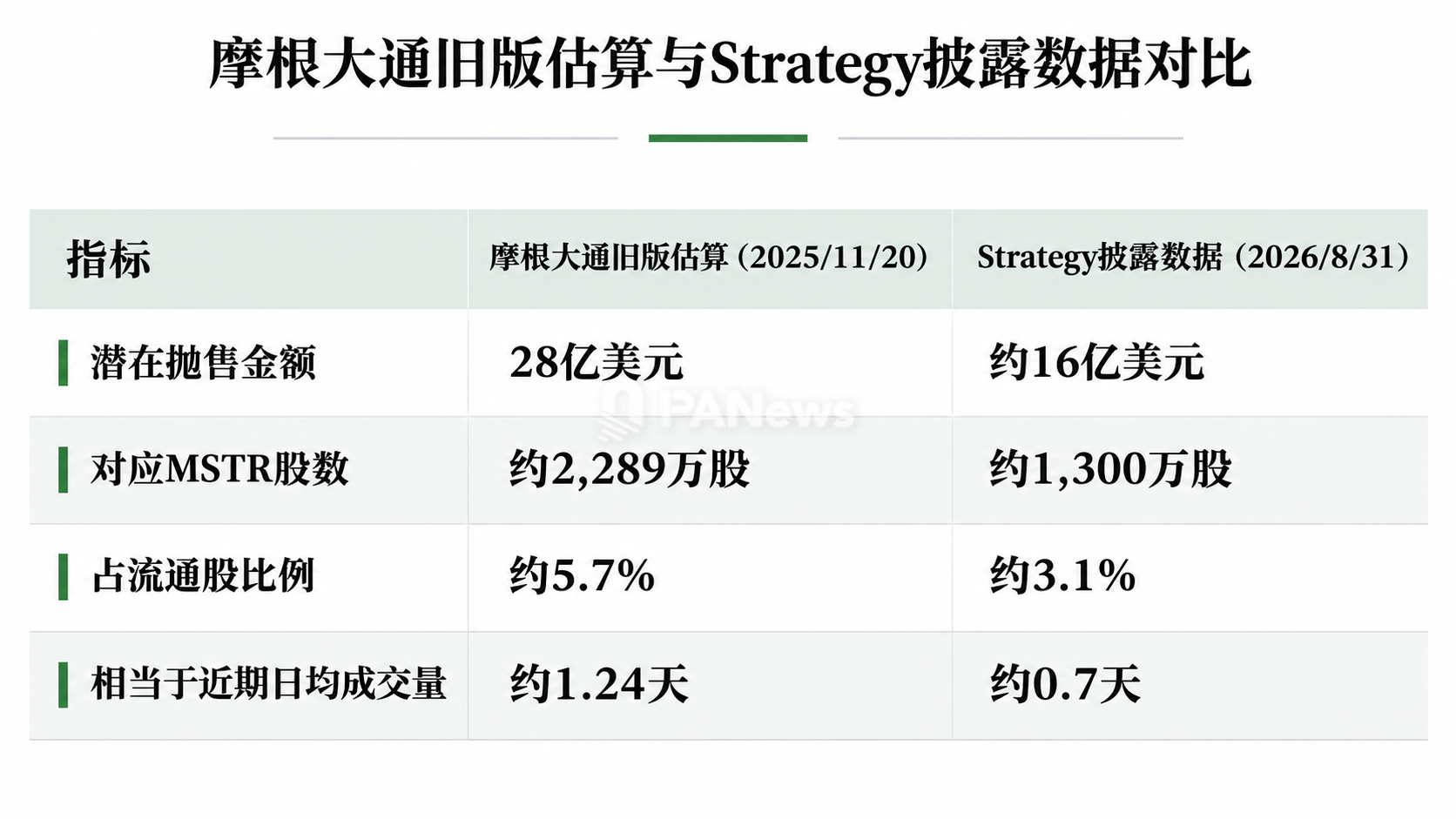
Unlike most small and mid-cap stocks that stagnate in liquidity after being excluded, MSTR boasts strong liquidity, with the passive selling pressure amounting to roughly one day's trading volume on a typical trading day, still within the absorptive range of the secondary market.
In other words, MSTR's passive selling pressure resembles a fully expected short-term impact rather than a liquidity crunch.
Long-term depth pressure lies within the financing wheel that made Michael Saylor famous.
Strategy's business model relies on leveraging the U.S. stock market's financing capabilities to continuously issue stock for purchasing Bitcoin. As long as the stock price maintains a premium over the per-share net asset value (mNAV), the new issuances can increase existing shareholders' returns, creating a positive feedback loop.
However, the key prerequisite for this flywheel to spin is that the stock must sustain a valuation premium over net assets. Passive index funds are a critical buyer supporting this premium.
As of now, Strategy's mNAV is 1.08 times, already at a low for recent years. If removal from the index leads to a reduction in long-term buying support, the premium may continue to narrow or even fall below par, shifting the logic from "enhancing returns" to "diluting equity," slowing down the flywheel's rotational speed.
The direct impact of MSCI's removal of Strategy from the index is on stock demand but indirectly disrupts financing costs and the ability to consistently acquire Bitcoin.
A subtle signal has already emerged. According to an 8-K filing submitted by Strategy to the SEC on November 9, from November 2 to 8, the company sold approximately 2.05 million shares of common stock, raising a net amount of about $283.8 million. Of this, $188.3 million was used to repurchase STRC preferred shares, $81.9 million was used to purchase 1,036 bitcoins, and the remaining $13.6 million was added to cash reserves.
In other words, last week the funds used to repurchase STRC were already 2.3 times the amount set aside for buying Bitcoin.
This indicates that Strategy's capital expenditure structure is becoming more complex, as it needs to allocate large amounts of funds to maintain capital structure, service preferred shares, and reserve liquidity. Although there is still over $10 billion in ATM issuance quota on the books, losing the lift of passive funds means that the dilution cost and fund maintenance cost of each subsequent issuance will rise significantly.
Strategy also acknowledged in its quarterly report that the index removal might undermine the company's stock price, liquidity, and future financing ability.
This is the more profound impact of MSCI's removal. It will not immediately topple MSTR, but it will slow the capital efficiency of the financing flywheel.
Financial safety net is substantial, stock price risk is hard to transmit to BTC
Whenever Strategy faces negative public sentiment, the question "Will the company sell Bitcoin to pay off debts?" resurfaces.
From the current financial structure, this concern seems premature. Strategy's balance sheet has built a relatively solid financial safety net.
Firstly, there is little pressure concerning debt maturity. Bitwise CIO Matt Hougan has pointed out multiple times that the market is prematurely judging Strategy's debt repayment risks. Next September, the company has only one convertible bond principal of approximately $1 billion starting redemption, leaving nearly a year of maneuvering space, with the real peak repayment period concentrated between 2028 and 2030.
Secondly, liquidity reserves are abundant. The company has a cash reserve pool of nearly $5 billion, specifically for fending off economic downturns, repurchasing debt at a discount, and not engaging in speculation, which is sufficient to cover more than three years' worth of interest and preferred share dividend expenses.
Lastly, the oft-forgotten software business still provides stable cash flow. It can generate about $500 million in annual revenue, far less than Bitcoin holdings but more than enough to cover debt interest. Strategy's annual cash interest expense is only about $50 million, and regular cash inflows from the software business can easily cover it without needing to touch Bitcoin reserves.
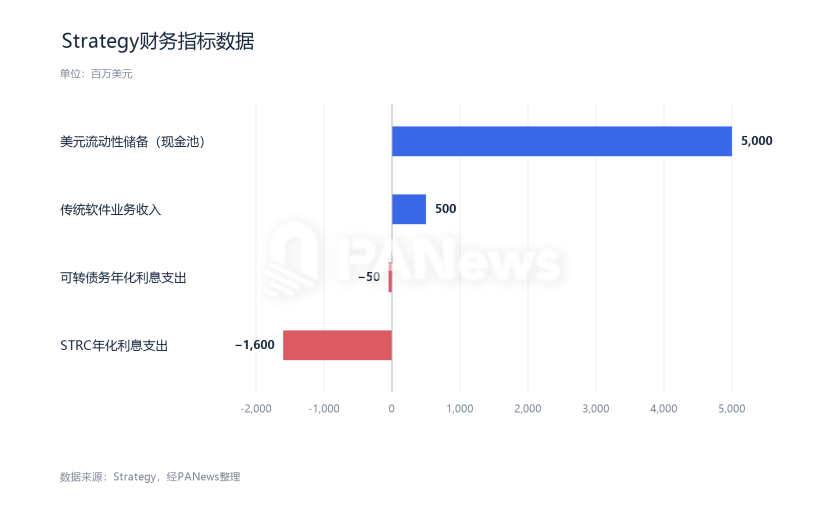
Even though Strategy has made sufficient risk buffers, its recent stock price has not been ideal.
MSTR's high correlation with BTC is a consensus in the market, and its dismal stock performance inevitably raises investors' concerns about further exacerbating BTC's downward trend.
Calculations by Sharpe Terminal also show that MSTR and BTC demonstrate a clear positive correlation at the daily return level.
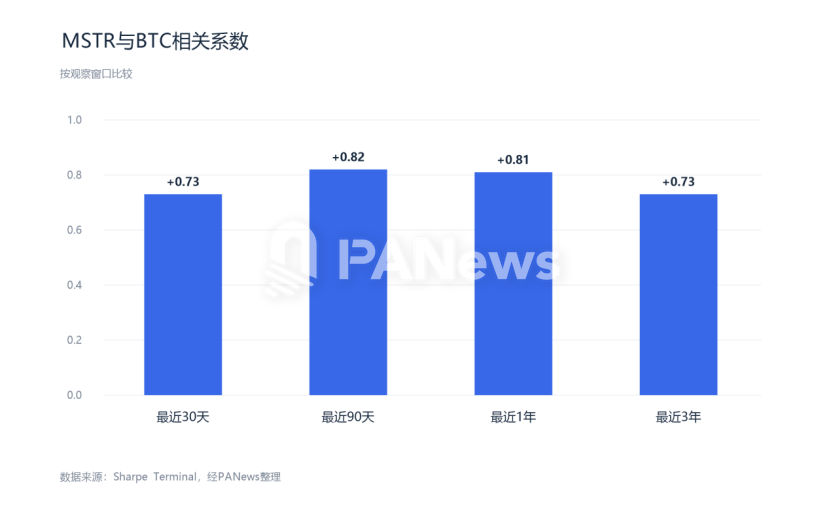
However, MSTR's stock price is not only influenced by BTC's price but also driven by stock-level factors such as financing costs, equity dilution, net asset premiums, and the flow of index funds, making its volatility often more pronounced than BTC's.
The most direct evidence lies within the interval performance since the announcement of MSCI's index removal. On October 15, after MSCI finalized the non-operational company rules, Strategy's stock price fell from a high of $151.29 all the way down to $122.35 yesterday upon the announcement, representing a nearly 20% decline. Meanwhile, BTC's decline was less than 10%, and the Nasdaq 100 dropped over 7%.
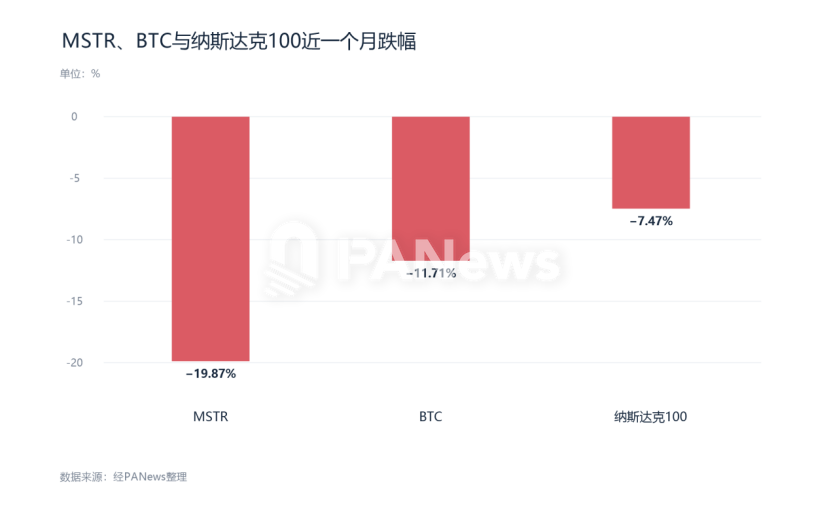
The excess retracement is the result of the separate pricing brought about by the index removal. Risks that belong to stocks do not fully transmit to Bitcoin.
Looking at the longer term, the same applies. Over the past year, MSTR has cumulatively fallen about 45.5%, while Bitcoin has fallen about 28.6% in the same period. The directions are consistent, but the magnitudes are disparate, reflecting the risk differential between the stock and the underlying asset.
In the short term, the upcoming price adjustments for MSTR mainly involve mean reversion at the valuation logic level; the true challenge will be to see if it can maintain the operation of the financing flywheel.
免责声明:本文章仅代表作者个人观点,不代表本平台的立场和观点。本文章仅供信息分享,不构成对任何人的任何投资建议。用户与作者之间的任何争议,与本平台无关。如网页中刊载的文章或图片涉及侵权,请提供相关的权利证明和身份证明发送邮件到support@aicoin.com,本平台相关工作人员将会进行核查。


