Jensen Huang stepped down, the founder of the first company in human history worth five trillion dollars was ousted, this is destined to be a turning point in the era of AI, and we always want to find the reasons.
In the overwhelming reports, one sentence has been circulated many times. It comes from a report in the American magazine Fortune on November 12, where an unnamed venture capitalist said:
If we must say who benefits from this, I think it's Anthropic.
Anthropic is a company that makes AI models, and its chatbot is called Claude, which is one of the strongest competitors to ChatGPT. Its relationship with Nvidia is quite complex: it is a major customer of Nvidia, and Nvidia has invested money in it. But the two have fought over one issue for years, whether to sell high-end chips to Country C. Nvidia wants to sell, but Anthropic does not.
Many bloggers on X have also noticed that there is something off with Anthropic. For example, @Dream1984Tube. On November 12, he posted a long English essay titled "Who Is Really Behind the Hunt for Jensen Huang?", where he said:
The first reporter from the New York Times to report Huang's affair had long-standing sources from Anthropic; the first Financial Times reporter to mention a romantic relationship coincidentally reported positively on Anthropic; the first to change the retweet of the romantic relationship on social media to "sleep" happened to be a former subordinate of an Anthropic executive; the first batch of lawmakers who signed for a congressional investigation were coincidentally supported by Anthropic’s ten million dollar donation; the first senator calling for Huang's resignation was coincidentally one with whom Dalio personally held closed-door meetings. A coincidence is a coincidence, but what about a series of coincidences?
We organized these pieces of information and then compared them with donation records, bills, lobbying reports, and public reports to attempt a review. The following is a list of surface facts that can be found in public records. But who knows the intentions of the people behind these operations.
Why a Hearing Is So Important
On November 4, three chairpersons of House committees jointly wrote a letter to Jensen Huang: Brian Mast, John Moolenaar, Crawford. These three names will appear again.
The letter invited Huang to attend a closed briefing on November 18 to discuss two matters: how Nvidia prevents foreign competitors from entering; and his interactions with a certain lady. That is Alice.
The last line of the letter requested Huang to respond by November 11.
He resigned on November 11.
But things did not stop. On the day after his resignation, November 12, the chair of the Senate Banking Committee, Tim Scott, sent a letter inviting Huang to attend a public hearing on December 3. This is the committee that oversees export controls in the Senate.
The weight of a closed briefing is far less than that of a public hearing.
In the United States, calling the head of a tech company to Capitol Hill for a public hearing is a ceremony in itself. Lawmakers sit higher than him, lights shine brighter than him, the C-SPAN channel that specializes in broadcasting Congress is filming, and the clerk records every word he says into the congressional archives. He must swear an oath; lying after swearing is a federal felony, punishable by up to five years; if he doesn't come, it starts with a subpoena, followed by contempt of Congress.
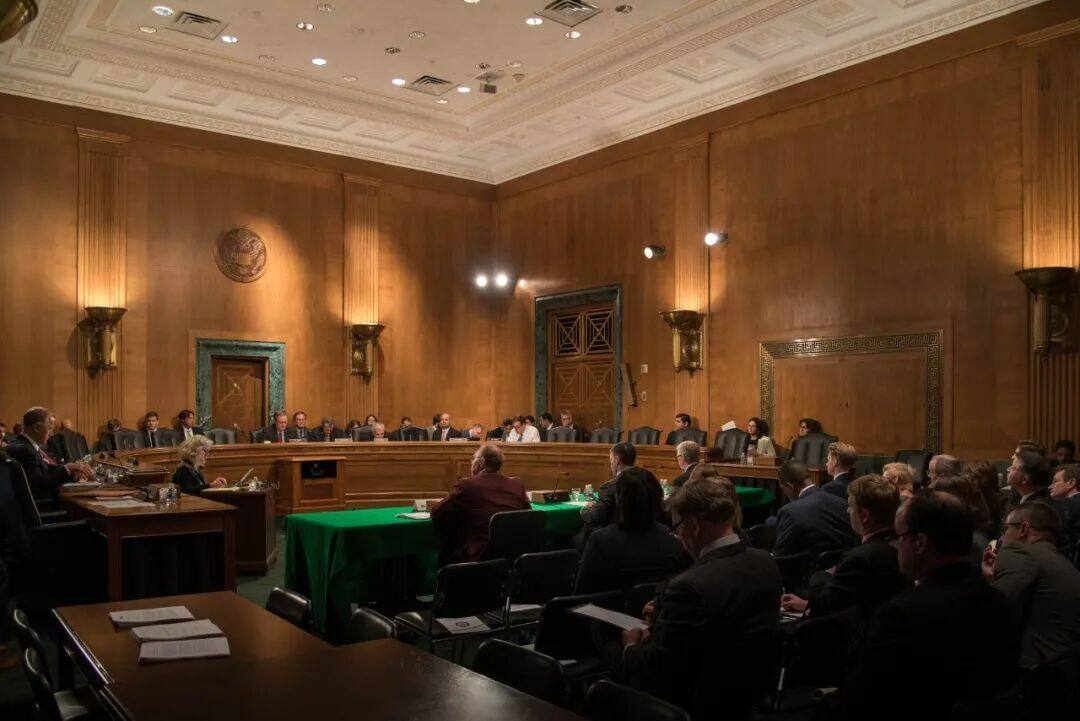
Senate Banking Committee Hearing
The more common cost is different. Every word you say could be cut into fifteen seconds and looped for the next ten years. In 2018, Zuckerberg sat in Congress for two days; the most famous image was the cushion under his rear, while few remember what he actually answered.
A hearing does not write laws, but it can determine whether a law can be written. In March 2023, TikTok CEO Shou Zi Chew sat in the House for several hours. Thirteen months later, Congress passed a bill requiring TikTok to either sell itself or be banned.
So hearings are a watershed in American politics: from this moment, a company’s matter officially becomes a national matter.
Jensen Huang has resigned, but the hearing goes on. What Congress wants to ask is much bigger than just one person.
Thus, bringing Huang, a key figure close to Trump, who is the only one that can rival Musk sitting on Trump’s private plane, to the hearing is no easy feat.
And the name Anthropic keeps appearing.
A Dinner Table, Three Confrontations
In May 2022, in San Francisco, at a high-end Chinese restaurant. This was Huang’s first meeting with Anthropic founder Dario.
According to a soon-to-be-published new book by New York Times tech reporter Kevin Roose, there was a hiccup before dinner. Anthropic's co-founder, Tom Brown, approached Huang to negotiate, claiming that Google's self-made AI chip TPU was more cost-effective than Nvidia's. Huang lost his temper on the spot, calling him a "bean counter," implying he was just a numbers guy, and threatened to leave the meal.
At the dinner table, Huang repeatedly mentioned his ambition to build the world's largest data center. Dario later privately muttered that he "was a bit like Trump."
Since then, the two began to confront each other.
On April 30, 2025. Anthropic published a blog talking about how Country C acquired chips: hidden in a fake pregnant belly, mixed in with live lobsters during transportation. The next day, an Nvidia spokesperson replied, saying it was a fabricated story. He also added a jab: "Country C has half of the world's AI researchers."
On January 20, 2026, in Davos, Switzerland, where global political and business elites gather annually. During an interview with Bloomberg, Dario said selling Nvidia's H200 chips to Country C "is like selling nuclear weapons to North Korea and flaunting it everywhere."
On April 15, Huang used the term "ridiculous" on the tech podcast Dwarkesh. He then stated the most biting statement: ceding the Country C market would jeopardize U.S. national security and technological superiority, all for the benefit of one company.
He didn’t name names, but everyone could tell to which company he was referring.
By the fall of 2026, the two met again at the White House. On September 27, Trump dined with Dario, a meeting later confirmed by Trump himself. Two days later, the White House hosted a lunch on "superintelligence." According to the Wall Street Journal, several tech executives, including Huang, directly asked Dario: why do you paint the risks of AI in such terrifying terms in public?
Because Dario frequently says, "AI could destroy humanity."
But the two companies are not completely without cooperation. After all, Nvidia has the strongest chips available. On November 18, 2025, Huang, Dario, and Microsoft CEO Nadella held a joint press conference announcing a three-party collaboration: Anthropic will purchase $30 billion of Microsoft cloud computing power, utilizing up to 1 gigawatt of Nvidia systems, approximately equivalent to the output of one unit of a large nuclear power plant; Nvidia pledged to invest up to $10 billion in Anthropic, with Microsoft contributing up to $5 billion.
Nvidia is a shareholder of Anthropic, also its supplier, and it serves as the biggest stumbling block to Anthropic’s desire to restrict Country C's AI technology.
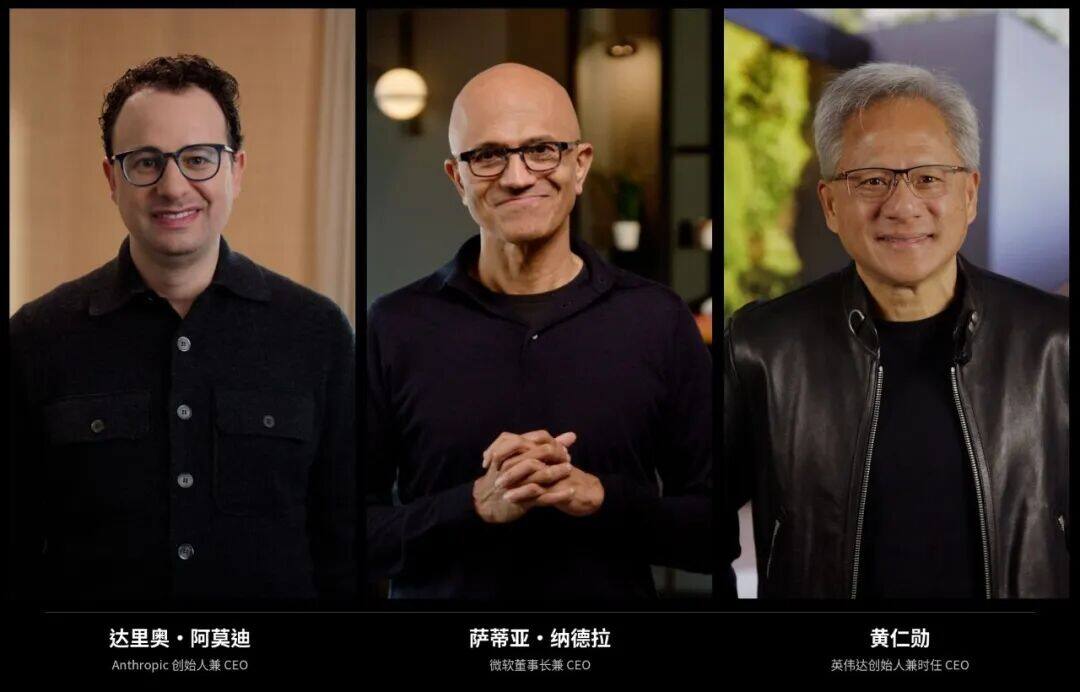
November 2025 three-party collaboration press conference
Where Did the Forty Million Dollars Go?
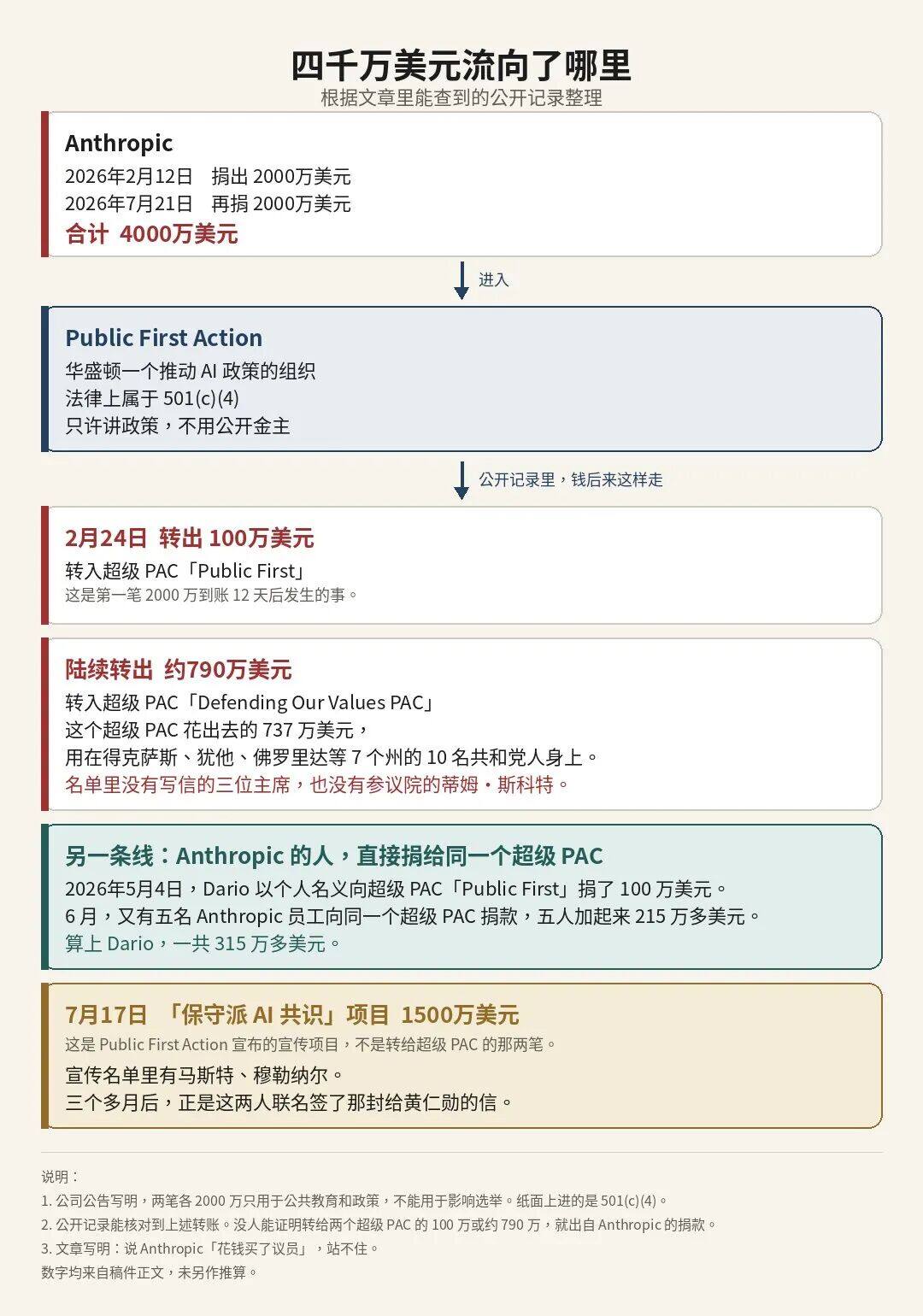
On February 12, 2026, Anthropic announced a $20 million donation to an organization called Public First Action. This is a Washington organization promoting AI policy, co-founded by former Republican Congressman Chris Stewart.
The announcement from Anthropic was quite frank, listing four policy proposals, the third being chips:
Support smart export controls on AI chips to keep the U.S. ahead of authoritarian rivals.
More than five months later, on July 21, another $20 million. This time more direct: we support tightening export controls on advanced chips and semiconductor manufacturing equipment.
How significant is the total of forty million dollars? According to Anthropic’s own lobbying expenses, about two hundred thousand a quarter, forty million would be enough for five years of lobbying in Washington.
On the same day the donation announcement was made, Public First Action launched its first advertisement since its inception, thanking Senator Marsha Blackburn for her work on child online safety and AI legislation in Tennessee. On the same day, a campaign organization associated with it ran another advertisement in Nebraska, supporting Senator Pete Ricketts, with a theme of "keeping advanced AI chips away from our rivals."
The company gave money to a political organization, and that organization immediately started running ads.
Aside from advertisements, where else did this $40 million go?
Let's first look at two concepts.
Public First Action is legally classified as a "501(c)(4)", which can be understood as an organization allowed solely to discuss policy. It can lobby, conduct public advocacy, spend a lot of money, but it cannot make influencing elections its primary purpose; the upside is that it does not have to disclose who provided the money.
An alternative is called a "super PAC," which is an account specifically for election campaigns. Its sole purpose is to influence elections, advertising for candidates, or campaigning against them. It has no spending limits, but the downside is that every deposit must be made public.
One is not allowed to touch elections but is opaque; the other is specifically for elections but fully transparent. Anthropic's forty million entered the first type.
In its July announcement, Anthropic stated: Both donations were solely for public education and policy and cannot be used to influence any federal, state, or local candidates' elections.
However, just twelve days after the first money came in, on February 24, Public First Action transferred $1 million to a super PAC called "Public First." Subsequently, according to reports compiled by the U.S. Federal Election Commission, it also transferred approximately $7.9 million to another super PAC called "Defending Our Values PAC."
No one can prove that the $1 million transferred originated from Anthropic's $20 million. But by November, Public First Action had raised approximately $80 million in total, with Anthropic accounting for half of it. For example, for every dollar it sent towards elections, about fifty cents came from Anthropic.
Next, let's look at Anthropic's personnel.
On May 4, 2026, Dario personally donated $1 million to the super PAC "Public First," filling in the employer field as Anthropic and the occupation field as CEO. In June, five other Anthropic employees donated a total of over $2.15 million to the same super PAC.
Including Dario, this super PAC received over $3.15 million from Anthropic personnel, accounting for more than sixty percent of its total fundraised amount (approximately $4.9 million).
The company claims its money does not touch elections, yet its CEO and employees became the biggest financial backers of the same campaign account.
Anthropic also has a political donation account called AnthroPAC, with money mostly coming from $5,000 checks written by employees, totaling just over $400,000. By November, it donated over $195,000 to candidates from both parties, with the list being almost half Democratic and half Republican. Mast received $2,500, and Crawford $1,000, including Mast and Crawford among the three who wrote to Huang.
On July 17, the Public First Action, which received $40 million from Anthropic, announced a $15 million project called "Conservative AI Consensus." It started with over $7 million for ads, publicly promoting four Republican lawmakers; in the following month, it would also promote twelve other Republican lawmakers, including Mast and Moolenaar on the list.
Three months later, it was indeed Mast and Moolenaar who co-signed that letter to Huang.
The intent of this $15 million project was very clear: "Conservatives built this country's technological advantages and will not hand them over to a few companies that don't listen to anyone."
But it's not over yet; these are not all the details.
Further Upstream
Organizations providing ideas to Washington are called think tanks. Lawmakers write bills and letters, and many of the statements and data come from their reports.
In researching "how the U.S. should manage technology towards Country C," three think tanks are very important.
One is the Center for Security and Emerging Technologies (CSET) at Georgetown University. When it was established in 2019, Georgetown's press release was titled "The largest AI and policy center in the U.S. settles at Georgetown," and it received funding from a charitable fund called Open Philanthropy, starting with $55 million, followed by two more adds, totaling $102 million. This center has fifty-one people, averaging about two million dollars per person.
Another is RAND Corporation, one of the oldest think tanks in the U.S., which conducts research for the Pentagon. From 2020 to 2026, it received seventeen payments from the same fund, totaling $86.956 million.
The third is the Institute for Progress (IFP) in Washington, which received three payments totaling $21.457 million.
All the money from the three comes from the same pocket.
This pocket was renamed on November 18, 2025, and is now called Coefficient Giving. Its founders are a couple's foundation: Dustin Moskovitz and his wife Cari Tuna. Moskovitz is one of the co-founders of Facebook and one of Anthropic's earliest investors. According to Forbes, quoting Cari Tuna in February 2026, the couple transferred their Anthropic shares to a non-profit organization in early 2025, those shares were worth about $500 million at that time.
The letter to Huang was exactly the product of this research pipeline that had been produced over the years. And at the source of this pipeline stands an investor of Anthropic.
Who Benefits
What has been listed above is merely the surface; none of these operations can definitively indicate that Huang's stepping down was orchestrated by Anthropic. But how the minds behind every operation think remains unknown to everyone.
Anthropic has the currently recognized best model, and it is also the most severely restricted among all top AI frontier laboratories in Silicon Valley concerning Country C. On any social media searching for Claude, there will be strategies on how to use the Claude model domestically, but the final result of every strategy will basically be banned. Anthropic has even recently updated its ban policy, specifically targeting China.
Of course, there are counterarguments.
Some believe that if Anthropic truly wanted to bring Huang down, it would have been more cost-effective to take action after its own IPO. Huang’s departure has cast a shadow over the entire AI industry, threatening Anthropic's own valuation.
This is also the most abstract aspect.
In the three-party collaboration, Nvidia promised to invest up to $10 billion in Anthropic. According to Fortune, Nvidia also plans to purchase about $10 billion worth of stocks when Anthropic goes public.
They do not believe that the estimated $14 trillion Anthropic would cause trouble for its major shareholder before its IPO.
No one knows the truth.
免责声明:本文章仅代表作者个人观点,不代表本平台的立场和观点。本文章仅供信息分享,不构成对任何人的任何投资建议。用户与作者之间的任何争议,与本平台无关。如网页中刊载的文章或图片涉及侵权,请提供相关的权利证明和身份证明发送邮件到support@aicoin.com,本平台相关工作人员将会进行核查。


