Aave Labs' 180-day report card: a team of 97 people, nearly 20 million dollars in operating expenses, and approximately 44.58 million dollars in revenue from the Aave protocol during the same period.
Written & compiled by: KarenZ, Foresight News
In the DeFi world, there are only a few protocols managing hundreds of billions of dollars in assets, yet the development institutions willing to disclose team size, operating expenses, and work results are equally few.
Aave Labs recently delivered such a report card.
On November 13, Aave Labs released a 180-day work report covering the second and third quarters of 2026. The development team behind this DeFi leader had 97 members by the end of the third quarter, invested approximately 100,000 hours in the past six months, completed 6,096 tracked items, launched 28 products, features, or protocol deployments, with operating expenses nearing 20 million dollars.
On the other hand, the Aave protocol generated approximately 44.58 million dollars in revenue, while total deposits grew by about 40% in the third quarter, but protocol revenue decreased by nearly 37% during the same period.
On one hand, there is an expanding business landscape, and on the other, a team size of nearly 100 people with operating expenses of nearly 20 million dollars over six months. Aave is not only upgrading its lending protocol but also developing a mobile app, expanding institutional credit, supporting tokenized stock collateral, and even starting to provide interfaces for AI agents.
As the DeFi leader is no longer satisfied with merely being a lending protocol but is trying to become an infrastructure provider that covers more financial scenarios, how big can its business grow, and what costs will it need to bear for this?
97 people, spending nearly 20 million dollars in six months
Let's first look at Aave Labs' personnel and spending.
As of the end of the third quarter, Aave Labs had 97 team members. In the past six months, 23 people joined the team and 23 left, with personnel changes including both voluntary resignations and cancellations of some positions after team restructuring.
This team collectively invested approximately 100,000 hours over 180 days, completed 6,096 tracked items, 36 projects of different scales, launched 28 products, features, or protocol deployments, and led the drafting of 26 on-chain governance proposals and 20 Snapshot voting proposals.
Now let's look at the expenses. Aave Labs' spending in the second and third quarters totaled approximately 19.4776 million dollars, with engineering development and product accounting for about 63.2% of that.
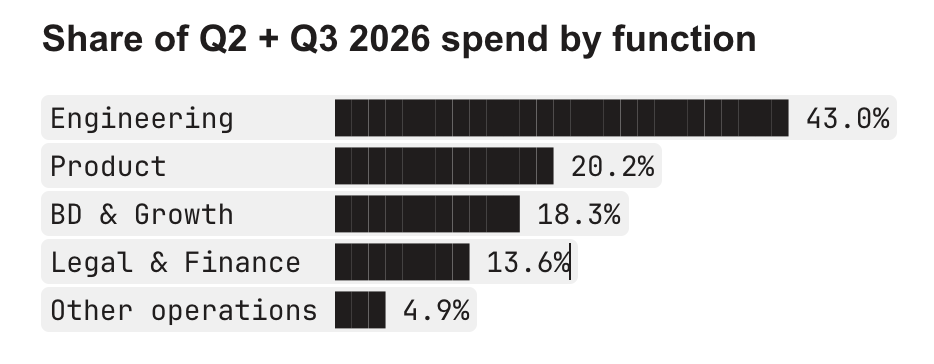
If averaged simply, it amounts to about 3.25 million dollars spent each month, over 100,000 dollars daily. However, this is just an average based on the disclosed period and does not represent daily spending that occurs identically.
It is noteworthy that the disclosed expenses do not include token compensation. Therefore, the 19.48 million dollars cannot be directly understood as Aave Labs' total operating costs.
Why does a DeFi company need such significant investment?
In the second quarter of 2026, Aave Labs took over approximately 40 technical and support functions previously handled by BGD Labs and the Aave Chan Initiative (ACI), including contract maintenance, security response, developer tools, and governance proposal execution code writing.
This change means that Aave Labs is not only developing new products but also taking on more responsibilities for underlying protocol maintenance and ecosystem coordination.
However, a more significant change comes from the funding model. In April this year, Aave DAO approved the Aave Will Win Framework. According to this framework, the gross income of relevant Aave branded products, after deducting agreed external cooperation shares, rebates, subsidies, and direct user incentives, will flow to the DAO treasury; development and daily operational costs do not fall under allowable deductions.
According to the previously announced plan, the funding Aave Labs applied for includes a 25 million dollar primary grant, a 17.5 million dollar growth grant linked to products and milestones, and 75,000 AAVE tokens vesting over four years. Among them, the primary grant uses a combination of initial and installment payments, and the growth grant requires corresponding product and governance conditions, not all provided in a lump sum.
This also changed Aave Labs' relationship with the DAO: previously, Aave Labs mainly relied on its own funds to support product-level construction and expansion. Now, the DAO funds the development work and obtains income from branded products within an agreed scope.
Deposits increase by 40%, but revenue drops by 37%?
This is the most worthy set of numbers to study closely in the entire report.
As of October 1, the total deposits of various versions of the Aave protocol grew from 24.11 billion dollars in early July to 33.8 billion dollars, an increase of 9.69 billion dollars in the third quarter, approximately 40% growth.
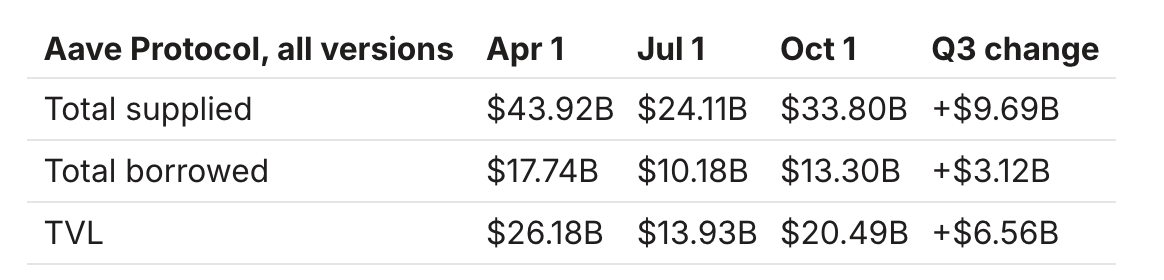
During the same period, the borrowing scale increased from 10.18 billion dollars to 13.3 billion dollars, growing by about 31%.
However, the growth of the third quarter needs to be viewed in a broader time frame.
On April 1, the total deposits of the Aave protocol were still at 43.92 billion dollars, which dropped to 24.11 billion dollars by July 1. Aave Labs stated in the report that the decline in the second quarter was mainly affected by the rsETH cross-chain bridge security incident and the overall contraction in the DeFi market.
On April 18, the rsETH cross-chain bridge was attacked, and the attacker exploited a vulnerability to obtain 116,500 rsETH without corresponding cross-chain destruction records on Ethereum and deposited 89,567 of them as collateral in eight positions within Aave V3, borrowing 82,650 WETH and 821 wstETH.
This incident did not breach the Aave protocol's smart contracts themselves, but the attacker leveraged the extraordinarily obtained collateralized assets to borrow a considerable amount of funds from Aave, putting the protocol at risk exposure.
Afterwards, Aave Labs coordinated cross-protocol recovery actions with other service providers. Through governance proposal execution, the liquidation of positions held by the attacker, and the replenishment of relevant assets, the asset support for rsETH was restored on May 26, and the affected Aave market resumed normal operations.
This incident not only impacted the protocol's deposit scale but also forced Aave Labs to delay the release of some products until the third quarter.
Therefore, while the 40% deposit growth in the third quarter is significant, it more reflects a phase of recovery after a substantial contraction. As of early October, the total deposit scale of Aave had not returned to the level of early in the second quarter.
However, revenue performance showed another contrast.
According to Aave Labs' on-chain statistical criteria, the Aave protocol's revenue in the second quarter was approximately 27.288 million dollars, while in the third quarter, it was about 17.2925 million dollars, reflecting a decrease of approximately 36.6% quarter-over-quarter.
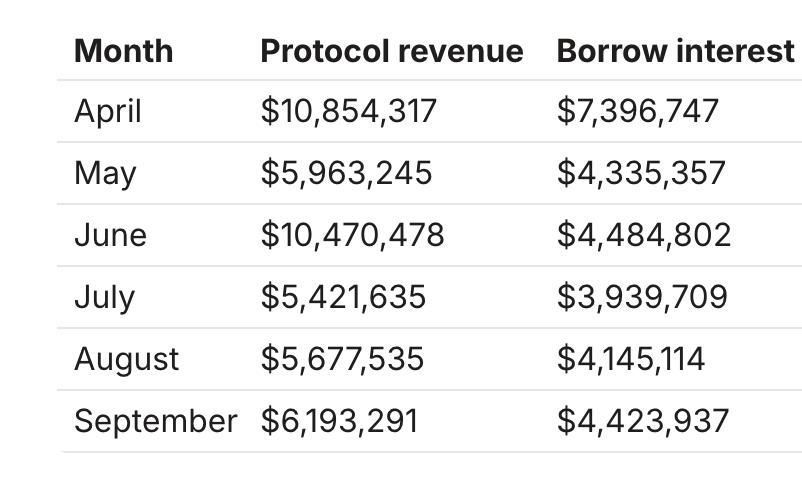
Why did the deposit scale increase while revenue actually decreased? First, the deposit scale and protocol revenue are not necessarily proportional. For lending protocols, more deposits mean a larger potential borrowing pool, but that does not guarantee that the funds will be borrowed, nor does it mean that borrowing rates will stay the same.
More importantly, Aave's protocol revenue also does not solely come from borrowing interest.
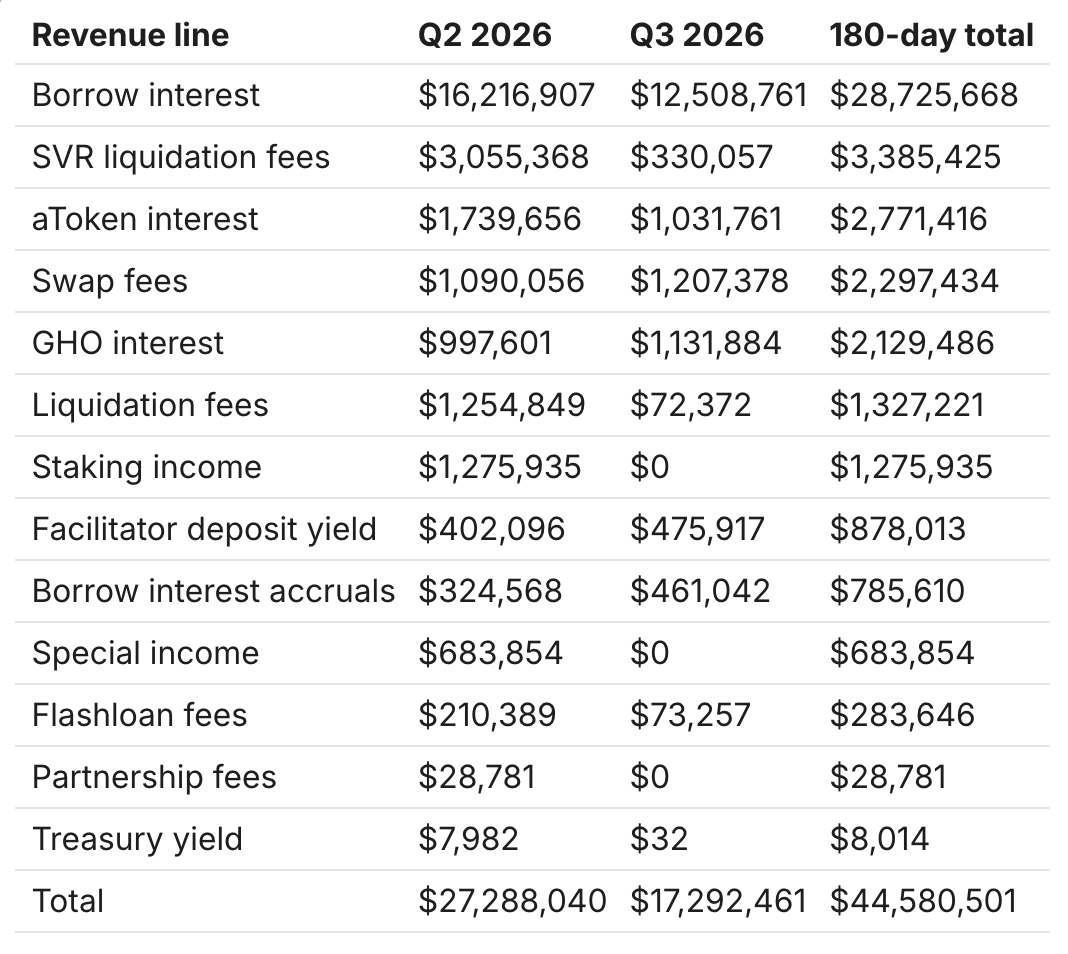
Data shows that within the two quarters of the statistical period, 44.58 million dollars in protocol revenue included approximately 28.73 million dollars from "borrowing interest," accounting for about 64.4%. Other revenue includes liquidation fees, exchange transaction fees, GHO interest, etc.
In the second quarter, there was a special factor: high liquidation-related revenue. Just in June, Aave's Chainlink SVR liquidation-related fees reached approximately 2.7785 million dollars, and ordinary liquidation fees amounted to approximately 1.1871 million dollars. These revenues drove the total protocol revenue to rebound that month.
In the third quarter, SVR liquidation-related fees dropped from about 3.0554 million dollars in the second quarter to 330,100 dollars, and ordinary liquidation fees fell from about 1.2548 million dollars to 72,400 dollars.
Meanwhile, borrowing interest income decreased from about 16.2169 million dollars to 12.5088 million dollars.
Conversely, the third quarter still showed positive changes.
GHO interest income grew by about 13% quarter-over-quarter; exchange transaction fees increased by about 11%, and compared to the third quarter of 2025, they grew by 229%; stablecoin borrowing scale increased by about 11%, outpacing the growth of stablecoin deposits, with utilization rising from about 75% to 79%.
Aave V4 does not want to be just a cryptocurrency lending market
If the financial data reflects Aave's current business condition, then the expansion of V4 showcases its market judgment for the future.
At the end of March this year, Aave V4 officially launched. By October 1, its deposit scale had reached 1.34 billion dollars, with active borrowing exceeding 400 million dollars.
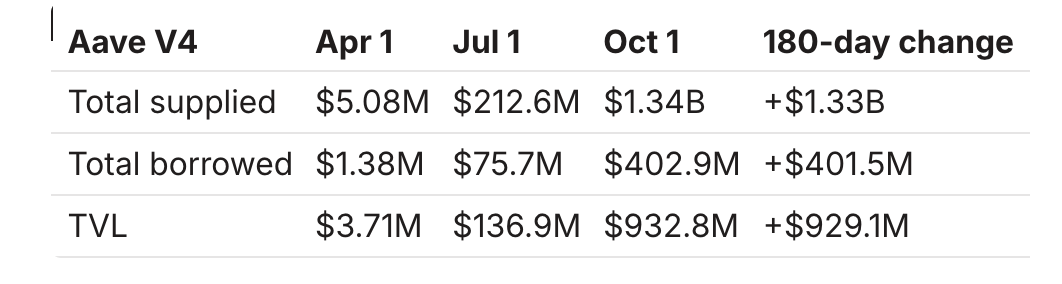
Although relative to the entire Aave's 33.8 billion dollars in total deposits, V4 still accounts for a small proportion, its growth rate is considerably remarkable.
What is truly worth noting is another obvious trend: Aave is attempting to integrate more financial assets into the on-chain collateral lending system.
On September 25, Aave V4 launched Equities Hub on Base, supporting seven types of Coinbase Tokenized Stocks-related assets, including stocks of Apple, Amazon, Google's parent company Alphabet, Meta, Microsoft, Nvidia, and Tesla.
These products provide eligible users with a channel to obtain liquidity using tokenized stocks as collateral, allowing them to borrow funds without directly selling the relevant tokens.
Aave is also developing another path closer to traditional finance. The Custodied Collateral Lending proposal, announced on September 15, aims to allow institutions to use assets held with Anchorage as collateral to borrow stablecoins, syncing relevant balance information to the blockchain via Chainlink CustodySync.
This means that some collateralized assets may not need to be transferred to traditional DeFi smart contracts first to participate in specific on-chain lending arrangements.
However, there are still significant technical and risk boundaries. How custodial assets are verified, how liquidations are executed, and who bears responsibility in the event of defaults are all more complex than ordinary on-chain collateral loans.
Another change in Aave V4 is opening independent instances to external operators.
For example, EtherFi migrated the credit backend of EtherFi Cash to a dedicated Aave V4 instance on Optimism in August, providing relevant lending capabilities to over 100,000 cardholders. This instance is managed independently by EtherFi and shares some revenue with Aave DAO.
Entering the fourth quarter, this model continues. Sentora launched an independently managed V4 instance in October, and according to the disclosed arrangement, Aave DAO can receive 50% of the protocol revenue from that instance.
This model is similar to providing financial infrastructure: Aave offers the technology and protocol framework, while partners are responsible for operating specific markets, asset allocation, and risk parameters.
However, it is essential to emphasize that externally managed instances are not equivalent to markets directly managed by Aave DAO, and their risk responsibilities and governance rights differ.
If this direction can continue to expand, Aave's revenue sources could shift from directly operating lending markets to income sharing generated by third parties using its protocol infrastructure.
This is a noteworthy business change in V4.
Aave's next batch of users may not understand DeFi at all
In the past, using Aave typically meant following a standard DeFi process: preparing a crypto wallet, cross-chain operations, connecting to applications, understanding collateralization ratios and liquidation risks, and then deciding how to deposit or borrow.
This process is not complex for users familiar with Crypto, but still presents a barrier for ordinary financial consumers.
Aave Labs clearly hopes to change this.
On August 26, Aave App opened up to the first batch of iOS users through Ghost Passes. According to the half-year report, the app has already supported deposits of stablecoins from five networks: Arbitrum, Ethereum, Base, HyperEVM, and BNB Chain, with eligible U.S. users also able to use fiat deposit functions through licensed third-party service providers.
As of the time of the report, the combined user balances in Aave App have exceeded 45 million dollars.
Compared to the total deposit scale of the entire Aave protocol, this number is still relatively small, but its significance lies in the change in business entry.
Aave no longer only hopes that users will proactively find the DeFi protocol but is attempting to package on-chain yield services into more easily understood mobile financial products.
Meanwhile, Aave Labs has also launched Stable Vaults, allowing other businesses to embed stablecoin on-chain yield functionalities into their products.
These two business lines target different customers: Aave App directly targets end-users, while Stable Vaults are aimed at enterprises wishing to provide similar functionalities.
Another notable new direction is AI.
In September this year, Aave Labs released the official MCP Server, enabling AI assistants to read Aave protocol data, view or manage position-related information, and prepare trades for users.
But this does not mean AI can autonomously control users' funds.
According to the official design, the MCP Server does not hold user funds, and generates unsigned transactions, which still require users to authorize using their own wallets. This distinction is crucial.
In the future, users may not need to open DeFi pages one by one to compare interest rates but could have AI help query yields, borrowing costs, and risk parameters across different markets, leaving the final trading decision to the user.
However, for now, this mainly represents a change in technical entry. The report did not disclose how many active users, transaction volumes, or revenues the MCP Server actually brought, so it cannot be directly regarded as a newly validated growth engine.
From Aave App to Stable Vaults, and then to MCP Server, these three products correspond to three different usage methods: users operating themselves, enterprises providing product interfaces for users, and AI assisting users in preparing actions.
But they all point in one direction: reducing the necessary Crypto expertise required when using Aave's underlying financial services.
The next examination question for the DeFi leader
Aave's report reveals an increasingly apparent change in the DeFi industry.
Early DeFi projects mainly competed on who could design more effective smart contracts, provide higher liquidity, and offer more competitive interest rates.
Today, as basic lending functions gradually mature, competition is extending to institutional customers, compliance access, distribution channels, and operational efficiency. Aave Labs is investing in these directions simultaneously.
However, it also faces three unanswered examination questions.
The first is quality of growth. Second is whether new businesses can genuinely produce sustainable income. The third question is the balance between governance and execution. Centralizing responsibilities may reduce cross-team coordination costs but also heighten dependency on key service providers within the DAO.
Competition among DeFi leaders is evolving from who can attract more capital to who can implement these funds into more financial scenarios and generate sustainable income from it.
免责声明:本文章仅代表作者个人观点,不代表本平台的立场和观点。本文章仅供信息分享,不构成对任何人的任何投资建议。用户与作者之间的任何争议,与本平台无关。如网页中刊载的文章或图片涉及侵权,请提供相关的权利证明和身份证明发送邮件到support@aicoin.com,本平台相关工作人员将会进行核查。


