

Every Monday, Wednesday, and Friday, focusing on the crypto market, Japan, South Korea, A-shares, and Hong Kong stocks, using data to review the market and using trends to seize opportunities, produced by PANews.
BTC Falls Below Half of Holder Cost Line, Defends $62,000 Lifeline, Nvidia and Anthropic Become Risk Preference Litmus Test
After experiencing consecutive weeks of decline, the market is shifting from mere price adjustments to reevaluating whether the bear market has reopened. On November 15, BTC dipped to about $61,000, marking a four-month low, and then rebounded to around $66,000, but buying pressure remains insufficient.
The funding situation is facing severe tests: in the past 10 trading days, U.S. Bitcoin spot ETFs recorded a net outflow of $2.6 billion, with a single-day net outflow of $240 million recorded just yesterday; the supply of stablecoins has sharply fallen by 4.2% in the past 90 days, and the lack of incremental dollars entering has left buying pressure weak. Meanwhile, mining company MARA has been crazy cashing out to enter the AI and supercomputing center construction, selling 1,713.9 BTC (approximately $121 million) in the past 8 days, accumulating over $3 billion in cash-out this year, which has thoroughly suppressed the secondary market's reception capacity.
Currently, the $62,000 to $66,000 range is the most concentrated support area among various analyses. Glassnode points out that this is a short-term holder cost concentration zone near the August low, accounting for about one-fifth of their holdings, with approximately 66,000 BTC added to the buy side during the most intense two-day sell-off. CryptoQuant data shows, long-term holders sold heavily between $62,000 and $65,000, allowing new buyers to take over. Darkfost found that excluding coins held for over 10 years, only 46% of the circulating supply is profitable, and when the price drops to $62,000, it is only 37.8%. Murphy pointed out that the price is above the average cost line of this part of the chips, where it stopped falling in February and June this year. Rekt Capital reminds, if the weekly close falls below approximately $63,300, it may replay the decline to $59,400 seen in June. The support levels below are:
- $58,500: June low.
- $57,800: 300-week moving average.
- $53,700: Realized price.
- Around $50,000: The drop zone anticipated by STASolutions and Wintermute.
According to CoinDesk, a 12% weekly drop, falling below the 200-week moving average has historically occurred only three times, all seeing a rise three months later, but each time first dropped another 10% to 17%, corresponding to about $54,000 to $59,000.
Resistance for rebounds is heavily layered above, with Rekt Capital and Martini Guy emphasizing that $65,700 is a battleground for short-term bulls and bears, and if the weekly line cannot hold, bearish re-tests will again dominate the trend, with stronger resistance above at the 200-week moving average (around $68,188) and the breakeven point of short-term holders at $74,100. Wintermute trading team admits that as long as Bitcoin fails to reclaim the 200-week moving average on a daily scale along with ETF funds returning, any rebound is more likely to be a short squeeze rather than a trend reversal, and prices may still remain under pressure towards the $50,000 range.
The implied volatility curve for Deribit options is steadily steepening into the longer term, with traders accumulating a massive amount of protective put options around $60,000, even pricing an up to one-third probability of falling below $53,700 by 2027. Rounder states that Bitcoin's historical "true bottom" rarely gives retail investors a second chance for a long stay above, and when prices consolidate around the $60,000 mark, reliance on put options to hedge black swan risks is necessary.
The core market trend indicator is anchored on external liquidity and the revaluation of tech stocks. With a valuation of up to $1.5 trillion, Anthropic plans to debut on NASDAQ on Thursday, its financing scale of over $60 billion is forming a huge "liquidity withdrawal effect" on global hedge funds. Additionally, Nvidia's performance after releasing earnings, Jensen Huang facing congressional inquiries, and the Federal Reserve's decision on December 9 will all directly determine whether Bitcoin completes a time bottom at $62,000 or opens a new round of downside.
ETH Rebound Not Confirmed as Reversal, Altcoin Leverage Not Cleared
Ethereum is weaker than Bitcoin, trading above $1,800. Analyst Void points out that ETH has lost its previous support structure, and the probability of falling back to $1,500 is greater than recovering directly to high positions. Even if it recovers to $2,000, it does not count as a reversal; it must stabilize above $2,100 to $2,200.
ETF funds are also flowing out, with Ethereum spot ETF experiencing a net outflow of $29.09 million yesterday, with three consecutive days of net outflows. Altcoins have been washed to extremes; Glassnode data shows that only 6% of the top 100 altcoins are above the 50-day moving average, and the proportion above the 200-day moving average has dropped from over one-third to 21% in a week. 2023's deepest washouts have all occurred within four days of Bitcoin's local lows, and Bitcoin has been higher 60 days later. However, Wintermute warns that the open interest for altcoins is nearly double that of Bitcoin, and leverage has not yet cleared, indicating that altcoins are unlikely to bottom out before Bitcoin.
Key Points for Today:
Upbit ICX Trading Pair (Already Delisted) Withdrawal Deadline
Predict.fun Launches PREDICT Token TGE (Postponed, Date TBD)
Upbit 24-hour Trading Volume Ranking: BREV, XRP, BTC, MMT, ETH
Bitcoin Spot ETF Total Net Outflow Yesterday was $240 Million
Ethereum Spot ETF Total Net Outflow Yesterday was $29.09 Million
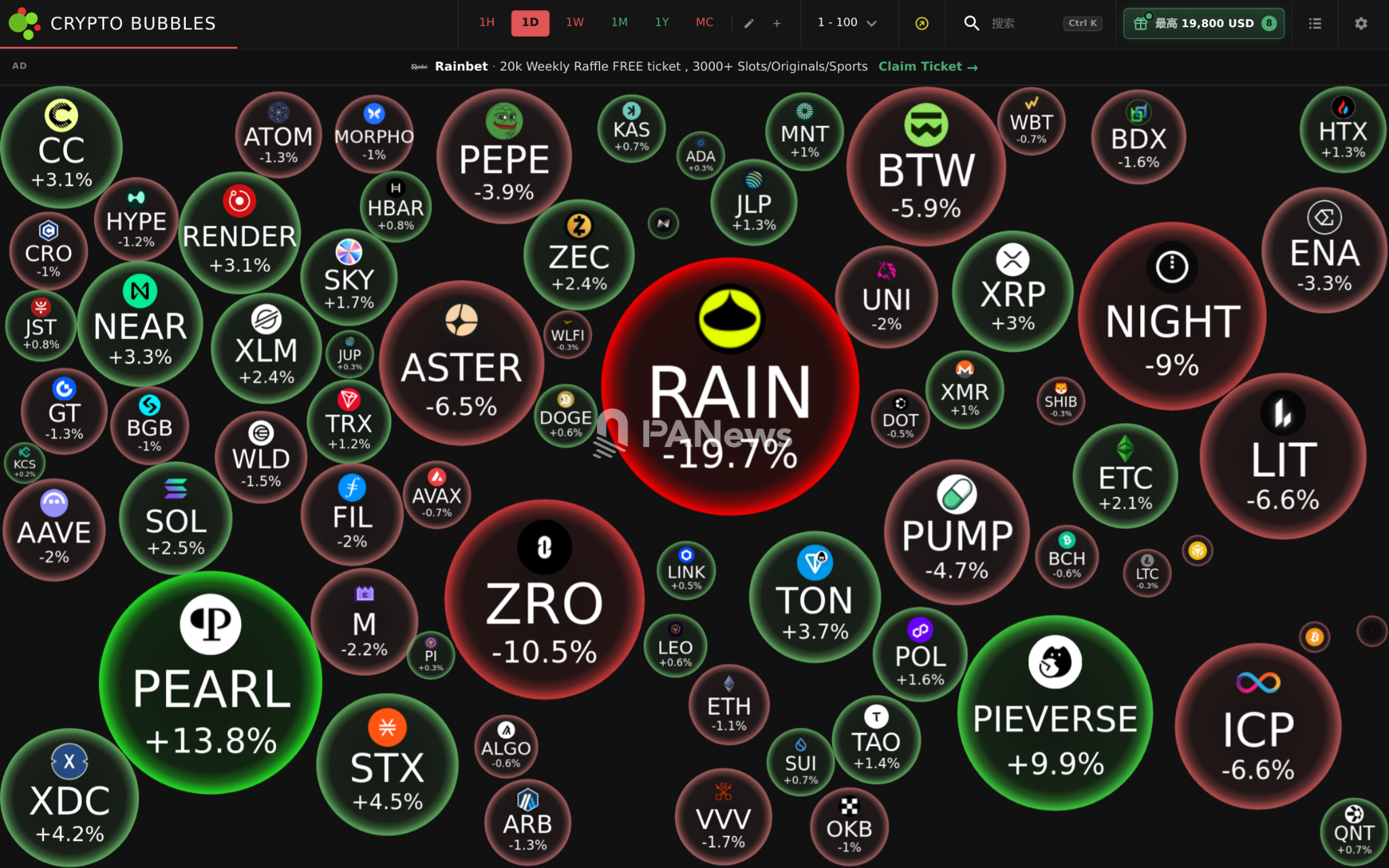
Today's Top Gainers in the Market of the Top 100 Currencies: PEARL up 13.8%, PIEVERSE up 9.9%, STX up 4.5%, XDC up 4.2%, TON up 3.7%.
Japanese and Korean Chip Stocks Surge Ahead of Nvidia Earnings, A-shares Shrink to Yearly Low
The semiconductor industry chain in the Korean and Japanese stock markets strengthened first, while A-shares saw a rebound after probing the bottom in the afternoon, but overall trading volume continued to decline; the Hong Kong market was relatively weak due to the adjustment of technology stocks.
The Korean Composite Index (KOSPI) closed up 1.99%, regaining losses incurred on Tuesday when global risk was repriced, dropping to a near nine-month low. Nvidia's one-quarter revenue of over $100 billion shattered the myth that AI hardware demand has peaked, causing global capital to flow back into the storage and manufacturing industry chain. Major heavyweight SK Hynix soared 4.19%, Samsung Electronics rose 2.31%, and SK Square climbed 4.42%; Samsung Electro-Mechanics skyrocketed 7.43% due to its announcement of deep collaboration with Nvidia, extending cooperation to MLCC and advanced substrates, while the robot concept Rainbow Robotics recorded a 20.06% limit rise. However, biotechnology stocks lacking computational power catalysts became cash cows, with Samsung Biologics and Celltrion dropping 3.39% and 2.58%, respectively.
The Japanese stock market encountered an awkward pattern of index fragmentation, with the Nikkei 225 index slightly increasing by 0.28%, while the Topix index fell by 0.42%. The rebound in U.S. Treasury yields, raising expectations for interest rate hikes, alongside weak domestic consumption, significantly hedged against the buying momentum brought by the chip chain in U.S. stocks. Semiconductor equipment stocks soared against the trend, with International Electric up 5.86%, Lasertec up 4.96%, Advantest and SoftBank Group rising 4.56% and 3.11%, respectively; however, finance and domestic demand giants faced collective sell-offs, with Mitsubishi UFJ Financial down 1.10%, Fast Retailing down 1.61%, and Rakuten Bank plummeting 15.16% due to sudden negative news, dragging down Rakuten Group by 5.67%, severely hampering the market's rebound pace.
The Hong Kong market traded weakly throughout the day, with the Hang Seng Index closing down 0.91% and the Hang Seng Technology Index down 0.58%. On the market, funds significantly fled from the consumer, medical, and cyclical sectors, turning to hard-core AI tech targets. Individual stock movements were extremely divergent, with JD Health plunging 15.43% due to earnings expectations, JD Group down about 7%, Zijin Mining International down about 6%, and Bilibili, Alibaba Health, etc., all falling; however, the AI unicorn Zhipu surged about 10% against the trend, MINIMAX rose about 4%, and Huahong Semiconductor was up about 4%, with JPMorgan maintaining a “buy” rating on Zhipu in a research report and giving a target price of HKD 1,200 to support its commercialization process.
After-hours, it was strongly reported that Tencent Holdings' net profit for the third quarter was 63.61 billion yuan (exceeding year-on-year expectations), but capital expenditures soared 527% to a record 81.433 billion yuan, far exceeding the market estimate of 55.4 billion yuan, directly leading to a free cash flow of -69.1 billion yuan for the quarter. The earnings report specifically explains that the huge cash consumption mainly comes from supporting the upgrades of the Hy series large models, enterprise reasoning, and the pre-purchase of computational power for WorkBuddy with over ten million daily active users. Excluding this prepayment, free cash flow would actually be positively valued at 16.9 billion yuan. This extreme capital expenditure fully validates the arms race of giants in AI infrastructure and sows critical foreshadowing for the next day's technology stock performance.
The A-share market saw a narrow-range tug-of-war with reduced volume, with the Shanghai Composite Index slightly up 0.09%, the Shenzhen Component Index up 0.20%, and the ChiNext Index rising 0.85% after dropping over 1%, while the Sci-Tech 50 Index surged 2.19%. However, the overall market liquidity has frozen, with total turnover in the two markets only 1.37 trillion yuan, refreshing the yearly low, and over 4,100 stocks fell. On the market, pure computational power themes “dance alone,” with Xiechuang Data soaring 18.02%, while ShenNan Circuit, Huadian Shares, Qingyun Technology, and other stocks hitting the limit; however, the AI comic concept and resource stocks collapsed collectively, with Wentou Holdings hitting the limit down for two consecutive days, China Rare Earth hitting the limit down, and Zhongjin Gold falling sharply by 7.32%.
免责声明:本文章仅代表作者个人观点,不代表本平台的立场和观点。本文章仅供信息分享,不构成对任何人的任何投资建议。用户与作者之间的任何争议,与本平台无关。如网页中刊载的文章或图片涉及侵权,请提供相关的权利证明和身份证明发送邮件到support@aicoin.com,本平台相关工作人员将会进行核查。


