
Author: Jae, PANews
The global capital market stands at a crossroads filled with a sense of division. In 2026, investors oscillate between the frenzy of "fear of missing out" (FOMO) and the panic of "bubble burst." The aftershocks of geopolitical tensions have not dissipated, the shadow of inflation has never truly left, and the capital wave stirred by artificial intelligence (AI) continues to swell, intertwining three threads to depict a complex macro picture.
As the end of 2026 approaches, Wall Street's forecasts for 2027 are being released one after another. Morgan Stanley sets a tone of "embracing risk" for next year; Goldman Sachs describes it as "growing pains"; while JPMorgan assesses that the market "will continue to rise, but the road will be bumpier."
After reviewing the latest annual outlooks from top institutions, PANews discovers a consensus that emerges clearly: AI remains the irreplaceable main theme for next year, but it can no longer drive valuations simply by telling a story; the global economy still holds resilience, but the looming sword of inflation has not retracted its sharpness. More importantly, the Beta era, where one could make money simply by blindly betting on sectors and buying indices, is turning a page.
Moneymaking in 2027 will be harder and will test true skills.
Wall Street is bullish on U.S. stocks for 2027, but earnings growth may face a "great halving"
Among various institutions' predictions, the U.S. stock market in 2027 is worth watching.
Morgan Stanley has upgraded its asset allocation rating for global stocks to the highest level of overweight, giving a target price for the S&P 500 index of 8,700 points by the end of 2027, indicating an upside potential of over 15% from the level at the time of the report's release.
This judgment is supported by solid earnings growth. After several months of market corrections, the valuation bubble of risk assets has been partially digested, and corporate earnings recovery is still ongoing. According to Morgan Stanley's calculations, the earnings per share (EPS) of S&P 500 constituents will rise from $369 in 2026 to $420 in 2027. Morgan Stanley believes that the increase in corporate profits alone is sufficient to drive stock prices higher.
Goldman Sachs' global equity strategy team is similarly optimistic. Based on November 12, 2026, the total return of the S&P 500 over the next 12 months is about 16%, the total return of the European STOXX 600 index in U.S. dollars is about 13%, the Japanese TOPIX index is around 24%, and the MSCI Emerging Markets index is approximately 21%.
Interestingly, although Goldman Sachs is optimistic about the stock market, it simultaneously believes that global corporate earnings growth will significantly decline.
Goldman Sachs uses the term "great halving" to describe the potential change in earnings growth next year. The EPS growth of the S&P 500 will plunge from 36% in 2026 to 11%, Europe from 18% to 7%, and Japan from 24% to 9%; even in the explosively growing Asian markets of 2026, growth will fall from nearly 80% to below 30%.
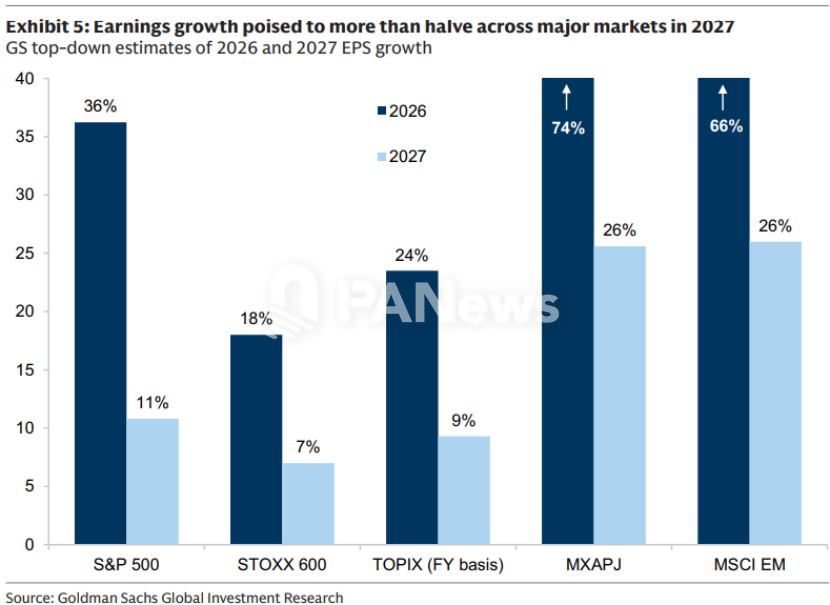
An unconventional conclusion emerges: even if corporate earnings growth is halved, the stock market may continue to rise, and the answer lies in valuations.
Goldman Sachs points out that after adjustments in technology stocks, the global tech sector's valuations have significantly declined relative to historical levels, with its price-to-earnings ratio returning to the 20th percentile over the past 20 years. Simply put, the current valuation of global tech stocks is lower than 80% of the time periods, nearing the level of value stocks.
This means that the market in 2027 does not need explosive earnings growth to support it. As long as the economy does not fall into recession, corporate profits maintain positive growth, and the marginal easing of interest rates and energy costs is added, stock prices will have sufficient support.
JPMorgan provides a long-term perspective in its 2027 long-term capital market assumptions, estimating that the annualized returns of U.S. large-cap stocks over the next 10-15 years will be around 7.5%, an increase of 0.8 percentage points from the previous year's forecast; the traditional 60/40 stock-bond portfolio expects an annualized return of 7%.
The underlying implication is that the current valuation level can still sustain positive returns, but every penny of future earnings will need to be traded for earnings realization.
AI "shovel sellers" peak, Chinese assets enter revaluation window
In the past year, the main logic of the AI trend has been "who dares to spend more money." From GPU chips to data centers, every time capital expenditure exceeds expectations, it triggers a round of stock price increases.
This AI cash-burning race is far from over. Goldman Sachs predicts that the global nominal AI investment scale will reach $1.8 trillion in 2027, stepping up from $1.1 trillion in 2026. According to this estimate, AI investment will contribute about 0.4 percentage points to global economic growth in 2027, with a contribution of approximately 0.6 percentage points to the U.S. economy.
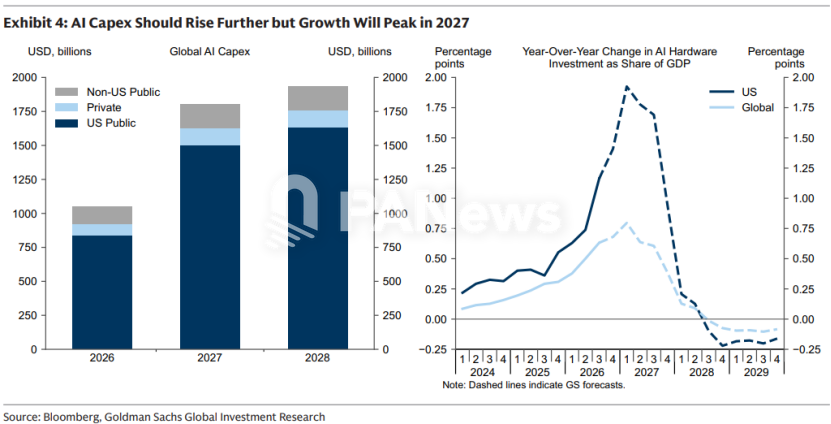
JPMorgan's assessment in its 2027 long-term capital market assumptions is even more aggressive. In the next 10-15 years, total global capital expenditure related to AI will reach $15 trillion. Investment boundaries will extend from chips and servers to electric grids, energy storage, industrial software, and supportive infrastructure, engulfing the entire industrial chain in this capital torrent.
However, beneath the feast, a turning point has already emerged. The capital expenditure growth of hyperscale cloud providers has significantly slowed, while the depreciation pressure from earlier huge investments is gradually appearing on the profit and loss statements. According to Goldman Sachs' calculations, the capital expenditure of cloud giants contributed 12 percentage points to the EPS growth of the S&P 500 in 2026, which will fall to 9 percentage points in 2027, and could even turn into a negative drag of -5 percentage points by 2028.
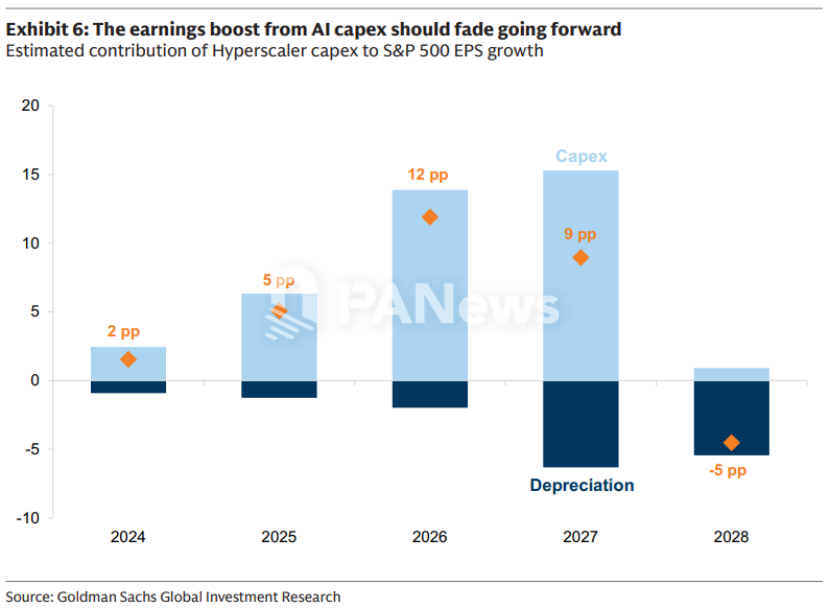
This means that the AI "shovel sellers," such as chip design, semiconductor manufacturing, and industrial equipment manufacturers, who made a windfall in the past two years, will face a severe test as growth peaks.
In the landscape of the AI industry chain, Chinese assets are also undergoing profound structural changes.
Goldman Sachs describes the AI trend in the Chinese market as "a different game," and has upgraded Hong Kong stocks to "overweight." Its logic lies in the fact that while AI capital expenditure in developed markets faces peak risks, the Chinese market, having undergone significant valuation discounts, possesses higher earnings growth elasticity and better risk-reward ratios.
Unlike Goldman Sachs, Morgan Stanley prefers A-shares during the same period. Elton Cheung, Head of Greater China Equities at Invesco, further points out that valuations of Chinese stocks, based on forward earnings, are still below historical averages.
Surging computing power meets energy wall, grid gaps create new shovel-selling opportunities
Beneath the glossy narrative of AI, energy and physical infrastructure will constitute the hardest bottom line of the macro economy in 2027. The surging computational power of the virtual world will ultimately crash against the energy wall of the physical world.
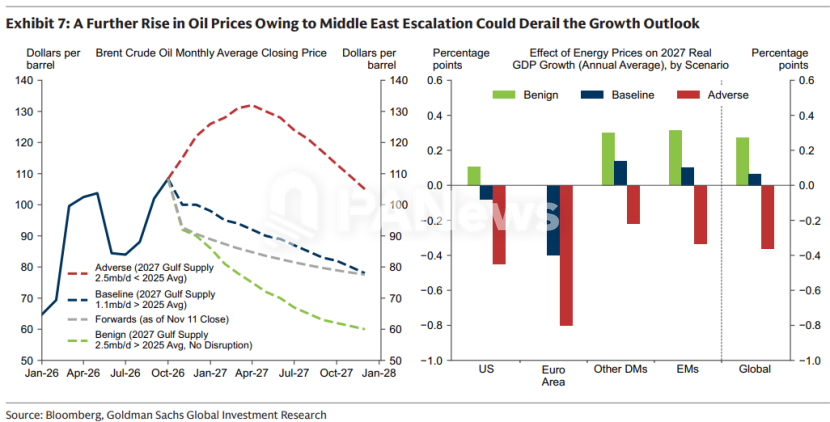
Goldman Sachs and Morgan Stanley have both devoted a lot of ink to the energy's transmission effects on the economy. Goldman Sachs posits that under base case conditions, Brent crude oil prices will fall to $78 per barrel by the end of 2027. This retreat will provide a strong macro tailwind, allowing the industrial manufacturing and consumer discretionary sectors, which faced pressure from energy costs in 2026, to experience margin recovery.
However, Goldman Sachs and PGIM have simultaneously raised alarms. The geopolitical game in the Middle East, especially the escalating situation in Iran, will be the biggest tail risk in 2027. Goldman Sachs' pessimistic oil price forecast is $132 per barrel. If oil prices surge due to conflicts causing supply disruptions, this risk will not only erode the real purchasing power of global consumers but will also quickly reverse central banks' fight against inflation, forcing interest rates to remain elevated for longer.
More profound than the impact of energy price fluctuations is the huge gap in global infrastructure.
JPMorgan points out that the world currently faces an infrastructure investment gap of up to $106 trillion, covering three key areas: digital infrastructure, energy transition, and transportation. Among these, the most concerning is the data centers and supporting grids that support AI operations.
JPMorgan's data shows that although capital expenditures by U.S. utility companies continue to rise, the approval and construction progress of new transmission lines severely lags behind the growth in electricity demand, with the annual addition of high-voltage transmission mileage falling far short of the Department of Energy's targets.
Therefore, the maintenance and upgrades of existing grids, fortifying systems against extreme weather, and the laying of energy storage systems have become highly certain investment directions. JPMorgan believes that rather than betting on a single explosive technology application, it is better to lay out “new shovel sellers” that produce transformers, high-voltage coils, and smart grid facilities.
The end of soaring computational power is a grid that needs to be rebuilt.
2027 Asset Allocation Principles: Scarce Growth + Return to Safety + Alternative Positions
As corporate earnings growth slows, the asset allocation logic for 2027 is shifting from Beta to Alpha strategies.
Stock Market: Embrace Risk in "Scarce Growth"
Goldman Sachs' Chief Global Equity Strategist Peter Oppenheimer has proposed an investment theme of "scarce growth." He pointed out that the market experienced a catching-up phase of value stocks over growth stocks in 2026, leading to a significant narrowing of the valuation discount for value stocks, which no longer holds price advantage; conversely, as overall corporate earnings growth declines, businesses that can continue to achieve growth above trend, such as those in the AI hardware extension and cybersecurity sectors, will regain a premium for their scarcity. Thus, Goldman Sachs suggests overweighting U.S. and Japanese stocks while underweighting European stocks, as the latter is more susceptible to high energy prices and political turmoil.
Morgan Stanley's risk-embracing strategy contains a hint of defensive undertones. It believes that because the tail risks of the macro economy have not yet dissipated, investors must build robust safety lines while gaining exposure to risk. In stock selection, Morgan Stanley emphasizes "quality first," preferring companies with healthy balance sheets, sustainable margins, and stable cash flows, with the industrial sector being its top choice for cyclical industries. Additionally, it suggests overweighting U.S. Treasuries as a hedge for long positions.
Fixed Income: Returning to Normal, Credit Quality Above All
The bond market is also welcoming a long-awaited allocation window. In JPMorgan's long-term capital market assumptions, the expected yield of global aggregate bonds has significantly climbed from a low of 2.1% in 2021 to 5.3%, marking the highest level in nearly twenty years.
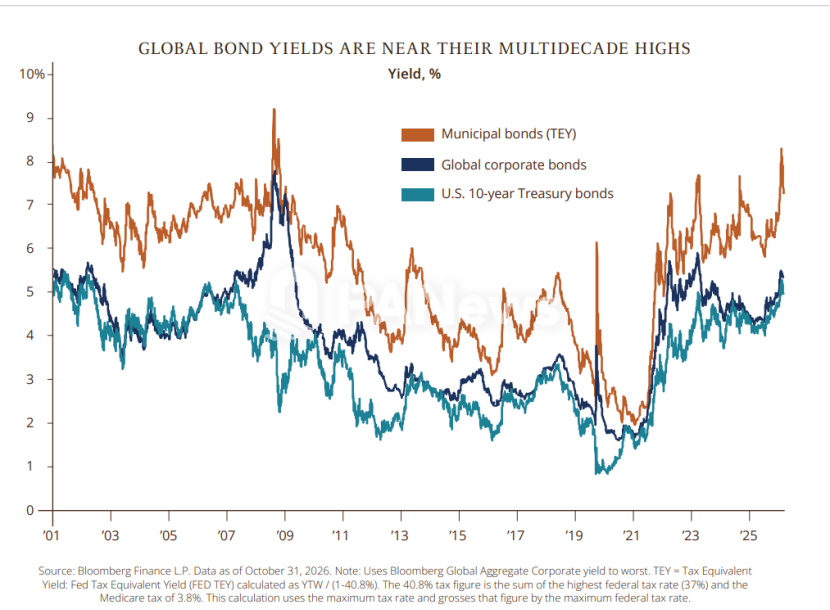
Goldman Sachs and Morgan Stanley agree that as a high-volatility market environment endures, the value of Treasuries as a hedging tool for investment portfolios is returning strongly. As the main concern of the market shifts from high inflation to economic recession, the correlation between stocks and bonds will revert to negative, and the defensive function of bonds will play a role again.
Alternative Assets: A Backup Path for Capital
The rising correlation between stocks and bonds has led to frequent failures of the traditional 60/40 investment portfolio, prompting top institutions to focus more on alternative assets. JPMorgan estimates that allocating 30% of the portfolio to diversified alternative assets could not only raise the expected return of the portfolio to 7.5% but also significantly enhance the Sharpe ratio that measures risk-adjusted returns by 21%.
Notably, in JPMorgan's 2027 long-term capital market assumptions, it provided profit estimates for Bitcoin for the first time: 10% annualized return in the baseline scenario, 16.6% in the optimistic scenario, and -11.2% in the pessimistic scenario.
Even with the quantifiable range provided, JPMorgan has not included Bitcoin in its primary strategic asset allocation model. The main reason is that the correlation between Bitcoin and traditional assets remains unstable, with high volatility. In its model, Bitcoin's expected annualized volatility reaches 55%, far higher than that of U.S. stocks and gold, making it more suitable as a high-risk alternative allocation rather than a ballast for investment portfolios.
This is a definitive "recognition" from traditional financial giants, but it is not yet an "acceptance."
Conclusion
By piecing together Wall Street's outlook for the coming year, a glimpse of the contours of 2027 can be obtained.
The AI revolution is reconstructing the logic of global capital at an unprecedented speed, but like every industrial revolution in history, the transition of old and new forces must inevitably be accompanied by cyclical pains. What follows will be a stress test of grid load, a natural rebound in growth rates, and the occasional emergence of "black swan" events from geopolitical and energy supply sides.
For all investors involved, learning to dance with volatility and lock in real value in an environment of scarce growth will be the most important survival rule in 2027.
免责声明:本文章仅代表作者个人观点,不代表本平台的立场和观点。本文章仅供信息分享,不构成对任何人的任何投资建议。用户与作者之间的任何争议,与本平台无关。如网页中刊载的文章或图片涉及侵权,请提供相关的权利证明和身份证明发送邮件到support@aicoin.com,本平台相关工作人员将会进行核查。


