

Produced by | Huxiu Technology Team
Author | Liang Karl
Editor | Miao Zhengqing
Header Image | Visual China
These 7 people laughed until the end
On November 19, Eastern Time, Anthropic officially closed on its first day of trading at $97.17 per share, up 17.07% from the offering price, with a closing market value of approximately $1.28 trillion, peaking at $2 trillion during the day. (Note from Huxiu: Based on the total number of shares calculated according to the final prospectus and simultaneous private placement, excluding the over-allotment.)
Finally, in less than six years since its founding, the artificial intelligence giant Anthropic raised approximately $81.3 billion through the largest IPO in history, becoming a publicly traded company. Its stock is traded on the Nasdaq under the ticker symbol "ANT".
On November 19 at 10:30 PM Beijing time, after the regular trading session began, the indicative opening price was raised several times during the delayed opening period. The first trade occurred about two hours later at a price of $111.50, up 34.3% from the $83 offering price.
This IPO is seen as a significant test for the artificial intelligence industry. Anthropic expanded its issuance scale, and the final pricing was also higher than previously expected, which relieved investors. Based on fully diluted share capital, the opening price pushed Anthropic’s market value slightly above $2 trillion, approximately $500 billion more than the market value corresponding to the offering price.
However, since Anthropic began trading, the Nasdaq Composite Index has been declining, and tech stocks have generally given back earlier gains, resulting in volatility for the seven tech industry giants participating in the simultaneous private placement. Ultimately, Anthropic closed its first trading day at $97.17, with a gain of 17.07%, with the opening price being the highest of the day and the lowest being $92.72.
Rewind to November 13 at JPMorgan's Manhattan headquarters. Anthropic CEO Dario Amodei sat across from JPMorgan CEO Jamie Dimon, participating in a live fireside chat aimed at existing and potential investors, one of the final stops on his pre-IPO roadshow.
When asked why it was time to go public now, Dario Amodei responded, “I think the biggest reason goes back to these bets on compute.” He indicated that there are huge opportunities in biology, robotics, cybersecurity, and more broadly in knowledge work, and Anthropic wants to ensure it invests enough to capture those opportunities.
As for selecting specific dates, he mentioned that he wasn’t particularly anxious about which month, which day, or what market conditions were ideal for going public. Before initiating the process, he consulted many people, and the piece of advice that resonated most was “never let your company be worth even a dollar more than its true value.”
He added that this is similar to an internal guideline at Anthropic, “make fewer promises, and deliver more.”
Before pressing the market opening button, Dario Amodei made a speech lasting about five minutes, more assertive than during the roadshow, stating, “Anthropic has pioneered various methods to understand and guide AI behavior to keep it under human control, but there is still a lot of work to be done, and the most challenging safety work lies ahead of us.”
“We will control the pace of training and deploying AI systems, taking as long as necessary until we are confident they are safe and will always be under human control.”

Why did the price increase, shares expand, and green shoe options work for such an opening?

The market's debate over AI valuations hasn't disappeared, but Anthropic still dares to "reverse operate," raising prices and expanding share issuance, with institutions willing to participate in抢筹.
Regarding this unusual phenomenon, a senior secondary market analyst told Huxiu that external regulatory influences had not affected Anthropic. Because in the face of safety concerns, it has been actively responding. In response to newly added compute approvals and grid constraints, it has already locked in through long-term agreements. Meanwhile, institutions still value the growth potential of models and application markets, which correspond to a multi-hundred billion dollar coding market and a multi-trillion dollar collaborative office scenario.
Another brokerage analyst shared the same view, “Currently, the short-term bottleneck for AI commercialization is on the supply side; in fact, demand has not shrunk.” As compute supply gradually improves, the cutting-edge models still have further acceleration space.
Anthropic’s issuance arrangement also supported trading on the first day. The issuance increased to 980 million shares, accounting for about 7.4% of the approximately 13.2 billion total shares, while the issuance price was higher than the previously set upper limit, leaving space for initial trading. Moreover, underwriters hold an additional 147 million shares of over-allotment options, which may aid the underwriter's stabilization price operations.
The aforementioned brokerage analyst explained to Huxiu, "Choosing to expand issuance rather than solely raising the issuance price helps stabilize the chip." Compared with simply pushing the issuance price up, increasing the issuance volume can provide more circulating chips and help alleviate supply-demand imbalance issues in the early stage of listing.
Of course, how much defensive capacity these arrangements have will ultimately depend on how high the market is willing to value Anthropic. The key for Anthropic is whether it can establish long-term competitive barriers.
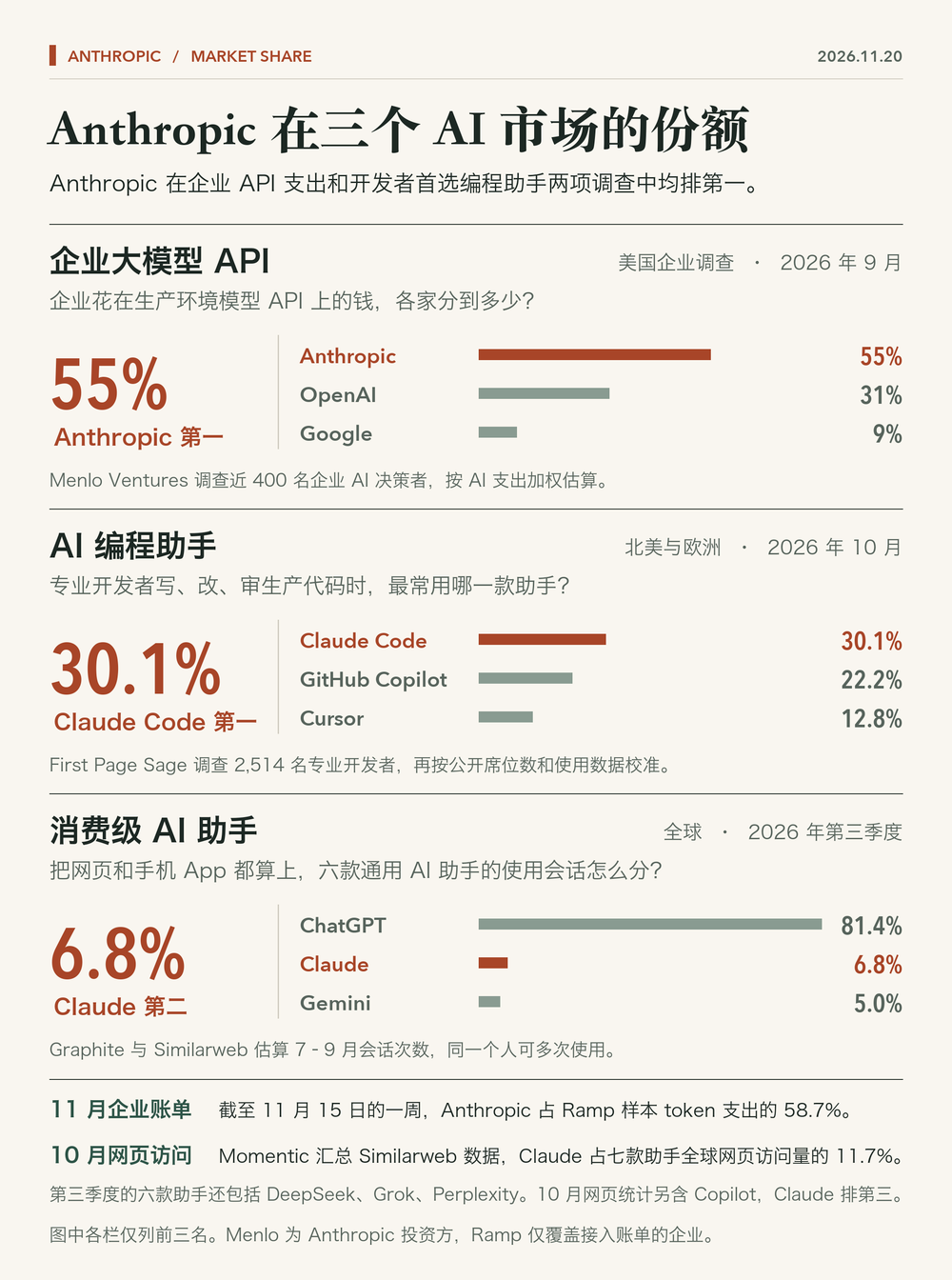
Regarding the enterprise-level market, Forrester Vice President and Chief Analyst Dai Kun is not optimistic. He told Huxiu that based on enterprise API spending, Anthropic is already in the top tier and even in a leading position, with OpenAI following closely behind, Google accelerating to catch up with its platform innovation capabilities, and Microsoft having Azure as its enterprise deployment and distribution entry.
However, being ahead does not mean having a moat. Dai Kun believes that Claude's advantages in finance, law, and healthcare primarily come from model capabilities, safety mechanisms, and enterprise trust, "but these capabilities can be caught up by competitors." At the same time, large enterprises' needs extend far beyond calling a single model, involving data management, knowledge infrastructures, contextual engineering, and agent-based process orchestration capabilities; at this point, Anthropic's advantage lies mainly in its first-mover advantage.
Third-party IDC Research Manager Sun Zhenya also stated that the application of large models in various vertical industries is still mainly concentrated on coding programming, and has not yet penetrated into core business processes of enterprises. To get into these business scenarios, it requires the enterprise's internal data, business rules, and logic, which cannot be solved by generic model vendors or agents themselves; it needs context.
The price set by the capital market reflects investors' judgment of Anthropic's current capabilities and leading position. The question is, how long can this lead be maintained.

980 million shares, $83, and those who boarded at the last moment

With the completion of the IPO, thousands of Anthropic employees and investors are set to acquire massive wealth. To understand this wealth creation movement, one must first look at where the company came from.
In January 2021, Dario Amodei, along with his sister Daniela Amodei and five others, founded Anthropic. These seven people share a common background; they all previously worked at OpenAI.
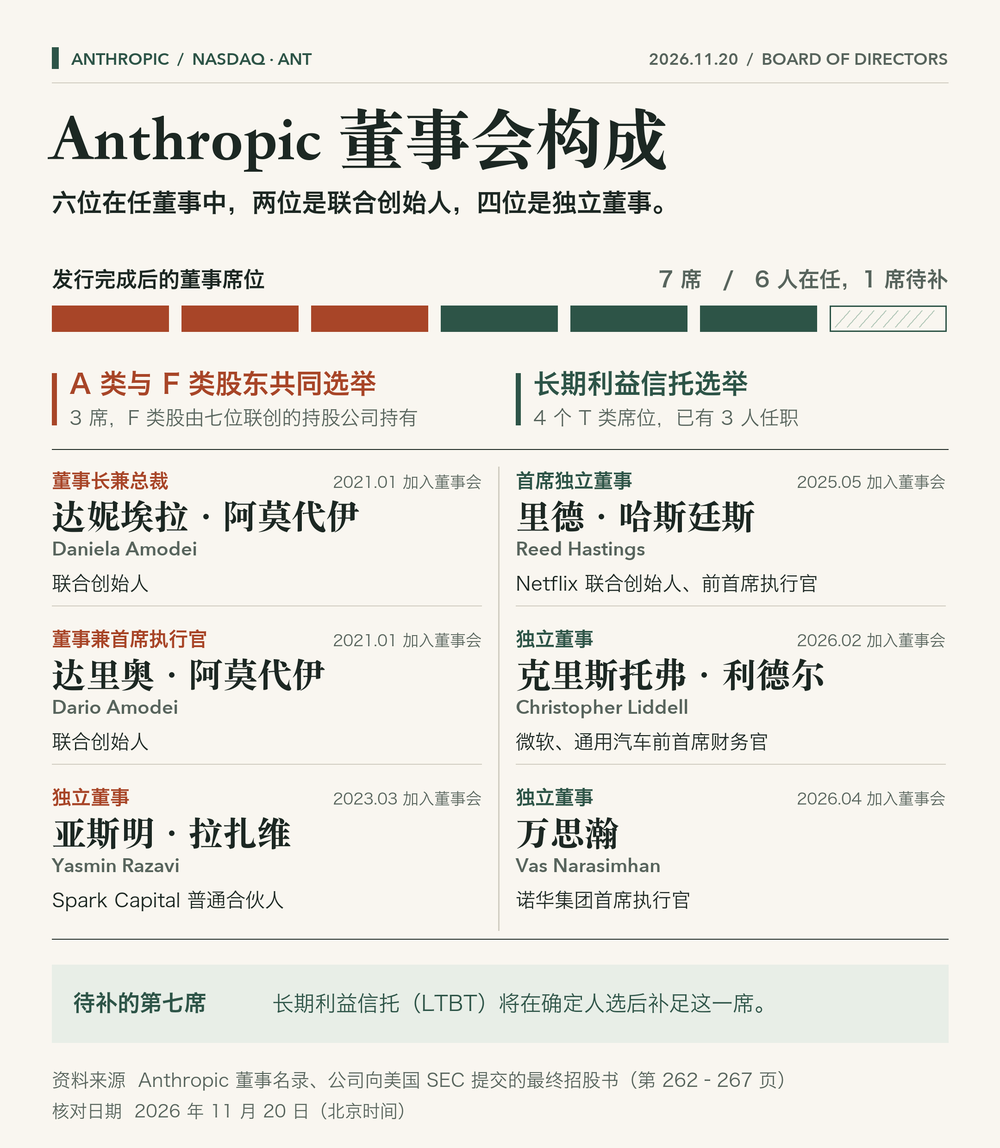
The prospectus reveals their resumes one by one. Among them, Dario Amodei served as Vice President of Research at OpenAI, while Daniela Amodei held positions such as Vice President of Safety and Policy, and Vice President of Human Resources. In other words, Anthropic’s initial team largely came from OpenAI's core research and management team. The prospectus describes them as “a group of researchers responsible for defining many breakthroughs of this round.”
As for why they left OpenAI to start anew, Dario Amodei shared a personal experience during the bell-ringing ceremony.
“Daniela and I lost our father, who died from a disease that only became treatable a few years later,” he said, noting that his career began with biological research. While working in the lab, he realized that scientists face a huge and dense complex jungle, whereas humans continuously break cognitive boundaries, relying on various tools and thoughts, “They come from thinking, from intelligence.”
From its inception to IPO, Anthropic has emphasized the long-term value that AI may bring, but Dario Amodei did not shy away from addressing how far technology is from truly transforming science and medicine, “I don’t want to speak too far ahead at this time. What we currently have are just early results.”
However, the changes in the company’s fundraising and valuation present a more direct growth curve. From raising $124 million in Series A financing in May 2021, to $65 billion in Series H financing in May 2026, fundraising has grown exponentially, and valuation has surged. Even just five months apart, the valuation skyrocketed from $965 billion at the time of Series H financing to a peak valuation of $2 trillion.
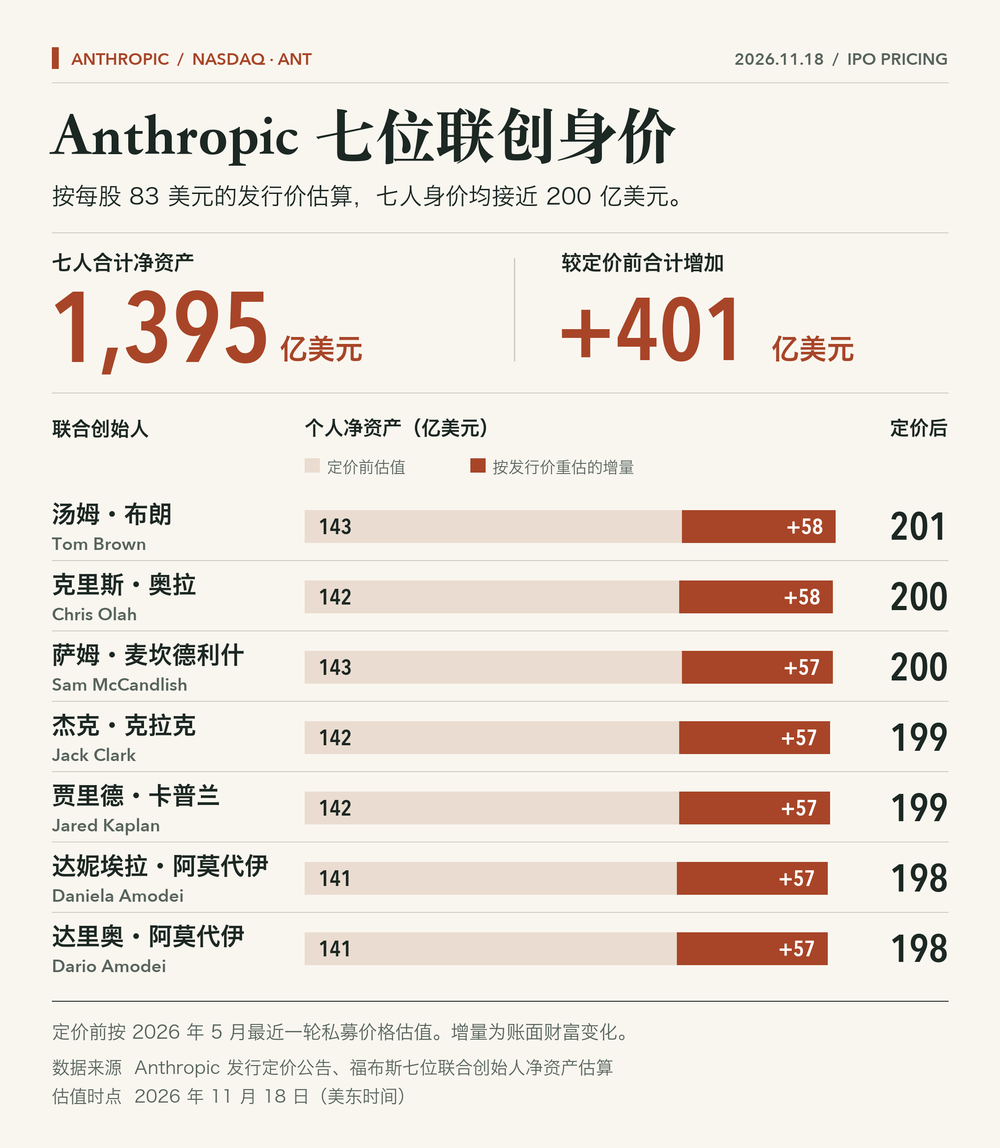
The prospectus shows that Anthropic issued 980 million shares at $83 per share, totaling approximately $81.34 billion for the entire issuance. Among this, the company newly issued about 956.4 million shares, while about 23.65 million shares were sold by the seven founders, with proceeds going to the founders. Additionally, underwriters received 147 million shares of green shoe options, equivalent to 15% of the base issuance size of 980 million shares.
In addition to the public offering, there is a noteworthy private placement worth $26 billion, with subscribers including Google, Nvidia, AMD, Broadcom, Micron, Microsoft, and TSMC. Notably, Google and Nvidia each subscribed for $10 billion. The identities of these seven companies are interesting as they are all chip suppliers or cloud service providers for Anthropic.
For these companies, investing in Anthropic is both a financial investment and relates to future compute and cloud service businesses.
The risk factors section of the prospectus also discloses this relationship. Amazon, Google, and Microsoft are simultaneously investors, customers, distribution partners, and competitors for Anthropic; Broadcom acts as both a supplier and lessor. Meanwhile, revenue from the channels obtained via cloud vendors has increased from 11% to 44%, and related accounts receivable now account for 52%.
This indicates that Anthropic's business growth is closely intertwined with the interests of these large tech companies. They both benefit from Anthropic’s growth and provide the necessary infrastructure for its development.
Before the IPO pricing, there were also two subscription messages that drew attention. The board and related parties expressed a non-binding subscription intention of up to $305 million; TSMC also held a board meeting on November 10, passing a resolution for a maximum subscription of $500 million. The former is a non-binding intention, while the latter has been decided by the board, thus they are of different natures, but both occurred before the final pricing.
For investors who bought new shares at $83, the prospectus disclosed a not-so-flattering number, with a tangible book value of only $9.70 per share, indicating an immediate dilution of $73.30 per share. This gap between the book value post-IPO and the issuance price also reminds investors that when purchasing stock, what they are primarily paying for is the expectation of the company’s future growth, rather than the current book value of its assets.
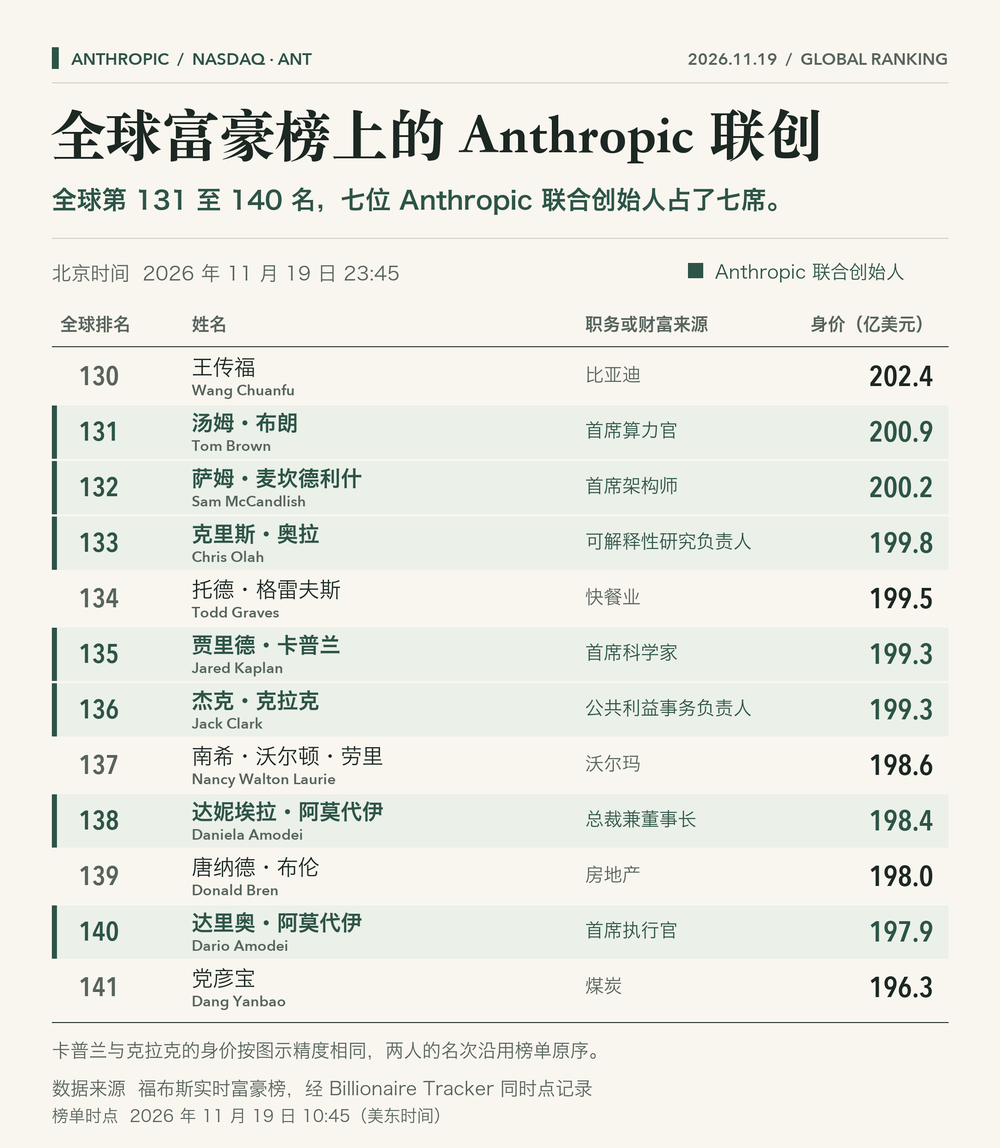
For employees within Anthropic, this IPO presents a different picture. According to Hill estimates, after listing, around 598 employees without founder backgrounds now have shares worth at least $100 million, and approximately 2,800 employees may own shares worth at least $10 million. In comparison to SpaceX’s IPO in June this year, that listing created around 4,400 millionaires.
Those who joined the company in its early days in junior positions usually end up with better financial returns than those who joined just before the IPO in senior positions. This is also true for Anthropic. The average exercise price of options held by early employees is only 52 cents, while publicly traded investors bought at $83, creating a net increase of approximately 159 times.
The same company, two worlds.

One stock, redefining the pricing of the entire AI transaction

The IPO of Anthropic may not only impact itself. The market is likely to use its trading price as a reference for valuing OpenAI and other AI companies.
“The financing and subsequent IPO valuation of OpenAI will likely be anchored to Anthropic,” said a senior secondary market analyst to Huxiu, effectively providing a new pricing reference for the entire industry. She predicts that in the early days of listing, a capital siphoning effect similar to that during the SpaceX IPO may occur.
However, the timing of Anthropic’s choice to go public is not an easy one. The market has shown apparent divisions in its attitude toward AI. On November 12, the news of Nvidia's board accepting Jensen Huang's resignation caused market turbulence. Subsequently, although Nvidia's reported earnings exceeded expectations and provided a quarterly revenue guidance of $130 billion, the stock price still fell 3% that day, down about 30% from October highs.
The market is concerned not only about whether AI demand can be sustained, but also when the huge capital expenditures can transform into actual returns. Anthropic's $83 offering price was determined under such market sentiment.
The analyst believes that buying pressure mainly comes from institutions and retail investors who did not receive enough allocation previously, and the 15% green shoe mechanism can provide some support. However, stock prices may not necessarily continue to rise, “there is indeed a gradual possibility of declining or even breaking issue this year,” and the ARR (annualized revenue rate) data will be repeatedly verified by third parties and information disclosed by the company; if growth fails to meet expectations, it could drag down stock prices.
In her view, the market's expectations for Anthropic's year-end revenue have already been guided by management in advance, “the likelihood of the year-end ARR being significantly above $81 billion is low, probably reaching $90 billion, and the ARR-driven valuation increase is limited.”
The market reaction following Anthropic's IPO quickly reflected in the stock prices of other AI companies.
After the news of an issuance price above the previously set upper limit was released, Nasdaq 100 index futures rose by 523 points prior to market, an increase of about 1.9%; S&P 500 futures were up 1.12%, and Dow futures rose 0.71%. The European Stoxx 600 index, which had fallen for three consecutive days, also turned to an increase.
Companies with investment relations with Anthropic also saw their stock prices rise. Micron rose more than 4%, AMD up 3.4%, Google up 2.9%, Broadcom up 2.8%, Amazon up 2%, Nvidia up 1.7%, and Microsoft up 1.6%. Although Anthropic had not yet begun trading, related companies' share prices had already seen a preemptive rise.
However, the trend of the U.S. stock market quickly changed after the market opened on the day of the IPO. Although the three major indices began to rise, the Nasdaq's gains narrowed to 0.2%, the S&P turned down by 0.3%, and the Dow dropped by as much as 537 points at one point. Nvidia's gain narrowed to about 1%, and Micron also fell back from the over 4% gain in pre-market to around 1%.
It is worth noting that at the time the market began to fall, Anthropic had not yet seen its first transaction, reflecting investors' concerns about interest rate trends and returns on AI capital expenditures. One can only say that the optimistic sentiment brought by the IPO did not change the existing market divides.
The price performance of the seven private placement companies did not remain synchronized either, with AMD becoming the biggest loser among them. AMD subscribed for $2.5 billion in shares, and its stock price briefly rose by 4.7% in early trading but quickly fell back after the release of a report by short-selling firm Hunterbrook, with intra-day losses exceeding 11%. Although not directly related to the IPO, this coincidence amplified market concerns about the overall sentiment on the "AI compute chain."
Another easily overlooked change is that starting this quarter, Anthropic’s stock price fluctuations will also affect some book earnings in Amazon and Google's financial reports. A research report released by Huatai Securities on November 18 estimated that, based on the midpoint of the issuance range, for every $1 increase or decrease in Anthropic's stock price, each of the two companies' earnings per share is expected to be affected by approximately $0.12 and $0.11, respectively.
Therefore, the first-day increase can only indicate that the market is willing to buy at this price. Once index funds gradually enter and the restricted shares begin to circulate, whether Anthropic can maintain its current valuation is the real question that this IPO needs to answer. For the post-listing stock price, digesting the lifted restrictions is more important than being pursued on the first day.

The truth of going public despite a $104 billion loss

Regarding Anthropic's financial situation, net losses look alarming, but more attention is warranted on the commitments related to compute.
The prospectus discloses a net loss of $104.039 billion for the first nine months of 2026. Of this, $94.324 billion stems from “fair value changes of convertible notes, derivative liabilities, and SAFEs,” which does not imply that the company actually spent an equivalent scale of funds. Given that the valuation of related liabilities is tied to the company’s valuation, rising valuations may inflate this portion of book losses. During the same period, the operational loss was $1.26 billion.
The real issue lies in that the total long-term commitments regarding compute and infrastructure amount to $900.9 billion, of which $70.7 billion will mature within the next 12 months. Meanwhile, as of October 31, Anthropic's ARR was $81 billion. This figure is calculated by annualizing the revenue of a certain period, and it is not actual revenue.
Revenue growth is rapid, but the pressure of compute contract expenditures is equally significant. Whether future revenues can keep pace with compute investments will directly affect Anthropic's operational status.
From an industry perspective, Dai Kun told Huxiu, “In the next few years, only a handful of top companies may gradually achieve coverage,” with the key being not only whether revenue can continue to grow but also whether revenue growth can consistently outpace the costs of training, inference, and model iterations. Improved inference efficiency and chip cost-effectiveness help reduce unit costs, but competition among model vendors will also persistently drive down model prices.
However, some optimistic IT industry analysts inform Huxiu that, focusing solely on Anthropic, according to the figures disclosed in the prospectus, as long as model revenue growth exceeds 20%, it can maintain a gross margin of over 50%, “which has already been proven to work.”
In the aforementioned fireside chat, Dario Amodei also addressed this issue. He referred to compute as “the deepest commercial challenge the company faces.” Buying too little may fail to meet customer demand and impact the training of the next generation of models; buying too much can financially overextend the company. Anthropic's current strategy is “to lean toward buying a little less,” and to add compute after demand exceeds expectations.
This approach can reduce the burden of idle compute, but it relies on the premise that the company can timely acquire new resources as demand grows. The funds raised from the IPO could provide greater leeway for this procurement strategy. The aforementioned optimistic analyst told Huxiu that if Anthropic hadn't secured this round of financing, there would certainly be a funding gap in the next four to five years.
From his perspective, the cost of equity capital is far lower than that of debt capital, “whether for debt repayment or otherwise, it’s actually beneficial.” However, this judgment is more from an industrial standpoint rather than a financial perspective.
Regardless of expanding investor participation or preparing funds for the coming years, Anthropic needs more external capital support. For a company that invests heavily in compute while also continuously training new models, relying solely on existing revenue is unlikely to cover future expansion plans comprehensively.
As for where the raised funds will be directed, some trends can be seen from Anthropic’s recent product movements.
On November 10, Anthropic launched products like Claude Sheets, Whiteboards, Meetings, and Data, connecting with over 9,000 connectors to bring Claude into more non-technical employees' work scenarios. In the past, Anthropic's corporate revenue was more related to developers and IT departments; now, the company aims to make finance, operations, marketing, and human resources also become paying users.
However, analysts generally believe that office software itself may not be the largest scene for future token consumption. Sun Zhenya points out that office scenarios will serve as a key entry point for employees' daily interactions with AI, allowing users to frequently use AI, but currently, coding programming still accounts for over 70% of enterprise token spending.
Dai Kun believes that for large model companies to venture into office suites, it is not merely that the business model has been validated; more importantly, office scenarios possess high-frequency usage, enterprise data, business processes, and payment entry, making them suitable vessels for an agent to execute tasks. In the future, the boundaries between applications are likely to gradually weaken, with models calling on different data and tools to accomplish tasks; traditional carriers like documents and spreadsheets will assume the functions of collaboration, auditing, and final delivery.
As for the next large-scale revenue-generating scenario, Dai Kun is more optimistic about professional knowledge work and business process transformation. The demand for AI in industries like finance, law, and healthcare is not just about generating a report or answering a question, but also involves embedding models into complete processes of research, review, compliance, and decision-making.
He has observed that corporate IT budgets are also changing, with large enterprises starting to strategically invest in agent-based AI, incorporating related expenditures for models, Copilot, Agent development platforms, etc., into IT budgets and assessing input-output ratios around business scenarios. However, enterprises are still in the early stages of adopting agent-based AI technology and are some distance from large-scale commercialization.
From this perspective, the total raised funds of about $107.3 billion this time will have to address future compute expenditures while continuing to expand enterprise customers and application scenarios. Anthropic needs to convince more companies to be willing to pay for Claude before the compute contracts expire and competitors drive down model prices.

Shareholders turn into competitors, a price war on two fronts

In addition to fundraising, Anthropic also faces a harsh reality: companies providing it with funding and infrastructure are also its most direct competitors.
On November 9, Anthropic released Claude Fable 5.2, reclaiming the top spot at a price of $8 per million input tokens. The next day, Google fully opened Gemini 4 Carbon, with an initial experience price of $2 per million input tokens, set to rise to $4 starting in December. According to Google, its costs are about a quarter of Fable's.
In MKA evaluations, Gemini 4 Carbon achieved slightly lower than Fable with a score of 71.89% versus 73.26%, but the individual task cost was only $5.63, while the latter was $35.28.
It is noteworthy that Google itself is a shareholder of Anthropic; according to IPO and concurrent private placement stock disclosures, Google holds about 13.7% of Anthropic's shares, primarily in non-voting Class N shares. Google benefits from Anthropic’s business growth while vying for customers with its models.
However, this may have become the norm. On November 17, Microsoft announced seven MAI models at the Ignite conference. Among them, Microsoft claimed that MAI Code 2 achieved 96% of Claude Opus 5.5's coding performance in internal evaluations, but at a mere 5% of the latter's price. According to Microsoft, this price includes a 50% promotional discount, which will be raised in May 2027. MAI Code 2 is available in GitHub Copilot.
The relationship between Microsoft and Anthropic is quite complex, as they are not only shareholders, customers, and cloud service providers but also competitors. Anthropic has acknowledged this multifaceted relationship in its prospectus.
Dai Kun explained that as multi-cloud architectures become a common choice for enterprises deploying AI, the relationship between both parties will become increasingly intricate. Large cloud vendors provide capital, chips, and cloud services, control distribution channels for enterprise customers, and also develop their models, making them “both partners and competitors” in practice. Anthropic's choice to collaborate with multiple cloud platforms is also to reduce dependence on a single supplier.
In the short term, constrained by Microsoft's capabilities, there will not be immediate pressure on Anthropic's gross margins, a said IT industry analyst told Huxiu, as model capabilities depend not only on compute but also on training methods, model architectures, data, and talent, “it's not purely about compute.”
An industry insider familiar with Microsoft informed Huxiu that previously, Microsoft was concerned that its investments in OpenAI projects made developing its own large models less of a priority, but this situation has changed.
Dai Kun also cautioned that if the capabilities of various models gradually converge in the future, cloud vendors that maintain channel access to enterprises and cost advantages in infrastructure would become more competitive. By then, the gross margins and pricing power of pure model companies will face challenges, and only those leading firms that continuously maintain a significant technological edge will be more likely to sustain high prices.
As for whether Anthropic's newly launched office suite will replace Microsoft's office software, Dai Kun believes that it is premature to read too much into this. In the short term, it “more competes with Microsoft Copilot rather than replacing Microsoft 365.”
For Anthropic, the actions of Google and Microsoft serve as reminders that having leading model capabilities does not guarantee the ability to sustain high prices in the long term. As more cloud vendors and tech companies launch their models, the transition costs for clients among different products could further decrease, making price and performance more direct factors of competition.
Whether Anthropic can continue to maintain its lead depends not only on whether its model capabilities can continue to widen the gap, but also on customers' willingness to pay long-term.

“Make fewer promises, deliver more”

Completing the IPO marks a new stage for Anthropic.
The first-day stock price increase reflects both market recognition of Anthropic and relates to the issuance scale, allotment structure, and trading chips involved. Based solely on first-day performance, it is difficult to judge the company’s long-term value.
Going forward, the market’s focus will gradually shift towards operational data. Investors will continuously compare Anthropic's ARR with the long-term targets set by the company. According to the company’s disclosed plans, the revenue target for 2028 is $200 billion, with a target operating profit margin of 35% at maturity. Whether growth can be smoothly realized in the next two years will become an important basis for the market to observe its operational condition.
During the bell-ringing ceremony, Dario Amodei discussed a concept called “the upward competition.”
He stated that if an AI company can prove that it can make correct choices regarding safety while still building an extremely successful company, then other companies might follow suit. For him, the industry’s goal should not just be to compete for model capability rankings, “whether Anthropic wins or loses at any given moment,” but to push the entire industry towards becoming better.
He also expressed, “the most difficult safety work is still ahead,” stating it could take as long as needed.
For a company that has just completed the largest IPO in history, such words can easily be interpreted as expressions of its corporate values. However, whether investment in safety can ultimately become a competitive advantage will still depend on the actual results. Anthropic needs to demonstrate that its continued investment in safety research will not hinder product iterations, revenue growth, and commercial returns.
From the perspective of capital flow in the AI industry, the market's focus may also be changing. In the past few years, substantial funds flowed into GPU, data centers, cloud services, and chip manufacturers, but as models gradually enter enterprise business processes, investors are beginning to seek companies that can convert AI capabilities into actual revenues.
The aforementioned brokerage analyst characterized Anthropic as “a hedge for the impact of AI on traditional business models.” This implies that some investors buying Anthropic focus not only on its potential to become a larger modeling company but also on the changes that AI technology may bring to traditional industries.
However, whether Anthropic can fulfill such expectations will depend on the operational data of the coming quarters, a pressure that needs to be faced by both founders and management. The funds raised from the IPO have already been received, and the pressure of compute expenditures as well as competition among models will not cease. For investors, every subsequent financial report will prove more persuasive than the promises made during the bell-ringing ceremony.
免责声明:本文章仅代表作者个人观点,不代表本平台的立场和观点。本文章仅供信息分享,不构成对任何人的任何投资建议。用户与作者之间的任何争议,与本平台无关。如网页中刊载的文章或图片涉及侵权,请提供相关的权利证明和身份证明发送邮件到support@aicoin.com,本平台相关工作人员将会进行核查。


