The battle for 60,000 dollars has begun. With rising interest rate expectations, giant IPOs continue to siphon off funds, leading to heavy losses for stocks and cryptocurrencies.
Written by: ChandlerZ, Foresight News
From November 19 to 20, the global financial markets showcased the most surreal and cruel scene of the year.
On one hand, AI giant Anthropic made its official debut on Nasdaq (ticker: ANT) with the aura of the "largest IPO in history," soaring 34% at the open and briefly reaching a market cap peak of 2 trillion dollars; on the other hand, global risk and safe-haven assets faced nearly simultaneous indiscriminate sell-offs, with the three major US stock indices plummeting over 2%, the S&P 500 recorded six consecutive declines, the Dow Jones fell by more than 1,100 points, gold dropped below 3,600 dollars, silver plunged nearly 5%, Bitcoin dipped to the 61,000 dollar range, and this morning, the Nikkei 225 index even plunged 4.5%.
Before and after the opening of US markets last night, driven by the initial surge in tech stocks, Bitcoin quickly rebounded and touched 64,005 dollars; however, the good times did not last long. As US stocks turned downwards across the board, BTC rapidly shed gains in less than two hours, falling below 62,000 dollars and hitting a low of 61,200 dollars.
The intense struggle between bulls and bears wiped out over 657 million dollars in leveraged positions across the network in the past 24 hours (with over 544 million dollars coming from long liquidations).
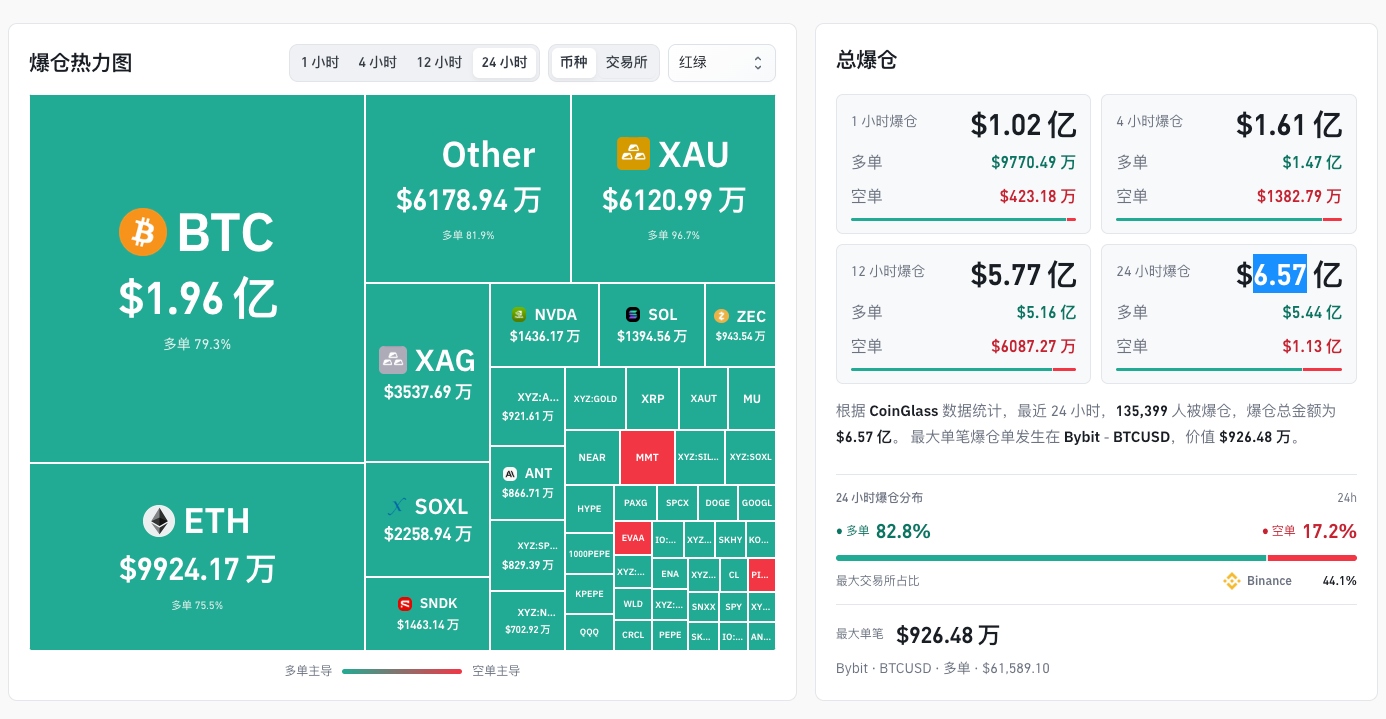
Looking at the overall situation, the cryptocurrency market has entered the coldest winter of the year. Bitcoin has dropped about 13%-16% over the past week, nearing a halving since last week when it fell below the 200-week moving average (around 68,000 dollars), approaching the historical high of 126,000 dollars from last October and facing a direct test of the psychological barrier at 60,000 dollars;
ETH performed even more weakly, retreating to around 1,740 dollars after failing to breach 1,800 dollars last night, having significantly lost the 2,000 dollar mark; mainstream altcoins also fell broadly, with SOL down to around 72 dollars, HYPE down to 65 dollars, and the total market capitalization of cryptocurrencies shrinking to about 2.11 trillion dollars. The CoinMarketCap fear and greed index has dropped to 11-12 (extreme fear), approaching the year's extreme values recorded during the February sell-off.
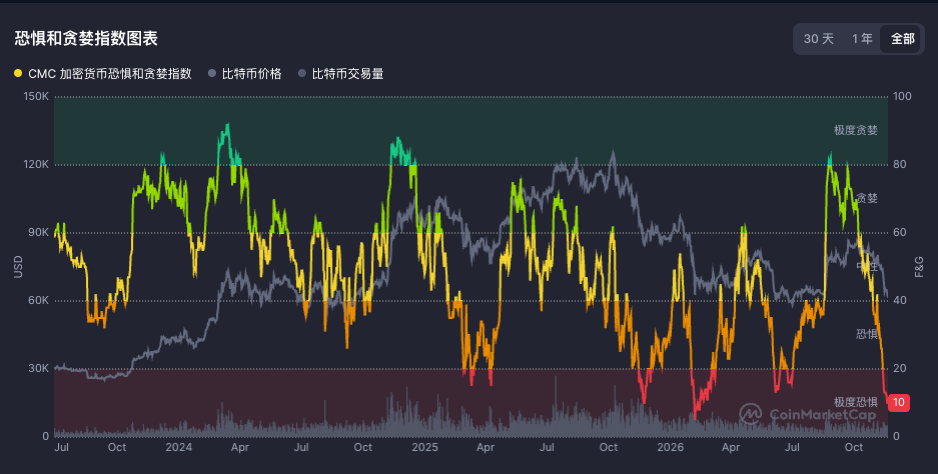
This round of decline faces three forces: external mega IPOs drawing funds, internal liquidity leaks, and macro interest rate hike expectations squeezing market liquidity. The liquidity black hole formed by the interplay of these three factors is indiscriminately clearing high-leverage positions and shaky chips out of the market.
Anthropic's largest IPO: It's not just sucking out the incremental funds
Last night, the biggest event on Wall Street was Anthropic's completion of an 81.3 billion dollar IPO at an issuance price of 83 dollars, coupled with a 26 billion dollar private placement involving tech giants, raising a total of 107.3 billion dollars from the market in a single day, surpassing SpaceX's record in June this year to become the largest IPO in human financial history.
Many people are puzzled: why does an AI company going public affect Bitcoin? The core reasons can be summarized in three points:
- Marginal buyers being directly siphoned off. As pointed out in the latest report by BitfinexAlpha, this Anthropic IPO allocated a considerable proportion of shares to retail and high-net-worth channels, and these high-odds funds overlap significantly with the core marginal buyers of the cryptocurrency market. Even within the crypto space, over 422 million dollars of open contracts had been locked in in pre-IPO perpetual contracts on platforms like Hyperliquid and Binance over the past few weeks.
- Expectation resonance turning into valuation deflation. Over the past few months, the correlation between crypto assets and US tech stocks has remained high. Last night, ANT opened up 34% (111.50 dollars) before quickly plummeting, ultimately closing only up 17% (97.17 dollars). This not only fell far below the first-day doubling signal set by former BitMEX CEO Arthur Hayes to ignite a full risk-on sentiment but also made the aggressive future computing power commitment of 900.9 billion dollars in its prospectus scare away secondary market buyers. When even AI leaders could not lift the Nasdaq, BTC and ETH, which are highly correlated with tech stocks, had to bear the pressure; last night, only a few AI-themed tokens showed resilience amid the IPO buzz.
- The blood-sucking betrayal by mining enterprises. Ironically, the AI boom is directly creating selling pressure on Bitcoin in the spot market. To raise funds for transitioning and expanding high-profit AI computing infrastructure, several leading listed mining companies, including Riot and Marathon Digital (MARA), have been consistently selling off their Bitcoin inventories, exacerbating the already weak spot market.
Why do gold, US stocks, and Bitcoin fall together? The macro "interest rate hike ghost" is the ultimate killer
If we return the focus to the internal cryptocurrency market, the data reveals that the liquidity drain is, in fact, more severe than the external narrative suggests.
As of November 18, the net outflow from US Bitcoin spot ETFs has reached approximately 2.9 billion dollars in less than three weeks in November. On just the 17th and 18th, the single-day net outflows were as high as 240 million dollars and 306 million dollars, respectively, with BlackRock's IBIT alone contributing 83%-87% of this month's net outflow.
Currently, the total asset scale of BTC spot ETFs has dropped to a three-month low (77.7 billion dollars), and the current coin price is about 20% lower than the recent average entry cost for institutions. Ethereum has similarly not been spared, with ETH spot ETFs experiencing net outflows for seven consecutive weeks, losing nearly 400 million dollars in the past week.
Additionally, in the past month, the total supply of stablecoins across the network has decreased by 16 billion dollars to 286 billion dollars, with 12 billion dollars evaporating on the Ethereum chain alone. This directly explains why, after ETH fell below 1,800 dollars, substantial bottom-buying efforts were nearly nonexistent.
In fact, the pricing anchor of this market cycle is not "geopolitical hedging", but rather "tightening US dollar liquidity".
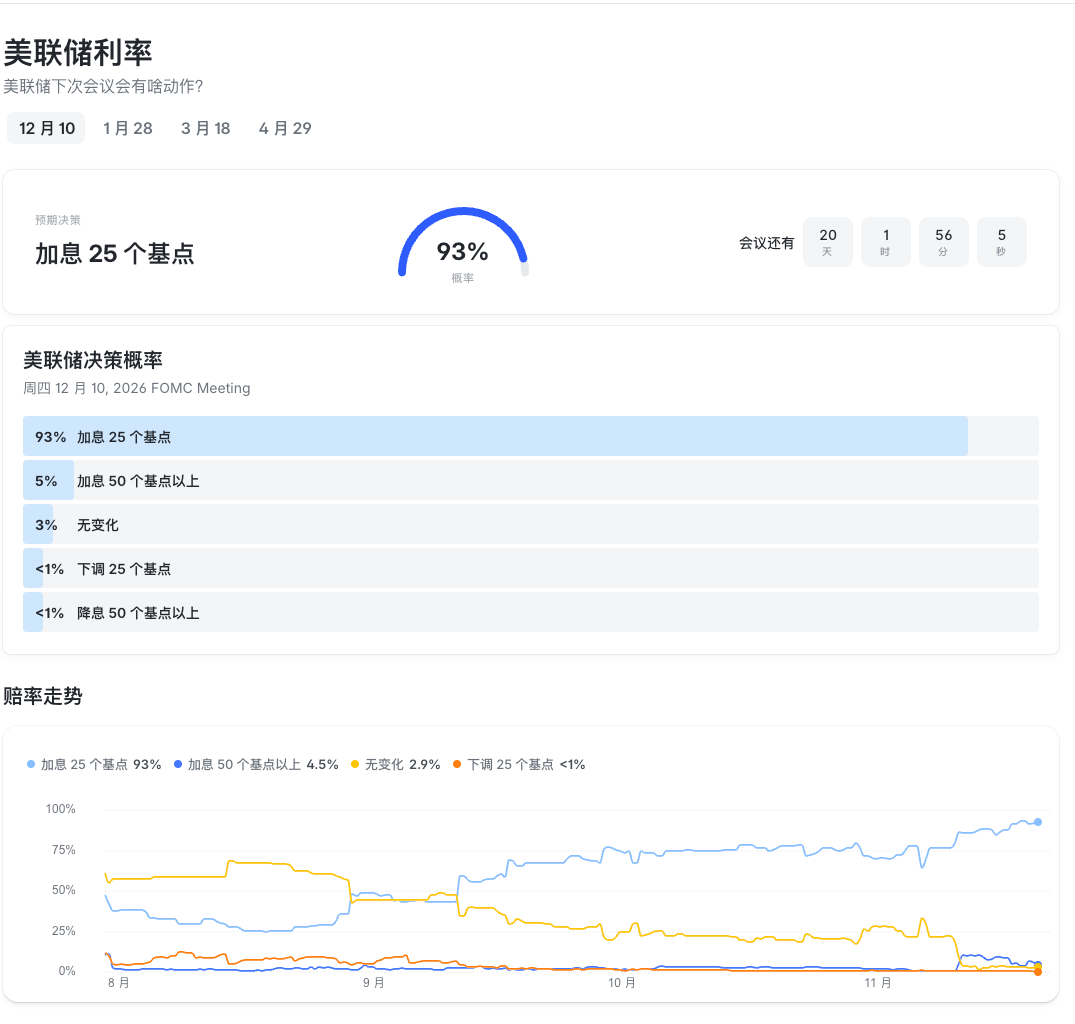
Since the US inflation data exceeded expectations on November 10, the Federal Reserve has released extremely hawkish signals this week. On one hand, a rate hike in December has almost become consensus, with a 50bp option even being discussed: the recently released minutes from the October FOMC meeting show that nearly all officials believe that further rate hikes may be necessary; Federal Reserve Governor Waller this week even publicly suggested that a 50 basis point rate hike in December might be needed to shock the market and curb inflation expectations.
Currently, on the prediction market Polymarket, the probability of a 25 basis point rate hike by the Federal Reserve in December has surged to 93%.
On the other hand, the market is also facing indiscriminate strangulation from the 2.5% US Treasury bonds and a strong dollar at 104. Under hawkish expectations and demand for hedging, the US dollar index has soared to around 103.9, reaching a new high of 19 months since April 2025, while the yield on 10-year US Treasury bonds has settled above 5%.
When holding a dollar deposit or US Treasury bond can easily yield more than 5% in risk-free returns, any asset that does not generate interest, whether it's gold or Bitcoin, will face liquidity sell-offs from institutional funds. In the face of margin calls and redemption waves, the only safe haven for traders is cash in dollars.
Future Market Analysis: At the 60,000 dollar mark, are we waiting for "capital to flow back" or "central bank market intervention"?
Standing at the current cliff edge of 62,000 dollars, the divergence in the cryptocurrency market is fully displayed.
The short-term focus may hinge on expectations of liquidity returning. Ripple CEO Brad Garlinghouse pointed out in an interview yesterday that the recent sell-off in the cryptocurrency market is largely due to funds reallocation for super IPOs like Anthropic. As the IPO trading settles, some of this capital is expected to flow back into the market. In the short term, whether the market can stabilize above 60,000 dollars is crucially dependent on two high-frequency indicators: whether next week's US BTC spot ETF (especially BlackRock's IBIT) can stop single-day outflows at the 300 million dollar level, and when the market cap of stablecoins will cease its decline.
Medium-term concerns and the "ultimate scenario": In Arthur Hayes' latest research article, he warns that if the massive valuations of AI giants like Anthropic and the upcoming wave of unlocks next year lead to credit tightening, risk assets may still face severe deleveraging in the short term; he even cautions that under extreme deflation and an AI bubble burst scenario, BTC risks a significant plunge.
However, he also highlights the ultimate logic of the cryptocurrency cycle, stating that global governments will never tolerate a collapse of AI infrastructure and the financial markets. Once the crisis forces central banks to return to "money printing to rescue the market," Bitcoin, with its absolutely fixed supply, will still be the preferred vessel to absorb an enormous influx of fiat currency.
However, as countless historical lessons have proven, before a shift in policy or a true return of capital occurs, surviving this liquidity winter of 5% US Treasury rates and a strong dollar is far more important than predicting where the bottom lies.
免责声明:本文章仅代表作者个人观点,不代表本平台的立场和观点。本文章仅供信息分享,不构成对任何人的任何投资建议。用户与作者之间的任何争议,与本平台无关。如网页中刊载的文章或图片涉及侵权,请提供相关的权利证明和身份证明发送邮件到support@aicoin.com,本平台相关工作人员将会进行核查。


