Author: Zen, PANews
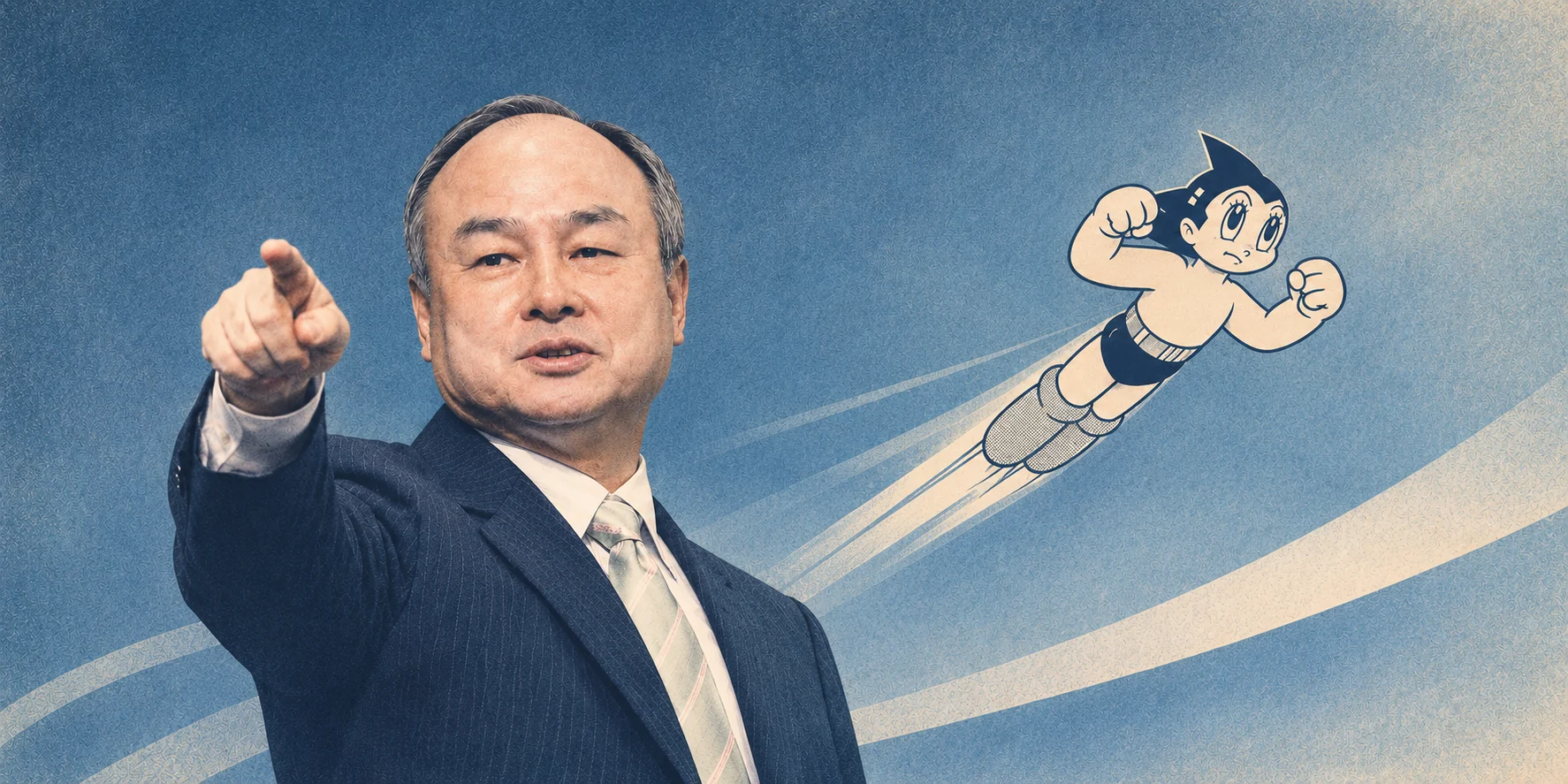
On June 18, 2015, at the Maihama Amphitheater in Urayasu City, Chiba Prefecture, Japan, Masayoshi Son mentioned his favorite childhood cartoon "Astro Boy" while introducing the humanoid robot Pepper, which SoftBank had developed over several years.
In Osamu Tezuka's work, the extraordinary robot Astro Boy lives in human society and gradually understands human emotions. Masayoshi Son recalled that this anime sparked his strong interest in robots as a child and became the inspiration for his later development of emotional robots.
The design of SoftBank's robot Pepper also shows traces of Astro Boy. Standing about 1.2 meters tall, it has a white body, a round head, and large eyes, capable of recognizing human facial expressions and responding differently based on human emotions.
Two days later, the first batch of 1,000 Peppers made available to Japanese consumers sold out within a minute. During that time, Masayoshi Son repeatedly painted a bolder future to the outside world: in 30 years, the number of robots on Earth would exceed that of humans, and SoftBank had the opportunity to become one of the leaders in this technological revolution.
In the following decade, Masayoshi Son invested heavily to realize this vision but also experienced a series of setbacks, including the discontinuation of Pepper and the sale of Boston Dynamics.
In November of this year, SoftBank acquired the research institute established by the founder of Boston Dynamics from Hyundai Motor. It had been five years since Masayoshi Son sold the controlling stake in Boston Dynamics. His dream of robotics has come full circle but never changed.
From Astro Boy to 10 Billion Robots
Masayoshi Son's visions for robots can be traced back to the 30th anniversary of SoftBank's establishment.
On June 25, 2010, Masayoshi Son spent two hours explaining SoftBank's development vision for the next 30 years to shareholders and the audience. In his vision, as semiconductor performance continued to improve, computers would gradually gain the ability to learn and think independently, bringing this intelligence into everyday human life by combining with robots.
At that time, Apple had just released the first-generation iPad, the mobile internet was still in its infancy, and it would be another 12 years before the birth of ChatGPT.
Two years later, SoftBank acquired the French robotics company Aldebaran and began developing what would become Pepper. Masayoshi Son initially hoped to create an ecosystem similar to that of smartphones with Pepper. Robot manufacturers would provide hardware, developers could write various applications for the robots, and users could expand the robots' capabilities according to their needs.
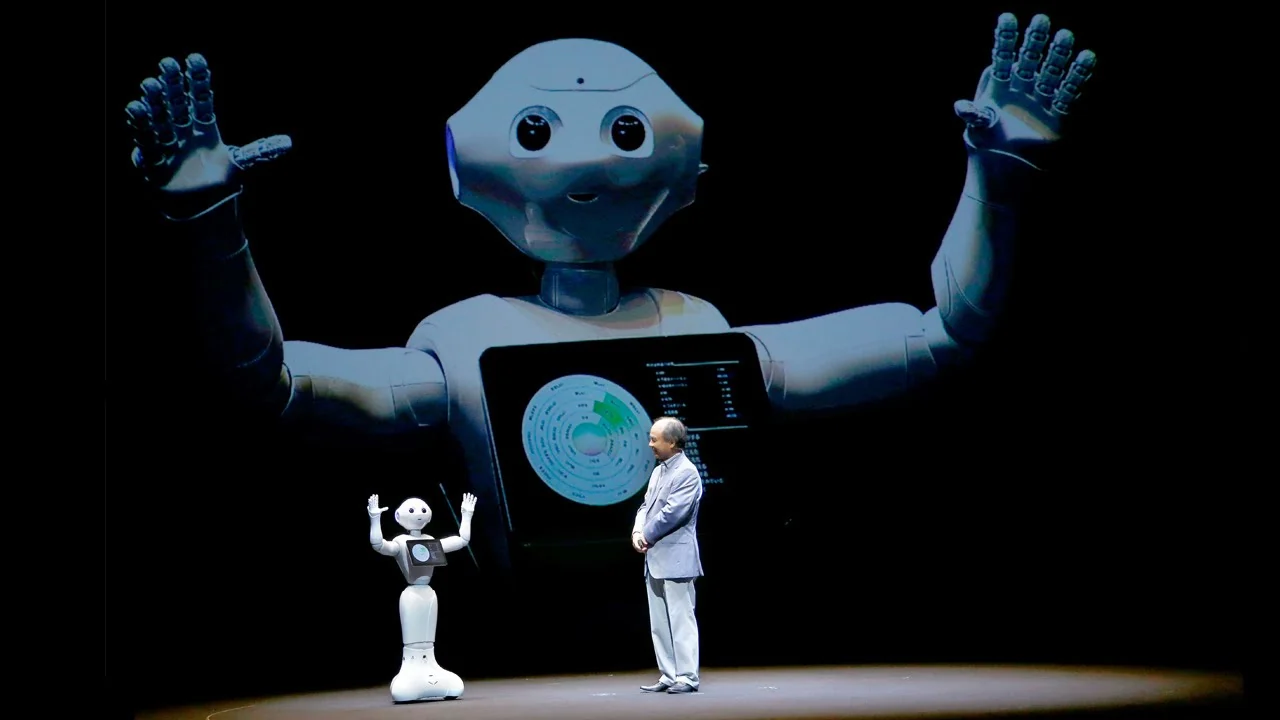
When Pepper was released in 2015, SoftBank had prepared about 200 downloadable applications for it. That same year, Masayoshi Son brought Alibaba and Foxconn into this robotics experiment. Both companies invested 14.5 billion yen each in SoftBank Robotics Holdings, acquiring 20% shares each.
Foxconn was responsible for large-scale manufacturing, Alibaba possessed a vast internet business ecosystem, and SoftBank provided robot technology and communication networks. In Masayoshi Son's vision, the collaboration of the three companies was expected to promote the global popularity of personal robots.
For Masayoshi Son, Pepper was just the starting point of the robotics dream. At the same time in the SoftBank shareholder meeting, he also made a forward-looking judgment: the value of future robots will mainly be reflected in intelligence, rather than hardware.
In February 2017, Masayoshi Son spent a lot of time discussing artificial intelligence, technological singularity, and robots at the Mobile World Congress (MWC), which is primarily focused on communication technology. He predicted that by around 2047, there could be 10 billion humans and 10 billion robots living on Earth, with the intelligence level of robots potentially far surpassing that of humans.
He also linked this vision to SoftBank's earlier decision to spend $32 billion to acquire chip architecture company Arm. In his view, in the future, billions of intelligent devices and robots would require semiconductors to support their computing and perception capabilities.
At this time, SoftBank was preparing a vision fund with a scale of up to $100 billion, and Masayoshi Son also began looking for robotics companies that could help SoftBank realize this vision.
Four months later, he acquired Boston Dynamics.
Two Ownership Changes of Boston Dynamics
On June 9, 2017, SoftBank announced an agreement with Alphabet, Google's parent company, to acquire Boston Dynamics.
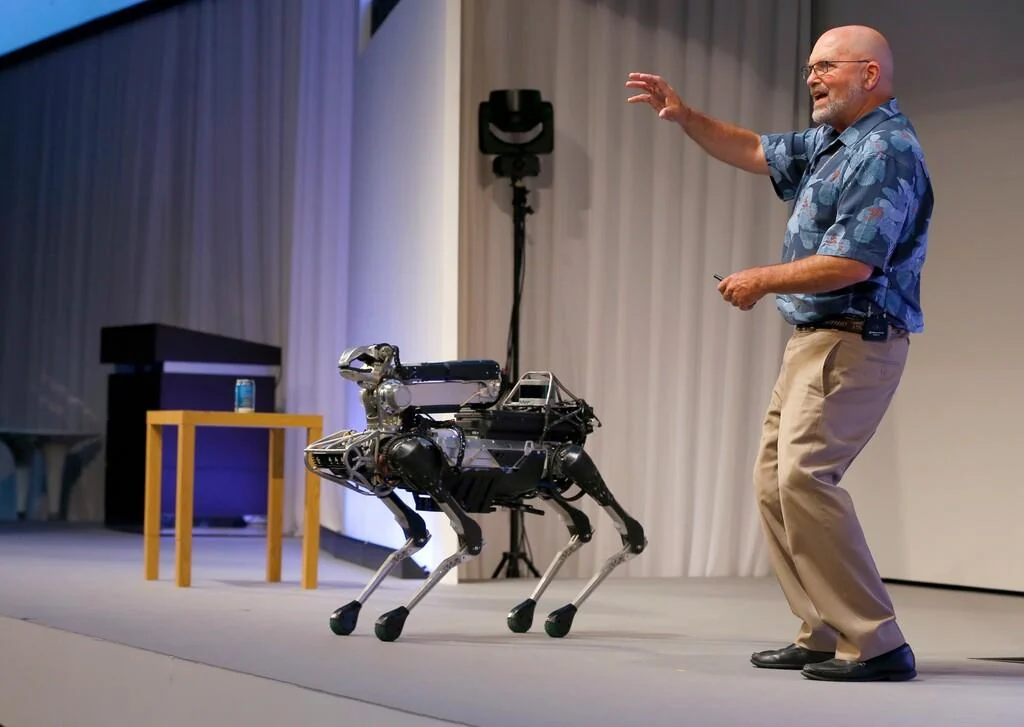
Founded in 1992 by Marc Raibert, Boston Dynamics was already one of the most well-known companies in the global robotics field when SoftBank acquired it. Its demonstration videos released on YouTube garnered significant attention — the quadruped robot BigDog could walk on rough mountain roads, regaining balance even when disturbed; while the humanoid robot Atlas could already navigate complex terrains, carry objects, and stand up after a fall.
In 2013, under the leadership of Android founder Andy Rubin, Google had sparked a wave of robotics acquisitions, with Boston Dynamics being the most recognized among them. However, as Rubin left Google in 2014, the organizational structure and commercialization direction of its robotics business began to change. The Alphabet management believed that Boston Dynamics would struggle to introduce products with sufficient commercial value in the coming years, and thus began to consider selling it.
Masayoshi Son's judgment was more focused on the long term. For SoftBank at that time, Boston Dynamics could compensate for Pepper's shortcomings in robot motion control and hardware technology. Pepper, while capable of communicating with people, could only move on wheels at the bottom, making it nearly impossible to perform tasks requiring complex physical motion. Boston Dynamics had decades of experience in legged robot development, enabling robots to enter environments that were traditionally reachable only by humans or animals.
However, Masayoshi Son soon encountered the same problem that Alphabet had faced previously: how long would it take for these technologies to translate into commercial revenue?
As of the fiscal year ending in March 2019, Boston Dynamics recorded only $1 million in revenue, with a net loss of $63 million; a year later, its revenue increased to $2 million, but its net loss further widened to $103 million. The over $100 million annual losses starkly contrasted with the viral success of its demonstration videos on the internet.
It wasn't until June 2020 that Boston Dynamics officially began selling its first commercial robot Spot, priced at $74,500.
By this time, SoftBank was also embroiled in a financial crisis.
In early 2020, the COVID-19 pandemic triggered severe fluctuations in the global capital markets, and the substantial assets held by SoftBank's vision fund faced valuation adjustments. For the fiscal year ending in March 2020, SoftBank Group recorded a net loss of approximately 961.6 billion yen. In March of that year, SoftBank announced plans to sell or monetize up to 4.5 trillion yen in assets, with the funds used for stock buybacks, debt repayment, and cash reserves.
In this subsequent asset adjustment, Boston Dynamics also became a bargaining chip and was placed on the trading shelf. On December 11, 2020, SoftBank sold its controlling stake in Boston Dynamics to Hyundai Motor Group for a transaction value of $1.1 billion. Following the completion of the deal, Hyundai held approximately 80% of the equity, while SoftBank retained around 20%.
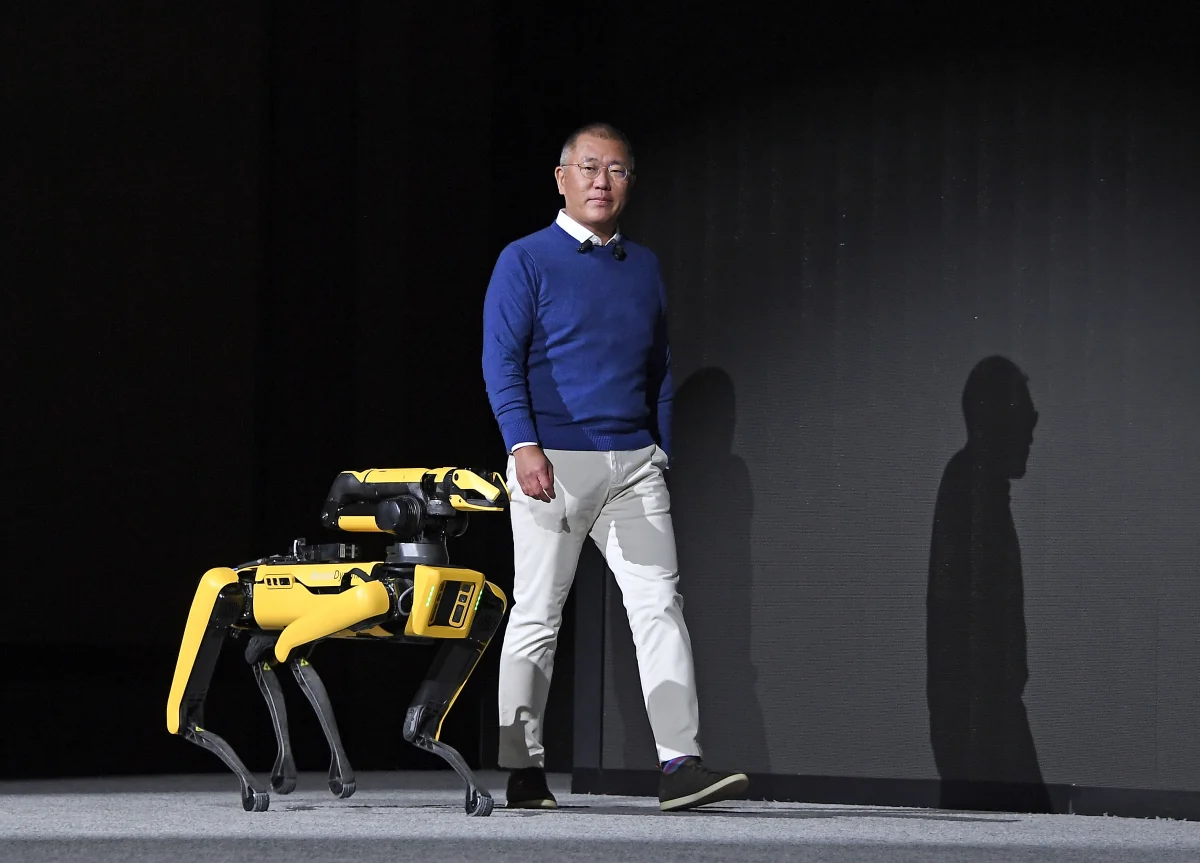
For Boston Dynamics, Hyundai Group was a good destination. While SoftBank had financial resources and experience in tech investments, it lacked large-scale industrial manufacturing capabilities. Hyundai, on the other hand, possessed factories, production lines, and logistics systems spread across the globe, which could help Boston Dynamics reduce manufacturing costs and provide important application scenarios for its robotic products.
Meanwhile, Pepper's commercialization experiment also came to an end. Due to insufficient market demand and stockpile issues, Pepper ceased production in 2020, with a cumulative production of about 27,000 units. In 2022, SoftBank sold its European robotics business responsible for developing Pepper to Germany's United Robotics Group.
From emotional robots to high-dynamics movement robots, Masayoshi Son's two previous attempts to directly enter the robotics product market did not achieve the expected commercial outcomes.
However, although Masayoshi Son temporarily set aside the vision of personal robot commercialization, he never left the robotics industry.
Just as SoftBank was shrinking its own robotics business, in April 2021, SoftBank invested $2.8 billion to acquire approximately 40% of Norwegian warehouse robotics company AutoStore. This company’s robots do not resemble humans and lack complex emotional interaction capabilities, but they handle goods efficiently in warehouses, process orders, and provide measurable economic benefits to customers.
Adjusting Life Plans and Going All In on ASI
In SoftBank Group’s 2026 annual report, Masayoshi Son revisited a life plan he made at the age of 19.
According to the original plan, he would establish a career in his 20s, accumulate funds in his 30s, face major challenges in his 40s, realize his vision in his 50s, and pass on his business to the next generation in his 60s. However, now at age 68, Masayoshi Son has decided to modify this plan and extend his entrepreneurial career by another 10 to 15 years.
His new goal is to promote the realization of Artificial Superintelligence (ASI).
The development of generative AI has significantly changed Masayoshi Son's judgment regarding the development stage of the robotics industry. The computers that he once imagined could learn and think autonomously now have more concrete technological paths to realization.
In Masayoshi Son's view, when this intelligence is combined with robots, it will form what is termed Physical ASI, allowing artificial intelligence to enter the real world and autonomously perform tasks in manufacturing, construction, agriculture, and even scientific research. Thus, robots become an indispensable part of SoftBank's overall AI strategy.
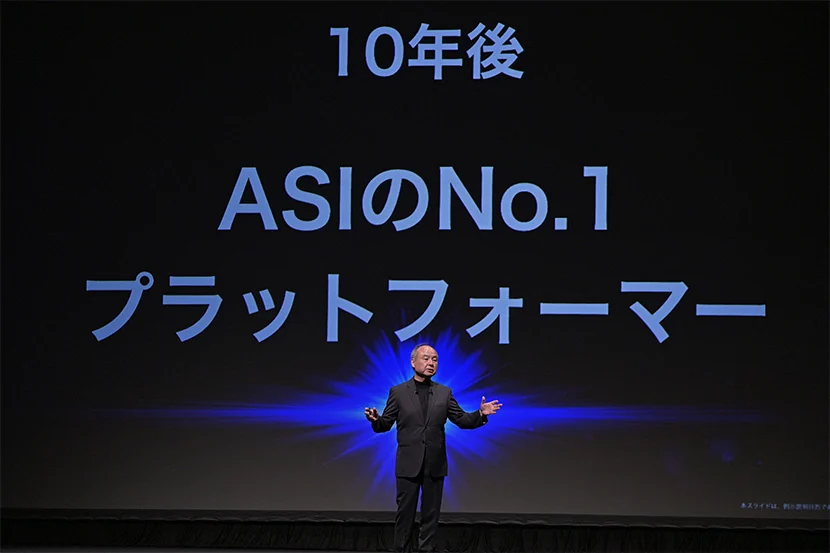
In the annual report, Masayoshi Son also made an analogy: in the game of Go, occupying the four corners of the board is often more important than how many pieces one has early in the game. The four corners of the ASI era are AI models, semiconductors, AI infrastructure, and robots.
In the first three fields, SoftBank has already invested massive amounts through investing in OpenAI, acquiring Arm, and building large AI data centers. As for the robotics field, the primary goal Masayoshi Son needs to address is precisely the capability that Pepper and Boston Dynamics lacked back in the day — to enable robots to possess sufficiently powerful intelligence and perform real work at lower costs.
On November 24, according to the robotics industry media The Robot Report, SoftBank completed the acquisition of the Robotics and AI Institute (RAI).
This research institution was established by Boston Dynamics founder Marc Raibert in 2022 and received over $400 million in initial funding from Hyundai Motor Group and Boston Dynamics. Unlike Boston Dynamics, this institution is not tasked with directly selling whole robots but focuses on fundamental technical issues such as artificial intelligence, motion control, perception, and autonomous operation.
In 2025, RAI announced research collaboration with Boston Dynamics to enhance the training of the Atlas humanoid robot to master more complex physical movements.
However, RAI's research model also means continuous and substantial funding consumption. From its establishment in 2022 to 2025, RAI has not generated operating revenue, while its operating losses expanded from 4.9 billion won in 2022 to 213.1 billion won in 2025, totaling over 310 billion won in cumulative operating losses over four years.
For Hyundai, which is pushing for mass production and factory deployment of Atlas, focusing resources on developing Boston Dynamics has clearer industrial logic.
SoftBank, on the other hand, faces a different situation. SoftBank has already invested in numerous robotics manufacturers and foundational model companies, and the general motion control, perception, and autonomous operation technology studied by RAI may apply to various robotic products and commercial scenarios in the future.
Building a Robotics Empire
According to SoftBank Group's latest financial report released in November, its investments in the physical AI field now exceed 30 companies, covering fundamental robotic models, humanoid robots, industrial automation, warehousing logistics, autonomous driving, and other areas. About 20 of these robot-related invested companies have been concentrated into an intermediate holding company, Robo HD, to promote sharing and collaboration in technology, talent, and business resources among these companies.
From the investment and acquisition situation in recent years, SoftBank has already laid out in multiple critical segments of the robotics industry.
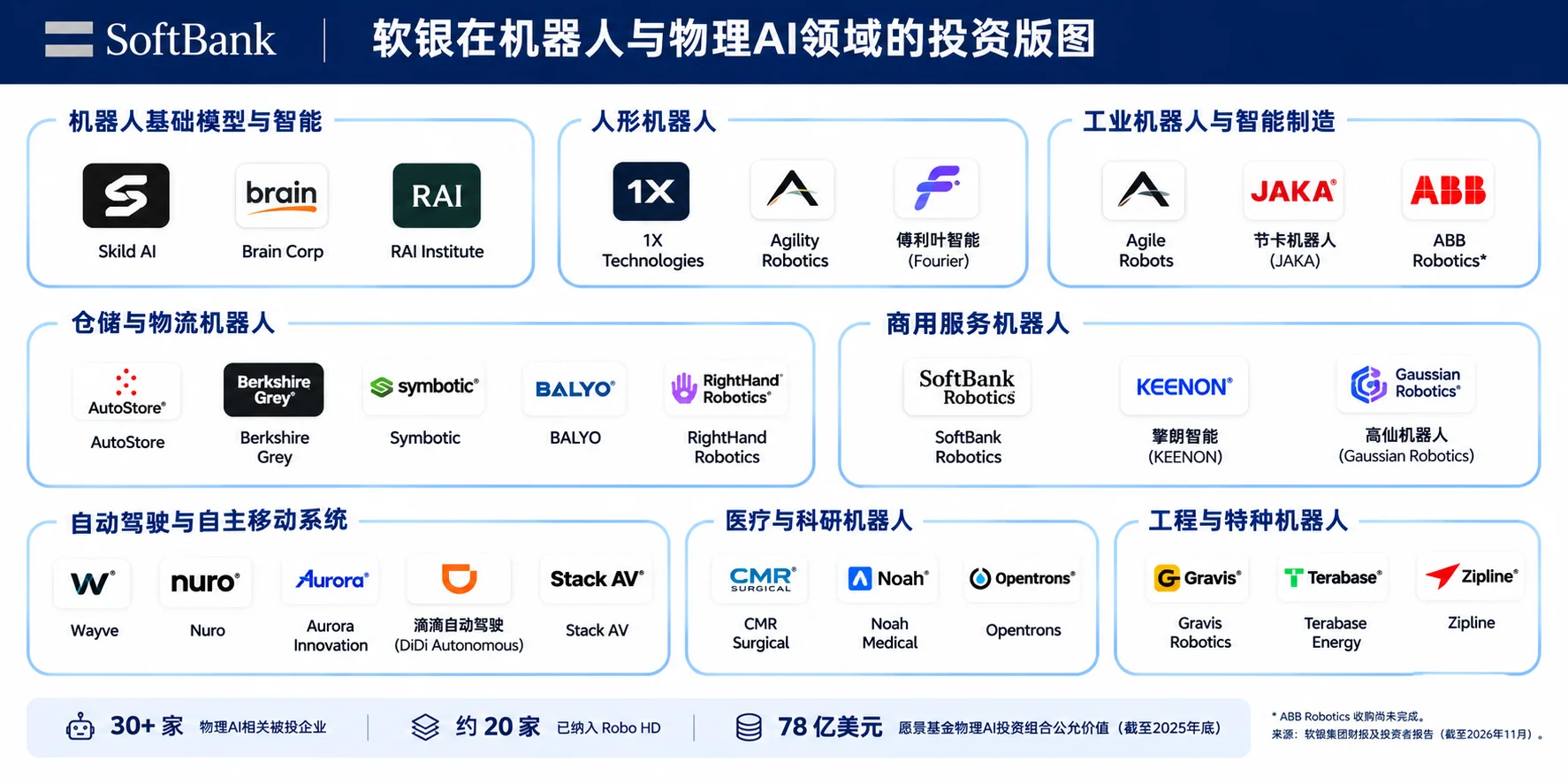
In the field of robotic foundational models, SoftBank has heavily invested in Skild AI.
In January 2026, Skild AI announced the completion of a $1.4 billion Series C funding led by SoftBank, with participation from NVIDIA's NVentures, Macquarie Capital, and Bezos Expeditions, bringing its valuation to over $14 billion.
This company, founded by former Carnegie Mellon University professors Deepak Pathak and Abhinav Gupta, is dedicated to developing general robotic foundational models that can adapt to different robotic hardware and perform various types of tasks. Under this technological path, robotics manufacturers can focus more on hardware design and practical applications, while foundational model companies have the opportunity to become technical suppliers for numerous robotic manufacturers.
In the fields of robotic entities and industrial applications, SoftBank is continuously expanding investment in companies like Agile Robots.
On November 12, 2026, German robotics company Agile Robots, founded by Chinese robotics expert Chen Zhaopeng, announced the completion of $500 million in Series F funding, with SoftBank as the lead investor and NVIDIA among other contributors, achieving a valuation of $8.5 billion.
Agile Robots has accumulated years of commercial experience in industrial robotic arms, dexterous hands, force control technology, and intelligent manufacturing solutions, with products primarily aimed at industries such as automotive and electronics manufacturing.
SoftBank is also seeking entry into the home humanoid robot market. In August of this year, according to The Information, SoftBank is negotiating to acquire a controlling stake in humanoid robot company 1X Technologies at a valuation of approximately $6 billion.
In the warehousing logistics and industrial automation fields, SoftBank's layout can be traced back to even earlier times.
In addition to acquiring approximately 40% of Norwegian warehousing automation company AutoStore for $2.8 billion just before selling its controlling stake in Boston Dynamics, in 2023, SoftBank also acquired the remaining shares it did not own in the American logistics robotics company Berkshire Grey for approximately $375 million, taking it private. This company mainly utilizes artificial intelligence and robotics technology to provide automated sorting, handling, and order fulfillment solutions for retail, e-commerce, and logistics enterprises.
Compared to the still early-stage commercialized general humanoid robots, warehousing logistics and industrial automation offer clearer market demand, customer groups, and business models.
Additionally, Chinese robotics companies are also an important part of this investment landscape. Besides Agile Robots founded by Chen Zhaopeng, SoftBank has also invested in Fourier Intelligence, JAKA Robotics, Qinjia Lieber, and Gausium through its vision fund, covering fields like humanoid robots, collaborative robots, commercial service robots, and cleaning robots.
From RAI's foundational research, Skild AI's general robotic models, to Agile Robots' industrial robots and AutoStore's warehousing automation systems, SoftBank is attempting to establish an industrial portfolio covering robotics technology research and development, intelligent models, hardware manufacturing, and practical applications.
Dreams and Reality Bills
Switzerland's industrial giant ABB, with decades of experience in industrial robot manufacturing, is viewed by SoftBank as an important industrial anchor in the robotics industry.
On October 8, 2025, SoftBank announced a final agreement to acquire ABB's robotics business for $5.375 billion. In addition to providing mature robotic hardware technology, ABB also offers global sales channels, manufacturing systems, customer resources, and long-accumulated industrial application experience. These resources are expected to provide pathways for commercialization and large-scale deployment of the cutting-edge robotic technologies invested in by SoftBank.
However, this transaction has encountered significant resistance. According to Reuters, insiders reported that Chinese regulatory concerns involve SoftBank's connections with American tech companies like OpenAI, prohibiting it from acquiring ABB's robotics business in China. The Chinese business accounts for approximately 30% of ABB's overall robotics business, and stripping this portion will substantially affect the existing acquisition plan.
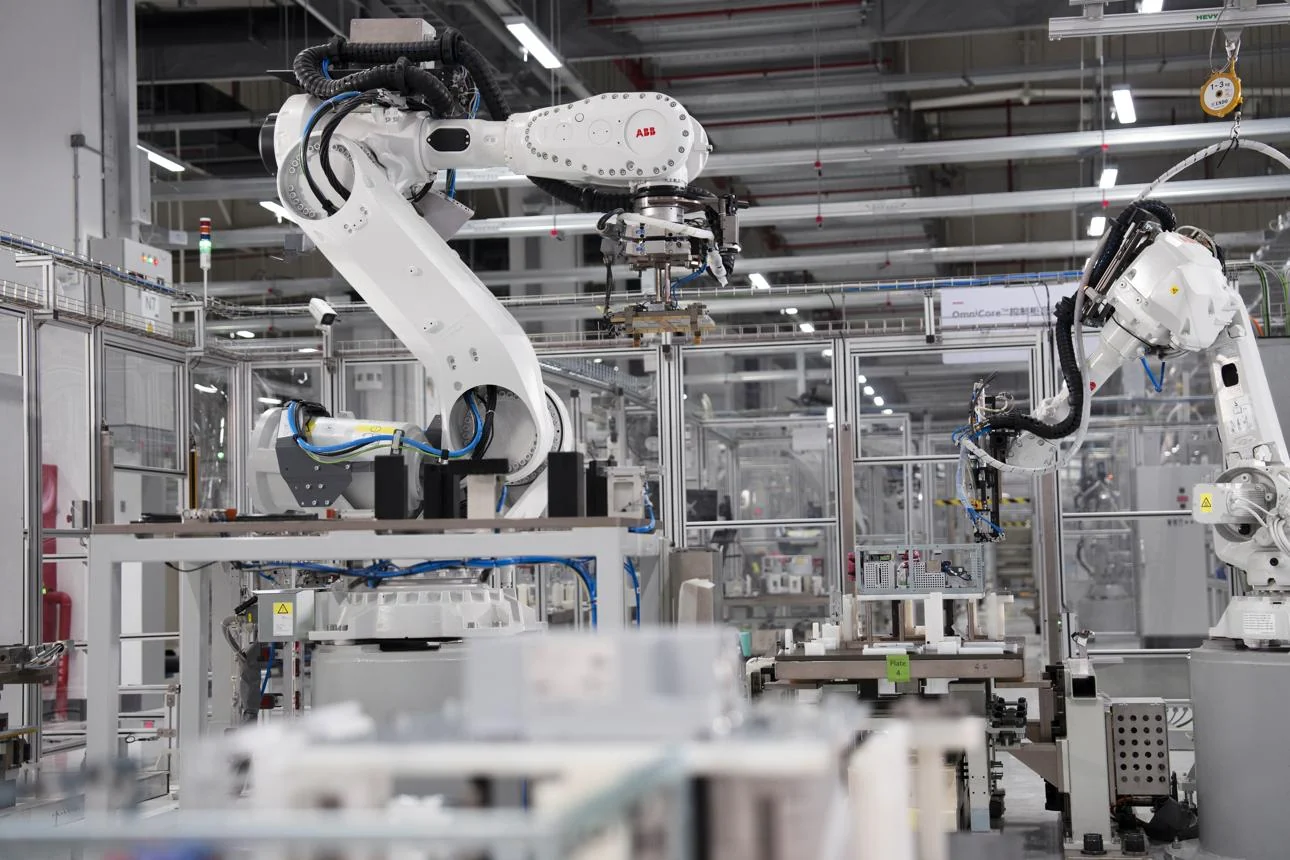
For SoftBank, the impediment to the ABB acquisition also reveals the complexity of its globalization industrial integration strategy. Even if it can incorporate robotics companies from different countries and technological pathways into its investment portfolio through capital operations, the sharing of technology, flow of data, and business synergy among companies remain influenced by multiple factors, including commercial interests, regulatory systems, and geopolitical concerns.
In addition to the resistance faced by multinational mergers and industrial integrations, SoftBank's financial status has also raised concerns in the capital market.
On November 26, according to Reuters, the five-year credit default swap (CDS) spread for SoftBank Group rose to 534.6 basis points, reaching a new high since October 2022. From July to September of this year, SoftBank's financing scale reached approximately 9 trillion yen, and financing costs surged to 461.9 billion yen, 2.6 times that of the same period last year.
Although SoftBank still possesses valuable assets like Arm, as its investments in OpenAI, data centers, and robotics expand, the group's financial situation increasingly relies on the valuations of AI-related assets and future investment returns. However, the technological R&D, large-scale production, and commercial landing of the robotics industry still need to undergo a lengthy cycle.
More than a decade ago, Masayoshi Son's judgment regarding the intelligence and popularization of robots appeared to be somewhat forward-looking. Today, advancements in AI technology provide more mature technical conditions for realizing this vision than back then. However, as evidenced by the experiences of Pepper's discontinuation and the sale of Boston Dynamics, the correct judgment of industrial development trends does not necessarily translate into commercial success.
For the now 69-year-old Masayoshi Son, this round of robotics investment is both a continuation of dreams from over a decade ago and a significant test of SoftBank's capital strength and industrial integration capabilities.
免责声明:本文章仅代表作者个人观点,不代表本平台的立场和观点。本文章仅供信息分享,不构成对任何人的任何投资建议。用户与作者之间的任何争议,与本平台无关。如网页中刊载的文章或图片涉及侵权,请提供相关的权利证明和身份证明发送邮件到support@aicoin.com,本平台相关工作人员将会进行核查。