

Every Monday, Wednesday, and Friday, focusing on the crypto market, Japan, South Korea, A-shares, and Hong Kong stocks, using data to review the market, and employing trends to seize opportunities, produced by PANews.
BTC Reclaims $60,000, Rebound Still Limited by Funding, Battle Between Bulls and Bears at $62,700
BTC experienced a sharp washout amid thin liquidity on Thanksgiving, after forming a higher low, the price has started to challenge $62,000. The market has begun discussing whether $55,000 has become a temporary bottom, but from the perspective of spot fund flow, institutional positions, and technical structure, it is still too early to declare the end of the bear market.
Behind this rebound are both low-position buying support and short covering. Alex Marzell believes that Bitcoin has completed a round of liquidity cleanup, and the preceding drop below $55,000 may have been the last concentration washout. The core test for the market now is $62,700. If this position can be effectively reclaimed, the range between $70,000 to $72,000 will become the potential target for the next phase; however, if the rebound fails again, the market may retest the previous low of $55,500.
The range between $55,000 and $58,000 is becoming the most important battleground for both bulls and bears. Tranquility Crypto points out that BTC has once again touched the lower boundary of the downward channel, with key support around $57,000 to $58,000, and there are a large number of spot buy orders in the $50,000 to $58,000 range, similar to the bottom-support structure that emerged around $55,000 to $60,000 in July of this year. Some large funds may have started accumulating in batches. Scient has also given a more cautious assessment, stating that although BTC has rebounded from around $55,000, it is still under pressure from the low point of the value zone around $61,300, and it needs to break through the volume control point at $64,100 and the four-hour reversal signal around $64,400 to strengthen.
Regarding the market, Saif Trades warns that the rebound to around $63,000 may be an opportunity to short, and there is a possibility of breaking below $55,000 and forming new lows. ProfitHusky also believes that the short side may continue to maintain an advantage in the short term, and there will still be downward pressure in the next month, but he is placing orders in batches in the $50,000 to $70,000 range, waiting for the trend reversal that may occur in the first quarter of 2027.
Rekt Capital seeks bottom clues from the deviation from historical highs. During the 2022 bear market, Bitcoin fell approximately 22% below the 2017 historical high, while this round of BTC has already fallen about 20% below the 2021 historical high; if the previous round's deviation repeats, the price may further drop to around $53,800. However, he also points out that as December approaches, the time window for the market to reach a potential cycle bottom is narrowing, and there may be limited time for further downward movement.
Santiment data reveals that since November 2, whale wallets holding between 10 to 10,000 BTC have decreased by approximately 150,000 BTC and still control 67.55% of the Bitcoin supply in the network. The continuous reduction by whales indicates that there may be continuous new sell pressure during the rebound process, and even if the price reclaims $60,000, it does not mean that large funds have turned back to net buying.
Additionally, approximately $7.4 billion in BTC and ETH options contracts will expire this Friday. Since the current price is significantly distant from the maximum pain point of BTC at $72,000, it is expected that market volatility will increase around expiry, and after contract settlement, a brief release of pressure may also occur. Currently, the $60,000 to $63,000 range has formed a new liquidity accumulation area, and short-term prices may fluctuate continuously in this range.
Affected by the dollar index and Federal Reserve policies, BTC is closely linked to the macro market. Economist Robin Brooks warns that if there are no dovish signals before the FOMC silence period on November 28, risk assets may face pressure. Traders suggest closely monitoring whether the weekly close can hold steady at $62,500 to $63,000, as well as whether the fund flow of the U.S. spot Bitcoin ETF can shift from net outflow to net inflow. If $60,000 is lost and the ETF continues to bleed, the market may once again revisit the $53,800 to $55,000 area.
Ethereum Rebound Still Pressured at $1,700, Altcoin Oversold Signals Flicker, Withdrawal of Funds Not Yet Ended
Ethereum and the altcoin sector are overall performing weakly, with exchange rates under continuous pressure. Due to heightened risk-off sentiment and significant redemptions of stablecoins, ecological liquidity is experiencing rare tightening. CryptoQuant data shows that in the past 60 days, USDT supply has decreased by $8.1 billion, almost entirely concentrated on the Ethereum chain, marking the largest single-month contraction since August 2022. Additionally, the total locked value (TVL) in DeFi dropped to $43.5 billion at the end of October, Ethereum's spot ETF had a net outflow of more than 640,000 ETH in one month, and the CME futures basis income slid to a low of $68 million, with funding rates occasionally turning negative.
On the trading side, Ethereum is repeatedly contesting the $1,600 to $1,700 range, having faced selling after a previous spike to $1,840 to $1,850. Trader Merlijn points out that $1,700 has become a significant resistance level, with $1,570 being a key defense line; if lost, $1,450 will come into view. Analizci Hoca believes that if the daily close can hold above $1,711 and achieve a weekly close above $1,724, there is a chance to challenge the $1,845 neck line. VoidOnChain states that it has established a bottom position in the $1,500 to $1,600 range, targeting a take-profit at $2,800.
Additionally, the altcoin sector is displaying extreme bottoming signals. Axel Bitblaze points out that currently, 100% of the top altcoins have fallen below the 50-day moving average, with 92% falling below the 200-day moving average. Historically, in similar “all breaking” market conditions, 9 out of 14 times the sector saw a bottom within the following 10% range, followed by a strong rebound of 30% to 70%, indicating that weak hands have been thoroughly washed out. However, Daan Crypto Trades emphasizes that until BTC completes its bottoming process, altcoins are unlikely to form an independent trend, and it is crucial to observe whether the ETH/BTC ratio can break through the critical line of 0.03.
In terms of institutional funds, Glassnode data shows that net inflows of Ethereum funds were almost zero in October, and institutional attention to ETH decreased from 42% to 25%, indicating reduced willingness for fund allocation. Ethereum core developers have set December 15 as the activation time for the Glamsterdam upgrade on the Hoodi testnet, with the mainnet window pointing to mid-January 2027, aiming to promote expansion routes like ePBS, but technical upgrades may still struggle to offset the pressure from fund outflows in the short term.
Today's Highlights:
Anza Confirms Agave v4.5 Mainnet Beta Upgrade Candidate Version
Upbit 24-hour trading volume ranking: BTC, XRP, HAEDAL, MMT, EGLD
Yesterday, Bitcoin's spot ETF had a total net outflow of $453 million, continuing a 7-day net outflow.
Ethereum's spot ETF had a total net outflow of $68.51 million yesterday, continuing a 9-day net outflow.
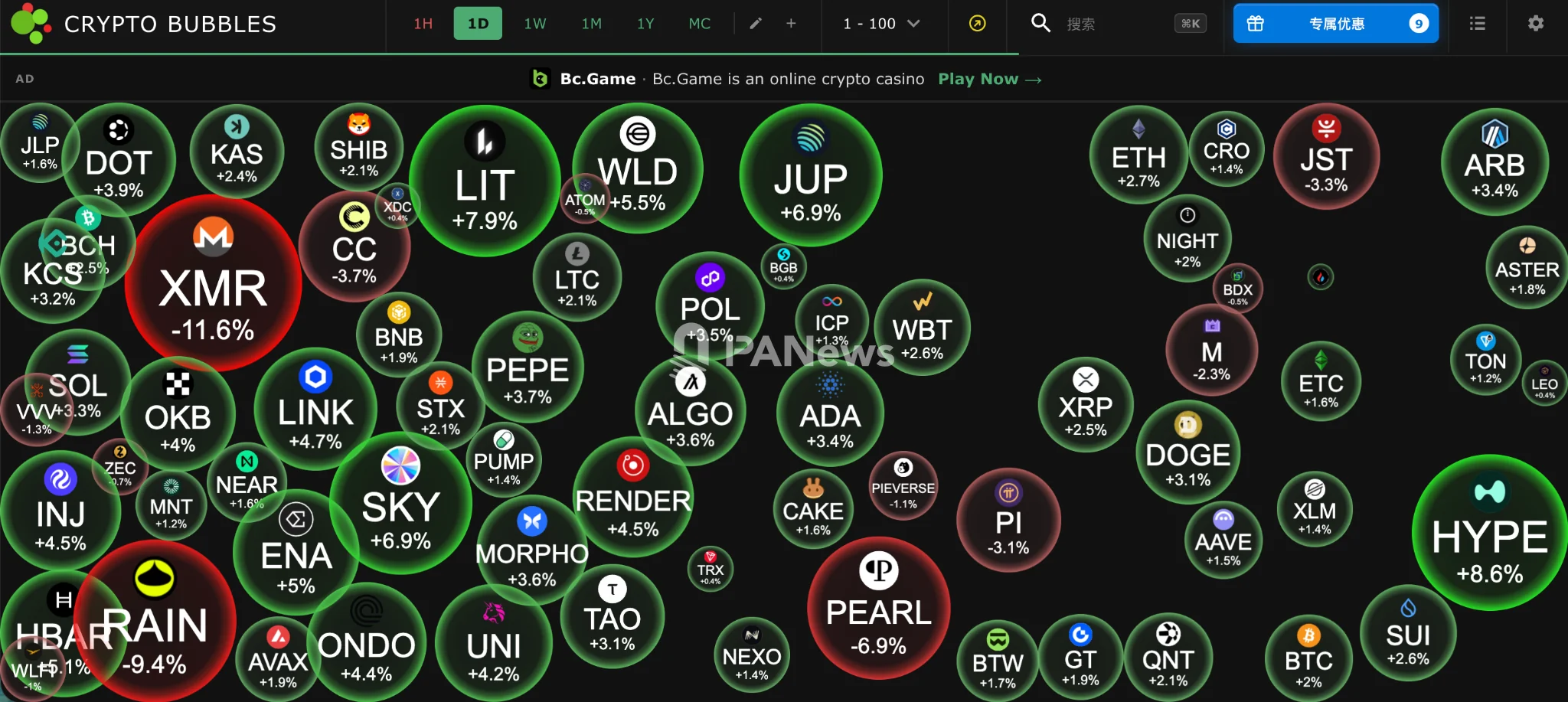
Today's largest gainers among the top 100 cryptocurrencies by market capitalization: HYPE up 8.3%, LIT up 7.8%, SKY up 6.8%, JUP up 6.6%, WLD up 5.5%.
Asian Tech Stocks Stage a Collective Counterattack, A-shares Startup Board Posts Largest Single-Day Gain in Two Years
On November 27, Asian stock markets welcomed a recovery in risk appetite, with technology stocks in South Korea, Japan, Hong Kong, and mainland China becoming the main force driving the rebound. Demand for AI chips, positive expectations in semiconductors, and policy support are driving funds back into the technology growth sector.
KOSPI Soars 4.34%, Strong Export Expectations
The South Korean Composite Index closed up 4.34%, with the KOSDAQ Index surging 8.13%, driven by both fundamentals and policy expectations. A Reuters survey shows that due to demand for AI-related memory chips, South Korea's exports in November are expected to grow 96.8% year-on-year, the highest since January 1974 and marking the 18th consecutive month of growth. The Bank of Korea raised its 2027 economic growth forecast from 2.9% to 4.1%, the fastest growth rate since 2021. iM Securities Chief Economist Park Sang-Hyun believes that the strength in semiconductor exports indicates that November export figures are likely to set a new monthly record.
On the policy side, Citigroup economist Kim Jin-wook expects the scale of the securities market stabilization fund may be raised from 10.76 trillion won to 20 to 40 trillion won, potentially activated as early as next month. Kiwoom Securities analyst Han Ji-young cautioned that prior to new funds genuinely flowing in, the rebound space may be limited, but "there is no need to adopt a more pessimistic attitude currently." On the stock side, Samsung Electronics rose 4.55%, and SK Hynix rose 5.41%. The rebound of SK Hynix does not imply risks have dissipated. Goldman Sachs, while maintaining a buy rating on SK Hynix, significantly lowered its target price from 3.5 million won to 2 million won, a drop of 43%, citing increased DRAM supply from China and weak NAND demand. TrendForce forecasts that NAND flash contract prices may decline by as much as 5% in Q1 2027, with NAND supply expected to grow by 25% to 30% next year, which may put new pressure on SK Hynix's profits.
Nikkei 225 Up 2.11%, Semiconductor Equipment Leads the Surge
The Japanese stock market also experienced a strong rebound, with the Nikkei 225 Index closing up 2.11%, while the Topix Index rose 1.73%. Semiconductor inspection, silicon wafer, and manufacturing equipment companies performed exceptionally, with Lasertec up nearly 10%, SUMCO up 9.81%, and Tokyo Electron up 4.43%.
Deutsche Bank’s latest global outlook for 2027 clearly favors U.S. and Asian tech stocks, believing that the tech stock sell-off that began in mid-October is nearing its end. The bank statistics show that similar volatility shocks historically take an average of 6-8 weeks to gradually subside, and this round of the Nasdaq 100 index has dropped about 12% since mid-October, while the overall semiconductor sector has fallen about 29%, already undergoing a significant valuation adjustment.
However, Deutsche Bank also warns that AI capital expenditures, while being the engine for the market's rise, may also become a source of future risks. The growth rate of capital expenditures by large-scale cloud service providers is expected to peak in 2027, but investors are likely to gradually shift their focus from the scale of investment to AI applications and commercial returns.
Hang Seng Tech Index Surges 6.43%, Domestic Computing Power Warms Up
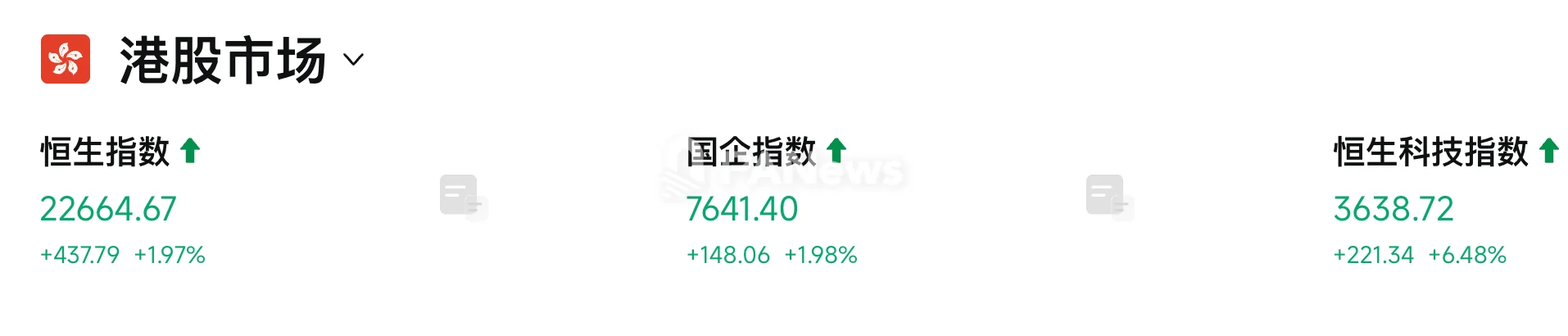
Hong Kong stocks continued to rebound, with the Hang Seng Index closing up 1.97% and the Hang Seng Tech Index soaring 6.48%. Semiconductor manufacturing, AI chips, and optical communication sectors strengthened across the board. SMIC rose 15.3%, while Shanghai Suir Technology and Biran Technology surged more than 30% and 25.48%, respectively. The AI large model concept is in high demand, with MiniMax and Zhiyu gaining over 20% in the afternoon. Lenovo Group rose nearly 7%, with earnings exceeding expectations; Alibaba gained over 3% during trading, as the market focused on self-developed AI chips. Media reports suggest the new generation chip "Zhenwu V900" is expected to go into mass production in the first quarter of next year. The founder of MiniMax stated they will accelerate the adoption of Huawei and Alibaba's AI chips to reduce dependence on Nvidia.
Gold stocks also collectively rebounded, with Lingbao Gold and China Gold International gaining around 10% during trading, and spot gold rising above $3,600. UBS has lowered its year-end gold price target for 2026 to $4,500 but maintains the 2027 year-end forecast at $5,000. CITIC Securities pointed out that this year's gold price plummeted 14.5% mainly due to liquidity tightening, and short-term rebounds will depend on the Federal Reserve's statements in December.
A-shares Signal Stability, Startup Board Soars 11.61%
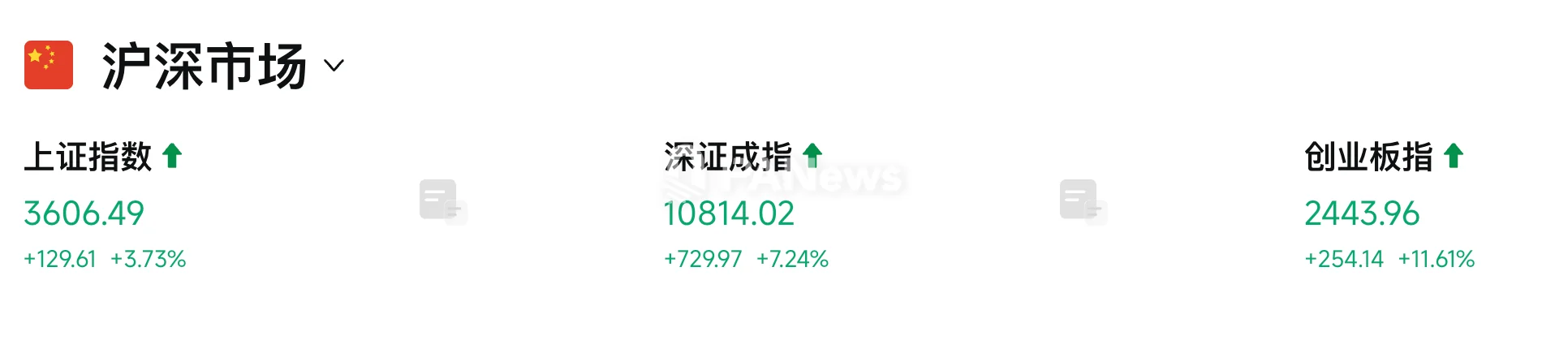
A-shares launched a strong counterattack, with the Startup Board closing up 11.61%, marking the largest single-day gain since October 8, 2024, the Shanghai Composite Index rose 3.73%, breaking above 3,600 points, the Shenzhen Component Index rose 7.24%, and the CSI 300 Index increased by 4.17%, while the STAR 50 Index surged 15.07%. Nearly 5,400 stocks in Shanghai, Shenzhen, and Beijing rose, with over 400 stocks hitting the daily limit, and total trading volume around 2.02 trillion yuan.
The direct catalyst was the State Council executive meeting held on November 27. The meeting proposed to strengthen the role of the "national team" in stabilizing the market, further optimize the quasi-"stabilization fund" functions of the Central Huijin Investment Company, "provide ample liquidity support," and improve policies for long-term funds such as insurance, annuities, and social security funds to enter the market. According to China Securities Journal, this is the first time the State Council executive meeting mentioned the capital market twice within a month, with relevant content reaching a record 285 words, the most in history.
Semi-conductors, CPO, HBM, photolithography machines, computing power, and humanoid robots and other tech sectors have all erupted. Yushu Technology hit the 20% limit up, and the humanoid robot sector followed suit. The transaction volume of the Sino-Korean semiconductor ETF exceeded 31.6 billion yuan, setting a historical record, with an increase of over 9%.
免责声明:本文章仅代表作者个人观点,不代表本平台的立场和观点。本文章仅供信息分享,不构成对任何人的任何投资建议。用户与作者之间的任何争议,与本平台无关。如网页中刊载的文章或图片涉及侵权,请提供相关的权利证明和身份证明发送邮件到support@aicoin.com,本平台相关工作人员将会进行核查。