This Issue Highlights
This week's report covers the statistical period from November 20, 2026, to November 27, 2026.
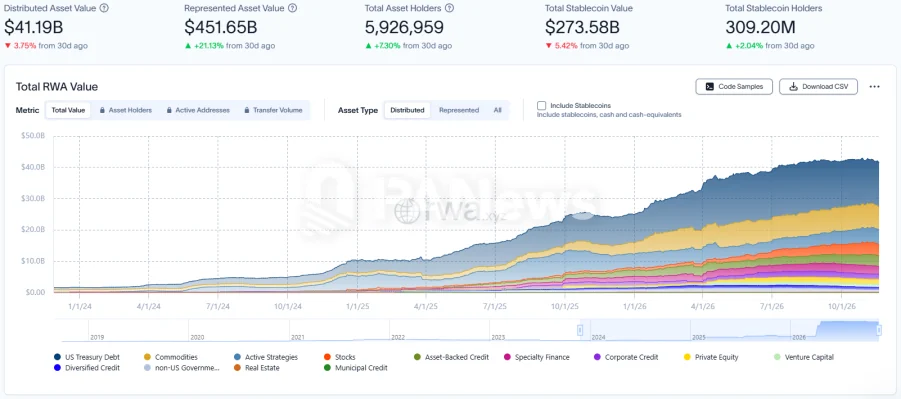
This week, the total on-chain market cap of RWA reported $41.19 billion, down 3.75% compared to the previous month, with pressures on the asset side in the short term. However, the total number of asset holders rose to 5.927 million, an increase of 7.3%, indicating a sustained increase in user participation willingness, revealing a divergence trend; the total market cap of stablecoins fell back to $273.09 billion, with monthly transfer volume significantly contracting by 56.96%. On-chain trading activity has notably cooled, but active user addresses and holder numbers continue to grow, with Ethena's USDe market cap rising 8.75% month-over-month, becoming the only stablecoin among the top to see counter-trend growth.
On the regulatory side, the Hong Kong Monetary Authority officially launched the CMU digital asset platform, achieving comprehensive tokenization of bonds and on-chain DvP atomic settlement, supporting 24-hour multi-currency settlements. Future plans include expansion to various asset types such as funds and RWAs, interfacing with tokenized deposits and regulated stablecoins; the European Central Bank has solicited cooperation from the financial industry to explore pathways for tokenized deposits and securities; South Korea plans to legislate requirements for overseas stablecoin issuers to deposit reserve assets in local banks, strengthening cross-border regulatory constraints.
At the project level, BlackRock launched the first tokenized Hong Kong dollar money market fund in the Asia Pacific region, allowing subscription with the licensed stablecoin HKDAP; JPMorgan Chase and HSBC completed digital gold fractional trading tests in London, exploring a new form of gold as on-chain collateral; the joint venture OKXICE TSV has been launched for compliant users in the U.S., planning to open up 113 tokenized assets in batches.
In segmented financing tracks, activities remain active with mine RWA infrastructure Global MPC and the art recovery and tokenization protocol LART completing funding successively.
Data Perspective
RWA Track Overview
According to the latest data disclosed by RWA.xyz, as of November 27, 2026, the total on-chain market cap of RWA reached $41.19 billion, down 3.75% compared to the same period last month. The total number of asset holders recorded was 5.927 million, up 7.3% from the same period last month, reflecting a divergence of short-term pressure on the asset side and increased user participation willingness.
Stablecoin Market
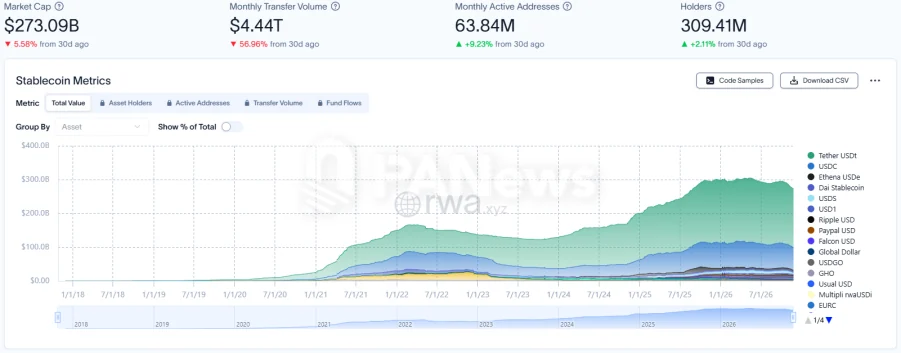
The total market cap of stablecoins reached $273.09 billion, down 5.58% compared to the same period last month; the monthly transfer volume was $4.44 trillion, significantly declining by 56.96% month-over-month; the total number of active addresses reached 63.84 million, up 9.23% from the same period last month; the total number of holders reached 309 million, a slight increase of 2.11% from last month. This month, the stablecoin track shows a marginal weakening of liquidity, with trading frequencies of existing funds contracting, although user resilience shows supporting diverging characteristics.
The top stablecoins are USDT, USDC, and USDe, among which USDT's market cap decreased by 4.31% compared to the same period last month; USDC's market cap fell by 2.93%; USDe's market cap rose by 8.75% compared to the same period last month.
Regulatory News
The Hong Kong Monetary Authority announced the formal launch of the CMU digital asset platform on November 25. The platform was developed and operated in collaboration with Hong Kong's Central Clearing and Settlement Systems, based on distributed ledger technology (DLT), enabling a central settlement system for debt instruments. The CMU digital asset platform realizes a fully paperless process from bond issuance in the primary market, secondary market trading, and settlement to interest payment and redemption, and supports traditional bond tokenization. The platform uses an on-chain atomic DvP settlement model, interfacing directly with real-time gross settlement (RTGS) systems and central bank digital currencies (CBDC), and supports 24-hour multi-currency settlement through cash tokens.
The Monetary Authority stated that the settlement system has a roadmap to expand the platform's coverage from bonds to other asset categories such as funds and real-world assets, while promoting its integration with other DLT platforms and payment tools (such as tokenized deposits and regulated stablecoins) to establish a digital financial ecosystem.
According to Cointelegraph, the European Central Bank (ECB) is inviting participants from the financial industry to engage in experiments under its “Appia” initiative to explore tokenized deposits and securities. The initiative has identified three priority areas: tokenized deposits and related payments, tokenized securities, and shared network governance.
Interested participants must apply in a collective initiative format composed of independent legal entities, rather than individually. Teams may apply for one or more workflows, and proposals will be evaluated based on expertise, practical experience, technical readiness, and expected contributions. The deadline for submitting applications for the first round of experiments is December 11, and subsequent applications will be assessed on a rolling basis. The ECB plans to release a blueprint in 2028 outlining relevant findings and recommendation frameworks.
South Korea Plans to Require Overseas Stablecoin Issuers to Deposit Reserve Assets in Local Banks
According to Digital Asset, South Korea's Financial Services Commission has stipulated in the drafting of the "Law on Digital Asset Innovation and User Protection" that overseas stablecoin issuers such as Tether and Circle must establish branches or offices in South Korea and register with the Financial Services Commission to carry out issuance and redemption operations while depositing or trusting reserve assets to local banks or other asset management entities. This requirement is similar to Section 18 of the U.S. GENIUS Act.
The bill states that the reserve assets of overseas issuers must be separated from their own property and managed by the asset management institution in prescribed ways, such as through bank deposits or government bond purchases, and must be managed separately by stablecoin. The specific scope of reserve assets will be determined by local regulatory systems and factors such as on-hand volume and circulation in South Korea. Additionally, overseas issuers must maintain operating funds in South Korea; if their South Korean branches are liquidated or bankruptcy occurs, assets in South Korea must be prioritized for repayment to South Korean creditors.
Local Experiences
BlackRock Launches Tokenized Hong Kong Dollar Money Market Fund in Hong Kong
According to the South China Morning Post, BlackRock announced on November 24 the launch of its first tokenized money market fund, the "BlackRock HKD Digital Liquidity Fund," in Hong Kong and the Asia Pacific region. Professional investors can now use digital cash including the Hong Kong Monetary Authority's licensed stablecoin HKDAP for subscriptions and redemptions, while retail investors must use Hong Kong dollars. The fund is a fixed-net-value money market fund that invests in short-term high-quality Hong Kong dollar money market instruments and deposits. Standard Chartered Bank acts as the custodian, administrator, and trustee, responsible for related tokenization operations. BlackRock's official product page shows that the fund was established on November 16.
Project Developments
JPMorgan Chase and HSBC Trade Digital Gold in London for the First Time
According to Bloomberg, JPMorgan Chase, HSBC Holdings, and StoneX Group completed a transaction last week in London using fractional ownership of physical gold bars, marking an early testing of the mechanism. The World Gold Council stated that this new system, called "pooled gold interests," is still in the experimental stage; if successfully promoted, it will become one of the significant new mechanisms in London's gold market structure in decades.
This system allows banks to use fractional ownership of gold bars as collateral without transferring the physical metal. Currently, thousands of billions of dollars' worth of gold changes hands weekly in London, mostly through "unallocated" paper contracts. The World Gold Council is also lobbying British authorities to incorporate gold into the country's financial collateral system.
Malaysia's Largest Bank Maybank Pilots Tokenized Government Bond Settlement
According to Ledger Insights, Malaysia's largest bank Maybank has completed another tokenization pilot using its licensed blockchain for the settlement of a tokenized Malaysian government bond transaction. The bank also provides custodial services for the underlying cash and securities. This is a further development following its completion of a cross-border payments pilot with Yinson Holdings involving tokenized deposits earlier this year. Maybank is also one of three participating institutions in Malaysia's Central Bank Digital Asset Innovation Center (DAIH).
Neuberger and Securitize Tokenized Fund HINC Launched on Aave Horizon
Securitize posted on Platform X that its high-yield bond tokenized fund HINC, jointly launched with global asset management institution Neuberger, has been launched on Aave's institutional-level RWA lending platform Horizon, allowing eligible investors to borrow USDC, GHO, and RLUSD against HINC as collateral. Securitize stated that HINC introduces actively managed high-yield credit assets to Horizon, bringing different risk and return characteristics.
OKXICE Confirms 113 Assets Were Opened for Trading in Batches Starting from November 24, 1:00 AM
According to the OKX official website, the tokenized securities trading platform OKXICE TSV, a joint venture with the Intercontinental Exchange (ICE), has been opened to compliant U.S. users since 12:00 PM Eastern Time on November 23 (1:00 AM Beijing Time on November 24), with assets available for trading in the TSV section of the OKX app 24/7. The website states that 113 assets (including stocks, ETFs, and ETPs) will be opened in batches starting from that day, with confirmed issuer and asset management firms including Better.com, BitGo, Circle, Coinbase, Direxion, eToro, Fidelity Investments, Robinhood, Securitize, Strategy, Strive, and Vida Global (including 6 crypto-related stocks). The platform operates under the U.S. SEC "Innovation Exemption," with trading conducted through OKX's Ethereum Layer 2 network X Layer using Uniswap v4-based AMM liquidity pools, provided by Securitize for tokenization infrastructure; the tokens are backed 1:1 by the underlying stocks and enjoy corresponding shareholder rights such as dividends and voting, with assets managed by users themselves.
The official site also explains that the platform is not a registered exchange or broker and has not received SEC approval. As of press time, trading hours had not yet arrived, and the official landing page still displays "Coming Soon," which does not indicate that trading is available. Companies such as Apple and Nvidia, among 67 others, have previously submitted objections.
OCBC Bank and StraitsX Pilot Stablecoin Payment Access to Business Bank Accounts
StraitsX announced a cross-border enterprise payment pilot in partnership with OCBC Bank (Oversea-Chinese Banking Corporation), integrating stablecoin settlements into existing OCBC accounts for participating clients, with NTT DOCOMO ASIA being the first client involved. This pilot employs StraitsX's dedicated wallet address (DWA) infrastructure, responsible for stablecoin receipt, fund identification, on-chain compliance, reconciliation, and settlement; OCBC Bank provides the banking relationship for receipt and fiat currency exchange withdrawal channels, allowing participating enterprises to avoid managing the underlying stablecoin payment processes themselves. The initial phase of the pilot focuses on certain cross-border enterprise payment scenarios, with future progression depending on applicable regulatory, compliance, and operational requirements. Unlike the previous concept verification of interconnectivity of tokenized deposit networks with StraitsX, OCBC, and Standard Chartered, this pilot is aimed at stablecoin payment access to existing business bank accounts.
The stablecoin financial services platform KOSH has announced the closure of all services. KOSH stated that despite efforts to operate, it has failed to establish a sustainable business, facing a difficult market environment and lacking funds to continue operations, thus deciding to gradually shut down all services. All KOSH Cards, virtual bank accounts (VBA), and withdrawal services will cease on November 30, 2026.
KOSH has sent withdrawal instructions to customer registered emails on November 18, and the withdrawal portal will remain open until December 15, with customers required to submit withdrawal requests by the deadline. For corporate clients, KOSH stated it is exploring solutions to assist them in migrating to other service providers, and the team will contact them directly to explain next steps.
U.S. Stock Token Trading Platform MSX Launches Two New Stock Tokens
The U.S. stock token trading platform MSX has launched spot and contract trading for the American home improvement retailer HD and the cloud-based financial management and human resources SaaS provider WDAY.
Financing Dynamics
Mining RWA Infrastructure Global MPC Completes $7.5 Million Strategic Financing
According to official news, Global MPC, a mining RWA infrastructure on the BNB Chain, announced the completion of a total of $7.5 million in strategic financing, with investors including MH Ventures, Mapleblock Capital, Paul Taylor, Genesis Capital VC, Becker Ventures, Titans Ventures, and Asva Capital.
Global MPC mainly develops blockchain infrastructure to convert real-world mining resources into on-chain digital assets for recording and circulation purposes.
According to official news, the art recovery and RWA tokenization protocol LART announced the completion of a $2.5 million financing round, with investors including IBC Group, x21 Digital, Genesis Capital VC, and GaeaVentures.
LART is a blockchain protocol based on the BNB Smart Chain, aimed at recovering lost art pieces, recording their provenance on-chain, and incorporating physical artwork into a regulated RWA framework.
Insights Summary
Gold and Bitcoin Suffer “Double Killing,” Will USDT Experience a De-pegging Crisis Again?
PANews Summary: Gold and Bitcoin prices have significantly retreated, raising market concerns about the risk of Tether's USDT losing its peg. Tether has a $7.95 billion excess reserve buffer, with 27% of its reserves comprising volatile non-cash assets like gold, Bitcoin, and stocks. Price drops could deplete this buffer, and S&P has rated its pegging capability at a minimum level of 5.
However, approximately 73% of Tether's reserves are held in short-term U.S. Treasury bonds and other high-liquid assets, with net operating profits reaching $4.5 billion in the first three quarters of 2026, indicating limited short-term payment risk. Tether rebutted S&P's assessment framework and has slightly reduced its gold holdings recently; analysts believe that extreme market conditions could expose collateral inadequacies, potentially generating phase de-pegging risks even if solvency remains reasonable and market panic persists.
PANews Summary: OKXICE leverages the SEC's five-year exemption to launch tokenized U.S. stocks, planning to roll out 113 assets in batches, but only 6 crypto-industry-related targets opened on the first day; among the initial 62 companies, 56 voiced objections, with a total of 67 companies indicating dissent. Companies do not entirely oppose tokenization; rather, they reject third-party constructed parallel records of shareholders' stakes.
OKXICE employs AMM pool matching, exposing risks related to pricing and underlying market deviations, with no central counterparty, noted in the SEC exemption documents, which also highlighted registry and pricing risks. The space has differentiated into venue tokenizations, issuer-led pathways, and exchange issuer-centric models, shifting the core battleground to shareholder registry control, with further observations required on dissenting lists, platform liquidity, and the rollout of plans by institutions like Nasdaq.
免责声明:本文章仅代表作者个人观点,不代表本平台的立场和观点。本文章仅供信息分享,不构成对任何人的任何投资建议。用户与作者之间的任何争议,与本平台无关。如网页中刊载的文章或图片涉及侵权,请提供相关的权利证明和身份证明发送邮件到support@aicoin.com,本平台相关工作人员将会进行核查。