Original | Odaily Planet Daily (@OdailyChina)
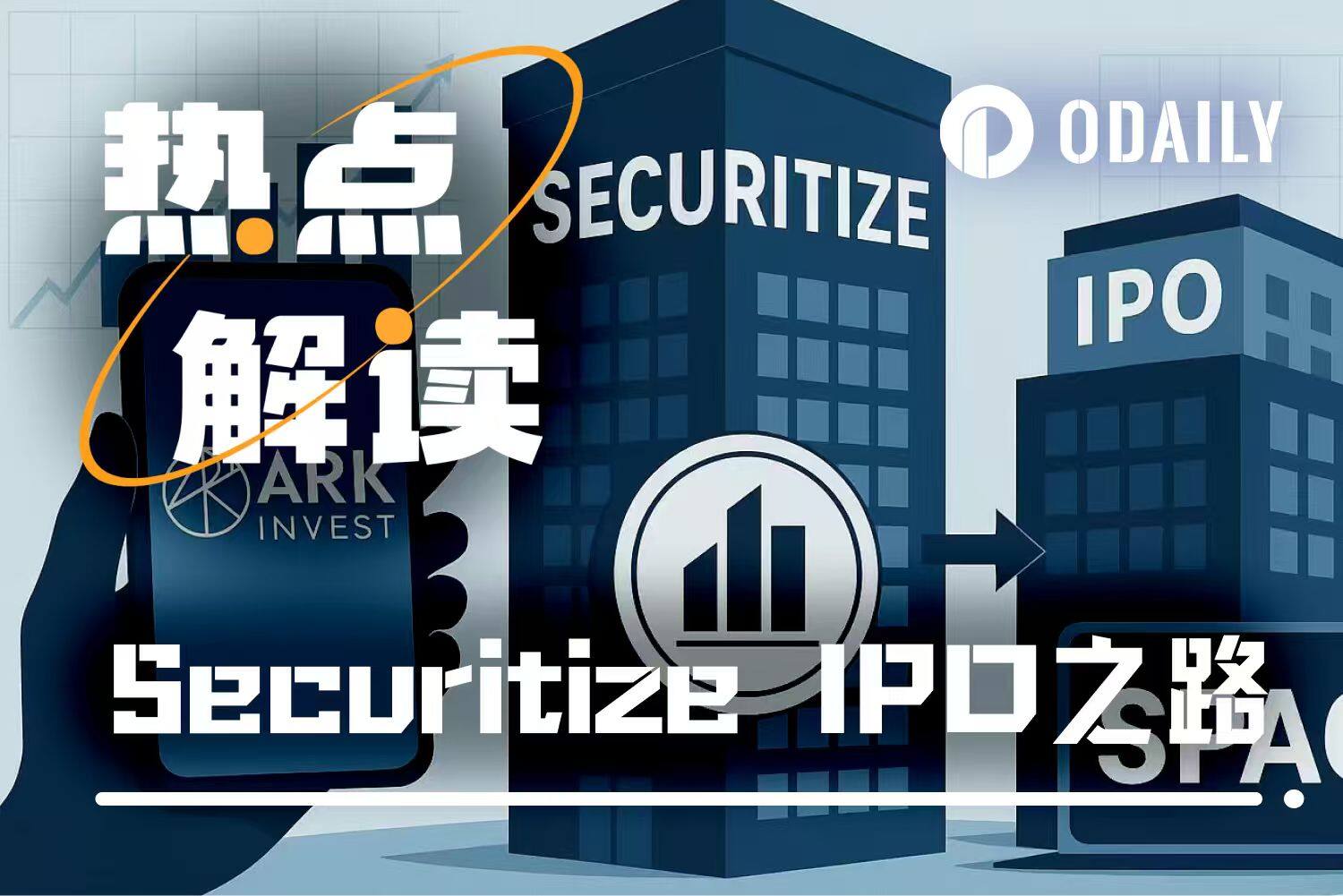
On December 17, the RWA platform Securitize announced plans to launch native on-chain stock products in the coming months, targeting the first quarter of 2026. Unlike most "stock tokenization" solutions on the market, Securitize will directly issue real, regulated shares on the blockchain and simultaneously record them in the issuer's official capital structure table; its tokens represent complete shareholder rights, including dividends, proxy voting, and more.
On October 28 of this year, Securitize disclosed plans to go public through a SPAC merger, with a post-merger valuation expected to reach $1.25 billion, trading under the ticker SECZ. As a key player in the tokenized money market fund space, Securitize has partnered with traditional asset management institutions such as BlackRock, Apollo, KKR, Hamilton Lane, and VanEck, accumulating a tokenized asset scale of over $3 billion.
In the current climate of heightened interest in RWA narratives, Securitize has become a market focal point. Odaily Planet Daily will analyze from a business perspective to help readers gain a deeper understanding of the company's layout and prospects.
Native On-Chain Stocks: Not "Price Mapping," but Legally Recognized Shares
To understand the significance of Securitize's product path, it is essential to place it within the overall structure of the current stock tokenization landscape. Most existing stock tokenization platforms can be broadly categorized into two mainstream models.
The first type is the synthetic model. Early examples include Mirror Protocol and Synthetix, where tokens track stock prices through derivative structures or oracle mechanisms, providing only price exposure without involving any real shares. Such products do not confer shareholder rights and carry counterparty risk and pricing discrepancies; they are essentially derivatives rather than equity.
The second type is the beneficial rights model. For example, MSX typically involves a platform or third-party custodian holding real shares (usually backed 1:1) and issuing tokens that represent beneficial rights or claims to those shares. Holders may gain economic exposure (such as price changes, possibly with dividend transmission) but are not direct legal owners; the official capital table records the custodian rather than the token holders.
In contrast to these two paths, Securitize is attempting a third model—native on-chain stock model. The stocks that Securitize plans to issue will be legally recognized as real shares, directly issued natively on the blockchain and simultaneously recorded in the issuer's official capital structure table. Token holders will possess complete shareholder rights, including dividends, proxy voting, and more. More critically, Securitize itself, as an SEC-registered transfer agent, ensures that token holders are the direct legal owners, rather than holding indirectly through intermediaries or SPVs. In other words, these assets are neither price trackers nor custodial "IOUs."
However, it is undeniable that the complexity of the native on-chain stock model is significantly higher than that of synthetic or beneficial rights models. It not only needs to address the issues of on-chain issuance and instant settlement but must also comply with a series of traditional financial regulations, including securities regulation, corporate law, and transfer agent systems, while achieving seamless integration with existing financial infrastructure. In practical terms, this means higher compliance costs, longer implementation timelines, and exposure to regulatory and institutional friction at every step.
In contrast, the advantages of synthetic or beneficial rights models are quite apparent: faster implementation, lighter structure, lower costs, and easier realization of 24/7 trading and DeFi compatibility. The path chosen by Securitize aims not to "evade regulation" but to genuinely eliminate the long-standing structural barriers between traditional financial systems and on-chain systems within the regulatory framework.
It is under this choice that Securitize's position in the RWA space becomes clearer.
Securitize is Becoming One of the "Standard Answers" for RWA Infrastructure
Securitize was founded in November 2017 by Carlos Domingo and Jamie Finn, headquartered in San Francisco, California. The company focuses on utilizing blockchain technology to transform traditional financial assets (such as stocks, funds, bonds, private equity, etc.) into compliant digital securities.
This positioning directly determines Securitize's partners and business forms. The most well-known case of Securitize is providing tokenization services for BlackRock through the BUIDL Money Market Fund. As of now, this fund has exceeded $1.7 billion in size, making it the largest tokenized money market fund product in the current RWA market.
In addition, Securitize has collaborated with several traditional asset management institutions, including Apollo, KKR, Hamilton Lane, and VanEck. Official data shows that its cumulative tokenized asset scale has surpassed $3 billion. If the early RWA narrative was more about "conceptual feasibility," Securitize's business has begun to enter the verification stage of "institutional feasibility."

This "bridging" positioning is also clearly reflected in Securitize's financing and shareholder structure.
Public information shows that Securitize has raised approximately $122 million to $147 million through multiple rounds of private equity financing. Early investors mostly come from the crypto industry itself, including Coinbase and Ripple. As the RWA narrative has gradually clarified, its shareholder structure has also undergone significant changes, with traditional financial giants like Morgan Stanley and BlackRock entering the fray, bringing the number of investors to over 50, and also securing significant holdings from ARK Invest led by "Cathie Wood."
This process of moving from "crypto circle recognition" to "Wall Street endorsement" is not coincidental but a natural result of its business path and institutional choices.
In this logic, moving towards the capital market is not surprising
On October 28, Securitize announced plans to go public through a merger with the special purpose acquisition company (SPAC) Cantor Equity Partners II, Inc. Upon completion of the transaction, the company's valuation is expected to reach $1.25 billion, with plans to trade under the ticker SECZ.
Cantor Equity Partners II, Inc. (NSDQ: CEPT) is sponsored by financial services giant Cantor Fitzgerald, led by Brandon Lutnick, the son of the U.S. Secretary of Commerce. Notably, the third-largest Bitcoin reserve company, Twenty One, also went public through a merger with another SPAC under Cantor Fitzgerald, demonstrating the group's ongoing involvement in the crypto asset space.
To align with its public listing and operations in the open market, Securitize is also enhancing its compliance and governance capabilities, announcing the appointment of former PayPal digital asset legal head Jerome Roche as General Counsel to prepare for ongoing disclosures and regulatory communications in the future on Nasdaq.
Conclusion
Returning to Securitize itself, as a leading project in the RWA space, the market's initial expectation of it may have been simply when it would issue tokens. However, from today's progress, this expectation may just be an inertia of thinking in the crypto market.
What Securitize ultimately moves towards is not a narrative stage centered around tokens but a larger structure formed by capital markets and regulatory systems. Yet this choice is not surprising. From its inception, the role it has played has been more akin to a bridge connecting TradFi and DeFi.
In this sense, Securitize's development path may reflect the profound changes the RWA narrative is undergoing, moving from imagination to reality, from concept to institution. How far this path can go depends not only on the expansion speed of a single company but also on whether the traditional financial system is genuinely willing to reserve a real space for "native on-chain assets."
免责声明:本文章仅代表作者个人观点,不代表本平台的立场和观点。本文章仅供信息分享,不构成对任何人的任何投资建议。用户与作者之间的任何争议,与本平台无关。如网页中刊载的文章或图片涉及侵权,请提供相关的权利证明和身份证明发送邮件到support@aicoin.com,本平台相关工作人员将会进行核查。