If you haven't read the first article, please finish the previous one before reading this one. The previous article can be found here → “A Comprehensive Explanation of Polymarket: Why MUST YES + NO Equal 1?”
In the previous text, we mentioned that YES + NO = 1, like a dollar bill being torn apart. But there is a question that everyone hasn't considered: who exactly tore this dollar bill? Was it the officials?
Many friends have questions about how pricing is determined when a new market opens and no one has traded yet. Is there an opportunity to grab low-priced chips at the opening?
This leads us to two new concepts: Split and Merge.
"Printing Machine": Split
In the corner of the order interface on Polymarket, there is an option that many people may not have noticed:
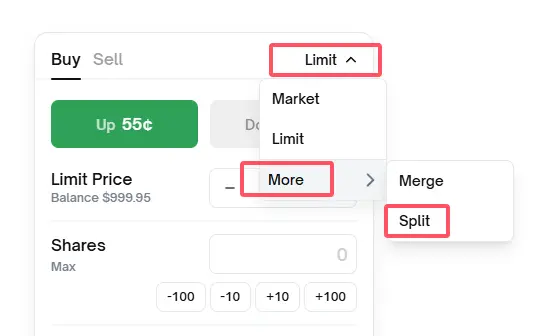
After clicking it, we input 1 and then click Split shares to perform the printing operation. After signing with the wallet, you will see in the Sell tab:
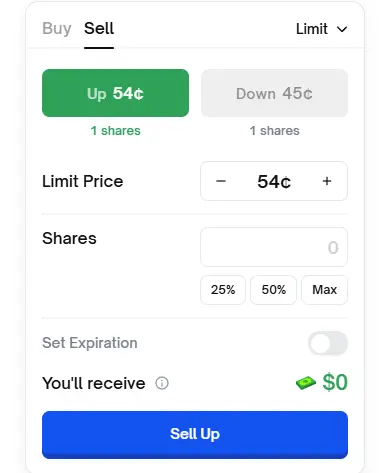
Do you see that? At this point, I have 1 share of Up (YES) and 1 share of Down (NO)!
You should have a deeper understanding of YES + NO = 1 now!
This is the split operation of Polymarket. To put it simply, you can split 1 dollar into two vouchers, one for YES and one for NO, at any market at any time.
So to answer the initial question, who tore this dollar bill? The answer is: anyone can.
When a new market opens, we can use splitting to have many YES and NO chips. You can freely price your YES and NO, which is the source of market chips after the opening.
So what are the application scenarios for splitting? There are many. When you need a lot of chips and the market's liquidity is insufficient, you can accumulate chips through splitting.
For example, when there is a very hot market and YES is being driven up crazily, if you are not optimistic about YES but the depth of the NO market is insufficient, you can print your own chips and then sell the crazily inflated YES, keeping a lot of NO chips and waiting for the price to return to rationality.
Of course, this example is just a usage scenario and not a specific strategy.
"Shredder": Merge
Next, let's try the merge operation:
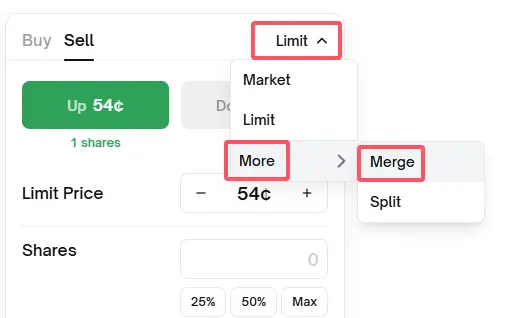
After we input 1 and click Merge Shares, then sign with the wallet, the two vouchers are merged, and the torn 1 dollar is returned, while the corresponding YES and NO shares disappear.
So the merge operation is like a shredder, crushing YES and NO, and returning 1 dollar to you.
Many people think that after buying YES, they can only wait for settlement or sell YES. In fact, the merge operation provides you with a third option: buy NO to merge with the YES you hold, directly turning it into dollars without waiting for settlement.
For example, in high-frequency market making, if YES is bought at 0.3, the price might rise to 0.8 in just one second. If the market maker feels the risk is too high and wants to exit, but after one second, Polymarket matches off-chain, and it takes about 5 seconds to see the position on-chain, depending on the condition of the Polygon mainnet (sometimes network fluctuations may take longer).
At this point, if the market maker sees NO selling at 0.24, they can directly buy NO at 0.24. Now your chips are YES (cost 0.3) + NO (cost 0.24), and merging directly turns it into 1 dollar.
The total cost is 0.54, and you get back 1, netting 0.46. You don’t need to wait for YES to arrive on-chain; you can merge and exit within seconds.
This is a common technique used by many high-frequency market makers and bots to lock in profits in the shortest time and earn returns during large fluctuations.
The Survival Path of Market Makers
The operations of merging and splitting are generally less encountered by ordinary users, but market makers use them almost every day.
In some markets with high liquidity and trading volume, the best bid is 0.50, and the best ask is 0.51, with almost no price difference.
However, in the screenshot from my previous article, that inactive market:
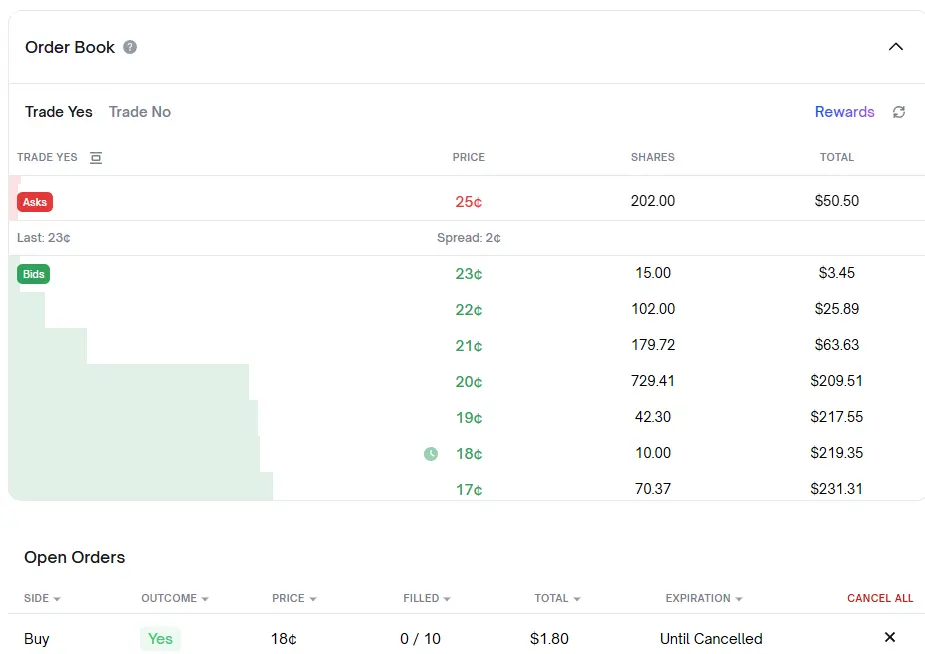
You can see that the best bid is 0.23, and the best ask is 0.25, with a slight price difference. In many inactive markets, this price difference is often large.
For example:
- YES: best bid 0.40, best ask 0.60
- NO: best bid 0.40, best ask 0.60
Adding up the best ask prices: 0.6 + 0.6 = 1.2 > 1, which means if you buy YES and NO at the market price now, you would need to spend 1.2 dollars to gather 1 dollar.
It is precisely this kind of inactive market with poor depth and large price differences that is where Split can be very effective.
You can now split 1 dollar into 1 YES + 1 NO.
You list YES for sale at 0.59 and NO for sale at 0.59.
If both transactions are completed, you will receive 0.59 + 0.59 = 1.18 dollars.
1.18 - 1 = 0.18, you net 0.18 dollars!
This is what market makers do every day. When market liquidity is insufficient and spreads are large, they generate a large number of chips through splitting, then place orders to provide liquidity and earn the spread between buying and selling.
Sometimes market makers may accumulate a large amount of YES or NO due to one-sided market conditions. When liquidity does not meet their exit needs, they will also choose to buy the other side to perform the Merge operation. This example was discussed in the "Shredder" section, so I won't elaborate further.
One more thing, when you provide liquidity, some markets also offer rewards, for example:
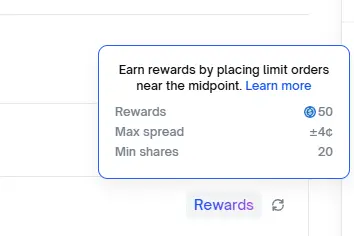
This means that if you place orders floating up and down 4 price levels, with a minimum of 20 shares, you can share a reward of 50 dollars. The official has a specific calculation for order placement points and order time, and those who meet the conditions will share this 50 dollars.
In the early days, liquidity rewards were very high, but they have now decreased significantly. If you are interested in this aspect, you can check the official liquidity rewards panel: https://polymarket.com/rewards
Additionally, market makers have many strategies; this is just an example and does not represent the optimal strategy. After all, what market makers fear most are insider investors, as insider investors often leave market makers with nothing. Therefore, professional market makers have very sensitive decision-making systems. When they determine that the market is showing one-sided conditions, they will immediately cancel all open orders.
Q&A
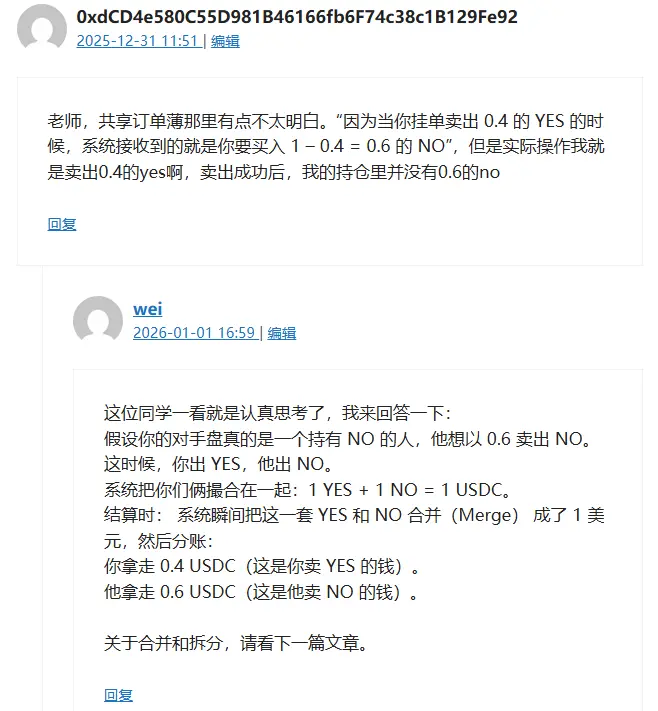
This student's question should be thoroughly understood after reading this article. This is a very good question, and I will share it separately with everyone.
Conclusion
Split and Merge may seem like very simple functions, but they actually represent two different trading mindsets.
Ordinary traders immerse themselves in studying price fluctuations, making choices between YES and NO.
Advanced players study liquidity, using splits to generate chips to earn spreads, and using merges to optimize exit paths.
I hope that when you trade, you can think from multiple angles, and you may discover more opportunities.
I believe that after understanding YES + NO = 1 in the previous article, you can appreciate the clever design of splitting and merging more deeply through this article. If you find this article good, I hope you can share it with more people.
If you are a newcomer to Polymarket, you must read this → “Beginner's Guide: A Step-by-Step Tutorial on Getting Started with Polymarket with Zero Barriers (Including Anti-Ban and Low Friction Deposit and Withdrawal Strategies)”
Additionally, if you have any content you would like to see, feel free to leave a message, and I will share targeted content when I have the opportunity.
免责声明:本文章仅代表作者个人观点,不代表本平台的立场和观点。本文章仅供信息分享,不构成对任何人的任何投资建议。用户与作者之间的任何争议,与本平台无关。如网页中刊载的文章或图片涉及侵权,请提供相关的权利证明和身份证明发送邮件到support@aicoin.com,本平台相关工作人员将会进行核查。