Author: Chloe, ChainCatcher
The U.S. Senate Banking Committee will hold a crucial vote on the "Digital Asset Market Structure Act (CLARITY Act)" on January 15. Although the Agriculture Committee has postponed its review until the end of January due to issues related to the definitions of DeFi and bipartisan consensus, it is undeniable that this is the most significant piece of legislation for crypto regulation since the "GENIUS Act."
This article will deeply analyze the core controversies of the current bill: from the banking industry's "deposit defense battle" over high yields on stablecoins, to whether DeFi developers should bear criminal responsibility for "code," and the political tug-of-war over the "moral clause" involving the Trump family. It can be said that this is not just a legislative vote, but a direct confrontation between traditional financial power and decentralized mechanisms, the outcome of which may determine the direction of the global crypto market for the next decade.
Reshaping the Regulatory Landscape: The Jurisdictional Battle Between SEC and CFTC
On January 15 at 10:00 AM, the U.S. Senate Banking Committee will proceed with the review of the "CLARITY Act." Although the market initially expected both committees (Banking and Agriculture) to advance simultaneously, the current situation is evidently more complex.
A "Push and Pull" Between the Two Committees?
Senate Banking Committee: Led by Tim Scott, the core task is to define the legal framework for digital assets under the Securities Act. The bill is expected to end the SEC's current practice of indefinitely classifying tokens as securities based solely on "investment expectations," and instead establish a clear exit mechanism and legal process for "transitioning from securities to commodities." The committee will proceed as planned, aiming to delineate clear boundaries for the SEC's jurisdiction.
Senate Agriculture Committee: Led by John Boozman, this committee is responsible for amending the Commodity Act and delineating the jurisdiction of the CFTC. Due to ongoing disagreements between the two parties on core details such as the definition of DeFi technology and interest yields on stablecoins, it has been decided to postpone the review until the end of January. The goal is to allow more time for bipartisan consensus to ensure that key Democratic votes can be secured during the final vote, avoiding a deadlock in the Senate due to polarization.
The SEC's Shift in Attitude, Seeking to Bring the Crypto Market Out of the Regulatory Gray Area
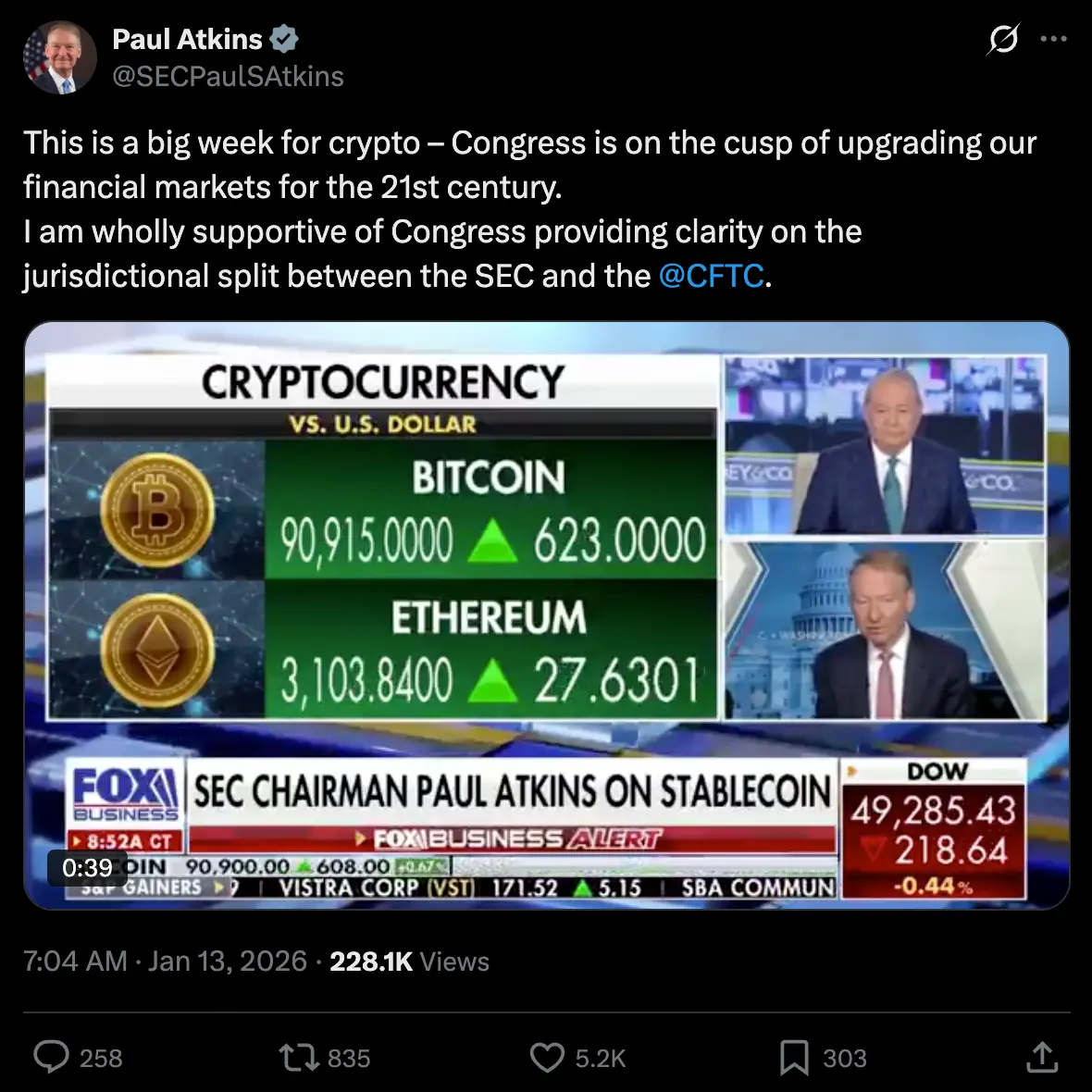
SEC Chairman Paul Atkins emphasized in a post on X on January 13 that this week is milestone for the cryptocurrency industry and publicly supports Congress in clearly delineating the jurisdictional boundaries between the SEC and CFTC, a significant departure from the "enforcement-based regulation" criticized during the tenure of his predecessor. Atkins advocates for a legislative framework aimed at bringing the crypto market out of the regulatory gray area.
He also pointed out that enhancing market certainty aligns closely with Trump's vision of creating "the world's cryptocurrency capital." Atkins is optimistic about the bill being approved and signed into law within the year, expecting it to significantly promote the long-term development of the crypto market while strengthening investor protection.
The Deposit Defense Battle: Should Stablecoin "Yields" Be Completely Banned?
One of the current focal points of controversy stems from the patchwork revision of the "GENIUS Act." Although the bill explicitly states that stablecoin issuers cannot pay interest, it does not impose restrictions on "distributors," leading to strong dissatisfaction from traditional financial institutions.
For example, Coinbase currently offers about 3.5% rewards to users holding USDC. Since Coinbase acts as a distributor rather than an issuer (Circle), this is legal under the current framework of the "GENIUS Act." However, the American Bankers Association (ABA) is lobbying for lawmakers to extend the interest ban to include affiliated companies and partners of stablecoin issuers.
Three Core Concerns of the Banking Industry
1. Deposit Outflow: The banking industry is concerned that if stablecoin yields continue to exceed traditional savings rates, it will trigger a massive shift of funds. The ABA cited Treasury data indicating that without strict interest bans, up to $6.6 trillion in bank deposits nationwide could be at risk of outflow.
2. Weakened Lending Capacity: The loss of deposits will directly impact the core business model of traditional banks, especially the lending capacity of community banks. Banks use deposits to provide critical loans to local businesses, farmers, students, and homebuyers; if the funding pool shrinks due to competition from stablecoins, it will severely disrupt local lending operations.
3. Unfair Competition: Stablecoins are often marketed as products with similar functions to bank deposits but lack the substantive insurance protection of the Federal Deposit Insurance Corporation (FDIC). The ABA criticizes that cryptocurrency exchanges intentionally downplay risk differences through pervasive advertising, creating unfair competition that exposes consumers to financial risks.
Counterattack from the Crypto Industry
Coinbase Chief Policy Officer Faryar Shirzad countered the banking industry's accusations. He pointed out that U.S. banks earn over $360 billion annually from payment and deposit businesses, and their eagerness to ban stablecoin rewards is fundamentally to protect vested interests rather than for prudent regulation.
Additionally, Shirzad cited independent research from Charles River Associates (CRA) and Cornell University confirming that there is no significant correlation between the growth of stablecoins and the outflow of bank deposits, and that rewards would need to reach 6% to have a substantial impact. He warned that while the U.S. debates internally, China has announced interest payments for its digital yuan; if the U.S. weakens the competitiveness of stablecoins due to bank lobbying, it would effectively cede dominance in the global digital currency race, threatening the supremacy of the dollar.
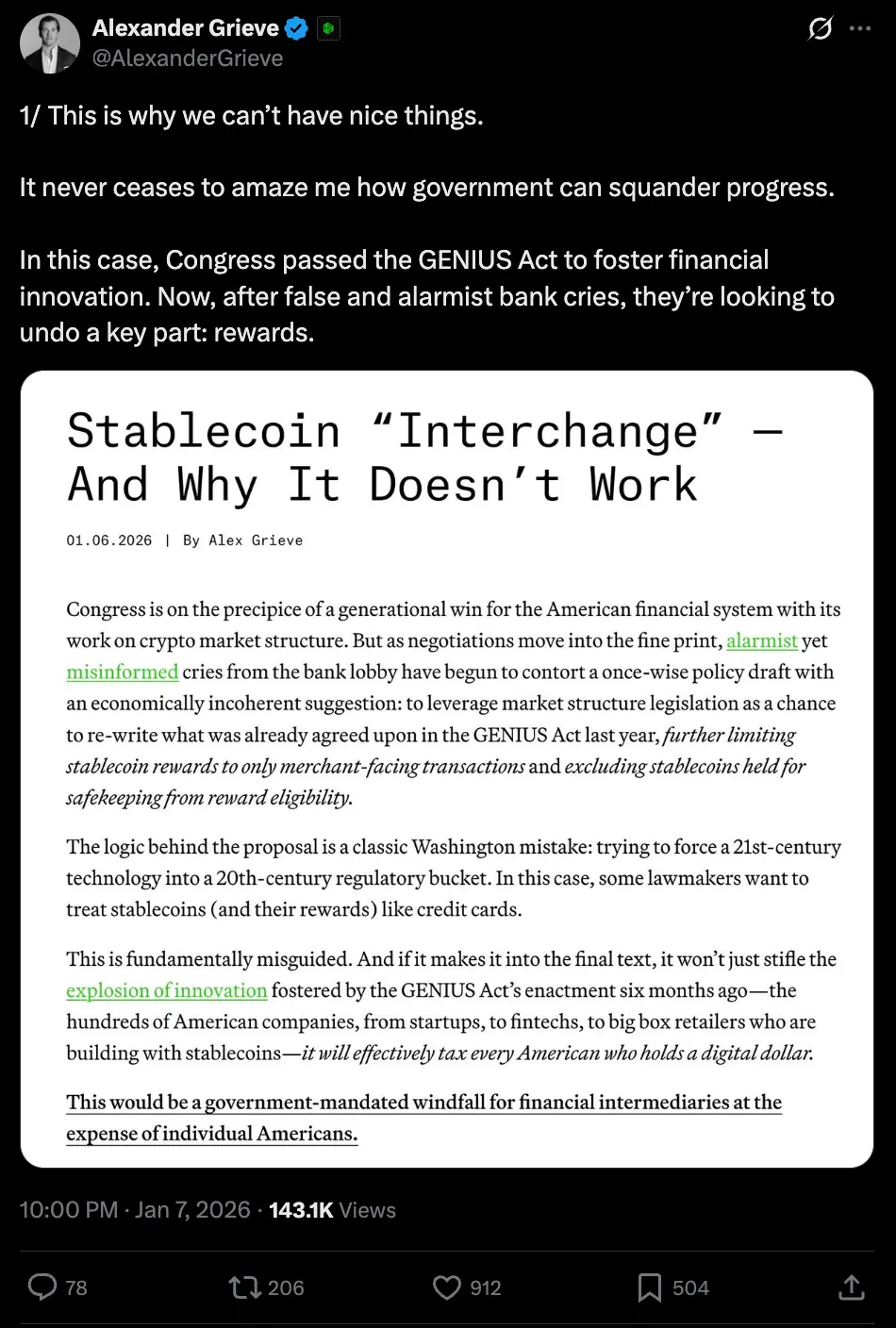
On the other hand, Alexander Grieve, Vice President of Government Affairs at Paradigm, characterized the banking industry's demands as "false and alarmist" political interference. He believes that if lawmakers are forced to amend the reward provisions in the "GENIUS Act" to mandate that distributors cannot pay yields, it would essentially amount to imposing a "hidden holding tax" on stablecoin holders, forcing intermediaries to withhold profits that should belong to consumers. Grieve warned that such actions, aimed at protecting traditional financial profits at the expense of technological innovation, would severely undermine the international attractiveness of the U.S. stablecoin ecosystem, leading to a comprehensive lag in the competition for Web3 financial infrastructure.
DeFi Controversy: Does Writing Code Count as "Conducting a Currency Business"?
This is the highest technical threshold in the bill and the main reason for the Agriculture Committee's postponement of the review. The point of contention is: should the person writing the code be held responsible for the automatic execution of that code?
The U.S. Department of Justice has previously prosecuted developers of mixers (such as Tornado Cash co-founders) under the "Unlicensed Money Transmitting Businesses Act," based on the assumption that "code is an intermediary." Regulators believe that by writing and deploying code with fund processing capabilities, developers essentially create an automatically operating "money transfer business." In other words, developers must be responsible for the subsequent execution of the code. This legal interpretation equating "software development" with "financial operations" is viewed by the Web3 industry as a fundamental threat to technological innovation.
In response, the DeFi Education Foundation (DEF) and core practitioners argue that this is an unfeasible logical paradox in technical practice. Traditional financial institutions can assume compliance obligations because they have "substantial control" over transactions; however, once a truly decentralized protocol is deployed, it possesses immutable and automatically executing characteristics, and developers completely lose the ability to intercept transactions or freeze assets. Requiring a "developer" who cannot intervene in software operation to bear the same compliance responsibilities as banks is akin to demanding that car manufacturers be held criminally liable for every speeding violation on the road.
If the bill adopts the current stringent definition, developers will face criminal risks due to their published smart contracts being used for illegal purposes by third parties. This would not only destroy the technical foundation of DeFi but also trigger a massive exodus of R&D talent, ultimately leading to the marginalization of the U.S. in the global competition for next-generation financial infrastructure.
Moral Clause: The Trump Family and Conflicts of Interest
As the Trump family's deep involvement in the DeFi platform World Liberty Financial (WLF) and its stablecoin USD1 rapidly expands (with a market cap reaching $3.4 billion), political ethical issues have become one of the key variables in whether the "CLARITY Act" can achieve bipartisan consensus.
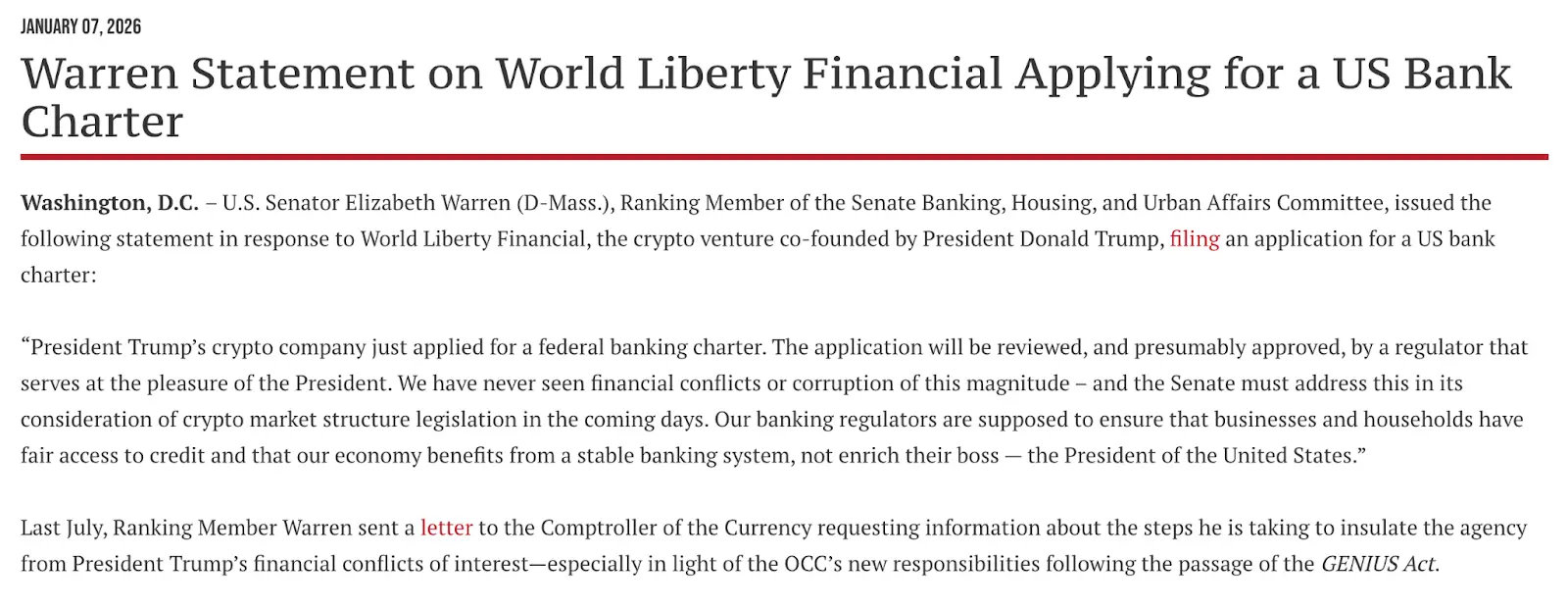
Entities under WLF officially applied for a "national trust bank charter" from the Office of the Comptroller of the Currency (OCC) last week. This move immediately sparked a political storm, with the core controversy being whether a regulatory chief appointed by the president has the authority to review a banking application owned by the president's family. Democratic leader Elizabeth Warren promptly issued a statement, pointing out the conflict of interest:
"President Trump's crypto company has just applied for a federal banking charter, and that application will be reviewed by a regulator appointed by the president. We have never seen such a scale of financial conflict or corruption. The Senate must address this issue head-on as it reviews the market structure bill in the coming days, as the duty of bank regulators is to ensure the fairness and stability of the economic system, not to profit from the private enterprises of their boss (the president)."
In response to the related controversy, Democratic senators, including Elizabeth Warren, insisted on including a "moral clause" in the "CLARITY Act," which aims to prohibit federal officials and their immediate family members from deriving personal benefits from digital asset businesses during their tenure. Although the House previously chose to avoid this topic for the sake of passing the bill, Senate Democrats have made it clear that if restrictions on conflicts of interest for government officials are not included, they will block the final vote. This adds a layer of political maneuvering beyond the technical aspects to the vote on January 15.
This Moment Will Set the Tone for the Next Decade of the Crypto Industry
The vote on the "CLARITY Act" is essentially an attempt by the U.S. government to incorporate the strategic status of crypto assets into the existing financial and political system. Regardless of the final outcome, the "gray area" between the crypto industry and traditional finance is gradually fading. This vote will have far-reaching impacts on three levels:
First, regulatory certainty will trigger a massive "compliance premium." If the "CLARITY Act" can clarify the boundaries of authority between the SEC and CFTC, it will completely end the turmoil of "enforcement-based regulation," bringing certainty for trillions of dollars in institutional funds to enter the digital asset market. At that point, cryptocurrencies will officially transition from marginal speculative assets to mainstream financial products and tools.
Second, this is a geopolitical competition over the focus of innovation. Whether it is restrictions on stablecoin yields or the definition of responsibilities for DeFi developers, it essentially tests the limits of the U.S. tolerance for technological innovation. If the bill ultimately leans towards conservative banking protectionism or imposes harsh penalties on code, it is likely to trigger a brain drain; conversely, if it can retain flexibility for innovation, the U.S. may solidify its position as the "world's cryptocurrency capital," further consolidating the dollar's hegemony in the digital age.
Finally, the bill's vote marks a "deep integration" of Web3 and traditional power. From the competition for interests between stablecoins and bank deposits to the moral clause targeting the president's family, cryptocurrencies are no longer a utopia for tech geeks but the center of real power and capital games.
免责声明:本文章仅代表作者个人观点,不代表本平台的立场和观点。本文章仅供信息分享,不构成对任何人的任何投资建议。用户与作者之间的任何争议,与本平台无关。如网页中刊载的文章或图片涉及侵权,请提供相关的权利证明和身份证明发送邮件到support@aicoin.com,本平台相关工作人员将会进行核查。


